Christmas Table Runner Ideas That Dress the Whole Table
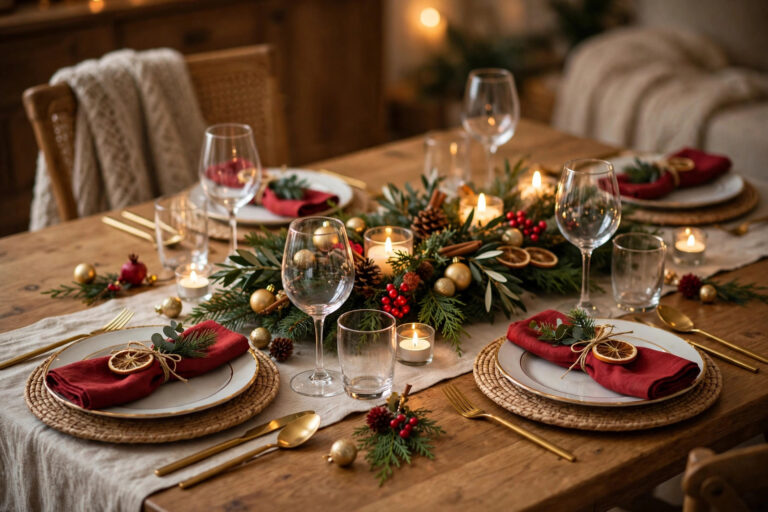
A Christmas table runner is the smallest change that makes the biggest difference to a dinner table. One strip of fabric down the middle, and a plain wooden table suddenly looks like a Christmas table. No new tablecloth, no new plates, no full redecoration. Just a runner, and the whole room leans in. I learned this the year I hosted Christmas dinner with a table I had owned for a decade and plates I had owned even longer. I did not want to buy a matching set of anything. I bought one red plaid runner for less than the cost of a takeaway dinner, laid it down the centre, and guests asked where I had found such a beautiful table. The runner did all of that work. Everything else on the table was already in my cupboards. That is the honest appeal of a runner. It carries the colour, the texture and the Christmas feeling, while the plates and glasses you already own do the practical work. It also protects the table from hot dishes and candle wax, hides a scratched or stained middle, and gives candles, greenery and ornaments a proper stage to sit on instead of sliding around on bare wood. This guide covers the runners that work best at Christmas, the sizing rule that stops a runner looking wrong, a no sew DIY runner you can make in one evening, and how to layer greenery and candles on top without turning the table into a fire risk or a cluttered shelf. Whether your table seats four or fourteen, there is a runner idea here that fits it.
Start With the Sizing Rule, Not the Shopping
Every runner mistake I have ever made came from buying the pretty one first and measuring second. A runner that is too short looks like a placemat that got lost. A runner that is too wide covers the plates. A runner that hangs to the floor looks like a tablecloth that shrank. Get the size right first and every style choice after it gets easier. The width rule is simple. A runner should cover about one third of the width of your table. On a standard dining table that is about 40 inches wide, that means a runner about 13 to 14 inches wide. Wider than that and plates start sitting on fabric instead of wood, which wobbles glasses and stains the runner with every spill. Narrower than a quarter of the width and the runner looks like a ribbon, not a centrepiece. The length rule matters just as much. Measure your table, then add 12 to 24 inches, so the runner hangs 6 to 12 inches over each end. A runner that ends exactly at the table edge looks unfinished, like it was cut too short. A runner that hangs 12 inches over each end looks generous and finished. For a 72 inch table, that means a runner about 84 to 96 inches long. If you are buying ready made, the common sizes are 72, 84, 90 and 108 inches, so pick the one closest to your measurement and let the overhang do the work. There is one more measurement worth taking before you shop: the height of your centrepiece. A runner invites you to build up the middle of the table, and that is exactly where the sightline problem starts. Sit down at the table and look across it. If you cannot see the person opposite, the centrepiece is too tall, not the runner. Keep greenery under four inches tall at its highest point and let candles carry the height instead, because candle flames are thin and light passes around them. This one test, done before anyone sits down to eat, saves more dinners than any decoration I know. If your table is round, the rule changes slightly. A runner on a round table should run straight across the middle and hang evenly over both sides, about 6 to 8 inches past the edge. It will not reach every seat the way it does on a rectangular table, and that is fine. On a round table the runner is a stripe of colour and texture, not a full dressing, and the plates around it carry the rest of the look. Section 7 has the full round table plan. Buy the runner after you measure, not before. Write the two numbers on your phone, width and length, and check them against every runner you consider. A beautiful runner in the wrong size will never look right, and a plain runner in the right size will always look intentional.
The Classic Red Plaid Runner
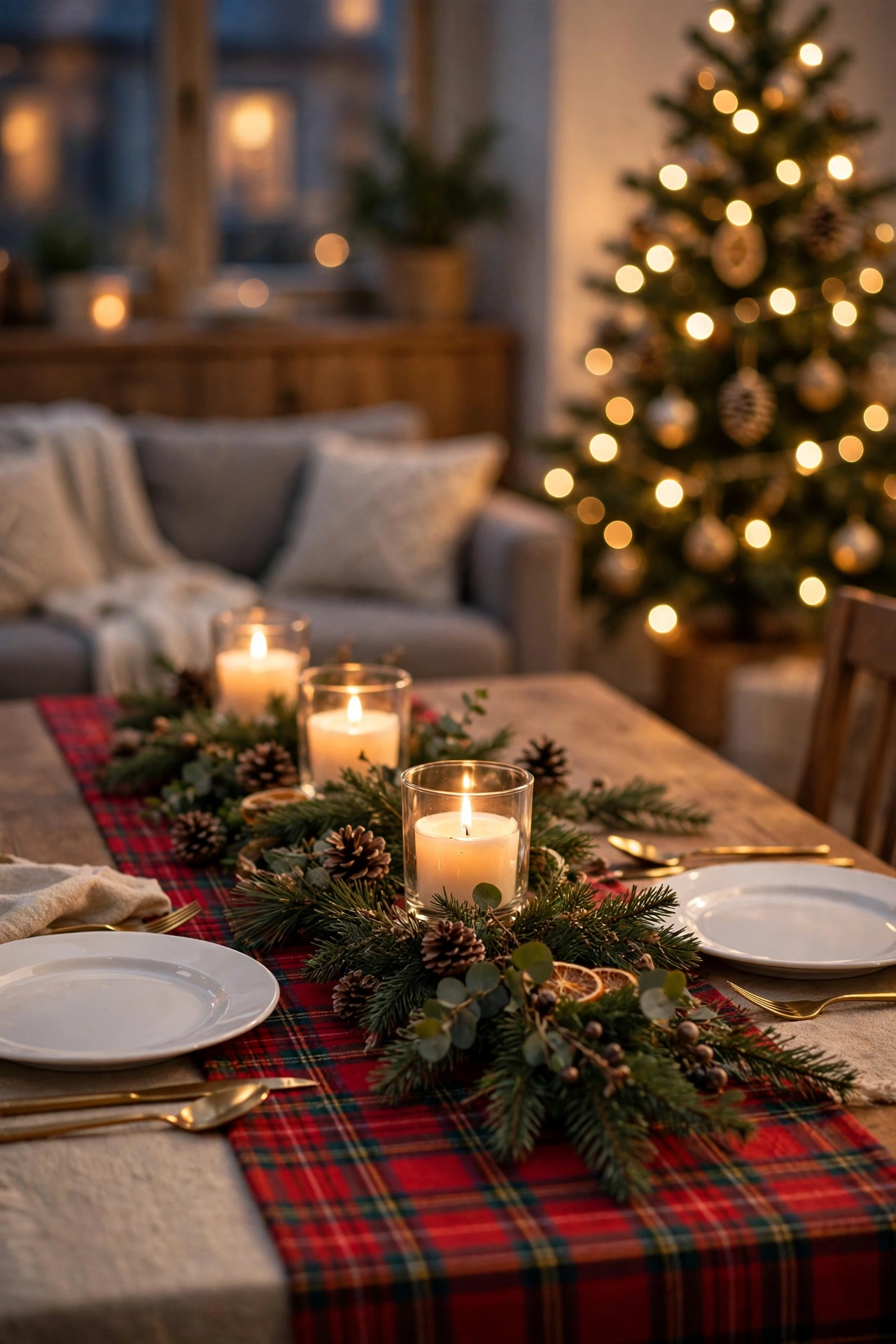
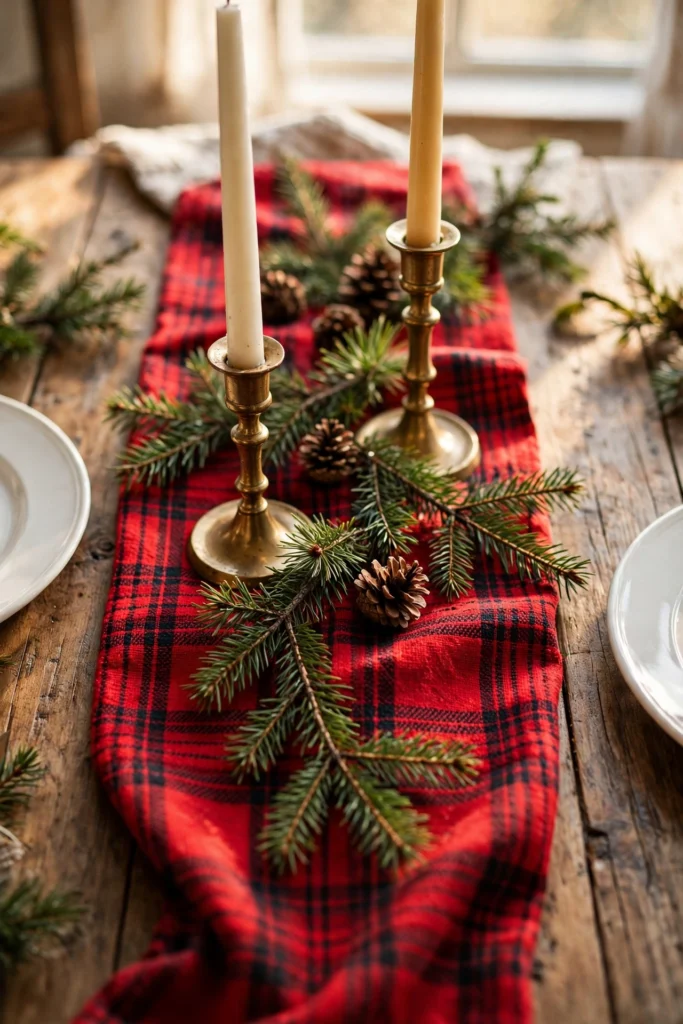
If you only buy one Christmas runner in your life, make it a red plaid one. Plaid is the most forgiving pattern in Christmas decorating. It hides stains, it suits wood, white plates, gold cutlery and green glassware all at once, and it reads as Christmas from across the room without a single ornament on it. A red plaid runner is also the easiest runner to style, because the pattern does so much of the work that the rest of the table can stay simple. The best plaid runners for a Christmas table are woven, not printed. A woven plaid has the pattern in the threads, so the colours look deep and the fabric has a soft weight that lies flat and stays put. Printed plaid on thin polyester looks shiny under candlelight and slides around when someone reaches across the table. If you can, choose cotton, wool blend or linen in plaid. These fabrics grip the table slightly, they wash well, and they look better every year as they soften. Style a red plaid runner with restraint, because the pattern is already doing a lot. Plain white plates, plain glasses and one metal, gold or brass, are all it needs. Add a low garland of fresh or faux greenery straight down the spine of the runner, pinecones tucked in at intervals, and three candles in glass holders at different heights. That is a complete Christmas table. The plaid gives the colour, the greenery gives the texture, the candles give the light, and nothing competes with anything else. For a family table with children, plaid is the practical choice too. Spills wipe off a cotton plaid runner, red wine does not show on a red pattern the way it shows on cream linen, and a plaid runner that comes out of the wash slightly creased still looks good, because plaid is a relaxed pattern. Iron it if you like, but do not iron it because you think you must. A plaid runner looks like a farmhouse table, and a farmhouse table is allowed to look lived in. One caution: plaid is so strong that it fights with other patterns. If your runner is plaid, keep the napkins plain, the placemats plain, and the plates plain. One pattern per table is the rule that keeps a plaid table looking styled instead of busy. If you love pattern, put it on the runner and nowhere else.
The Deep Green Velvet Runner
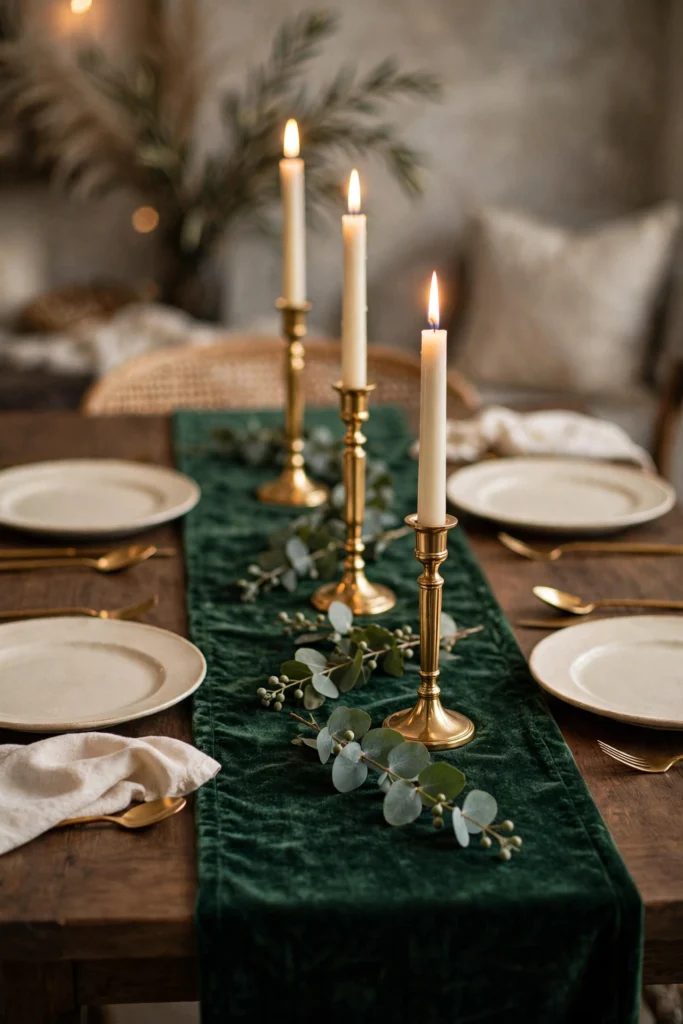
A deep green velvet runner is the most elegant option on this list, and the one that photographs best under candlelight. Velvet catches light in a way no other fabric does. The pile shifts from dark green to almost black as the light moves across it, so the table looks alive even before a single candle is lit. It is the runner to choose when the dinner is a proper occasion, a Christmas Eve meal, a formal family gathering, or a table you want guests to photograph. Velvet works best on a plain tablecloth or a bare wooden table. Over a white or cream linen cloth, a green velvet runner looks like a jewel stripe down the middle. On bare dark wood, it looks rich and warm. What it does not like is a busy tablecloth underneath. Velvet plus a patterned cloth is too much texture fighting in one place, so keep the layer under it plain and let the velvet be the star. The styling for velvet is simple and a little more formal than plaid. Gold candlesticks, not glass votives. Cream or ivory plates, not patterned Christmas plates. A few sprigs of eucalyptus or cedar laid flat along the runner, not a thick garland, because velvet already has the weight and the greenery should be a light touch on top. A string of warm fairy lights woven loosely through the greenery adds the sparkle that velvet alone does not give. Keep the lights battery operated and the battery pack hidden under the runner at one end, out of sight and away from any plate. Velvet has two practical weaknesses to plan for. The first is that it shows every crumb and every drip, especially in a dark green. Keep a lint roller in the kitchen on Christmas Day and give the runner a quick roll before guests sit down. The second is that velvet does not like water. A spilled glass will mark it, so use coasters under glasses or accept that this runner is for the adult table, not the children table. Most velvet runners are dry clean only, so check the label before you buy, and do not put a velvet runner in the washing machine on a guess. If the budget allows, buy velvet in a proper weight. Thin velvet looks flat and creases into sharp lines. A medium weight velvet with a soft backing drapes over the table ends in a gentle curve and lies flat in the middle. Hold it up in the shop if you can. If it falls in soft folds, it is right. If it stands stiff or flops like paper, it is not worth the price.
The Rustic Burlap and Jute Runner
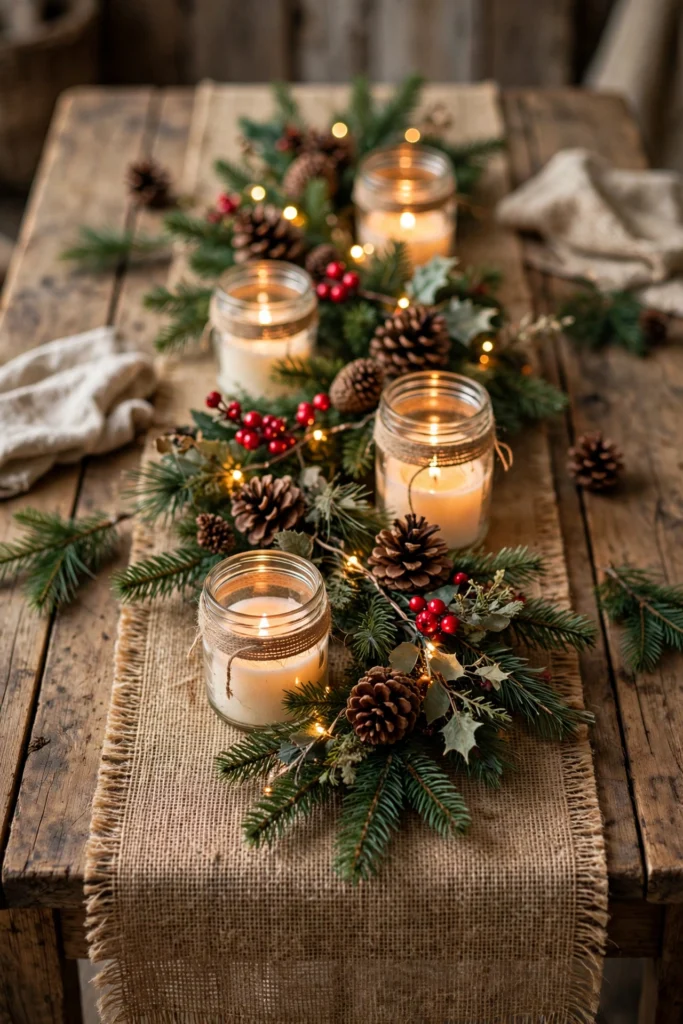
A burlap runner is the opposite of velvet in every way, and that is exactly why so many people love it. It is rough, natural, cheap, and almost impossible to ruin. It suits farmhouse tables, cottage kitchens, and any Christmas table where the mood is relaxed rather than formal. If your Christmas dinner is a big family meal with children, dogs, and a lot of passing dishes, burlap is the runner that will survive it and still look good at the end of the night. Burlap works because its texture does the decorating. The loose weave, the natural tan colour, the slightly frayed edges, all of it says handmade and homely without any extra effort. Lay a burlap runner down the centre of a wooden table, add a garland of fresh greenery, pinecones, and a few red berries, and the table is done. White candles in glass jars, not tall candlesticks, suit burlap best, because the look is low and natural, not tall and formal. Burlap also takes layering better than any other runner fabric. A thin cream lace runner laid over the centre of a burlap runner, narrower by a few inches on each side, is a classic farmhouse combination that looks far more expensive than it is. A strip of red plaid ribbon down the middle of a burlap runner does the same thing in a different style. The burlap gives the base, the second layer gives the colour, and the greenery on top ties them together. This is the layering trick to use when you want a dressed table but you only own one plain runner. There are two things to know before you buy burlap. The first is the smell. New burlap smells like a farm store, because it is a farm material. Air it outside for a day or two before Christmas, or wash it once on a gentle cycle if the label allows, and the smell fades. The second is shedding. Burlap drops fibres, especially when new. Shake it outside before you lay it on the table, and do not lay it directly under plates where fibres can drift into food. Keep plates on wood or placemats, and let the burlap be the strip down the middle where the centrepiece sits. A jute runner is burlap’s slightly smarter cousin. It is woven tighter, sheds less, and has a cleaner edge, while keeping the same natural look. If you like the farmhouse style but you want a runner that looks a little more finished, jute is the better buy. Either way, a natural fibre runner costs a fraction of a velvet one, and it is the runner I recommend first to anyone decorating a Christmas table on a tight budget.
The DIY No Sew Christmas Table Runner
This is the golden idea in this guide, and the one that gets pinned the most, because it costs almost nothing and looks like it came from a shop. A no sew Christmas table runner takes about twenty minutes, needs no sewing machine, and uses fabric you can buy by the metre at any craft store. If you have ever wanted a runner in exactly the right size and exactly the right colour, this is how you get it. You need one piece of fabric, a roll of iron on hem tape, an iron, and a pair of scissors. Choose a fabric with a little weight: cotton canvas, linen look cotton, or a medium weight quilting cotton in a Christmas print. Avoid anything slippery, like satin, because it will not hold the hem tape well, and avoid anything very thick, like upholstery fabric, because the iron cannot heat through it evenly. A good test is to hold the fabric up. If it drapes in a soft fold, it will work as a runner. Measure your table first, using the sizing rule from Section 1, then cut the fabric to the length you need plus four inches for the hems, and to the width you want plus two inches. Fold each long edge over by one inch, press it flat with the iron, then slip the iron on hem tape inside the fold and press again, holding the iron in place for ten seconds per section. The tape melts and bonds the fold shut. Do the same at each short end, folding over by two inches so the ends hang with a little weight. That is the whole project. Twenty minutes, and you have a runner in the exact size your table needs. The fun part is the finish. A plain runner made this way is a blank canvas, and the simplest finishes look the best. A row of small fabric Christmas trees ironed on down the centre, cut from a contrasting fabric with the same hem tape, turns a plain red runner into a handmade statement. A strip of ribbon ironed along each long edge gives a plain cream runner a tailored finish. Pom pom trim or tassels on the short ends, attached with a few stitches or fabric glue, make the runner look bought, not made, and cost almost nothing. Two practical notes from runners I have made this way. First, test the hem tape on a scrap of your fabric before you commit to the full runner, because some fabrics with a coating or a heavy print do not bond well, and it is better to learn that on a scrap than on a finished runner. Second, wash the fabric before you cut it, because cotton shrinks a little on the first wash, and a runner that shrinks after you make it will never sit straight again. Wash, dry, iron, then measure and cut. A handmade runner also makes a lovely gift. Make one in the recipient’s colours, roll it up, tie it with ribbon, and tuck a sprig of dried orange or pine inside the roll. It costs a few pounds, it is personal in a way a shop bought runner never is, and it is the kind of gift people actually keep and use every December.
Layering Greenery and Candles on the Runner
A runner on its own is a good start, but a runner with greenery and candles on it is a finished table. Layering is the skill that turns a strip of fabric into a centrepiece, and it is simpler than it looks. The rule is to build in three layers, and to keep each layer doing only one job. The first layer is the runner itself, the colour and the texture. The second layer is the greenery, which gives the table its shape and its Christmas smell. Lay a garland down the spine of the runner in a gentle S curve, not a straight line, because a curve looks styled and a straight line looks like a queue. Fluff the garland out until it looks twice as wide as it did in the packet, because a flat garland looks cheap no matter what you paid for it. Tuck pinecones, small oranges, and cinnamon sticks into the greenery at intervals, in twos and threes, never in a perfect row. The greenery should look gathered, not placed. The third layer is the light. Candles give a Christmas table its warmth, and they belong on the runner, not beside it, because the runner is the stage. Use three heights of candle, tall tapers in holders, medium pillars in glass, and small votives tucked into the greenery. Space them unevenly, a tall one near one end, a cluster of two in the middle, a small one near the other end, because uneven spacing looks natural and even spacing looks like a hotel lobby. Battery fairy lights woven through the greenery add a second kind of light, small and warm, that makes the whole table glow once the room lights go down. Safety is part of layering, not an afterthought. Keep every flame at least a hand width from any greenery, and never let a candle sit directly on a fabric runner. Candles go in glass holders or on a small plate, always. If your greenery is real and dry, it is flammable, so keep the candles in glass and never leave the table unattended with candles lit. Battery candles have become genuinely good in the last few years, and for a table with children or pets, they are the right choice. Use real candles for the look and battery candles for the places where a real flame is a risk. The last layering rule is about space. Leave the ends of the runner clear. The middle of the table is for decoration, the ends are for serving dishes, elbows, and the bread basket. A runner that is decorated from end to end leaves nowhere for the food to go, and the food ends up on a sideboard while guests reach across a forest of greenery. Decorate the middle two thirds, leave the ends for the meal, and the table works as well as it looks. For more on keeping the centrepiece low and the table practical, see our Christmas dining table guide and our centrepiece guide, which both use the same low and clear rule.
Small Tables, Round Tables and Tight Spaces
A small table is not a problem for a runner, it is a size to respect. The mistake people make with a small table is choosing a runner that is too wide and too busy, which swallows the table and leaves no room for plates. On a table that seats four, the runner should be narrower than the usual rule, about 10 to 12 inches wide, and the decoration on top of it should be a single idea, not a full garland. For a small rectangular table, the best runner is a plain one in a solid colour, cream, deep green, or a soft red, with one low centrepiece on it. A single tray with three candles and a few sprigs of greenery, sitting on the runner, is a complete decoration. The tray is the trick here, because it lifts away in one move when the food arrives, and the runner underneath stays clean. Skip the garland, skip the scattered pinecones, skip the second layer. One tray, one runner, done. A round table needs a different approach, because a runner cannot cover a circle the way it covers a rectangle. Lay the runner straight across the middle and let it hang evenly over both sides, about 6 to 8 inches past the edge. The runner becomes a stripe, and the centrepiece sits where the runner crosses the middle of the table. A low bowl of ornaments, a small cluster of candles, or a tiny potted tree in the centre works better than a long garland, because a garland on a round table fights the shape of the table. Let the roundness win. A narrow table, like a breakfast bar or a console used as a dining table, suits a runner better than a tablecloth, because a tablecloth on a narrow table hangs like a curtain and gets caught on chairs. A runner leaves the sides of the table visible and the chairs free to pull in. Choose a runner in a light colour on a narrow dark table, or a dark runner on a narrow light table, because contrast is what makes a narrow runner visible at all. A runner the same colour as the table disappears, and a runner that disappears is a wasted decoration. For a table that has to work hard, a kitchen table where children do homework and adults eat dinner, choose a washable cotton runner in a dark pattern. Plaid and dark green both hide stains, cotton washes easily, and a runner that can go in the washing machine on Boxing Day is a runner that will come out again next Christmas. The best runner for a busy table is the one you are not afraid to use.
Care, Storage and the Mistakes to Avoid
A good Christmas runner should last for years, and the difference between a runner that lasts and a runner that looks tired after one December is almost always care, not quality. Wash a cotton or linen runner on a gentle cycle, cold water, and hang it to dry rather than tumble drying it, because heat is what shrinks and fades fabric. Iron it while it is still slightly damp, on the reverse side if it has a print, and fold it rather than hanging it, because a folded runner keeps its shape and a hung runner stretches at the fold. Store the runner rolled, not folded, if you have the space. Rolling avoids the hard crease lines that a folded runner keeps all year and shows on Christmas Day. Wrap it in a clean cotton pillowcase or a sheet of tissue paper, not a plastic bag, because fabric needs to breathe in storage and plastic traps damp. Keep it somewhere dry and dark, away from the attic damp and the loft heat, and it will come out next December looking the same as the day you put it away. There are a few mistakes that quietly ruin a table runner, and all of them are easy to avoid once you know them. The first is scented candles on a food table. A vanilla or cinnamon candle fighting with roast turkey is a smell battle nobody enjoys, and the runner absorbs the scent and keeps it. Use unscented candles at the table, and save the scented ones for the hallway. The second is a runner that is too long. A runner that hangs to the floor gets caught on chairs, pulled by children, and stained by shoes. Six to twelve inches of overhang is generous, more than that is a trip hazard. The third is ironing a runner with a print on the right side, which can melt the print or shine the fabric. Always iron on the reverse. The last mistake is buying a runner to match the plates instead of the room. The runner should match the room, the wood of the table, the colour of the walls, the feeling of the house, because the room is what guests see first. Plates come and go. The room stays. A runner that suits the room will suit every plate you ever put on it.
Conclusion
A Christmas table runner is the fastest, cheapest, and most forgiving decoration on the whole Christmas table. It carries the colour, it gives the candles and greenery a stage, it protects the table, and it can be changed in a minute if the look is not working. Start with the size, choose one fabric and one colour story, keep the centrepiece low so guests can see each other, and let the runner do the work it was made for. Whether you buy a classic red plaid runner, a deep green velvet one, a rustic burlap one, or make a no sew runner in exactly your colours, the table will look dressed, and dinner will feel like an occasion. That is the whole point of a runner. It turns an ordinary table into a Christmas table, and it does it with a single strip of fabric. For more table ideas, our dining room guide shows how the runner fits into the whole room, and our centrepiece guide shows what to put on top of it.
FAQ
What size Christmas table runner do I need? Measure your table, then choose a runner about one third of the table width and 12 to 24 inches longer than the table, so it hangs 6 to 12 inches over each end. On a standard 40 inch wide table, that means a runner about 13 inches wide. On a 72 inch table, look for a runner about 84 to 96 inches long.
Can I use a table runner instead of a tablecloth? Yes, and for many tables a runner is better. A runner dresses the centre of the table and leaves the wood visible at the sides, which suits wooden tables and small tables better than a full cloth. Use a tablecloth when the table itself is damaged or stained, and a runner when the table is worth showing.
Can I layer two runners? Yes. Layer a narrow runner over a wider one, with a few inches of the bottom runner showing on each side. A lace runner over burlap, a velvet runner over linen, or a plaid ribbon over a plain runner all work. Keep the two runners in different textures and the same colour family so they look layered, not clashing.
How do I stop a table runner sliding? Lay a thin non slip shelf liner or a strip of rug gripper under the runner, cut slightly smaller than the runner so it does not show. On a polished wooden table this stops the runner moving every time someone reaches across. A heavier fabric like velvet or wool also slides less than a light cotton runner.
What is the best fabric for a Christmas table runner? Cotton and linen are the most practical, because they wash well and lie flat. Velvet is the most elegant but needs dry cleaning and shows every crumb. Burlap and jute are the most forgiving and the cheapest, and they suit relaxed farmhouse tables. Choose the fabric for how you use the table, not just how it looks in the shop.
Can I put hot dishes on a table runner? Use trivets or heatproof mats under hot dishes, even on a thick runner. A hot casserole dish can scorch cotton and melt synthetic fabric, and the mark will not come out. The runner protects the table from scratches and spills, but it is not a heatproof mat.