Christmas Front Door Decor Ideas for a Warm Welcome
Your front door is the first Christmas decoration your guests see, and it is the last one you see every time you come home. Long before anyone notices the tree inside or the garland on the mantel, they have already formed an opinion about your whole house from the doorway. A bare door in December feels unfinished, even when the rooms behind it are beautiful. A dressed door does the opposite. It tells people they are welcome before the door even opens.
The good news is that a front door is the smallest decorating job in the house, and it is the one with the biggest return. You do not need a deep porch, a big budget, or a whole weekend. You need a wreath sized to the door, a garland that frames it, one warm light source, and something at floor level to finish the picture. Four layers, fitted to the door you actually have, and the entrance looks planned from the street.
This guide treats the door as one system, not a pile of separate purchases. It starts with measuring, because every sizing mistake in Christmas front door decor ideas comes from guessing. Then it covers the wreath, the garland frame, the lighting, the planters, the doormat, and the small stoop version for doors with almost no space at all. It finishes with styles, honest budgets, weatherproofing, and a one hour plan you can do this weekend.
1. Start With the Door, Not the Porch
Every good front door display starts the same way, with a tape measure, not a shopping cart. Stand on the street and look at your door the way a guest does. The door is a rectangle, usually about 36 inches wide and 80 inches tall, and everything you hang on it has to relate to those two numbers. Decorations that ignore the size of the door always look wrong, either lost on a big door or crowding a small one.
Measure the width of the door first, then the height from the threshold to the top of the frame. Write both numbers down and take them shopping, on paper or on your phone. A wreath that looks generous in a shop often looks small on a real door, because shops display wreaths at eye level and close up, while your door is seen from the pavement, ten or fifteen feet away. Distance shrinks everything, so the piece that looks slightly too big indoors is usually exactly right outside.
Next, look at the colour of the door, because it decides your palette. A green wreath glows on a red, navy, or black door, where the contrast makes the greenery read clearly. On a green door, the same wreath disappears, so you need berries, a bold bow, or gold picks to separate the wreath from the door behind it. On a white door, almost anything works, but a pale wreath can wash out, so add depth with dark greenery and a strong ribbon. On a wood door, warm metallics and cream look better than bright red, which can fight the grain.
Then check what is around the door. A deep porch gives you room for planters, lanterns, and a bench. A flat door with one step gives you almost nothing at floor level, and that is fine, because the door itself becomes the whole display. A door under a roof overhang stays dry, so fresh greenery lasts. A door that takes rain and wind needs faux greenery and wired fixings, or you will be rehanging it after the first storm. The guide called Christmas Front Porch Decor Ideas covers the wider porch in detail, and it is worth reading alongside this one if you have a porch to fill, but the door itself follows its own rules, and those rules come first.
Finally, decide on one style before you buy anything. Classic red and green, farmhouse neutrals, modern black and gold, or Scandinavian pale wood and white, pick one and let every piece serve it. A door with one red bow, one gold star, and one plaid mat is not eclectic, it is confused. One style, repeated in three or four places, looks expensive. Five styles on one door look like a clearance sale.
2. The Wreath, Sized to the Door
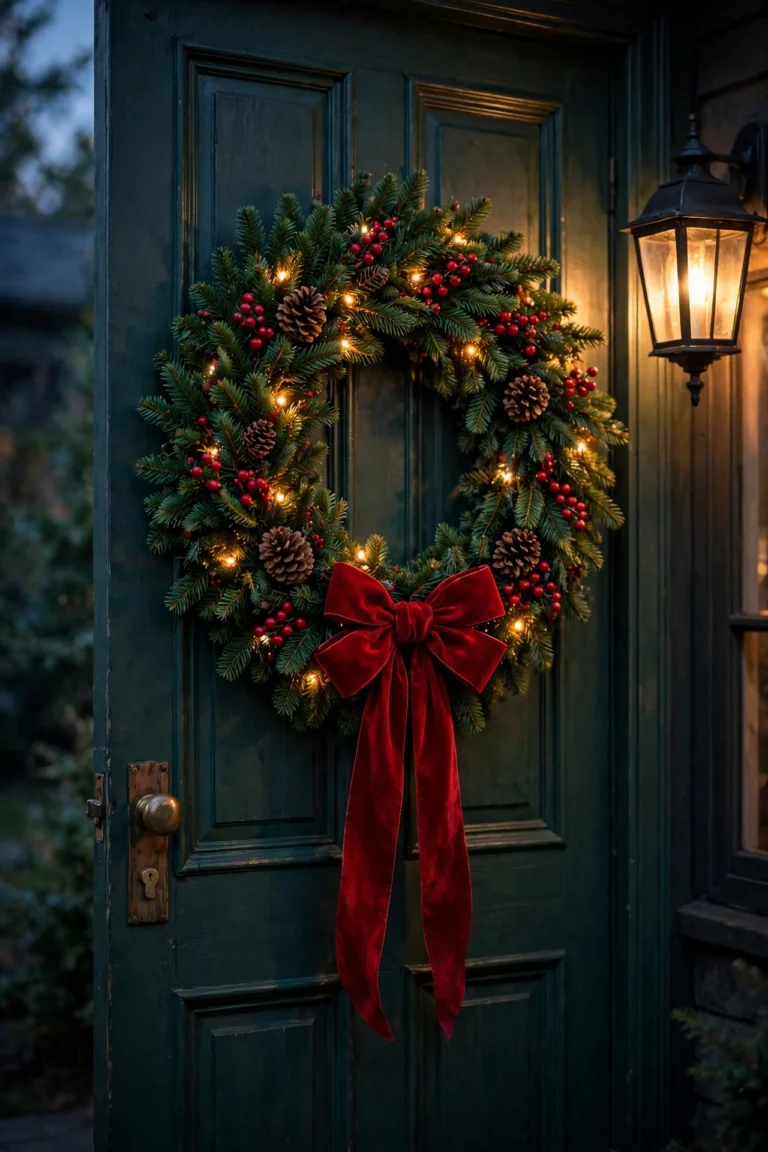
The wreath is the main event on a Christmas front door, and its size matters more than its style. The rule that every fresh 2026 guide agrees on is simple. A front door wreath should span about two thirds of the width of the door. For the usual 36 inch door, that means a wreath 22 to 26 inches across. For a 30 inch door, 18 to 20 inches is right. For a 32 inch door, 20 to 22 inches works. A wreath under half the width of the door looks lost, like a postage stamp on a wall. A wreath wider than the door looks like a mistake.
Hang it so its centre sits roughly 58 to 64 inches from the floor, which is eye level for most adults. That is higher than most people expect, and it is the single most common hanging error. A wreath hung at chest height makes the door look top heavy and empty, because the eye reads the blank space above it first. Measure from the floor, mark the spot lightly with a pencil on the inside of the door if you need to, and hang from there.
How you hang it matters as much as where. An over door hanger that slots over the top of the door is the best choice for most homes, because it needs no nail, no hole, and no damage. Check that the hanger fits the thickness of your door so the door still closes properly, and choose one rated for the weight of your wreath, because a heavy fresh wreath on a light hanger will slide. A suction hook works on a glass panel door. A removable adhesive hook works on a smooth painted door, if it is rated for outdoor use and for the weight. Never use a nail on a rented door, and never trust a ribbon looped over the top of the door on a windy day, because the wreath will spin and the ribbon will slip.
Choose the wreath itself by density, not by decoration. A full wreath looks lush and expensive. Look for dense greenery with branches that fan out in several directions, not a thin ring you can see through. Mixed greens, fir with cedar or pine, look more natural than a single flat green. Then add one strong accent and stop. One wide velvet bow at the bottom, or a cluster of pinecones, or a spray of red berries, is enough. Ten small picks crowded onto one wreath make it look busy from the street, where nobody can see the detail anyway. If your door is dark, pick a wreath with berries or a light bow so it reads clearly. If your door is light, a deep green wreath with a dark bow gives you the contrast you need.
Fresh or faux is a real choice, not a snobbery test. A fresh wreath smells wonderful and looks unbeatable for the first two weeks, then it dries and drops needles, and it needs misting every few days. A good faux wreath costs more once and lasts for years, and the best ones now mix real looking tips with a few real stems tucked in. If your door faces south and takes full sun, faux is the practical choice, because a fresh wreath will dry out in days. If your door is sheltered and north facing, fresh is a joy. Either way, buy the size first and the style second, because a perfectly styled wreath in the wrong size will never look right.
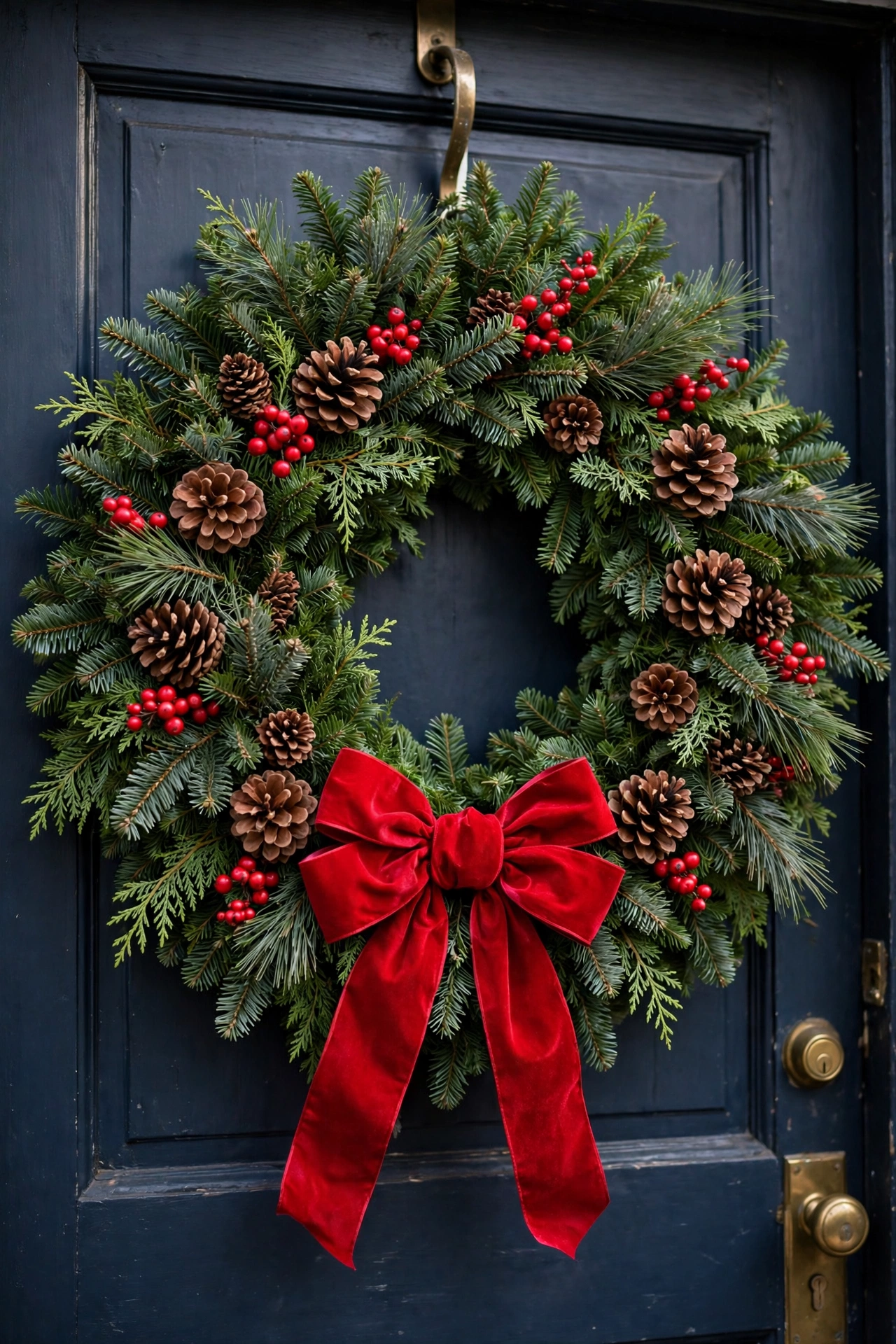
3. Frame the Door With Garland
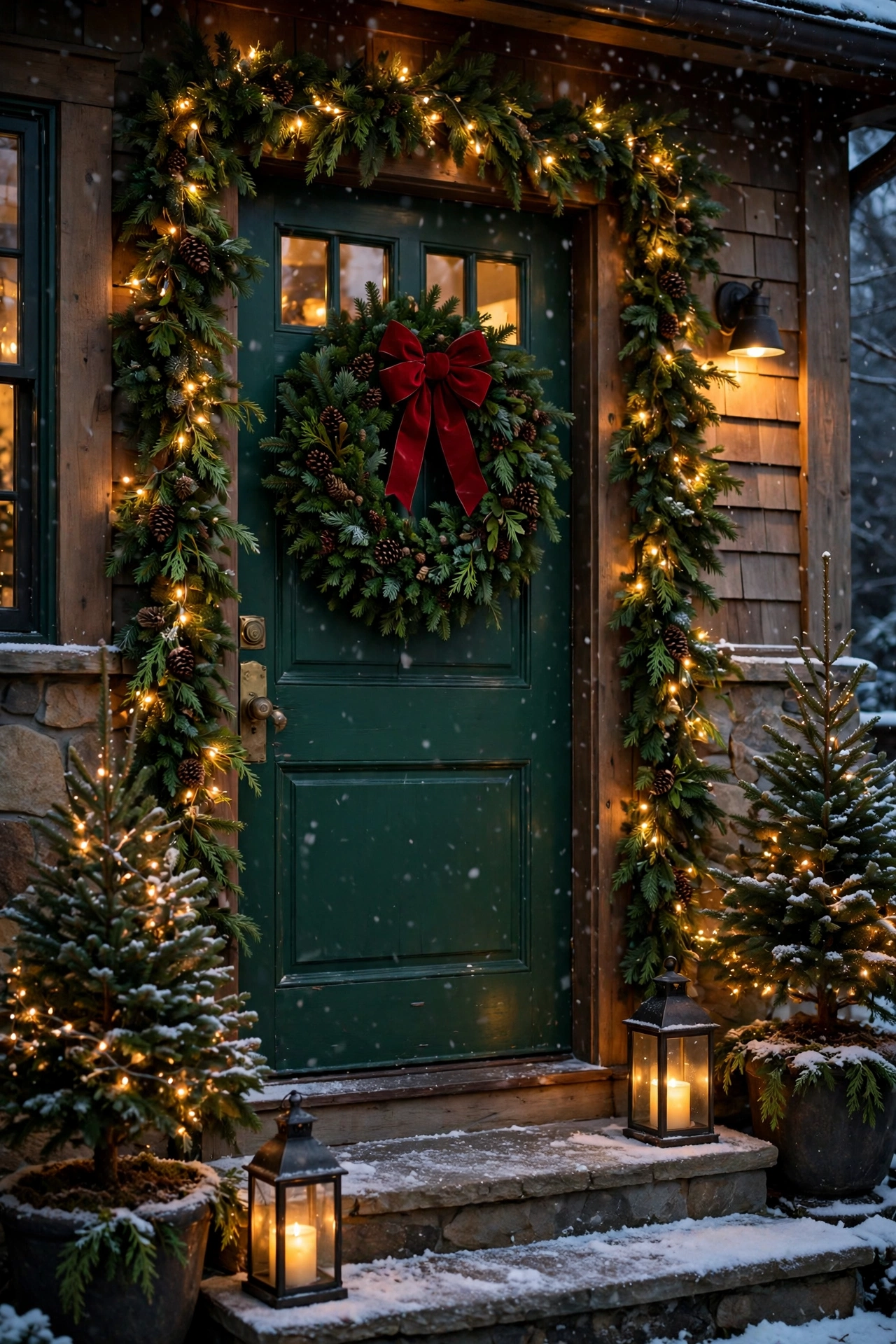
If the wreath is the main event, the garland is the frame that turns a door into an entrance. A garland run around the door frame outlines the doorway in green, and it is the single most effective layer for making a plain frontage look festive. It works on every door, from a grand double door to a flat apartment door, because it uses the frame, not the floor.
The length is a simple sum. For a standard 80 inch tall door that is 36 inches wide, you need the height twice plus the width, which is 80 plus 80 plus 36, or 196 inches, about 16 feet 4 inches of garland. Two 9 foot garlands joined at the top is the easy way to cover it. If you want the garland to swag low in the middle, add another foot. If your door is taller, measure it and do the same sum, because guessing leaves you a foot short at the bottom, which is the worst place to run out.
Hang it in three places at minimum, both top corners and the centre top, and wire it, do not just drape it. Use small removable hooks or wire ties at the corners, and let the garland hang naturally down each side. A garland that is only hooked at the top will slide down one side in the first wind, and a garland held by tape will fall when the cold kills the adhesive. For a brick surround, use brick clips that grip the mortar joint without drilling. For a painted frame, use removable outdoor hooks rated for the weight. Never staple into a frame you care about.
Pre lit garland is worth the extra cost on a front door, because the lights are woven through it at the factory and you never have to wrap a separate string around a garland that is already hung. Warm white is the only choice that flatters greenery. Cool white makes green look grey and tired, and multicolour lights fight the wreath instead of supporting it. Battery packs hide behind the top corner of the frame, and a timer set for dusk to 11 pm means you never have to remember to switch it on or off. If your garland is unlit, weave one string of warm white lights through it before you hang it, working on the ground where it is easy, not on a ladder in the cold.
Keep the greenery full at the top and lighter at the bottom, so the frame does not feel top heavy. Tuck a bow or a pinecone cluster into each top corner to hide the join, and let the ends finish at the same height on both sides, or deliberately asymmetric with one side fuller, which looks intentional rather than accidental. Step back to the pavement and check it. From the street, the garland should read as a clean green frame around the door, with the wreath sitting comfortably inside it, not fighting it.
4. Light, and the Dusk Test
Christmas front door decor is judged at dusk, not at noon. At noon, the greenery does the work. At dusk, the light does. A door with no light looks flat and a little sad after sunset, even if the wreath and garland are perfect. A door with warm light looks welcoming from the street, and it is the light that makes guests slow down as they walk up the path.
The rule is warm white only, everywhere on the door. Warm white, around 2700K, makes greenery look rich and gold look soft. Cool white makes the same greenery look grey and the same door look cold. If you buy one thing for the door this year, make it a string of warm white lights and a timer. Set the timer for dusk to 11 pm, so the door glows when people are actually arriving and going home, and so you never waste batteries or electricity all night.
Lanterns are the second light source, and they do a different job from the string lights. Two lanterns with warm battery candles, one on each side of the door, turn a dark doorway into a welcome at ground level, where the string lights cannot reach. Use battery candles, never a real flame near dry greenery, and put the lanterns on timers too. On a small stoop, one lantern is enough, placed on the side away from the main walking line so nobody kicks it. On a wide porch, a pair of different heights looks better than a matched pair, because it feels collected rather than bought as a set.
Test the whole door at dusk before you call it done. Walk to the end of the path, or across the street, and look back. That is the view your guests get, and it is the view your neighbours see. Ask three questions. Can you see the wreath clearly, or is it lost in shadow. Does the light fall on the door, or does it spill uselessly onto the wall. Is there one clear bright spot, the wreath, or three competing bright spots fighting each other. If the wreath is dark, add a small light above the door, or weave lights into the wreath itself. If the light is patchy, move the lanterns closer to the door. The dusk test takes five minutes and it is the difference between a door that photographs well at noon and a door that actually welcomes people home at night.
5. Planters and Height on Both Sides
A wreath and a garland dress the middle of the door. Planters dress the floor, and they give the display its height. Without something at floor level, the door floats, all decoration at eye level and nothing grounding it. With two planters, one on each side, the entrance feels balanced and finished, like a picture with a frame that reaches the ground.
Aim for a pair of planters, one on each side of the door, so the entrance feels symmetrical. Choose pots 16 to 24 inches tall and fill them so the total height, pot plus greenery, reaches 4 to 5 feet, which is roughly the midpoint of the door. A small pot with a tall thin tree looks top heavy. A tall pot with a tiny plant looks empty. The pot and the plant should feel like one object, not two things stacked by accident.
What goes in the planters is up to you, and the best choices are the simplest. A small potted evergreen, real or faux, with a string of warm white lights wound through it, is the classic for a reason. It is green all winter, it needs no watering if it is faux, and it survives frost. A pair of frosted mini trees in matching pots is the modern version, pale and bright against a dark door. A tall branch arrangement, bare twigs with a few ornaments and a bow, is the cheapest option and looks intentional if the branches are tall enough. Whatever you choose, keep both sides the same plant, or at least the same height, because mismatched heights make the door look lopsided from the street.
On a small stoop, one tall planter in the corner beats two cramped ones. Put it on the side away from the door swing, so the door opens freely and nobody has to squeeze past it. On a wide porch, you can add a second layer, a basket of pinecones or a small bench with a folded plaid throw, but only if the walkway stays clear. The rule for the floor is the same as the rule for the door. One clear path, wide enough for two people to pass, matters more than one more decoration. If a guest has to step around your planters to reach the doorbell, you have too much on the floor.
Weatherproofing starts at the floor too. Weigh down light pots with a brick or a bag of stones in the bottom, so the wind cannot topple them onto the step. Put a saucer under any pot that will sit on a painted step, or the water will stain it. If your planters are real evergreens in soil, water them once before the cold sets in, then leave them alone, because wet soil in a frost will crack a terracotta pot. Faux trees need nothing at all, which is why so many people choose them for the door.
6. The Layered Doormat
The doormat is the smallest piece of the door and the easiest one to get wrong, because most people buy one mat and expect it to do three jobs. It has to clean shoes, it has to look festive, and it has to survive wet December weather. One thin mat does none of those well. Two layered mats do all three, and the layered look is the detail that makes a door look finished in photographs.
The formula is simple. A larger flat rug underneath, usually a red and cream plaid or a plain natural weave, and a smaller coir mat on top of it. The top mat does the cleaning, because coir scrapes mud off shoes. The bottom rug does the decorating, because it adds colour and pattern and makes the whole threshold look wider. Pick a bottom rug about as wide as the door, 30 to 36 inches, so it does not look lost, and a top mat a few inches narrower on each side, so the pattern shows as a border. A mat much narrower than the door looks like an afterthought. A mat much wider than the door looks like a carpet that escaped.
Colour follows the door. On a dark door, a red plaid rug underneath a plain coir mat is the classic, because the red reads clearly against the step. On a light door, a green and cream pattern works better, because red can look harsh in bright light. Avoid a mat with words on it if you can, because a greeting mat that says something clever is charming once and tired by the third visit, and a plain mat never dates. If you love a funny mat, keep it as the top layer and swap it out in January, when the joke has worn off.
Practical matters decide whether the layered look survives the month. Put a non slip pad under the bottom rug, or the whole stack will slide on a wet step. Shake the coir mat out every few days, because it holds mud and grit that will scratch the step if it builds up. In a wet week, bring the bottom rug in at night and put it out again in the morning, or it will stay damp and smell. And if your step is stone, expect the coir mat to shed fibres for the first week, which is normal and stops once the loose fibres are gone.
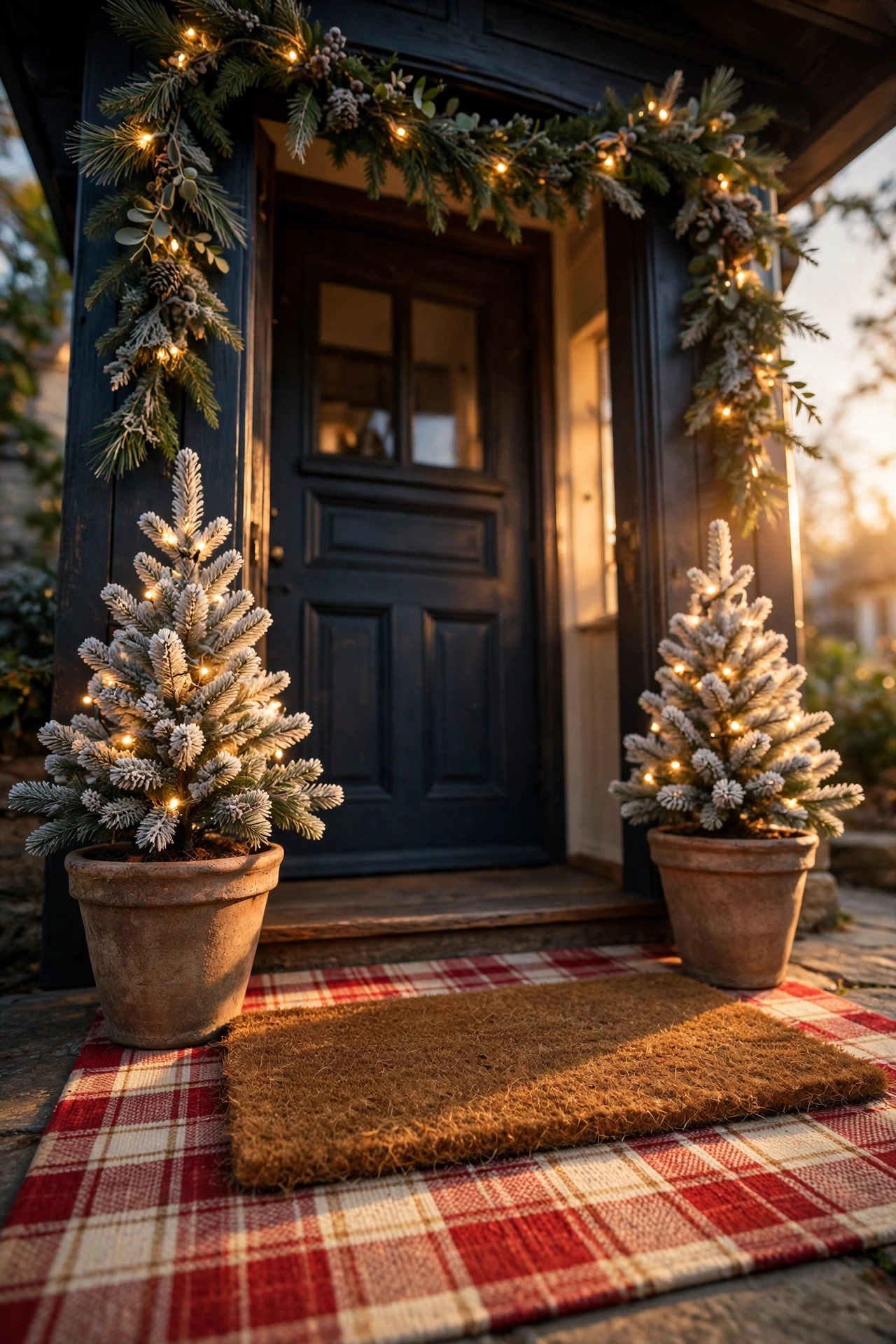
7. Small Front Door Christmas Decor, the Three Piece Stoop
Not every front door has a porch. Some doors open straight onto a pavement, some onto a single step, and some apartment doors open onto a shared hallway where you cannot put anything on the floor at all. Small front door Christmas decor is not a lesser version of the big porch. It is a different job, with its own rule, and the rule is three pieces, no more.
On a stoop under about 4 feet deep, use exactly three things. One wreath on the door, one tall planter in the corner, and one strand of lights along the rail or frame. Add a doormat, and stop there. Anything more narrows the path and invites trips. A small porch often looks best of all, because every piece is close enough to be seen properly, and there is nowhere for clutter to hide.
For a flat front door with only a step, the three pieces change shape but not number. A lit wreath on an over door hook, a layered doormat at the threshold, and one slim lantern with an LED candle on the top step. That is the whole list, honestly, and all three come to about 40 to 60 dollars. No drilling needed, because over door hooks, suction hooks, and removable adhesive hooks hold everything, and the lantern sits on the step where nobody will trip over it.
For an apartment door, the three pieces move inside the rules of the building. A wreath on the door, a small garland around the frame if the hallway allows it, and a battery candle in the window beside the door. Check the building rules first, because some hallways ban anything on the floor, and a lantern in a shared hallway is a trip hazard for your neighbours. A wreath and a window candle are almost always allowed, and they are enough, because the hallway is narrow and the door is close to everyone who passes it.
The principle behind the three piece rule is decorate up, not out. When floor space is limited, put the emphasis on the doorway. A wreath and a narrow garland frame the entrance without filling the landing with decorations. A small porch or a flat door does not need matching trees on both sides. One slim tree in a planter can provide height and sparkle while leaving plenty of space for people to come and go. And if you can only afford one thing this year, make it the wreath, because a good wreath on a bare door does more than five small things scattered around a crowded stoop.
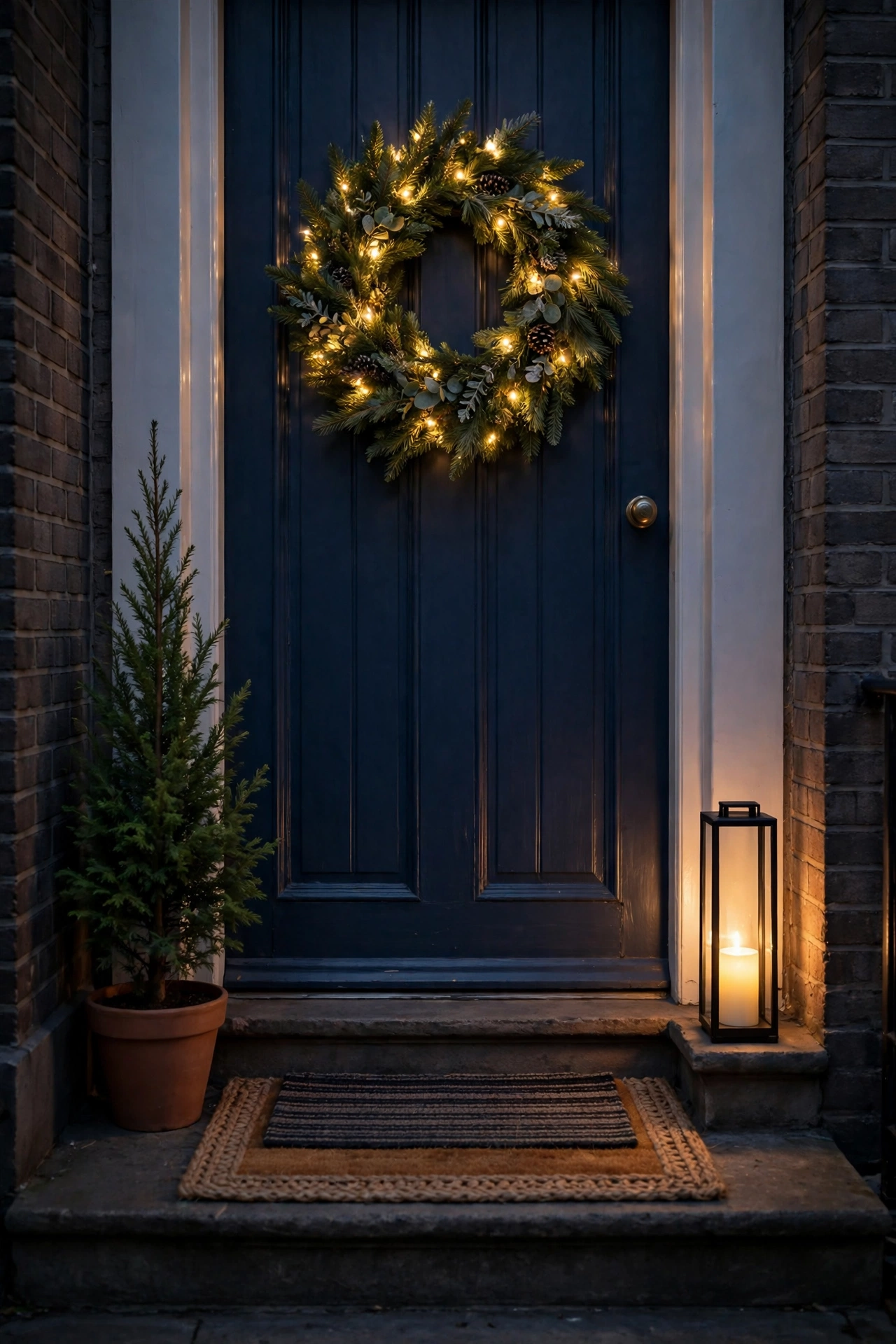
8. Styles, Budgets, and Weatherproofing
Once the four layers are in place, style is the easy part, because it is only a matter of choosing one palette and repeating it. Classic red and green is the safest choice and the easiest to shop for, because every shop stocks it. A green wreath, a red velvet bow, red berries, and a red plaid mat, with gold only in the lanterns, is a door that never looks wrong. Farmhouse neutrals suit a modern house better. A plain green wreath with cream ribbon, natural wood planters, and a coir mat with no pattern, looks calm and expensive, and it photographs beautifully in daylight. Modern black and gold suits a dark door. A black and gold wreath, gold lanterns, and a black and cream mat, with no red at all, looks sharp and deliberate. Scandinavian pale wood and white suits a small door, because the pale colours make a narrow entrance feel bigger.
Budgets are honest when they are written down, so here are three tiers for a standard door. Under 75 dollars, one 24 inch faux wreath, two outdoor LED light strands, a timer, a doormat, and cut greenery from a tree lot or your garden. That is the whole door, and it looks finished, because the wreath is the right size and the lights are warm. Around 150 dollars, add a pre lit garland for the frame and two planters with small frosted trees. Around 300 dollars, add a fresh oversized wreath, a pair of good lanterns, and a layered mat with a proper rug underneath. All three tiers look good from the street. The difference is fullness, not taste, and a 75 dollar door with the right wreath size beats a 300 dollar door with a wreath that is too small.
Weatherproofing is the part most guides skip, and it is the part that decides whether your door still looks good on Christmas Eve. Wire everything twice, because one wire will fail in a storm and two will hold. Weigh down pots and lanterns, so the wind cannot roll them across the step. Keep cords off the walkway, or tape them flat, so nobody trips in the dark. Bring cushions and fabric in before a storm, because wet fabric on a step is a slip hazard. Check the door after the first rain, because that is when you learn which hook holds and which one does not, and fix it then, not on Christmas Eve. And if your door takes direct rain, choose faux greenery for the wreath and garland, because fresh greenery will go brown and drop needles in a wet week, while faux greenery looks the same on day one and day thirty.
The One Hour Door Plan
If you only have one hour this weekend, here is the plan that actually gets finished. First ten minutes, measure the door and write down the width and height. Next ten minutes, hang the wreath at eye level, centre 58 to 64 inches from the floor, on an over door hanger. Next fifteen minutes, hang the garland around the frame, wire it at the corners, and set the timer for dusk to 11 pm. Next fifteen minutes, put the planters in place, one on each side, or one tall planter in the corner if the stoop is small. Last ten minutes, lay the layered mat, set the lanterns by the door, and step back to the pavement for the dusk test. If the wreath reads clearly and the light is warm, you are done.
The door is the smallest room in the house to decorate and the first one anyone sees, so it deserves that one hour more than any room inside. Do it this weekend, while the wreaths are still in the shops and the garlands are still full, and every time you come home in December, the door will do what it is supposed to do. It will make you glad to be home, and it will make your guests feel welcome before you have even said hello. For the inside of the doorway, the guide called Christmas Entryway Decor Ideas continues the welcome from the threshold into the hall, and for the windows beside the door, the guide called Christmas Window Decor Ideas shows how a wreath in every window ties the whole front of the house together.
FAQ
How big should a Christmas wreath be for a front door?
About two thirds of the width of the door. For a standard 36 inch door, that is 22 to 26 inches across. Hang it so the centre is 58 to 64 inches from the floor.
How much garland do I need to frame a front door?
The height of the door twice plus the width. For a standard 80 inch tall, 36 inch wide door, that is about 16 feet 4 inches. Two 9 foot garlands joined at the top cover it.
How do I hang a wreath without damaging the door?
Use an over door hanger rated for the weight of the wreath, or a suction hook on a glass panel, or a removable outdoor adhesive hook on a smooth painted door. Never use a nail on a rented door.
What should I put on a small front door for Christmas?
Three things only. A lit wreath on the door, a layered doormat at the threshold, and one slim lantern with an LED candle on the step. That is the whole list, and it is enough.
Are battery candles safe on a front door?
Yes, and they are the only safe choice near dry greenery. Use battery candles inside lanterns, on timers, and never use a real flame near a wreath or garland.