Christmas Advent Calendar Ideas: 24 Days of Joy
The countdown is half the magic of Christmas. A tree goes up in an afternoon. The lights go on in an evening but an advent calendar stretches the season out across twenty four small mornings. That slow daily joy is why families keep them long after the children grow up. The best advent calendar ideas are not the expensive ones. They are the ones that fit your home, your budget, and the people who will open them. They are the ones you will actually finish before the first of December.
This guide covers the formats that work, the fillers that get used instead of forgotten, and a simple twenty four day activity plan you can copy as it stands. Every idea here can be made at a kitchen table with supplies you probably already own. Every one of them can be packed away and used again next year.
1. When to Start: Advent Begins on 29 November 2026
A standard Advent calendar opens each day from the first of December until Christmas Eve. That period contains twenty-four doors, pockets or envelopes. In the church calendar the Advent season starts on the fourth Sunday before Christmas. In 2026 that Sunday is the 29th of November. Some families begin their countdown on that Sunday. That choice gives either twenty-five or twenty-six days depending on the counting method. Either option is fine. Pick one start date, write it on the calendar, and plan the rest of the calendar to that date.
Begin making the calendar in early to mid November. The simplest formats take about an hour. The most involved ones, such as a chest of matchbox drawers, take two or three evenings. Starting early means you are choosing fillers calmly instead of panic buying small toys on the 30th of November. It also means the calendar can be set up as part of your decorating weekend instead of becoming one more job in the busiest week of the year.
If you buy a ready-made calendar instead, check the same dates. Chocolate calendars and beauty calendars sell out fast in November. The ones left in December are usually the flavours and brands nobody wanted. A handmade calendar never has that problem, because you choose every single thing inside it.
2. The Envelope Garland: The Classic That Costs Almost Nothing
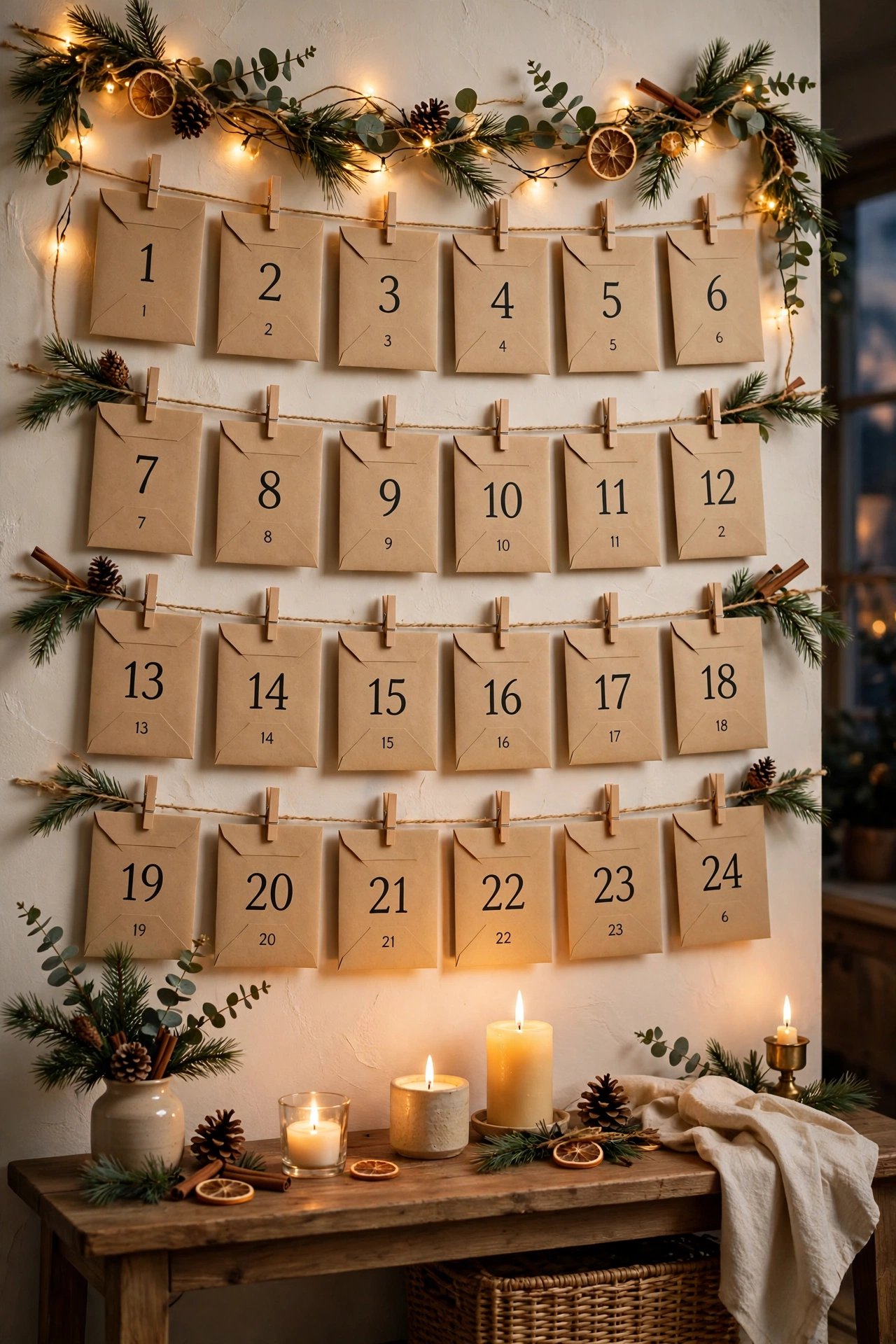
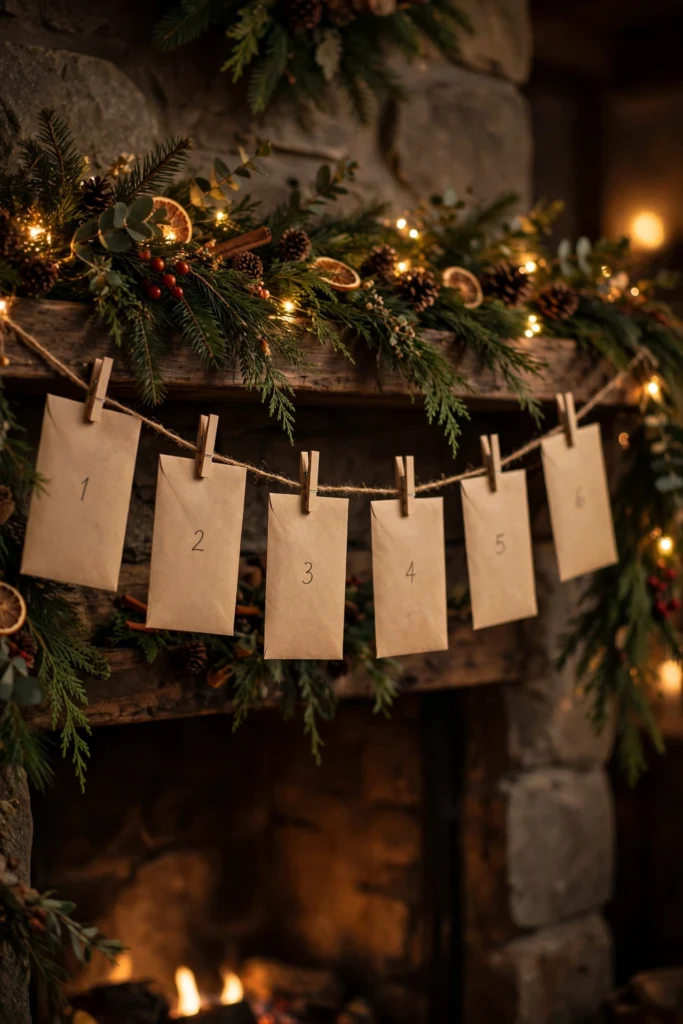
Number twenty four small envelopes, write one surprise on a card for each day, clip them along a piece of twine with wooden pegs, and hang the garland across a doorway, along a mantel or down a staircase banister. That is the whole project, and it is the format most families start with for good reason. Envelopes cost almost nothing, they hold a folded note plus one small treat, and the garland itself becomes part of the decoration.
Use plain kraft envelopes for a warm rustic look, or white envelopes with red number stickers for a cleaner one. Number them clearly in order, because children will hunt for the right number every morning and a smudged seven looks a lot like a one. Peg them in order along the twine so the garland reads one to twenty four from left to right, and leave a little slack between pegs so the envelopes can be unclipped without pulling the whole line down.
Hang it where the family actually passes every morning. A mantel is lovely but a doorway or a hallway wall gets opened on time, and a calendar that is opened on time is a calendar that works. For hanging ideas that suit the same spots, the garland guide on this blog covers lengths and fixings for mantels, doorways and staircases.
One practical tip: keep a small basket or tray underneath the garland for the empty envelopes and the pegs. By the third week of December the mantel will be covered in opened paper otherwise, and a tidy calendar looks good right up to Christmas Eve.
3. Kraft Bags on a Branch: The Forgiving Favourite
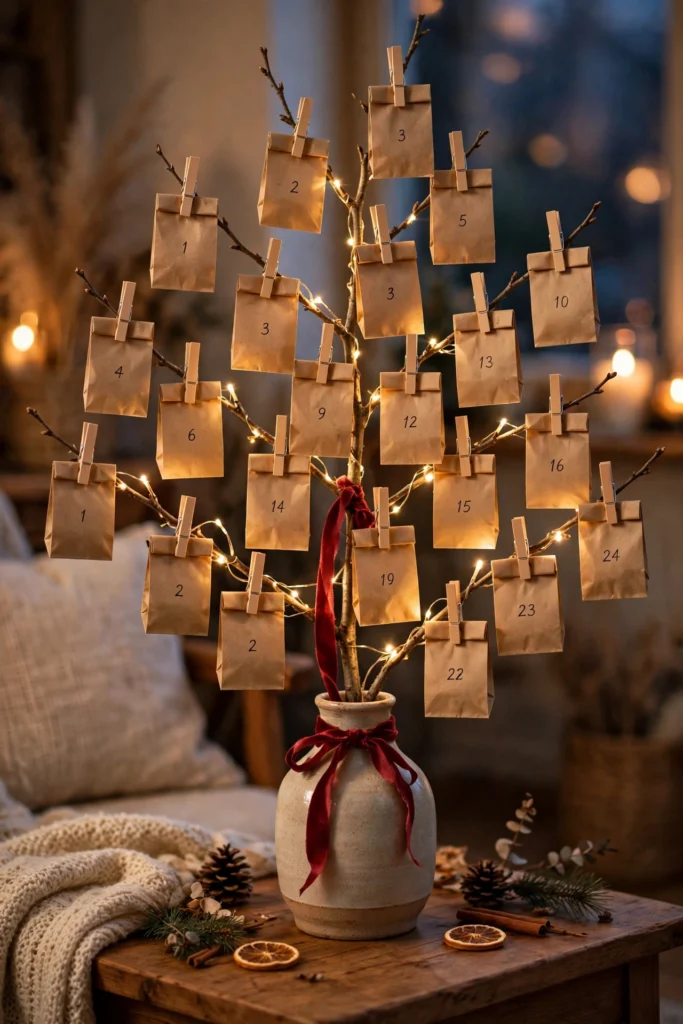
Small kraft paper bags clipped to a bare branch in a vase are the most forgiving DIY advent calendar you can make. The bags hold more than envelopes, they cost little, and they look nice even with just a few simple additions. All you need is a branch from the garden, a heavy vase, twenty four small bags, some twine and a pen. That is the full shopping list.
Put the branch in the vase. Fill the vase with stones or dried beans so it stays steady when a child pulls a bag. Number the bags one to twenty four, then clip them to the branch using small pegs or tie them on with short pieces of twine. Put the heavier fillers in the lower bags to keep the branch balanced, and keep the top bags light. Add a sprig of evergreen into the vase. Wrap a short string of battery-powered fairy lights around the branch. That turns a simple idea into something that feels like a real centrepiece.
This kind of advent calendar works well on a side table, a console table or a kitchen counter. It is perfect wherever the branch sits at eye level for the kids who will open it. It also packs away beautifully. The bags fold flat, the branch can go back outside, and next year all you need is fresh numbers and fresh fillers.
If a branch feels too wild for your room, you can use the same bags pegged along a length of twine on the wall, or hung from a tension rod inside a doorway. The bags are the idea. The branch is only the display.
4. The Matchbox Drawer Chest: A Weekend Project That Lasts Years
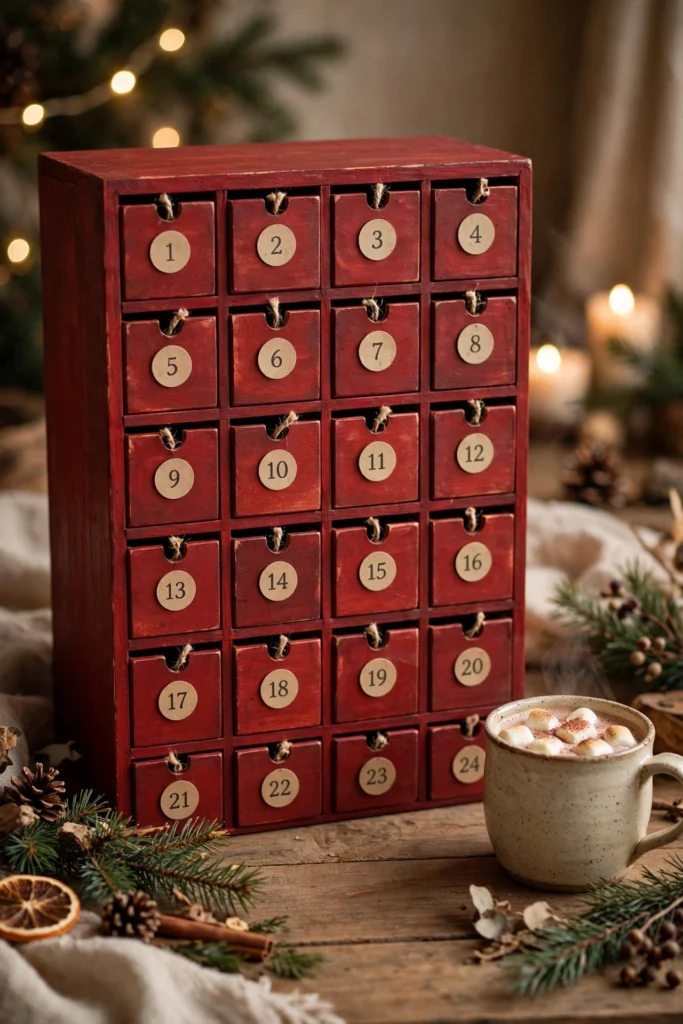
Glue twenty four small matchboxes into a little chest of drawers, number each drawer with a round seal, and you have a calendar that becomes part of the family tradition. It takes two or three evenings to build, which is the most time any format in this guide asks for, and it is the one most worth the effort, because a finished chest can be refilled every December for years.
Use empty matchboxes, or buy plain craft matchboxes from a craft shop. Glue them in rows of six by four, or four rows of six, and let the glue dry fully before you number them, or the drawers will stick. Round number seals look tidier than handwritten numbers on tiny drawers, and a sheet of twenty four seals costs very little. Paint the outside of the chest one colour, red, green or plain kraft, and leave the drawer fronts plain so the numbers stay easy to read.
Each drawer holds one small thing: a chocolate, a sticker, a hair clip, a tiny ornament, a rolled up note. That small size is actually a strength, because it stops you overfilling and keeps the surprise proportionate to the day. Put one slightly bigger treat in drawer twenty four, the Christmas Eve drawer, so the countdown ends on a high note.
Store the chest flat in a box with tissue paper between the drawers after Christmas. A chest that survives storage is a chest that gets used for a decade, and a calendar with ten years of Decembers inside it is worth more than any shop bought version.
5. Paper Cones, Pockets and a Jar of Scrolls: Three More Easy Formats
Not every family wants a building project, and not every home has wall space for a garland. Three simpler formats cover those cases, and each one takes under an hour.
Paper cones on a branch work like the kraft bags but lighter and prettier. Roll cones from patterned paper, glue the seam, punch a hole near the top and thread twine through it. Hang them from a branch, a length of twine or a small wall hook rail. Cones hold wrapped sweets, a rolled note or a tiny ornament, and they cost almost nothing to make.
A pocket calendar is a piece of felt or fabric with twenty four small pockets sewn or glued in rows. It hangs flat on a wall or a door, which makes it the best choice for a small home or a rented home, because it needs no nails and no shelf. Fill the pockets the same way you would fill drawers, and roll the whole thing up for storage in January.
A jar of rolled scrolls is the lowest effort version of all, and it is the one to choose if December is already busy. Write twenty four notes, one per day, roll each one up, tie it with thread and drop it in a clean glass jar. Each morning someone pulls the right number. There is no building, no hanging and no storage problem, and the notes themselves can be the whole surprise: an activity, a joke, a memory, a small kindness to do that day.
6. What to Put Inside: Fillers for Kids, for Adults and for the Whole Family
Fillers are where most advent calendars go wrong. Twenty four random small toys become twenty four pieces of clutter. Twenty four chocolates become a sugar crash by the second week. The rule that works is simple: mix three kinds of filler across the month and never let one kind run for more than three days in a row.
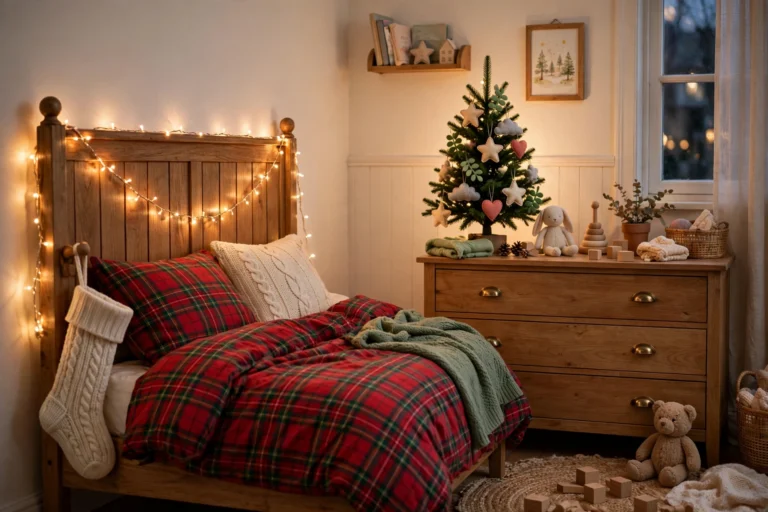
For children, mix small treats with small activities and one tiny keepsake a week. Treats can be a chocolate, a biscuit or a dried fruit pouch. Activities can be a paper snowflake to cut, a cookie to decorate, a story to read together or a Christmas film to watch. Keepsakes can be a sticker sheet, a small ornament for their own mini tree, a hair clip or a tiny figure. A kids room decorated for Christmas gives these small surprises a home of their own, and the kids room guide on this blog has ideas for a mini tree and a reading nook that suit an advent calendar perfectly.
For adults, think small luxuries and useful things rather than novelties. A good tea bag, a lip balm, a pair of cosy socks, a scented candle sample, a sachet of bath salts, a nice pen, a chocolate worth eating slowly. One thoughtful filler beats five joke fillers, and an advent calendar for a partner works best when the fillers show you were paying attention all year.
For the whole family, alternate a treat day with an activity day. Activity days cost nothing and are usually the days people remember: bake together, drive to see the lights, write the wish lists, make the wrapping paper, build a snowman if the weather allows. Small stocking style fillers work just as well in a calendar as they do in a stocking, and the stocking guide on this blog lists fillers people actually love, which saves you guessing.
One filler to avoid is anything that makes noise, needs batteries or sheds glitter. A calendar opened at seven in the morning should not wake the whole house, and glitter in a matchbox drawer will be found in the carpet until Easter.
7. The 24-Day Activity Plan: One Small Thing Each Evening
If choosing twenty four fillers feels like too much planning, use this plan instead. It mixes treats, activities and quiet days, and it is built around weekends, so the bigger activities land on Saturdays and Sundays when there is time for them. Copy it as it stands or swap any day for a family favourite.
Days one to three ease in. Day one, write the wish list or a letter to Santa. Day two, cut paper snowflakes and tape them to the windows. Day three, cocoa and a short film, something under ninety minutes on a school night.
Days four to seven build the habit. Day four, decorate one window with a garland or a star. Day five, bake a first batch of biscuits together. Day six, a Saturday project: make salt dough ornaments, mix, cut, bake and paint once they are cool. Day seven, a walk to look at the neighbours lights, hot chocolate in a flask.
Days eight to fourteen keep it small on weekdays and bigger at the weekend. Day eight, read one Christmas story at bedtime. Day nine, make your own wrapping paper by stamping plain brown paper. Day ten, a small treat, a chocolate or a favourite sweet. Day eleven, write cards for grandparents. Day twelve, a Saturday film night with popcorn and blankets. Day thirteen, a craft afternoon, paper chains or orange slice garlands. Day fourteen, hang the homemade ornaments on the tree.
Days fifteen to twenty count down properly. Day fifteen, a family photo in front of the tree. Day sixteen, bake a second batch, this time for neighbours or teachers. Day seventeen, a puzzle evening or a board game. Day eighteen, wrap the presents together with the paper you made on day nine. Day nineteen, a Saturday outing, a Christmas market or a lights trail. Day twenty, a quiet evening, books and blankets only.
Days twenty one to twenty four finish gently. Day twenty one, pack a small gift box for someone who needs one. Day twenty two, decorate the table for Christmas dinner. Day twenty three, a Christmas Eve box: new pyjamas, a book and something cosy. Day twenty four, open the last door, light the candles, and enjoy the evening you spent all month building towards.
8. Where to Hang It, and How to Store It for Next Year
An advent calendar works best where the family passes every morning. The kitchen wall beside the breakfast table, the hallway at the bottom of the stairs, the living room wall opposite the sofa, or the mantel in the room where everyone gathers in the evening are all good spots. A calendar hung in a spare room is a calendar that gets forgotten by the tenth of December, so choose the busiest wall, not the prettiest one.
Check the fixings before you hang anything heavy. A garland of twenty four filled envelopes is heavier than it looks, and a branch in a vase needs a stable base. Use proper hooks, not tape on painted walls, and keep the calendar away from radiators, open flames and the direct blast of a heater, especially if it holds paper, dried oranges or anything flammable. Battery lights are the safe choice on any calendar, and real candles never belong on or near one.
When Christmas is over, store the calendar the way you would store any decoration you want to keep. Empty every pocket, drawer and envelope. Brush off crumbs and glitter. Fold garlands loosely, roll pocket calendars, wrap a matchbox chest in tissue paper, and label the storage box with the year and the format. A labelled box gets opened next November. An unlabelled box gets opened never.
Write one note before you put the box away: what worked, what nobody liked, and what to buy differently next year. That note is the most useful part of the whole project, because next December you will open the box and know exactly where to start.
Conclusion
An advent calendar is a small daily promise, and keeping a small promise every day is what makes December feel like Christmas instead of just feeling busy. Start in November, pick a format that fits your home, fill it with a mix of treats and activities, and hang it where the family will actually see it. The calendar does not need to be perfect. It needs to be opened, one door at a time, for twenty four mornings in a row, and that is a tradition worth building.
Start this weekend. Number twenty four envelopes, or fill one jar with scrolls, and let the countdown begin.