Christmas Centerpiece Ideas That Look Planned
A Christmas centerpiece is the decoration that your guests stare at for two hours straight. It sits in the middle of the table while everyone eats, talks, and reaches across it for the potatoes, so it has to do two jobs at once. It has to look like December, and it has to stay out of the way.
I have seen Christmas centerpieces that fail on the second job. They are too tall, too wide, or too fragile, and by the main course someone has moved them to the sideboard. A good centerpiece is low enough to talk across, narrow enough to leave room for plates, and sturdy enough to survive a full dinner service. Everything in this guide follows that rule.
You do not need a florist budget either. The best Christmas centerpiece ideas in this guide use things you probably already own: a tray, three candles, some greenery from the garden or the craft store, and a handful of ornaments. We cover candle centerpieces, natural greenery, the one tray rule, small and round tables, ornament bowls, winter villages, and a full budget plan under twenty dollars. Pick one idea, build it in an afternoon, and your table is done.
The Low and Long Rule, Size Your Centerpiece Before You Style It
Before you buy or build anything, measure the table. A centerpiece that fits is a centerpiece that stays on the table all evening, and a centerpiece that does not fit gets moved to the floor by dessert.
Height comes first. Sit in your usual chair and look straight ahead. Anything taller than about twelve inches blocks the face of the person opposite you. Keep the tallest element under that line, and keep the very tallest pieces at the ends of the table rather than the middle, where sightlines cross. Tall candlesticks look elegant in photos and terrible at dinner, so save them for the sideboard.
Width comes second. For a standard table, the centerpiece should take up no more than one third of the width. On a table thirty six inches wide, that means a runner or arrangement about twelve inches across, with plates and glasses still fitting comfortably on both sides. Measure the space between the place settings, not the full table, because the settings are what the centerpiece has to share the table with.
Length is the easy part. A centerpiece can run almost the full length of the table, as long as it stays low and narrow. A long, low garland runner down the middle of a rectangular table is one of the most forgiving designs there is, because it fills the space without blocking anyone. For a round table, think in a circle instead: one compact arrangement in the middle, about a third of the table diameter, with room for serving dishes around it.
Finally, plan for the food. Serving dishes, a gravy boat, and a bread basket all need table space too. If your centerpiece is a tray, you can lift the whole thing away in one move when the platters arrive, which is exactly why the tray method in Section 4 works so well. Build for the meal, not for the photograph, and the photograph will still look good.
Candle Centerpieces, Warm Light Without the Worry
Candlelight is the fastest way to make a Christmas table feel warm. One warm glow at the centre of the table changes the whole room, and it costs almost nothing. The trick is choosing the right candles and keeping them safe around greenery, paper, and sleeves.
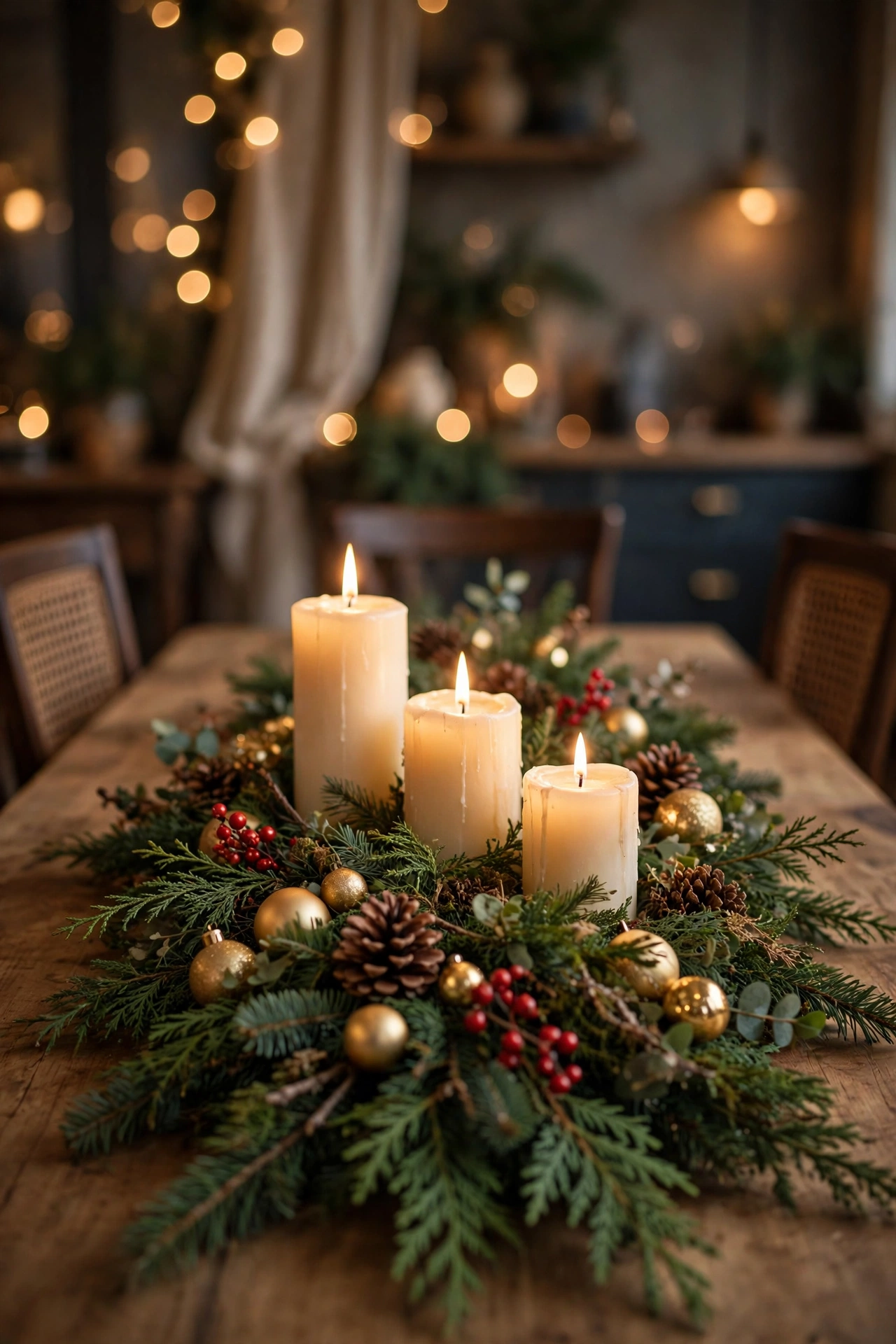
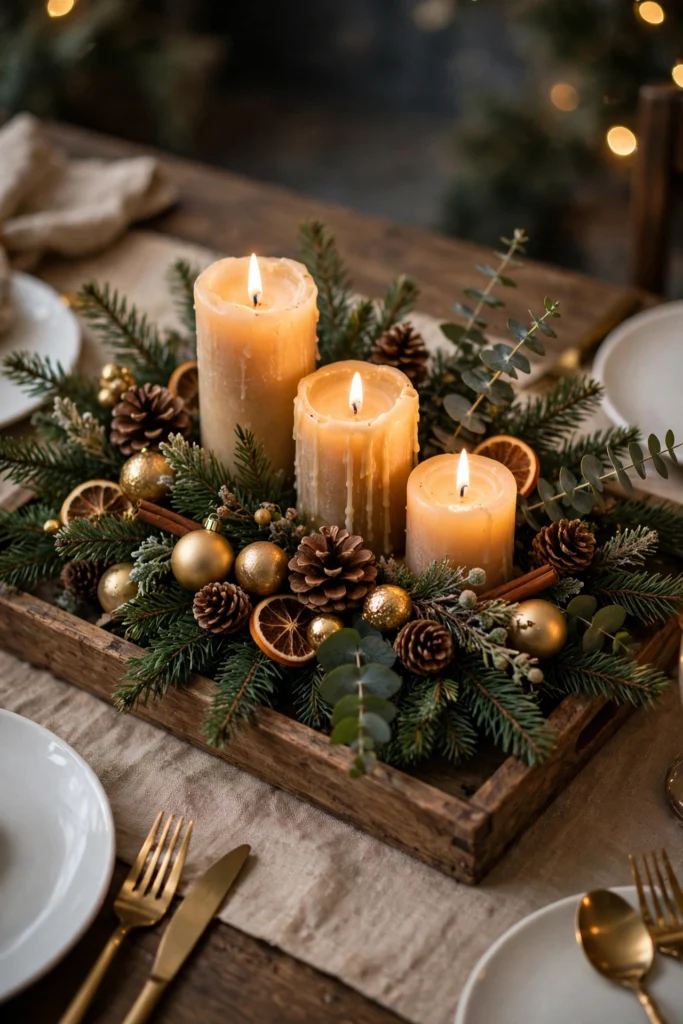
Pillar candles are the workhorse. Three pillars in different heights on a tray or a wooden board, surrounded by evergreen sprigs and a few pinecones, is a complete centerpiece in five minutes. Choose unscented pillars for the dinner table, because a strong scent fights with the food. Cream or deep red pillars suit almost any palette, and they cost about three to six dollars each at a craft store.
Taper candles in brass or glass holders add height without blocking sightlines, because the candle itself is thin. A row of three or five tapers down the centre of the table, with greenery tucked around their bases, looks formal and costs very little. Keep the tapers in stable holders, and never place a taper where someone has to reach across it for a dish.
Flameless candles are the honest answer for families with children, pets, or a lot of greenery on the table. Modern battery candles flicker convincingly, run on a timer, and cannot set a pine sprig alight. Use them inside lanterns, hurricane vases, and anywhere real flame would sit close to dry material. Keep the real candles for the mantel, where nobody is reaching across them.
Whatever you choose, follow three safety rules. Keep every flame at least six inches from greenery, paper, and fabric. Never leave candles burning in an empty room. And blow them out before the last person leaves the table, because the prettiest centerpiece in the world is not worth a scorched tablecloth. A small ceramic plate or a metal tray under the candles catches wax and protects the wood, and it costs nothing if you already own one.

Natural Greenery and Dried Orange, the Centerpiece That Smells Like December
If you buy one thing for your centerpiece, make it greenery. Fresh cedar, pine, and eucalyptus cost a few dollars a bunch, fill a table with scent, and hide a multitude of sins. A loose, generous pile of greenery down the middle of the table, with candles and ornaments tucked in, looks abundant rather than arranged, which is exactly the feeling you want.
Start with a base layer of cedar or pine garland running the length of the table. Let it spill slightly over the edges, because a garland that ends in a neat straight line looks like a shop display. Tuck in sprigs of eucalyptus for a softer grey green note, and add a few rosemary sprigs, which smell wonderful and double as a garnish in a pinch.
Dried orange slices are the cheapest luxury in Christmas decorating. Slice oranges thin, dry them low and slow in the oven, and tuck them into the greenery with cinnamon sticks and star anise. They catch the candlelight, they smell like Christmas for weeks, and they cost almost nothing. Our full garland guide covers the drying times and the mould problem to avoid, so read Christmas Garland Ideas before you start if this is your first time drying citrus.
For a smaller, tighter arrangement, build a greenery wreath flat on the table and set a hurricane candle in the middle. A simple evergreen wreath, the same kind you would hang on a door, laid flat with a large candle in the centre, is a complete centerpiece. Add a few red berries, pinecones, and small ornaments around the outer edge, and you are done in ten minutes. The wreath keeps the greenery contained, which matters on a small table, and the full guide to wreath styles is in Christmas Wreath Ideas if you want to make the wreath yourself.
One practical note: fresh greenery dries out. Mist it lightly with water the morning of the dinner, keep it away from heat vents and radiators, and expect it to last about a week indoors. If you are building the centerpiece more than a few days ahead, use good quality faux greenery instead. The best faux cedar looks convincing from across a table, and you can use it again next year.
The One Tray Rule, a Centerpiece That Moves in One Hand
The tray is the single most useful tool in Christmas table decorating. Build your centerpiece on a tray, and the whole thing lifts away in one move when the platters arrive, then comes straight back for dessert. No dismantling, no hunting for a spare surface, no centrepiece balanced on a chair.
Choose a tray that fits the table. A rectangular wooden tray about eighteen to twenty four inches long suits a standard dining table. A round tray about fourteen inches across suits a round table. The tray should be shallow, with a rim low enough that candles and greenery still show over it, but high enough to contain wax drips and dropped pine needles.
The classic tray formula is simple: three pillar candles at different heights, a ring of evergreen sprigs around them, a few pinecones, and a scattering of small gold or silver ornaments. That is the whole design. It takes fifteen minutes, it costs under twenty dollars if you need to buy the candles, and it looks intentional rather than thrown together. Change the ornament colour, and the same tray works for a completely different palette next year.
A tray also solves the small table problem. On a table for four, a full garland runner eats the whole surface. A single tray with one candle, a few sprigs, and three ornaments gives you the same feeling in a fraction of the space, and it still lifts away when dinner arrives. Our dining table guide shows the tray formula in context, with place settings and serving space planned around it, so read Christmas Dining Table Decor Ideas if you are planning the whole table at once.
Keep the tray practical. Line it with a piece of linen or a paper doily if the wood is rough, and check that it is not too heavy to lift with one hand when it is full. A tray you cannot lift defeats the purpose. Test it before the guests arrive: build it, lift it, set it down on the sideboard, and bring it back. If any piece slides, secure it with a dot of museum putty or a small piece of floral foam.
Small and Round Tables, Centerpieces That Fit the Space You Have
Small tables are not a problem, they are a size to respect. A centerpiece built for a table for eight will drown a table for four, and a round table needs a different shape entirely. The fix is to shrink the design, not the ambition.
For a small rectangular table, go vertical in a narrow band. One slim garland runner, one candle, and three ornaments in a line down the centre. That is enough. Resist the urge to add a second candle or a taller arrangement, because the table needs the space for plates. A single beautiful object, done well, beats a crowded display every time.
For a round table, build a circle. A low, wide bowl or a round tray in the middle, filled with greenery, three short candles, and ornaments, mirrors the shape of the table and leaves an even ring of space for place settings. Keep the arrangement under a third of the table diameter, and keep it low, because on a round table everyone is facing the centre and a tall piece blocks every sightline at once.
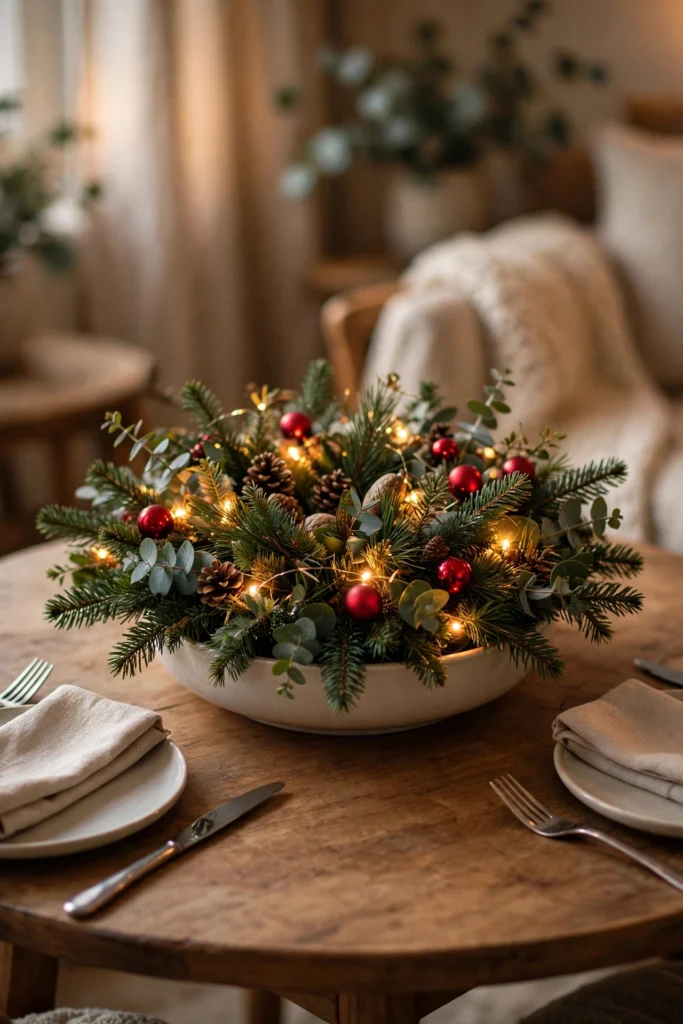
A pedestal bowl is a good friend on a round table. A footed compote or a wide, shallow bowl raises the arrangement a few inches, which gives it presence without adding height, and it keeps the greenery off the tablecloth. Fill it with pinecones, ornaments, and fairy lights, and it glows from within when the lights are low.
If your table is very small, a table for two, for example, skip the centrepiece and decorate the corners instead. Two small bud vases with a pine sprig and a red berry at each end of the table, and one candle in the middle, give the feeling of a centrepiece without taking any space at all. The same trick works on a breakfast bar or a kitchen island, where a full arrangement would block the cooking.
Ornament and Bauble Centerpieces, Use the Box You Already Own
You probably own the prettiest centerpiece material already: the box of ornaments in the attic. A bowl of ornaments is a five minute centerpiece, it costs nothing, and it uses the baubles that never quite fit on the tree.
Start with a wide, shallow bowl, a footed compote, or a large hurricane vase. Fill it loosely with ornaments in two or three colours from your palette, mixing sizes: a few large baubles at the bottom, medium ones in the middle, and small ones on top. Tuck in a string of battery fairy lights before you add the last layer, and the whole bowl glows from the inside when the lights are on.
Shatterproof ornaments are the right choice for a table centerpiece, because elbows and serving dishes pass within inches of it all evening. Save the fragile glass heirlooms for the tree, and use plastic or wooden baubles on the table. If a bauble does roll off, it bounces instead of shattering across the floor.
Colour discipline makes an ornament bowl look expensive. Pick two colours plus one metallic, for example red and cream with gold, or deep green and white with silver, and stick to them. A bowl of random colours looks like storage. A bowl of three coordinated colours looks like a design decision.
For a longer table, make a row of three small ornament bowls instead of one big one, spaced evenly down the centre. Each bowl holds a few baubles and a tea light, and together they read as one long centerpiece. The gaps between the bowls leave room for serving dishes, which is the practical bonus. When dinner is over, the bowls move to the sideboard as a set, and the table clears in seconds.
Christmas Village and Winter Scene Centerpieces, a Little World on the Table
A Christmas village centerpiece turns the middle of the table into a tiny world, and it is the one centerpiece children remember. A tray of fake snow, a few ceramic houses with lit windows, bottle brush trees, and a sprinkle of fake snow is a scene, not just a decoration, and it takes about twenty minutes to build.
Start with a tray or a shallow wooden box as the base. Spread a thin layer of cotton batting or fake snow across it, then place three to five small houses in a loose cluster, leaving space between them so each one reads separately. Add bottle brush trees in different heights, a few tiny figurines if you have them, and a string of battery fairy lights woven through the snow. The lights inside the houses matter most: a warm glow in a tiny window is what makes the whole scene feel alive.
Keep the village low. Houses under six inches tall suit a dinner table, because anything taller blocks sightlines. Put the tallest house at one end of the tray rather than the middle, and keep the centre of the tray open, so the scene reads as a landscape rather than a wall.
A winter scene does not have to be a village. A woodland version, with pinecones, moss, small deer figurines, and a few white candles, suits a rustic table. A snowy version, with white houses, silver trees, and blue fairy lights, suits a modern palette. The base is the same, a tray, fake snow, and warm light, so you can change the theme next year by swapping the houses.
Storage is the only downside. Village pieces are fragile and bulky, so pack them in their original boxes or wrap each house in tissue and store them upright in a labelled bin. Our storage guide covers the label and zone system that keeps fragile decorations safe until next December, and it is worth reading before you buy a village set, because a set you cannot store is a set you will regret.
The Under Twenty Dollar Centerpiece, a Real Budget That Looks Like More
A beautiful Christmas centerpiece does not need a big budget. Here is a complete plan for under twenty dollars, using a mix of things you own and a few small purchases, with real prices from a typical craft store.
Buy three pillar candles in cream, about three to four dollars each, for nine to twelve dollars total. Buy one bunch of faux cedar garland, about five dollars, or gather real greenery for free from the garden. Use a tray, a board, or a large plate you already own as the base. Add pinecones gathered outside, or a small bag for about two dollars, and a handful of ornaments from your own tree box. Total spend: fourteen to nineteen dollars, and the candles and garland are reusable next year.
The build takes fifteen minutes. Lay the garland in a loose S curve across the tray, set the three candles at different heights along it, tuck pinecones into the gaps, and scatter the ornaments last. Step back and look at it from a seated position. If you can see the person opposite, it is done.
If your budget is even tighter, go natural. A bowl of pinecones with a string of battery fairy lights you already own costs nothing. A row of three jam jars with a tea light and a pine sprig in each costs the price of the tea lights. A single wreath laid flat with a candle in the middle costs nothing if the wreath is last year’s. The material matters less than the discipline: low, narrow, coordinated, and liftable.
After Christmas, the clean up matters as much as the build. Real greenery goes in the compost or the garden waste bin, never in the regular rubbish if your area composts it. Candles go back in their box, ornaments go back in the labelled bin, and the tray goes back on its shelf. A centerpiece that packs away in ten minutes is a centerpiece you will happily build again next year.
Conclusion
A Christmas centerpiece is not a sculpture, it is a working part of the dinner table. Keep it low enough to talk across, narrow enough to leave room for plates, and built on a tray or a base you can lift away when the food arrives. Candles give it warmth, greenery gives it scent, ornaments give it colour, and a village gives it a story. Pick the idea that fits your table size and your budget, build it in an afternoon, and then enjoy the dinner instead of fussing with the decor. That is the whole point: the centerpiece should serve the meal, not the other way round.