Christmas Outdoor Decor Ideas for a Warm Welcome
The outside of your house creates the feeling before anyone walks through the front door. Neighbours can see it from the road, guests can see it from their cars, and you can see it every night when you return home. A few well placed lights and a little greenery can make the whole property feel festive after dark, and most of it can be done in a single afternoon.
The mistake is looking at the yard like a shop window and trying to fill every inch. The houses that look best on a December evening are the ones with a plan: one colour of light, one clear focal point, and the same palette repeated from the street to the door. This guide walks through the whole property in order, from the roofline to the walkway to the yard, with weatherproof choices, real costs, and a small yard version that needs almost nothing.
Section 1: Start With a Plan, Not a Shopping Trip
Great outdoor Christmas decor starts on paper, not on a ladder. Before you buy a single strand, walk around the property in daylight and draw three zones: the roofline and entry, the walkway, and the yard. Each zone gets one job. The roofline frames the house. The entry welcomes people. The walkway guides them. The yard adds the magic, but only after the first three are done.
Count your outlets first. The most common installation mistake is running out of outdoor GFCI outlets while hanging lights, so walk the house and count all outdoor outlets before you buy anything. One weatherproof outdoor timer can control a whole zone, and putting every light on timers means everything comes on at dusk and clicks off at bedtime with no daily effort.
Pick one light colour for the whole exterior and repeat it everywhere. Warm white, around 2700K to 3000K, suits brick, siding, and stone, and it reads as welcoming from the street. Cool white on a porch reads like a car park at midnight, so save the cool tones for a single accent if you use them at all. If you want colour, pick two or three complementary tones and assign them to zones, for example warm white on the roofline, soft blue on the shrubs, and red accents at the entry. A single palette is what makes a display look planned instead of accidental.
Measure before you buy. Measure the roofline, the porch rail, the walkway length, and the trees you plan to wrap. As a rough guide, plan for about 100 mini lights per foot of roofline, plus extra strands for trees, shrubs, and the walkway. Buying by measurement stops the mid-project shop run and the leftover tangle of half-used strands in January.
Section 2: Roofline Lights, the Frame of the Whole Display
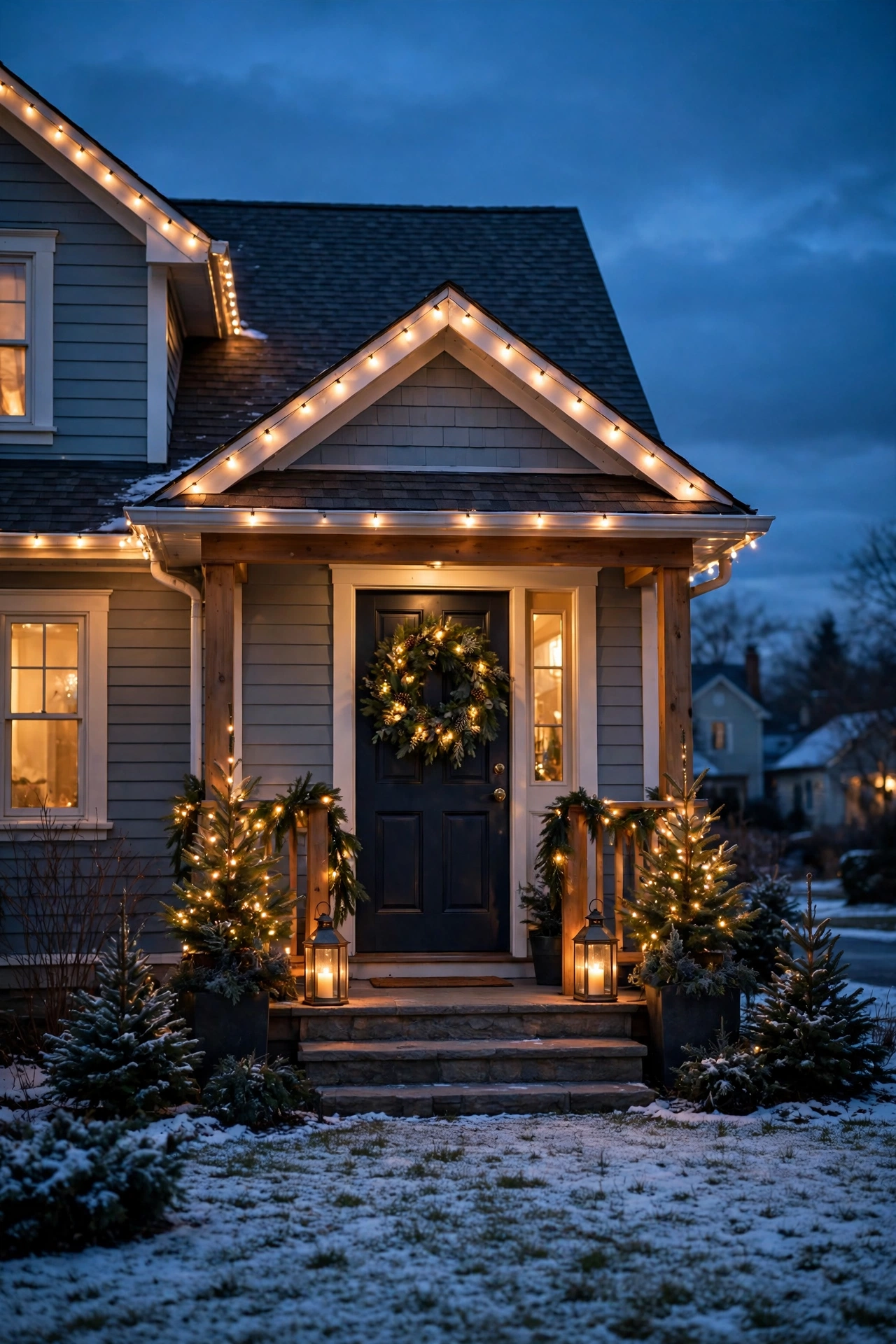
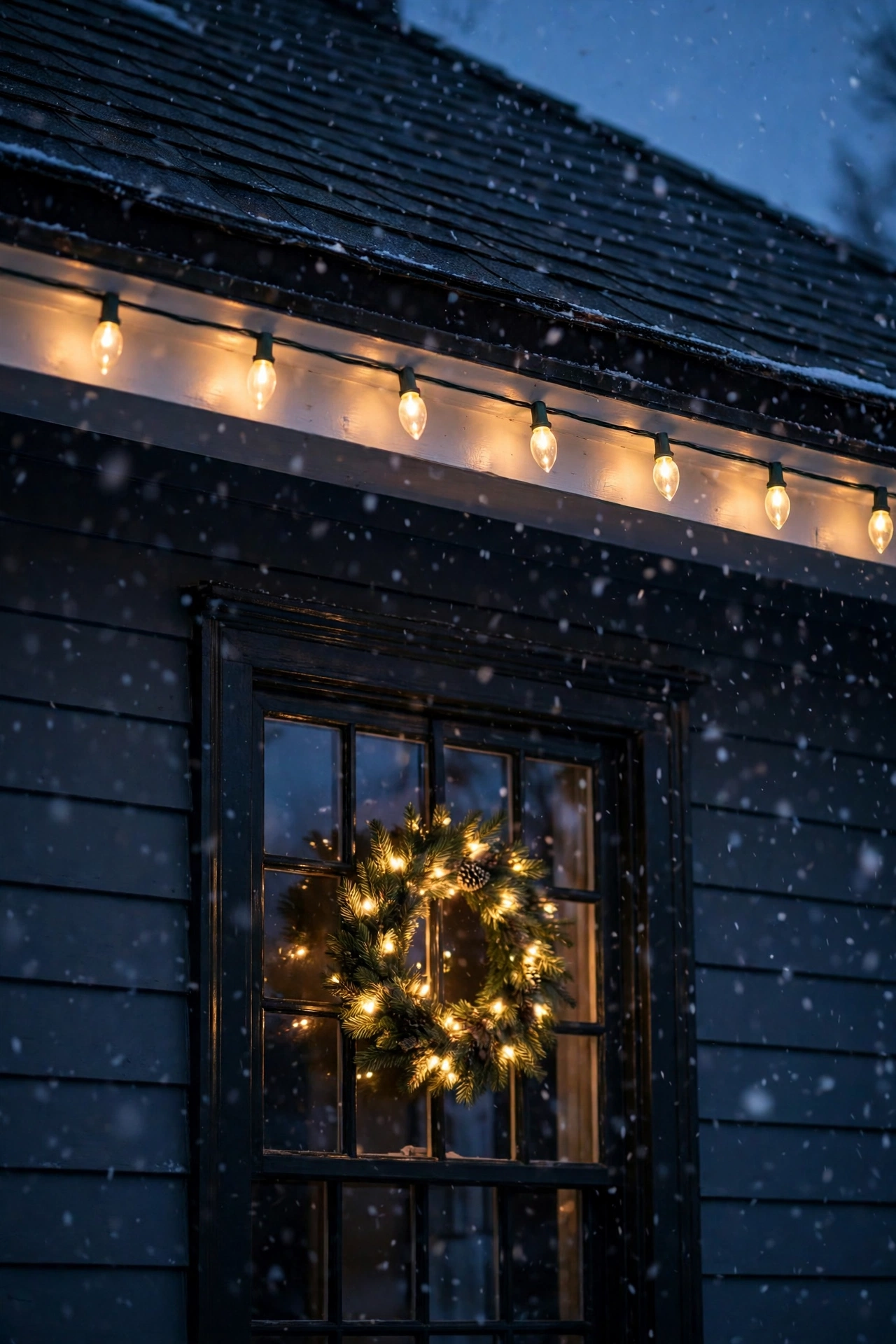
A single clean line of warm white lights along the roofline instantly frames the house and makes every other decoration read better after dark. Large C9 bulbs give the cleanest, most classic glow and read as professional from the street. Mini lights work too, but they need more strands to make the same line, so C9 is the simpler choice for a first roofline.
Use clips, never nails or staples. All-in-one plastic clips grip the shingle edge or the gutter without piercing anything, and they hold the bulbs in a straight line. Hang the strand with the bulbs pointing out and slightly down so the glow washes the wall below. Work in daylight, on a dry day, with a stable ladder and a helper holding the base. Never hang lights in the rain, and never stand on the top two rungs of a ladder.
Buy lights labelled specifically for outdoor use, with sealed, weatherproof connectors and UL rated wiring. LED strands handle moisture and temperature swings better than older incandescent sets, they use far less energy, and they run cooler, which matters when a strand rests against dry garland or a wooden eave. A 100 foot LED string uses about 8 watts, so a whole roofline costs very little to run all December.
Keep the roofline to one run and stop there. The roofline is the anchor, not the whole show. If you light everything at once, the house looks busy and nothing stands out. Pick the roofline as the hero element and let the entry, the walkway, and the yard support it.
Section 3: Dress the Entry, Wreath, Garland and Planters
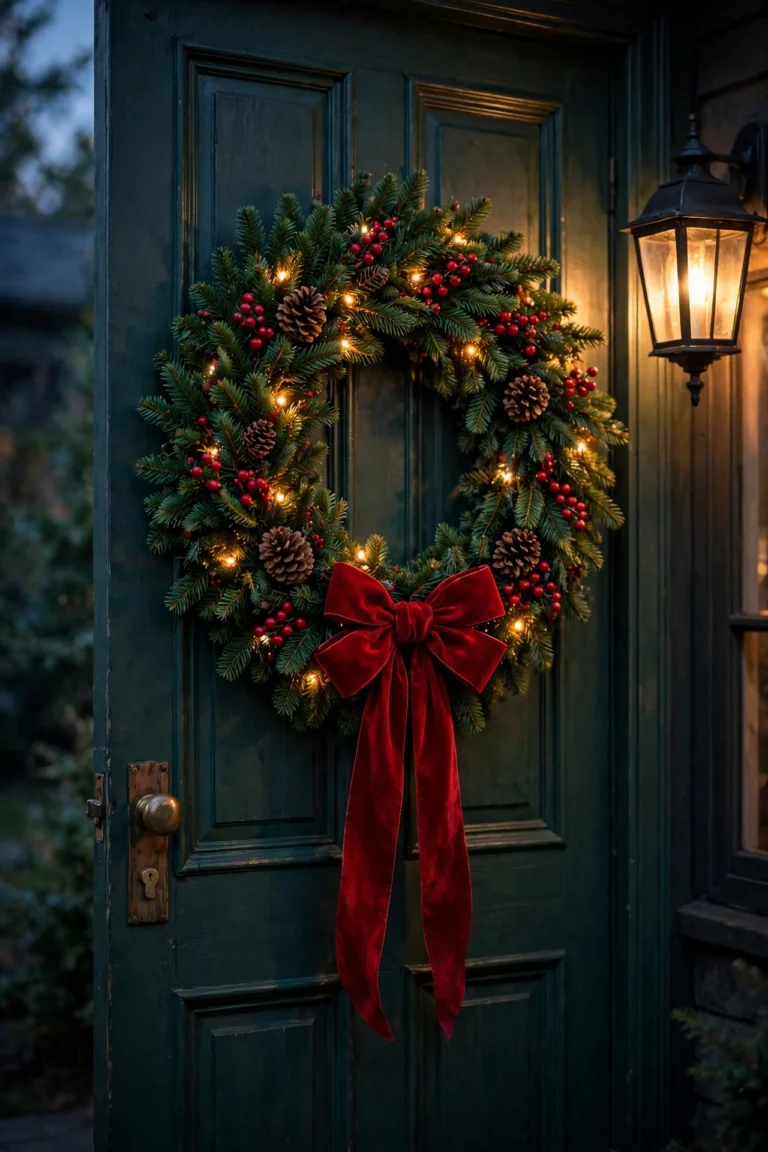
The entry is where guests slow down, so it deserves the most care. Start with a lit wreath centred on the door, at eye level, wired on in two places so wind cannot spin it. A wreath should fill half to two thirds of the door. Anything smaller disappears, and anything larger fights with the door frame. Our full porch guide covers wreath sizing, garland lengths, and lantern placement in detail, so start there if the porch is your main project. The same layered approach works inside too, and our Christmas Fireplace Decor Ideas guide shows how to carry it across the mantel, hearth and firebox.
Wrap the porch columns or the railing with lit garland. One full garland on the railing, fixed in three places, with warm battery lights tucked inside, turns a plain porch into a welcome. Our Christmas Garland Ideas guide covers lengths and hanging tips for every spot, so measure the rail before you buy the strand. If the porch is covered, cafe lights strung across the ceiling in two crossed passes turn the overhang into an outdoor room. G40 or S14 bulbs read cozier than mini string lights when you are up close.
Fill tall planters with evergreens and birch logs. A tall planter on each side of the door, filled with evergreen branches, red berries, and a few birch stems, gives height without taking floor space. Add one warm light inside each planter, a small battery strand or a single lantern, and the planters glow after dark. Weigh planters down with a brick or a bag of stones at the base so a winter storm cannot topple them onto the steps.
Put two lanterns with warm battery candles on timers, one on each side of the door. Three or five black metal lanterns of graduated heights up one side of the steps is the shortcut to an expensive looking entry on a small budget. Warm white only, never cool white, and never a real flame near dry greenery.
Section 4: Light the Walkway So Guests Find the Door
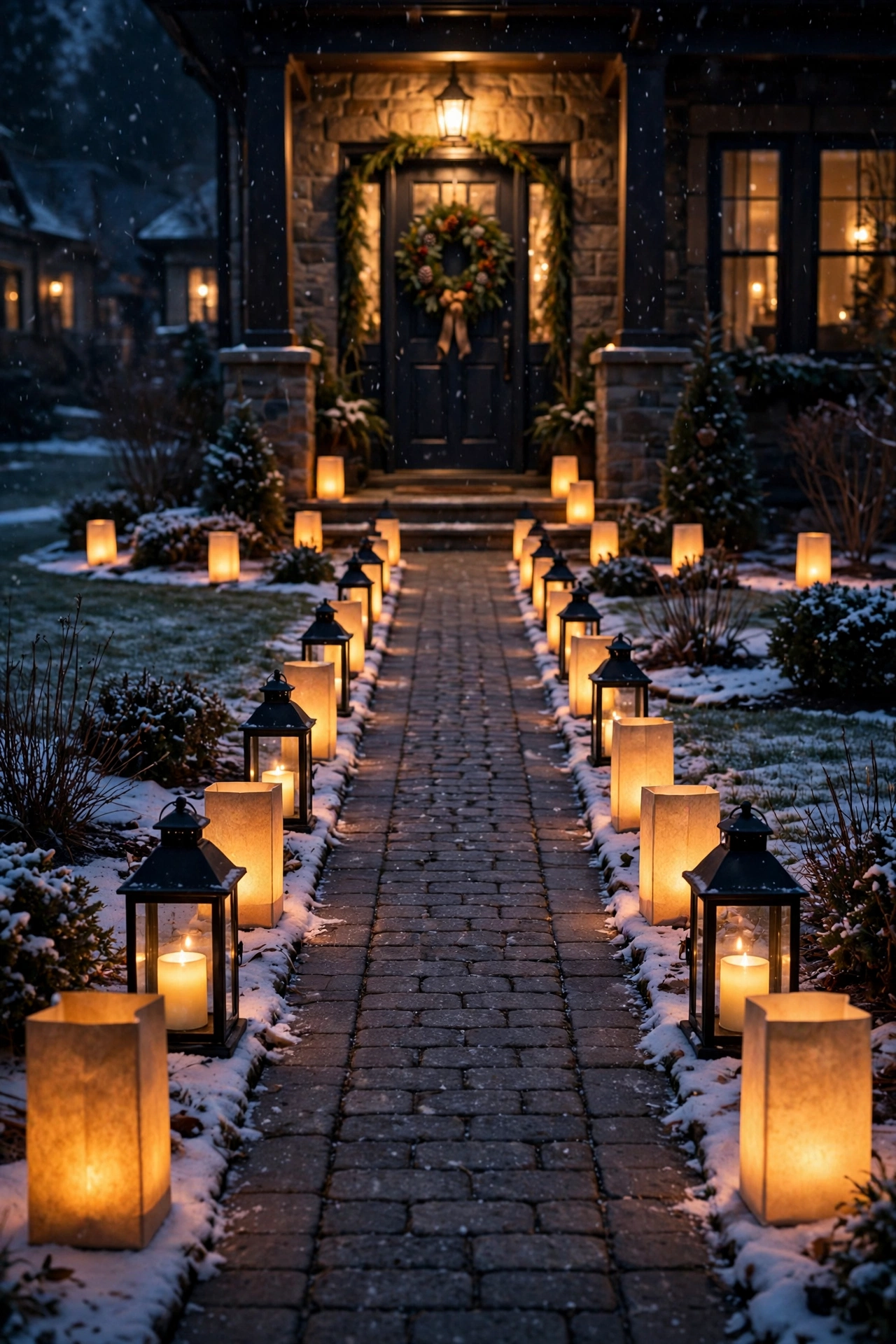
The walkway is the most practical zone and the one people forget. Line the walk with stake lights or short path lights, then add one warmer layer on top. Luminarias, paper bags with sand and a battery candle inside, placed along the path edges, guide the eye and the feet straight to the door. They cost almost nothing, they take ten minutes to set out, and they photograph beautifully. For a sturdier version, use mason jar luminaries or metal lanterns in the same spacing.
Keep the brightest lights at the entry so guests know where to go. The walkway lights should be softer than the porch lights, not brighter. If the path lights outshine the door, the door disappears and the whole display loses its focus. One light colour, the same warm white as the roofline, keeps the path and the porch reading as one display.
Keep cords off the walkway. Run extension cords along the lawn edge or under a cord cover, never across the path where a guest can trip in the dark. Use only outdoor rated extension cords, keep every connection off the ground and out of puddles, and plug everything into a GFCI outlet. If a connection has to sit outside, wrap it in a weatherproof connection box, which costs a few dollars and saves a tripped breaker on a wet night.
Light the mailbox too, if you have one. A small wreath on the mailbox, a wrap of garland, or a single strand of lights turns the far end of the walkway into part of the display instead of a dark gap. It is a five minute job and it ties the street end of the property to the door.
Section 5: Yard Pieces That Survive Wind, Rain and Cold
Yard pieces are where displays often go wrong, because anything sitting on a lawn has to face real weather. Choose items rated for outdoor use, anchor every piece, and keep the number low. One or two good pieces beat six wobbling ones.
Life size illuminated wire deer are the classic yard piece. A trio of pre-lit wire reindeer grazing under a bare tree, all facing the same direction, is the piece neighbours mention year after year. Stake each one down with the supplied stakes plus one extra, and face them toward the street so the shape reads from the road. A single deer looks lost, and three look like a scene.
Chicken wire light spheres in a cluster of three are the best DIY yard piece. A roll of chicken wire, three warm white strands, and an afternoon makes three lit spheres in graduated sizes. Group them near the front walkway, in odd numbers, and they read as sculptural even in daylight. Hang them from a tree branch instead, and they become glowing ornaments at eye level.
Inflatables are the fastest big statement, and the easiest to get wrong. One inflatable, well anchored with all its stakes and sandbags, looks cheerful. Three inflatables crowded together look like a sale lot. Pick one, give it space, and run its fan on the same timer as the rest of the display so it is not humming all night. A 12 foot inflatable uses around 30 watts, so the running cost is small, but the visual cost of a second one is high.
Whatever you choose, wire everything twice and weigh it down. Wind is the enemy of every yard display. Stake, sandbag, or weigh down pots, lanterns, deer, and spheres before the first storm, and check the anchors after the first windy night. Bring cushions and lightweight pieces inside before a storm, and keep the walkway clear of cords, stakes, and guy lines.
Section 6: Trees, Shrubs and the Vertical Layers
Trees are the workhorse of any yard display, because they fill the vertical gap between the roofline lights and the ground pieces. Wrap trunks and main branches on the trees closest to the house, working from the bottom up, with the strand spaced evenly so the light climbs the tree instead of bunching at the base. Icicle lights hanging from lower branches add a soft, snowy effect even without real snow.
Hang glowing light balls or Moravian stars from bare branches. Group stars in odd numbers and space them randomly through a large tree, and the whole tree glows from the inside. Oversized ornaments made from globe shades or food storage bowls, wrapped with string lights and clustered in odd numbers on the lawn, give the same effect at ground level.
Do not forget the shrubs. Wrapping a shrub in a single net of warm white lights takes five minutes and turns a dark green blob into a glowing shape. One colour, one net per shrub, and stop. Two colours on one shrub looks like a mistake, and a half wrapped shrub looks unfinished. If a shrub is near the walkway, light it, because it frames the path. If it is far from the house, leave it dark and let the eye rest.
Birch log clusters wound with fairy lights are the simplest vertical piece of all. Three or four birch logs, stood upright in a planter or a bucket of stones, wrapped with one battery strand, give a tall, narrow glow that fits a small yard, a balcony, or a porch corner. They cost little, they store flat, and they look good from November to January.
Section 7: Small Front Yard Christmas Decor, Less Space, Same Glow
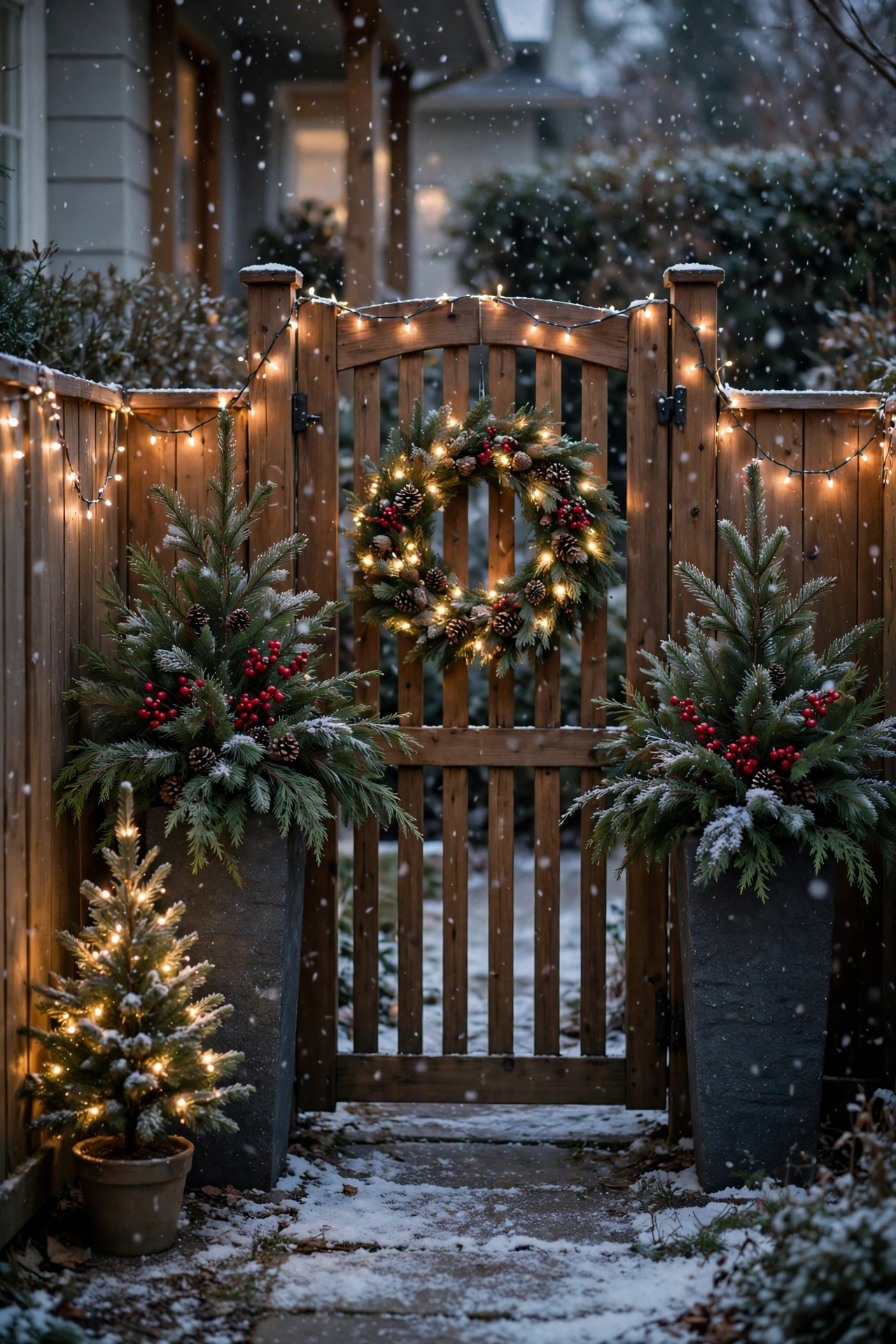
A small front yard is easier, not harder. The golden rule is the same as indoors: decorate up, not out. One small lit evergreen tree, two tall planters, and a wreath on the gate give a small yard the same glow as a big display, with nothing blocking the walkway.
Start with one tree, not three. A single small evergreen, real or artificial, in a weighted planter near the door or the gate, wrapped in one strand of warm white lights, is the focal point. Everything else supports it. If the yard is tiny, skip the lawn pieces entirely and put the tree in the brightest spot, where the street can see it.
Use the gate and the fence as your second surface. A lit wreath on the gate, a swag of garland along the fence rail, and one strand of lights on the fence line give a small yard a finished edge without using a single square foot of lawn. Hang the wreath at eye level and wire it on in two places, the same as a door wreath.
Keep the walkway clear and let one grouping do the work. One grouping, a tree, a planter, and a lantern, placed to one side of the walk, with the other side left empty, looks curated instead of crowded. A clear walkway matters more in a small yard, because there is nowhere else to step. If you have a rented townhouse entry or a small stoop, the same formula works: wreath, one planter, one lantern, done.
Renters can do all of this without a single nail. Adhesive hooks rated for outdoor use, freestanding planters, battery lights, and a tree in a pot leave no marks and pack away in one box in January. The landlord never needs to know, and the deposit stays safe.
Section 8: Budget, Timing and Safety, the Practical Finish
Most homeowners install lights in early to mid November and remove them by mid to late January, and that timing is worth following. Installing early means working in daylight on dry days, not on a ladder in a December storm. Taking them down in January, while the memory of how they went up is fresh, makes next year faster. Label every strand and every box by zone as you pack it away, and next December starts calm instead of chaotic.
Three honest budgets cover almost every home. Under 50 dollars: one warm white roofline strand, one wreath, and a set of luminarias for the walkway. Under 100 dollars: add two planters with evergreens, two lanterns with battery candles, and a timer. Under 200 dollars: add a trio of wire deer or a set of light spheres, a lit garland for the porch rail, and a second timer. Every one of these budgets buys a display that looks planned, because the money goes to one palette and one focal point, not to a cart full of unrelated pieces.
Safety is not optional outdoors. Use only outdoor rated lights, cords, and timers. Keep every connection dry and off the ground. Plug into GFCI outlets only. Keep lights and cords clear of gutters full of dry leaves. Never use indoor extension cords outside, never overload one outlet with a chain of adapters, and never leave a damaged strand in service. If a strand has a cracked socket or exposed wire, throw it away, because a ten dollar strand is never worth a fire.
Put every light on a timer. One weatherproof outdoor timer per zone, set to come on at dusk and off at 11 pm, saves electricity, saves the nightly walk to the plugs, and gives the house the same warm glow every evening without fail. Timers are the single upgrade that changes the whole display, and they cost less than one strand of lights.
Conclusion
Christmas outdoor decor is not about how much you buy, it is about how clearly you plan. One light colour, one focal point, three zones in order, and everything on a timer. Start with the roofline, dress the entry, light the walkway, then add one yard piece that can survive the weather. If your yard is small, do the same plan smaller: one tree, two planters, a wreath on the gate, and a clear walkway.
Start tonight with the smallest possible step. Walk the property, count the outlets, measure the roofline, and pick your one light colour. That ten minute walk is the whole plan, and everything after it is just hanging lights in the order you already decided. The street will notice, the guests will feel it, and you will see it every evening when you come home.
Quick Start Checklist
- Walk the property, count outdoor GFCI outlets, measure roofline, walkway and trees
- Pick one light colour, warm white 2700K to 3000K, for the whole exterior
- Roofline first, one clean C9 line, clipped not nailed, on a timer
- Entry next, wreath, garland, planters, two lanterns with battery candles
- Walkway, luminarias or stake lights, cords off the path, brightest at the door
- Yard, one or two anchored pieces, deer trio or three light spheres
- Small yard version, one tree, two planters, wreath on the gate, clear walkway
- Everything on weatherproof timers, dusk to 11 pm, install early to mid November