Christmas Tablecloth Ideas That Set the Whole Table
A Christmas tablecloth is the fastest way to turn an ordinary dining table into a Christmas table. Before a single plate goes down, before the candles are lit, before the greenery is laid out, the cloth does the work. It sets the colour, it sets the mood, and it tells everyone walking into the room that this meal is not an ordinary Tuesday dinner. One piece of fabric, and the whole table changes. I learned this the year I hosted Christmas dinner on a table that had seen better days. The wood was scratched from years of homework, hot mugs and moving house, and I did not have the money for a new table. I bought a red plaid tablecloth, the cheapest proper one I could find, spread it over the table, and the scratches disappeared. Guests complimented the table. Nobody knew the cloth was doing a repair job as well as a decorating job. That is the honest appeal of a tablecloth. It covers what you want to hide, it protects what you want to keep, and it makes the whole room look dressed without a single other purchase. A tablecloth also does practical work that a bare table cannot. It protects the wood from hot dishes and candle wax, it muffles the clatter of plates and cutlery so dinner sounds softer, and it hides a table that does not match the chairs, the room, or the occasion. A runner dresses the middle of a table. A tablecloth dresses the whole table, edge to edge, and that is why it is the first decision to make when you plan a Christmas table. This guide covers the tablecloths that work best at Christmas, the sizing rule that stops a cloth looking wrong, how to layer a runner on top of a cloth, and the care that keeps a good cloth looking good for years. Whether your table seats four or fourteen, whether it is round, rectangular or a kitchen table pressed into service, there is a tablecloth idea here that fits it. For the middle of the table, our Christmas table runner guide pairs with everything here, and our Christmas dining table guide covers the full table plan.
Start With the Sizing Rule, Not the Shopping
Every tablecloth mistake I have ever made came from buying the pretty one first and measuring second. A cloth that is too small leaves the table corners showing like a shirt that does not fit. A cloth that is too big pools on the floor and catches on chairs, shoes and small feet. A cloth with the wrong drop looks either skimpy or sloppy, and no amount of candles will fix it. Get the size right first and every style choice after it gets easier. The drop is the part of the cloth that hangs over the edge of the table, and it is the number that matters most. For a casual family Christmas dinner, the drop should be 8 to 12 inches all round. That is enough to look generous and finished, and short enough that nobody sits on it or trips over it. For a formal Christmas dinner, the drop can go to 15 inches, which looks elegant and hides the table legs completely. A floor length cloth, where the fabric reaches the floor, is the most formal option of all, and it suits a large dining room where the table is a showpiece. It is not a good choice for a table where children eat, because the cloth becomes a curtain that small hands pull. Measure your table before you shop, in inches, and write the numbers on your phone. A rectangular table needs length and width. Add twice the drop you want to each number. A table that is 72 inches long and 40 inches wide, with a 10 inch drop, needs a cloth that is 92 by 60 inches. Ready made cloths come in standard sizes, so pick the one closest to your numbers and let the drop be a little generous rather than a little short. A cloth that is two inches too long looks fine. A cloth that is two inches too short looks like a mistake. For a round table, measure the diameter and add twice the drop. A 48 inch round table with a 10 inch drop needs a 68 inch round cloth. Round cloths are harder to find in shops than rectangular ones, so check the size before you fall in love with the pattern. A square cloth on a round table can work if the square is large enough that the corners hang evenly, but a proper round cloth always looks better, because the hem falls in one smooth line with no corners to catch. There is one more measurement worth taking before you buy: the height of your centrepiece. A tablecloth invites you to build up the middle of the table, and that is exactly where the sightline problem starts. Sit down at the table and look across it. If you cannot see the person opposite, the centrepiece is too tall, not the cloth. Keep greenery low and let candles carry the height instead, because candle flames are thin and light passes around them. Our Christmas centerpiece guide uses the same low and clear rule, and it works on a cloth just as well as it works on bare wood. Buy the cloth after you measure, not before. Write the two numbers on your phone, length and width or diameter, and check them against every cloth you consider. A beautiful cloth in the wrong size will never look right, and a plain cloth in the right size will always look intentional.
The Classic Red Plaid Tablecloth
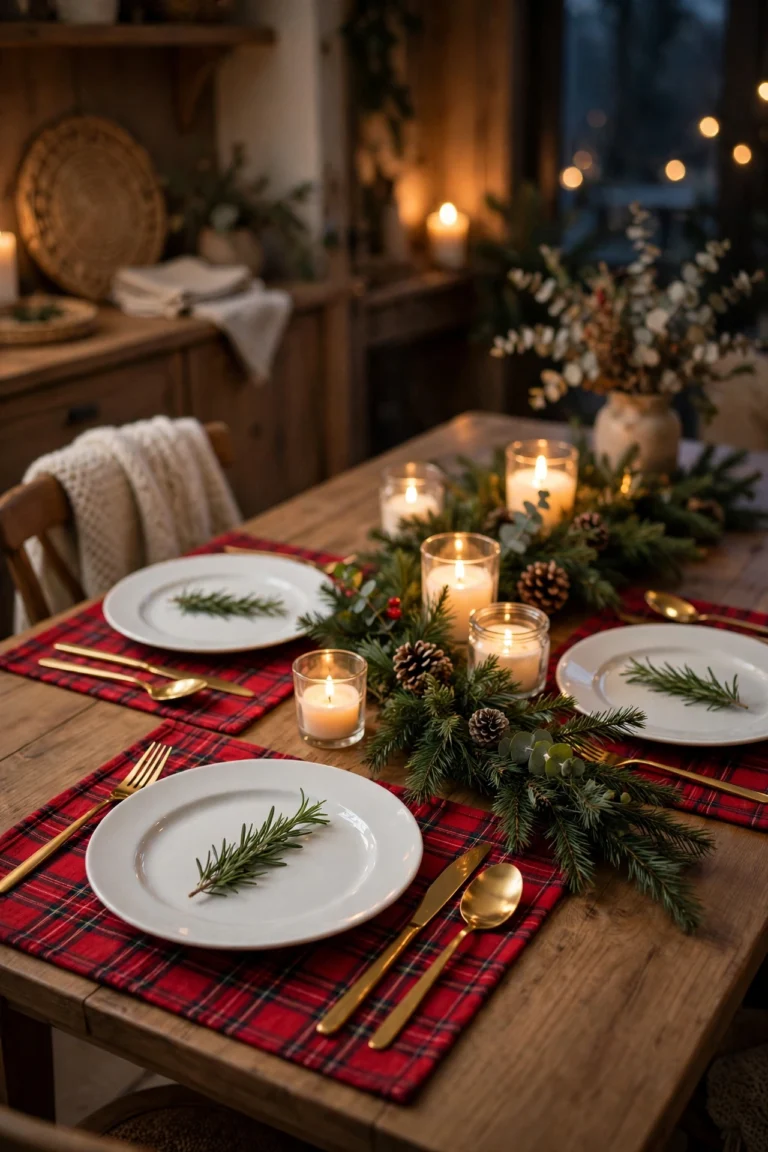
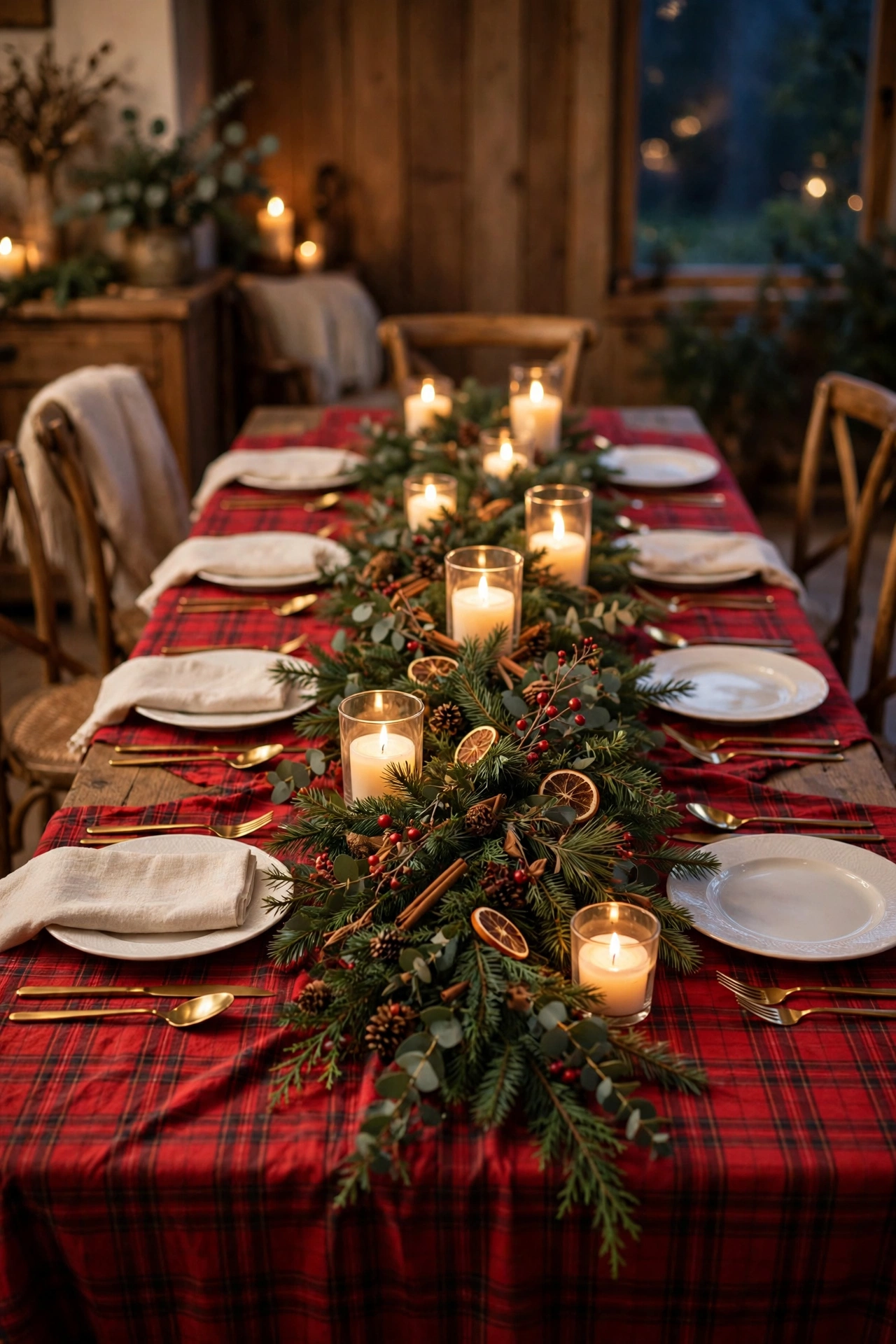
If you only buy one Christmas tablecloth in your life, make it a red plaid one. This is the golden idea in this guide, and the one that gets searched for most, because red plaid is the pattern that reads as Christmas from across the room without a single ornament on the table. It hides stains, it suits wood, white plates, gold cutlery and green glassware all at once, and it makes a plain dining room feel like a Christmas dining room in the time it takes to spread it out. The best red plaid tablecloths are woven, not printed. A woven plaid has the pattern in the threads, so the colours look deep and the fabric has a soft weight that lies flat and stays put. Printed plaid on thin polyester looks shiny under candlelight and slides around when someone reaches across the table. If you can, choose cotton, wool blend or linen in plaid. These fabrics grip the table slightly, they wash well, and they look better every year as they soften. A cotton plaid cloth is the workhorse of Christmas tables, and it is the one I recommend first to anyone buying their first Christmas tablecloth. Style a red plaid tablecloth with restraint, because the pattern is already doing a lot. Plain white plates, plain glasses and one metal, gold or brass, are all it needs. Add a low garland of fresh or faux greenery straight down the middle, pinecones tucked in at intervals, and three candles in glass holders at different heights. That is a complete Christmas table. The plaid gives the colour, the greenery gives the texture, the candles give the light, and nothing competes with anything else. For a family table with children, red plaid is the practical choice too. Spills wipe off a cotton plaid cloth, red wine does not show on a red pattern the way it shows on cream linen, and a plaid cloth that comes out of the wash slightly creased still looks good, because plaid is a relaxed pattern. Iron it if you like, but do not iron it because you think you must. A plaid tablecloth looks like a farmhouse table, and a farmhouse table is allowed to look lived in. One caution: plaid is so strong that it fights with other patterns. If your tablecloth is plaid, keep the napkins plain, the placemats plain, and the plates plain. One pattern per table is the rule that keeps a plaid table looking styled instead of busy. If you love pattern, put it on the tablecloth and nowhere else. A runner in a solid colour, deep green or cream, can sit on top of a plaid cloth, but a patterned runner on a patterned cloth is a fight, and the table loses. Red plaid also comes in softer versions that suit a calmer room. A red and cream plaid, sometimes called a grandmillennial tartan, keeps the Christmas feeling with less contrast. A navy and red plaid suits a dining room with dark wood. A burgundy and cream plaid looks richer and moodier than bright red, and it pairs beautifully with amber glass and dark greenery. The pattern is the same, the feeling changes with the colours, so pick the version that matches your room rather than the version that matches a photo.
Deep Green and Jewel Tone Velvet
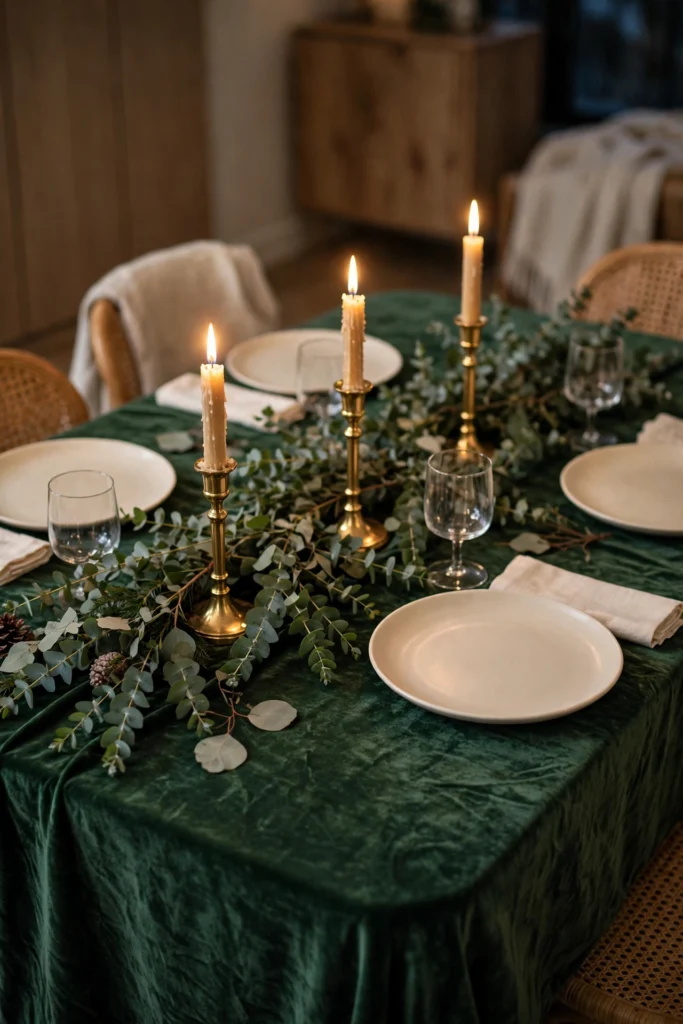
A deep green velvet tablecloth is the most elegant option on this list, and the one that photographs best under candlelight. Velvet catches light in a way no other fabric does. The pile shifts from dark green to almost black as the light moves across it, so the table looks alive even before a single candle is lit. It is the cloth to choose when the dinner is a proper occasion, a Christmas Eve meal, a formal family gathering, or a table you want guests to photograph. Velvet works best as a single bold statement. A green velvet cloth needs very little on top of it, because the fabric is the decoration. Gold candlesticks, not glass votives. Cream or ivory plates, not patterned Christmas plates. A few sprigs of eucalyptus or cedar laid flat along the middle, not a thick garland, because velvet already has the weight and the greenery should be a light touch on top. A string of warm fairy lights woven loosely through the greenery adds the sparkle that velvet alone does not give. Keep the lights battery operated and the battery pack hidden under the cloth at one end, out of sight and away from any plate. Jewel tones beyond green work the same way. A burgundy velvet cloth looks rich and warm with brass and cream. A sapphire blue velvet cloth looks striking with silver and white, and it suits a Christmas table that leans modern rather than traditional. A deep plum cloth with gold is the most dramatic of all, and it works best in a dining room with warm light. The rule for all of them is the same: one jewel tone, one metal, plain plates, low greenery. Let the colour carry the table. Velvet has two practical weaknesses to plan for. The first is that it shows every crumb and every drip, especially in a dark green. Keep a lint roller in the kitchen on Christmas Day and give the cloth a quick roll before guests sit down. The second is that velvet does not like water. A spilled glass will mark it, so use coasters under glasses or accept that this cloth is for the adult table, not the children table. Most velvet tablecloths are dry clean only, so check the label before you buy, and do not put a velvet cloth in the washing machine on a guess. If the budget allows, buy velvet in a proper weight. Thin velvet looks flat and creases into sharp lines. A medium weight velvet with a soft backing drapes over the table ends in a gentle curve and lies flat in the middle. Hold it up in the shop if you can. If it falls in soft folds, it is right. If it stands stiff or flops like paper, it is not worth the price. A good velvet cloth costs more than a cotton one, but it only needs to be bought once, and it will come out every Christmas for years.
Crisp White Linen and Winter White
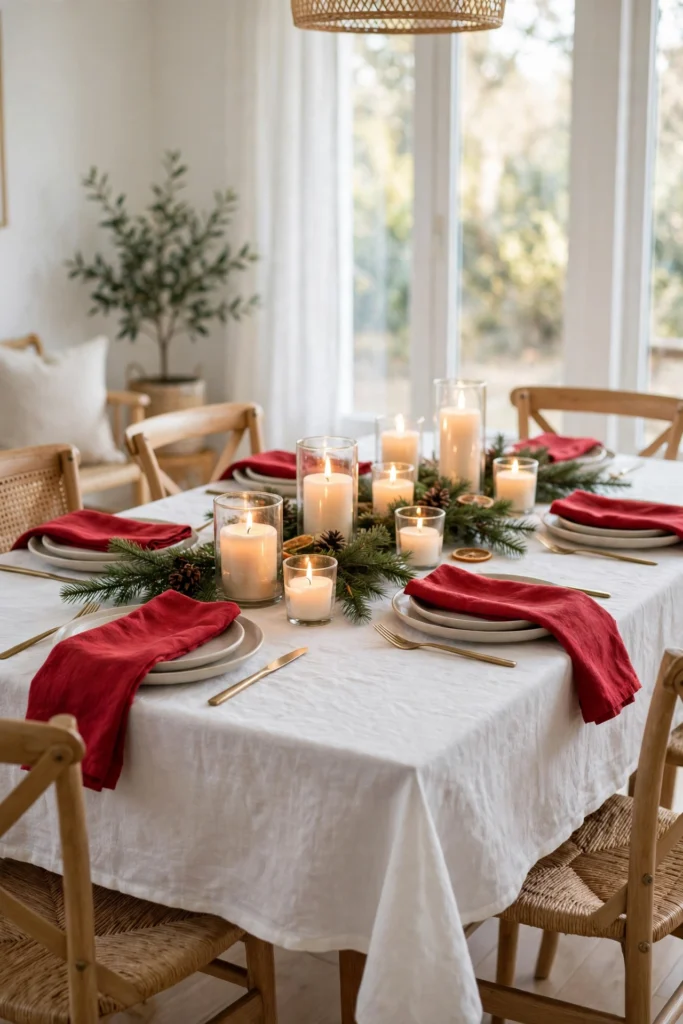
A white linen tablecloth is the quietest choice on this list, and the one that makes everything else on the table look better. White is a blank page. It makes red napkins look redder, green garlands look greener, gold candlesticks look richer, and candlelight look warmer. If your Christmas decorations are the stars, and the cloth is the stage, white linen is the stage to choose. White linen suits a formal Christmas dinner best, but it also suits a relaxed one, because the styling changes with what goes on top. For a formal table, use a full length white linen cloth, gold or silver chargers under white plates, tall taper candles in proper holders, and a low garland of cedar and white roses or white berries down the middle. For a relaxed table, use a shorter drop, plain white plates, red linen napkins, and a garland of fresh pine with pinecones and cinnamon sticks. The cloth is the same. The feeling changes with the layers. Linen has a texture that cotton does not. The slight slub in the weave, the way it softens with every wash, the way it holds a crease if you iron it and forgives you if you do not, all of it says quality without saying expensive. A linen cloth does not need to be pure linen to look the part. A linen look cotton, or a cotton linen blend, gives most of the texture at a much lower price, and it is easier to wash. Pure linen is the luxury version, and it is worth it if the table is a showpiece, but a blend is the sensible version for a family table. The honest problem with white is stains. Red wine, gravy, cranberry sauce and candle wax all show on white, and Christmas dinner has all four. There are two ways to handle this. The first is to accept it and treat the cloth as a working cloth, not a museum piece. Soak stains in cold water the same night, before they set, and most of them come out. The second is to protect the cloth where the risk is highest. Placemats under plates, coasters under glasses, and a runner down the middle where the serving dishes sit, all keep the worst of the meal off the white. A runner over a white cloth is not just decoration, it is armour, and Section 6 covers it in full. Winter white is the softer version of this idea. A cream or ivory cloth, rather than a bright white one, looks warmer in candlelight and shows stains a little less. It suits a farmhouse table, a cottage dining room, and any room with warm wood. Pair winter white with natural textures, a burlap runner, wooden chargers, pinecones and plain greenery, and the table looks like a country Christmas without trying hard. Pair bright white with gold and glass, and the table looks like a city Christmas. The cloth is the same shape. The colour temperature is the choice.
Rustic Farmhouse: Burlap, Linen and Buffalo Check
A farmhouse Christmas table is built on texture, not shine, and the tablecloth is where that texture starts. Burlap, natural linen and buffalo check are the three fabrics that define this style, and they all share the same honest quality: they look handmade, they feel natural, and they forgive a busy family dinner. A natural linen cloth in an unbleached oatmeal or flax colour is the most versatile farmhouse base. It has the soft slub of linen, the warm tone of undyed fabric, and it pairs with almost anything. Lay it on a wooden table, add a plaid runner down the middle, wooden chargers, white plates, and a garland of fresh greenery with pinecones and red berries, and the table is done. The linen gives the warmth, the runner gives the colour, the greenery gives the Christmas. Nothing on the table needs to be expensive, because the textures are doing the work that shine does on a formal table. Buffalo check is the farmhouse pattern, and it is bolder than the small plaids in Section 2. The large red and black squares, or red and white squares, read as Christmas from across the room, and they suit a relaxed table where the mood is cheerful rather than formal. A buffalo check cloth works best in a kitchen or a dining room with wood furniture and simple plates. Keep the rest of the table plain, white plates, plain glasses, one green garland, because the check is already loud. Buffalo check also comes in black and white, which looks striking with red napkins and green garland, and in green and white, which is calmer and suits a smaller room. Burlap as a full tablecloth is the most rustic choice of all, and it is not for everyone. A burlap cloth is rough, it sheds fibres when new, and it smells like a farm store until it has been aired. But on a farmhouse table, with a lace runner over the middle, wooden chargers and jar candles, it looks like a Christmas table from a storybook. If a full burlap cloth feels like too much, use burlap as a runner over a plain linen cloth instead. You get the texture without the shedding, and the table is easier to clean. A jute cloth is burlap’s slightly smarter cousin, woven tighter, shedding less, with a cleaner edge, while keeping the same natural look. There are two things to know before you buy a farmhouse cloth. The first is the smell. New burlap and new natural linen both carry a strong smell from the mill. Air the cloth outside for a day or two before Christmas, or wash it once on a gentle cycle if the label allows, and the smell fades. The second is shedding. Natural fibre cloths drop fibres when new. Shake the cloth outside before you lay it on the table, and keep plates on wood or placemats rather than directly on the cloth where fibres can drift into food. Let the cloth be the base, and let the plates sit on something solid. Farmhouse cloths are also the cheapest good cloths you can buy. A cotton buffalo check cloth, a natural linen cloth, or a burlap runner all cost a fraction of a velvet cloth, and they are the cloths I recommend first to anyone decorating a Christmas table on a tight budget. A farmhouse table does not need to look expensive. It needs to look warm, and these fabrics are warm by nature.
Layering a Runner Over Your Tablecloth
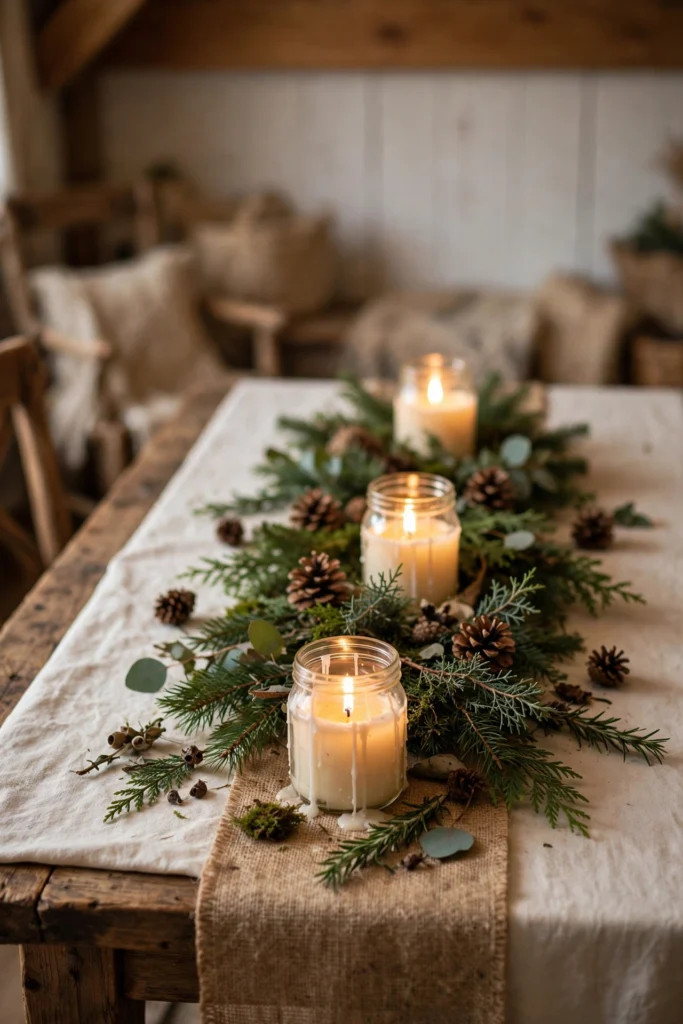
A tablecloth and a runner are not rivals. They are partners, and the best Christmas tables use both. The cloth sets the base colour and covers the table. The runner adds a second colour, a second texture, and a stripe down the middle that holds the greenery and candles. Layering is the skill that turns a dressed table into a styled table, and it is simpler than it looks. The rule is to contrast, not match. A runner in the same colour and fabric as the cloth disappears, and a runner that disappears is a wasted layer. A red plaid runner on a cream linen cloth is a classic pairing, because the cream lets the plaid shine and the plaid gives the cream its Christmas colour. A deep green velvet runner on a white linen cloth is the formal version of the same idea. A burlap runner on a red plaid cloth is the farmhouse version, where the rough texture of the burlap calms the bold pattern of the plaid. The cloth is the base, the runner is the accent, and the two should look different enough that you can see both at a glance. The runner on a cloth should be narrower than a runner on a bare table, because the cloth is already covering the width. About 12 to 14 inches wide is right for a standard table, and the overhang at each end should match the cloth or fall a little shorter. A runner that hangs further than the cloth looks like a mistake, so measure both before you buy. If your cloth has a 10 inch drop, let the runner hang 8 to 10 inches. The two layers should end in the same place, or close to it, so the table edge looks tidy from every seat. The greenery and candles sit on the runner, not beside it, because the runner is the stage. Lay a garland down the spine of the runner in a gentle S curve, not a straight line, because a curve looks styled and a straight line looks like a queue. Fluff the garland out until it looks twice as wide as it did in the packet, because a flat garland looks cheap no matter what you paid for it. Tuck pinecones, small oranges and cinnamon sticks into the greenery at intervals, in twos and threes, never in a perfect row. Use three heights of candle, tall tapers in holders, medium pillars in glass, and small votives tucked into the greenery, spaced unevenly so the table looks gathered rather than arranged. Our Christmas table runner guide covers the full layering method, and our Christmas centerpiece guide covers the low and clear rule that keeps the table practical. Safety is part of layering, not an afterthought. Keep every flame at least a hand width from any greenery, and never let a candle sit directly on a fabric cloth or runner. Candles go in glass holders or on a small plate, always. If your greenery is real and dry, it is flammable, so keep the candles in glass and never leave the table unattended with candles lit. Battery candles have become genuinely good in the last few years, and for a table with children or pets, they are the right choice. Use real candles for the look and battery candles for the places where a real flame is a risk. The last layering rule is about space. Leave the ends of the runner clear. The middle of the table is for decoration, the ends are for serving dishes, elbows and the bread basket. A runner that is decorated from end to end leaves nowhere for the food to go, and the food ends up on a sideboard while guests reach across a forest of greenery. Decorate the middle two thirds, leave the ends for the meal, and the table works as well as it looks.
Round Tables, Small Tables and Odd Shapes
A small table is not a problem for a tablecloth, it is a size to respect. The mistake people make with a small table is choosing a cloth with a big bold pattern that swallows the table and leaves no room for plates. On a table that seats four, the cloth should be a solid colour or a small pattern, cream, deep green, or a soft red, with one low centrepiece on it. A single tray with three candles and a few sprigs of greenery, sitting on the cloth, is a complete decoration. Skip the thick garland, skip the scattered pinecones, skip the second layer. One tray, one cloth, done. A round table needs a round cloth, and the sizing rule from Section 1 is the one to follow. Measure the diameter, add twice the drop you want, and buy the round cloth closest to that number. A round cloth in red plaid looks wonderful on a round kitchen table, because the pattern follows the curve and the hem falls in one smooth line. A round cloth in white linen with a red runner across the middle is the classic Christmas look for a round table, because the runner becomes a stripe and the centrepiece sits where the runner crosses the centre. A low bowl of ornaments, a small cluster of candles, or a tiny potted tree in the centre works better than a long garland, because a garland on a round table fights the shape of the table. Let the roundness win. A narrow table, like a breakfast bar or a console used as a dining table, suits a runner better than a tablecloth, because a tablecloth on a narrow table hangs like a curtain and gets caught on chairs. If you must use a cloth on a narrow table, choose a short drop, 6 to 8 inches, so the cloth does not swing into knees and chair legs. Choose a cloth in a light colour on a narrow dark table, or a dark cloth on a narrow light table, because contrast is what makes a narrow cloth visible at all. A cloth the same colour as the table disappears, and a cloth that disappears is a wasted decoration. For a table that has to work hard, a kitchen table where children do homework and adults eat dinner, choose a washable cotton cloth in a dark pattern. Plaid and dark green both hide stains, cotton washes easily, and a cloth that can go in the washing machine on Boxing Day is a cloth that will come out again next Christmas. The best cloth for a busy table is the one you are not afraid to use. A vinyl backed cloth is the extreme version of this idea. It looks like fabric from above, it wipes clean with a cloth, and it is the right choice for a table where spills are certain rather than possible. An odd shaped table, an oval, a pedestal, or a table with leaves that come out for Christmas, needs a cloth that can adapt. An oval table takes an oval cloth, or a rectangular cloth large enough that the corners hang evenly, which looks better than you might expect. A table with leaves needs a cloth measured with the leaves in, because the Christmas table is the full table, not the everyday one. Measure the table as it will be on Christmas Day, with every leaf in place, and buy the cloth for that size. A cloth bought for the everyday size will be too short on Christmas Day, and that is a mistake you only make once.
Care, Storage and the Mistakes to Avoid
A good Christmas tablecloth should last for years, and the difference between a cloth that lasts and a cloth that looks tired after one December is almost always care, not quality. Wash a cotton or linen cloth on a gentle cycle, cold water, and hang it to dry rather than tumble drying it, because heat is what shrinks and fades fabric. Iron it while it is still slightly damp, on the reverse side if it has a print, and fold it rather than hanging it, because a folded cloth keeps its shape and a hung cloth stretches at the fold. Store it in a breathable cotton bag or a clean pillowcase, not a plastic bag, because plastic traps damp and damp grows mildew over eleven months in a cupboard. Treat stains the night they happen, not in January. Red wine, gravy, cranberry sauce and candle wax are all easier to remove fresh than set. Blot wine with cold water and a little salt, never hot water, because hot water sets a wine stain. Scrape wax off with a blunt knife once it has hardened, then press the spot with a warm iron over brown paper to lift the rest. Soak a stained cloth in cold water with a little oxygen cleaner before it goes in the machine. A cloth that is treated on Christmas night will be clean by New Year. A cloth that waits until January will carry the stain into next Christmas. The mistakes to avoid are the ones that cost the most. Do not buy a cloth without measuring the table first, because the wrong size is the one mistake no styling can hide. Do not put a velvet cloth in the washing machine, because it will come out ruined. Do not use a white cloth on a table where children eat red sauce, because the cloth will not survive the meal. Do not iron a printed cloth on the printed side, because the heat can melt the print onto the iron. Do not store a damp cloth, because damp is the beginning of mildew. And do not leave candles burning on a fabric cloth when you leave the room, because a tablecloth is fuel and a flame is a flame. One last mistake is buying a cloth for a photo rather than for your table. A cloth that looks perfect in a shop or in a picture may be the wrong colour for your room, the wrong fabric for your family, or the wrong size for your table. Buy the cloth that fits your table, your family and your room, not the cloth that fits someone else’s photograph. The best Christmas tablecloth is the one that comes out every December, gets used, gets washed, gets folded away, and comes out again next year a little softer and a little more loved.
Conclusion
A Christmas tablecloth is the single purchase that changes a dining table the most, for the least money and the least effort. Measure the table, pick the drop, choose the fabric that suits your family, and layer a runner on top if you want the table to look styled rather than just dressed. Red plaid for the classic table, deep green velvet for the formal one, white linen for the table where the decorations are the stars, and natural farmhouse fabrics for the table where the meal is the point. Whichever you choose, treat it well on Christmas night, fold it away clean, and it will be waiting for you next December, a little softer, a little more familiar, and ready to set the whole table again.
FAQ
Q1 What size Christmas tablecloth do I need? Measure your table, then add twice the drop you want to each side. For a casual dinner, a drop of 8 to 12 inches is right. A 72 by 40 inch table with a 10 inch drop needs a 92 by 60 inch cloth. For a round table, measure the diameter and add twice the drop.
Q2 Is a red plaid tablecloth too busy for a small table? A large buffalo check can overwhelm a small table, but a small scale red plaid works well, because the pattern reads as texture rather than a statement. Keep the napkins, placemats and plates plain, and let the plaid be the only pattern on the table.
Q3 Can I put a runner on top of a tablecloth? Yes, and it is one of the best Christmas table looks. Choose a runner in a contrasting colour and texture, narrower than a runner on a bare table, with an overhang that matches the cloth or falls a little shorter. The greenery and candles sit on the runner.
Q4 How do I keep a white tablecloth clean at Christmas dinner? Use placemats under plates, coasters under glasses, and a runner down the middle where the serving dishes sit. Treat any stain on Christmas night with cold water before it sets, and wash the cloth on a gentle cold cycle.
Q5 Can I use a Christmas tablecloth on a round table? Yes, with a round cloth measured to your table. Measure the diameter, add twice the drop, and buy the closest round size. A red runner laid straight across the middle, with a low centrepiece at the centre, is the classic look for a round Christmas table.
Q6 Should I iron my Christmas tablecloth? Iron cotton and linen cloths while they are still slightly damp, on the reverse side if they have a print. Plaid and farmhouse cloths look fine with a light crease, so iron them only if you like a crisp finish. Never iron velvet, and never iron a printed cloth on the printed side.