Vintage Christmas Decor Ideas Full of Nostalgic Charm
The Christmas that most of us want to bring back is not a style. It is a feeling. Colored lights on a real tree, ornaments known since childhood, a room that glowed a little too warm, the smell of pine and cinnamon and candle wax, a mantel crowded with cards from people who are no longer here to send them.
Vintage Christmas decor attempts to rebuild that feeling in a modern home. It works best when you stop copying one decade perfectly and start collecting the pieces that carry a memory.
That distinction matters, because vintage decorating has two traps. The first trap is the museum trap: a room so full of old things that it feels like a shop, not a home, where nothing can be touched and nobody can relax. The second trap is the costume trap: buying a whole matching set of brand new retro look pieces in one afternoon, which looks the same in every house and carries no story at all. The real vintage look sits between those two. It is a few genuine old pieces, a few honest reproductions where the real thing is impractical or unsafe, and a lot of restraint, so the meaningful pieces have room to breathe.
This guide is built the way a real vintage room is built, one layer at a time. You will start with the palette and the era, because vintage is not one look: a 1940s Christmas, a 1950s Christmas and a 1970s Christmas are three different rooms, and picking one keeps the whole house coherent.
Then the tree, dressed the way childhood trees were dressed, with retro glass ornaments in saturated jewel tones, tinsel in careful doses, and a classic star or angel on top.
Then the small heroes that do the nostalgic work for almost no money: the ceramic tree, bottle brush trees, a village on a sideboard.
Then the light, because the fastest route back to childhood Christmas is warm multi tone light at every height, and the safety rules that matter when old wiring is involved.
Then the mantel, where old cards and family photos become the decorations.
Then the table, with plaid, milk glass and Santas.
Then how to thrift, inherit and make the pieces yourself, and finally how to keep a vintage room from tipping into clutter, including the rules for children, pets and small homes.
Most of these ideas cost very little. Many cost nothing, because the best vintage pieces are already in your house: a box of ornaments in the attic, a stack of old cards, a ceramic tree from a grandparent, a tablecloth folded in a drawer for twenty years. The work is not buying. The work is choosing, placing, and knowing when to stop.
What Makes Decor Look Vintage, Palette and Era First
I have seen vintage rooms that feel confused because people skip the first decision. Vintage Christmas decor starts with a choice that many people skip, which is why many vintage rooms feel confused. Before you buy or unpack anything, pick an era and a palette. Vintage is not one look. The 1940s and 1950s Christmas featured colorful glass ornaments, restrained tinsel, bottle brush trees, handmade paper decorations, and Santas with rosy cheeks, a cheerful, family-centered room in cranberry red, evergreen and cream. The 1960s and 1970s Christmas was bolder: light-up ceramic trees, bubble lights, metallic finishes, warm amber, avocado, red and gold, one bold focal point that carried the whole room. A room that mixes all of those eras at once reads as a jumble sale, not as nostalgia. A room that picks one era and repeats it reads as a memory.
Vintage style needs a palette rule that is simple and strict. Pick three colors before you buy anything, and repeat those colors everywhere. The classic vintage palette uses cranberry red, evergreen and cream. It is the easiest vintage palette, because it works in every room, and most pieces you already own will fit it. Brass, silver or warm walnut can finish the look. Another option is the pastel vintage palette: soft pink, mint, cream and silver, which suits a smaller room and a tree with glass ornaments in pastel hues. A third option is the deep jewel palette: ruby, emerald, sapphire and gold, which is the richest and needs the most restraint, because jewel tones go loud fast. Whatever palette you pick, stay committed. Use three colors, one metal, repeated in the tree, the mantel, the table and the wrapping paper. Repetition makes a room look intentional, not accidental, and it also makes a small budget look generous.
The next question is whether to use real pieces or reproductions, and honesty helps here. Authentic vintage generally means an older object from a past era, while antique is normally reserved for pieces that are at least a century old. Retro often describes a playful revival of a recognizable recent period, such as the colorful ornaments and molded decorations associated with mid-century holidays. A real box of Shiny Brite ornaments from the 1950s is a treasure, and it deserves a place where it can be seen, not hidden in a box. But a real ornament is also fragile, sometimes made with materials that are not safe around children, and often impossible to replace. A modern reproduction in the same colors gives you the look without the worry, and nobody standing across the room can tell the difference. The honest rule is this: use the real pieces where they are safe and visible, and use reproductions where the real thing would be handled, knocked, chewed, or plugged into the wall. Modern listed lights are usually the sensible choice for everyday illumination, while an old light string with brittle insulation belongs in a display that does not operate, or should be left out entirely. Safety is not a compromise on the look. It is part of the look, because a vintage room is supposed to feel safe and warm, not risky.
Start with one focal area, not the whole house. The tree, or the mantel, or the dining table. Get that one area right, with the palette, the era and the light all working together, and the rest of the house will follow naturally, because you will know what fits and what does not. Shop your existing decorations first. Open the ornament box, the card drawer, the linen cupboard, the attic boxes, and lay everything out on a table. You will almost certainly find that you already own the core of a vintage Christmas, and the only pieces you need to add are the ones that support your chosen era and palette.
The Tree, Dressed Like Childhood
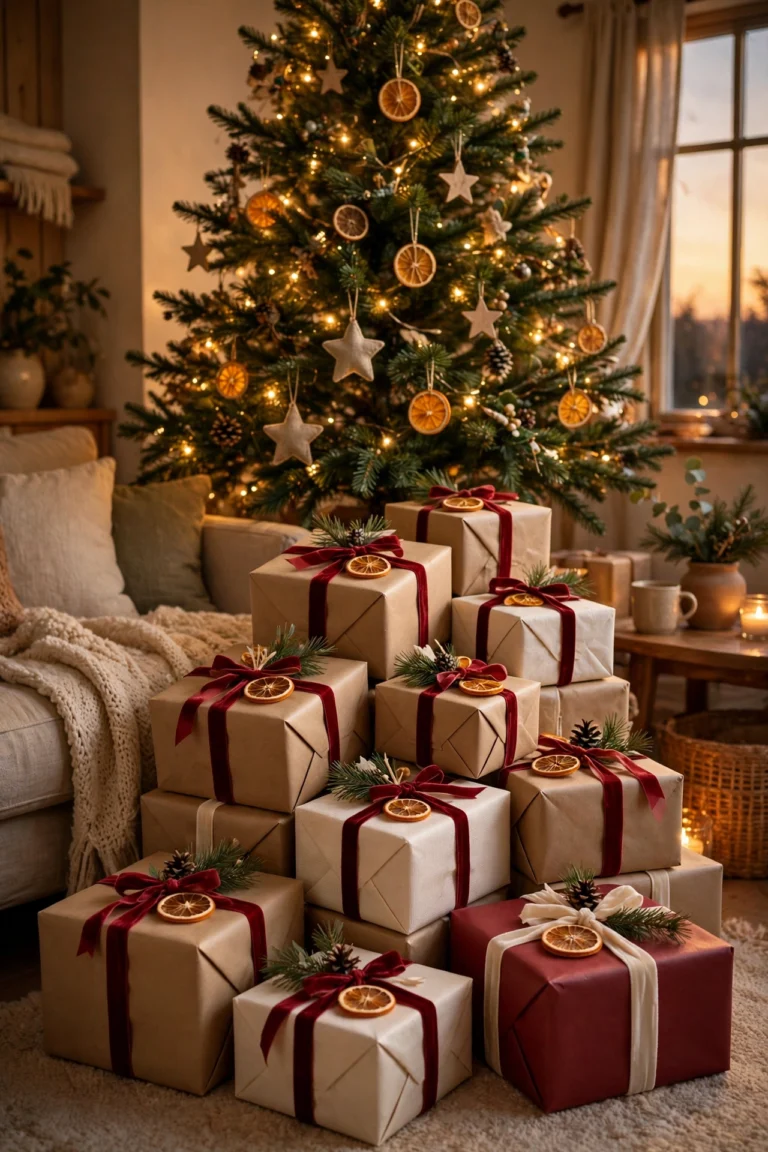
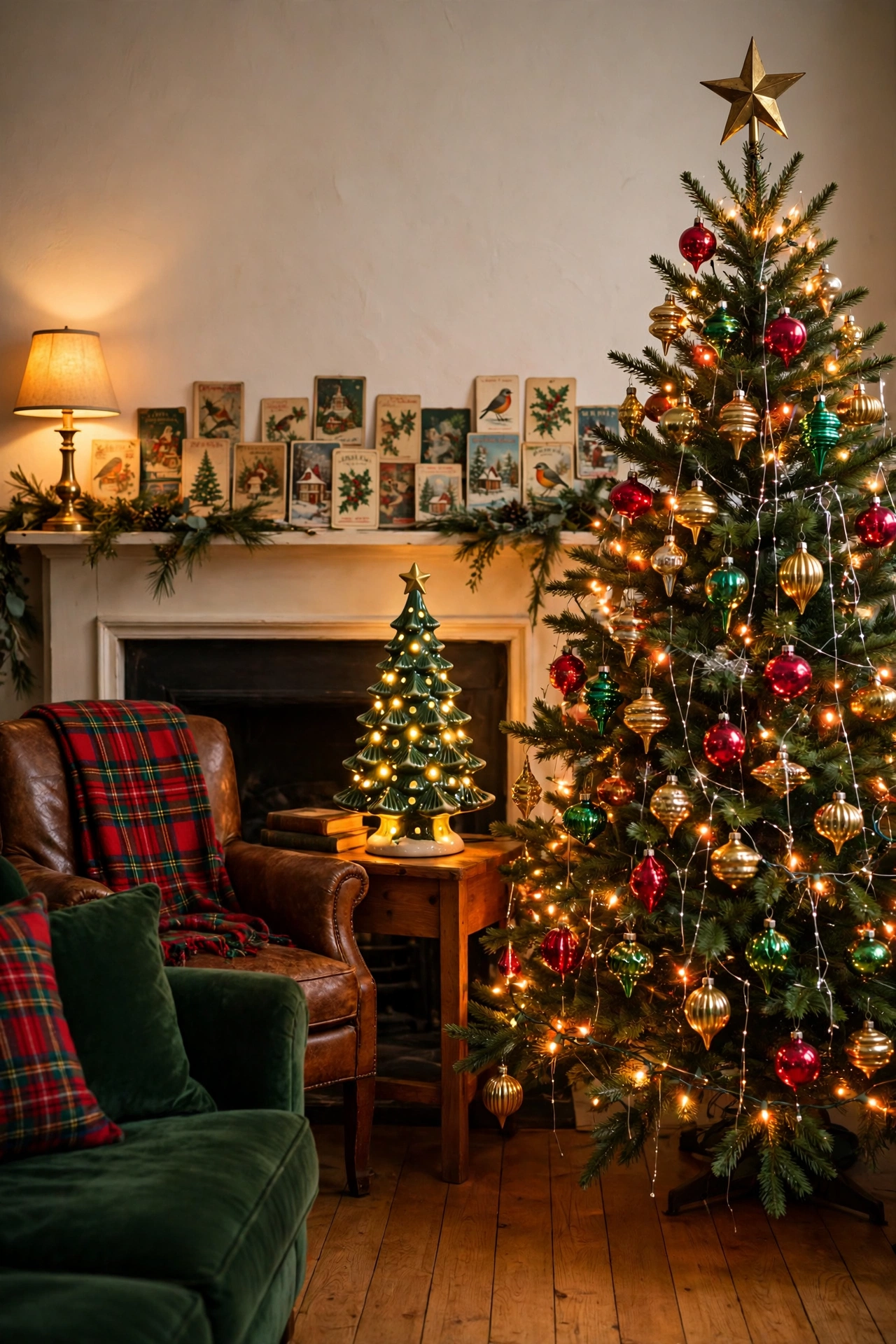
Everything starts with the tree, because in most childhood memories the tree was the room. The 2026 version of a vintage tree keeps the saturated color and the shine, then edits the quantity, so a small living room reads warm instead of stuffed. The tree in the photograph above is the model: a real evergreen, dressed in retro glass ornaments, lit with warm multi tone lights, topped with a classic star. It is not a big tree. It does not need to be. A six to seven foot tree is the vintage standard, and it carries the whole room when it is dressed properly.
Hang retro glass ornaments in saturated jewel tones first, after the lights. Reach for the colors that lived on family trees for decades: ruby red, emerald, sapphire, gold and a little teal. Glass or glass look baubles in those deep tones catch light with a soft uneven shine that plastic ornaments never manage, and the unevenness is the point. Old glass ornaments were not perfect. They had swirls, bubbles, a slightly lopsided neck, a faded patch where a thumb held them for fifty years. That imperfection is the charm, so do not hide it. For a six to seven foot tree, plan on 60 to 80 retro ornaments in a 40 30 30 color split: 40 percent red and gold, 30 percent green and teal, 30 percent blue and silver accents. Hang the largest ornaments lowest and deepest, tucked into the branches, and the smallest highest, near the tips, so the tree has depth instead of a flat shell of baubles on the outside. Mix in a few mercury glass minis, which are the small silvered ornaments that look like they have been in the family forever, and a few shaped ornaments, a bird, a bell, a Santa, one or two per tree, not a dozen.
Drape silver tinsel in neat, sparse strands, and treat the dosage as the difference between nostalgia and mess. Tinsel is back, and the people who remember it love it, but the memory is of a tree with tinsel, not a tree buried under it. Tinsel goes on last, about 150 to 200 single strands for a full tree, draped one strand at a time over the branch tips, not thrown in clumps. It comes off first in January, into a labeled envelope, so it never tangles and never ends up in the vacuum cleaner for the next six months. If you have small children or pets, keep the tinsel on the upper half of the tree, out of reach, and consider icicle tinsel only on the branches above shoulder height. The rule is simple: if you can see more tinsel than tree, take half of it off.
Top it with a classic star or angel silhouette. The topper is the one piece where vintage is almost always better than modern, because a brass star, a spun glass angel, or a simple lit star has not changed in seventy years and does not need to. If your family topper is fragile, hang it where it can be seen and admired, and keep a sturdy modern star in the box as a backup, not as a replacement. The topper goes on last, straight, centered, and slightly tilted toward the room, because a topper that leans away from the sofa is a topper nobody sees.
Finish the base the old way. A tree skirt in plaid, red velvet, or a simple cream quilt, or a galvanized metal collar if the tree is in a modern room and needs a clean line. Wrapped gifts in kraft paper with twine and a sprig of evergreen do more vintage work under a tree than any skirt, and they cost almost nothing. And if you want the full method for dressing a tree properly, including light depth, ornament placement and the one garland rule, the Christmas Tree Decor Ideas guide on this site walks through it step by step, and everything in it works for a vintage tree too, because the mechanics of a good tree have not changed since the 1950s.

The Ceramic Tree and the Small Heroes
Some vintage pieces can carry the mood of a room all by themselves, and the light-up ceramic tree is the best of them. A ceramic tree brings back a feeling of nostalgia in just a small footprint, which is why it is the first piece most vintage collectors buy and the last piece they would ever give away. The classic is the 15 inch green ceramic tree with multicolored plastic bulb tips that glow when it is plugged in, and it belongs on a side table, a console, a bookshelf, or the kitchen counter, anywhere at eye level where it can be seen in the evening. The original mold era pieces now sell for triple their original price on the resale market, and what drives the interest is the bulb tips: translucent, multi colored, and impossible to fake with a modern LED string. If you inherit one, test it, clean the bulb holes gently with a dry brush, and replace any missing bulbs with matching colors, not whatever is in the drawer. If you buy a modern reproduction, choose one with warm white light inside the ceramic, not cold blue white, because the warmth is what makes it look old. One ceramic tree per room is enough. Two in the same room compete, and three looks like a shop window.
Bottle brush trees are the second small hero, and they are the cheapest vintage look in this whole guide. A forest of bottle brush trees in different heights, green, white, and a little gold, grouped on a mantel, a windowsill, or a sideboard, reads as a winter wood in miniature. The trick is grouping: one bottle brush tree alone looks lost, but five to nine, in a cluster, tallest at the back, smallest at the front, with a little fake snow at the base, looks like a deliberate collection. Add a few tiny wrapped gifts at the foot of the forest, or a small mirror underneath to double the glow, and the group becomes the focal point of the whole mantel. Bottle brush trees cost a dollar or two each at a craft store, and they pack away in a shoebox in January, which is exactly the kind of vintage decorating that survives real life.
The third small hero is the nostalgic Christmas village. A village does not need to be the expensive collectible kind. A few tiny lit houses on a tray, a bottle brush tree or two, a scattering of fake snow, and a flameless pillar candle behind them, and you have a windowsill or a sideboard that glows all evening. Keep the tallest house below the middle of the window so daylight still gets in, and keep the village on one tray, so it lifts off in one move for cleaning. The village is also the best place in the house for the odd pieces that do not fit anywhere else: the tiny church from a thrift shop, the little lamppost, the miniature Santa on a sleigh. A village absorbs odd pieces and makes them look intentional, which is a gift in a vintage home.
Other small heroes earn their place the same way, by doing a lot of nostalgic work for very little money or space. A single retro Santa figurine on a side table, the old fashioned kind with a rosy face and a sack, not the sleek modern kind. A stack of old books tied with twine and topped with a sprig of evergreen. A milk glass vase, which costs almost nothing at a thrift shop and holds evergreen sprigs better than any modern vase. A wooden crate of ornaments on the floor beside the tree, with the lid off and the ornaments spilling out just enough to look used, not staged. The rule for all of them is the same: one hero per surface, not three. A side table with a ceramic tree, a bottle brush forest and a Santa is a shop. A side table with a ceramic tree and nothing else is a memory.
The Glow, Warm Multi Tone Light at Every Height
The fastest route back to childhood Christmas is the light itself, and vintage light has a specific character. Warm multi tone strands, the classic red, green, gold and blue mix on a warm base, soften a room in a way a single cool white never will. The multi tone look is the one most people over forty remember, because it is the light their childhood tree had, and it is the light that makes a vintage room feel vintage even before the ornaments go on. Choose warm multi tone lights over one flat white for the tree, and warm white for everything else: the mantel garland, the window, the village, the ceramic tree. One flat white light in a vintage room reads as a hospital corridor. Warm light reads as December.
Layer the light at every height, because a vintage room glows from the floor to the ceiling, not from one overhead fixture. The tree carries the main light, deep inside the branches, about 100 lights per foot of tree height, so the glow comes from inside the tree rather than sitting on the surface. The mantel carries the second layer: fairy lights woven through the garland, a pair of brass candlesticks with real taper candles for dinner and flameless candles for every other evening. The windowsill carries the third layer: a ceramic tree, a village, or a row of flameless pillar candles in glass holders, so the room glows from the outside too. The dining table carries the fourth layer, which is candlelight, and the kitchen counter carries the fifth, which is a small string of warm lights under a cabinet or along a shelf. None of these lights is bright on its own. Together, they make the room feel like it is lit from within, which is the whole point of a vintage Christmas.
Bubble lights deserve a special mention, because they are the most vintage light of all and the most misunderstood. A bubble light is a small glass tube filled with liquid that bubbles when it warms up, and a string of them on a tree is pure 1950s magic. Modern reproductions exist, they are safe, and they work the same way, but they need to stand upright to bubble, so hang them on the outer branches, not buried deep in the tree. They are also the one light you should never leave running all night, because they are designed for display, not for unattended use. Put the tree lights on a timer, so the glow is automatic and nobody has to remember to switch them off.
Safety is not optional in a vintage room, because vintage means old, and old electrical pieces are the one place where nostalgia can be dangerous. Decades old wiring with cracked cords is a fire risk no glow is worth, and antique tinsel was often made with metals that should not be handled by children. The rules are simple and non negotiable. Never use an old light string with brittle insulation, cracked plugs, or exposed wire: it belongs in a non operating display, or in the bin. Never use real candles near dry greenery, curtains, or paper decorations, and never leave a real candle burning in an empty room. Use flameless candles anywhere near fabric, paper, or a tree, and keep real candles in brass holders on a clear surface, away from anything that can catch. Check every old electrical piece before you plug it in, and when in doubt, use a modern listed reproduction. The room will look exactly the same, and it will be safe, which is what a family Christmas is supposed to be.
The Mantel, Old Cards and Family Photos
The mantel is where vintage Christmas becomes personal, because it is where the family story lives. The most nostalgic Christmas decorations in any home are not bought. They are printed, saved, and handed down. A mantel dressed with old Christmas cards, family photos, stockings and a garland is not a display. It is a timeline, and it is the one surface in the house where more is genuinely more, as long as the more is personal.
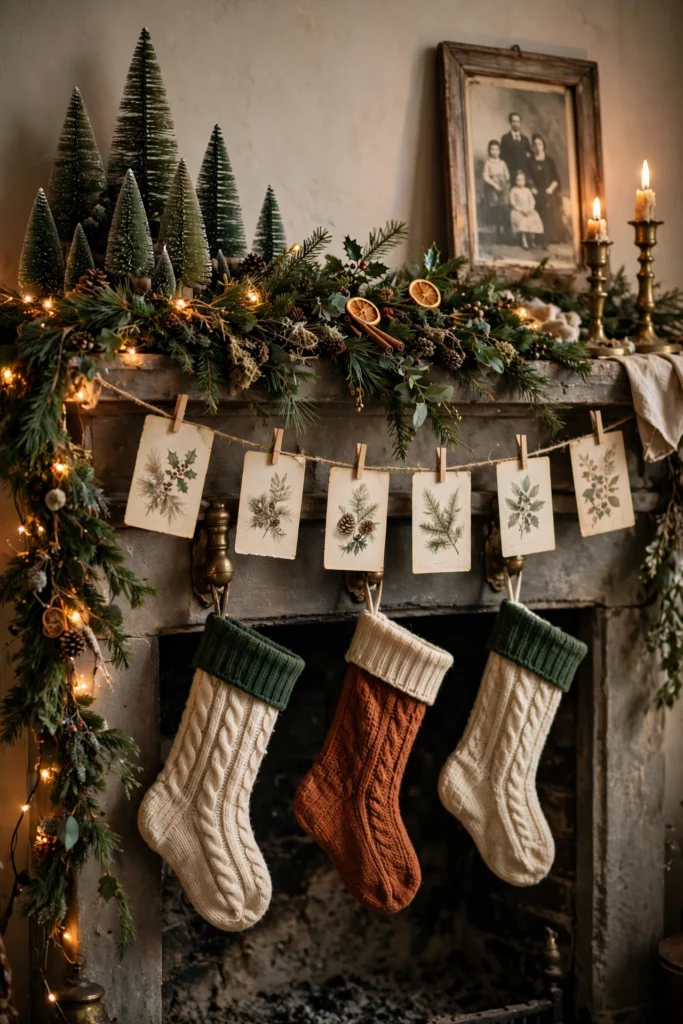
Turn old Christmas cards into the garland. Hang them from removable hooks or a length of twine in one gentle swag across the mantel, oldest cards at one end and newest at the other, so the display reads like a timeline of the family. Use mini clothespins on twine, which hold the cards without damage and let you swap them easily. If you do not have old cards, start the tradition this year: keep the best cards you receive, write the year on the back, and in three years you will have a garland with a history. Cards can also stand in a row along the mantel, leaning against the wall, one frame overlapping another slightly for the casual layered look. The rule is to show the fronts, not the backs, and to let the handwriting and the old stamps be part of the decoration, because that is what makes a card vintage instead of just old paper.
Turn printed photos into hanging ornaments and mantel pieces. A small framed photo of a grandparent, a wedding, a childhood Christmas, leaning against the wall on the mantel, does more nostalgic work than any shop bought decoration. Lean them, never nail them, and let one frame overlap another slightly for the casual layered look. For the tree, print a few favorite family photos in small sizes, mount them on card, punch a hole, thread a ribbon, and hang them among the ornaments. They will be the first ornaments anyone looks at, and the last ones anyone packs away. If you have a no fireplace home, the same idea works on a shelf edge, a bookcase top, or a console: line the photos and cards along the shelf, add a garland, and the shelf becomes the mantel.
Hang the stockings from weighted holders or a ribbon tied along the mantel, never from nails, and in a no fireplace rental, line them along a shelf edge instead. Weighted stocking holders are the honest vintage solution: a heavy brass or cast iron holder that sits on the mantel and holds the stocking by a hook, no drilling, no damage, and it looks right in a vintage room because it is the way stockings were held before anyone drilled a hook into a mantel. Knitted stockings in cream, rust and deep green suit a vintage room better than bright red store bought ones, and a stocking with a name tag, handwritten, is a decoration in itself.
Dress the mantel itself with a garland, a few bottle brush trees, brass candlesticks, and one strong focal piece, and stop there. The focal piece can be a wreath, a large framed photo, a mirror, or a ceramic Santa. One focal piece, not three, because the cards and the photos are already doing a lot of visual work. And if your mantel needs a fuller guide, including garland lengths, swag spacing and the one hour mantel plan, the Christmas Fireplace Decor Ideas guide on this site covers it in detail, and every measurement in it works for a vintage mantel too.
The Vintage Table, Plaid, Milk Glass and Santas
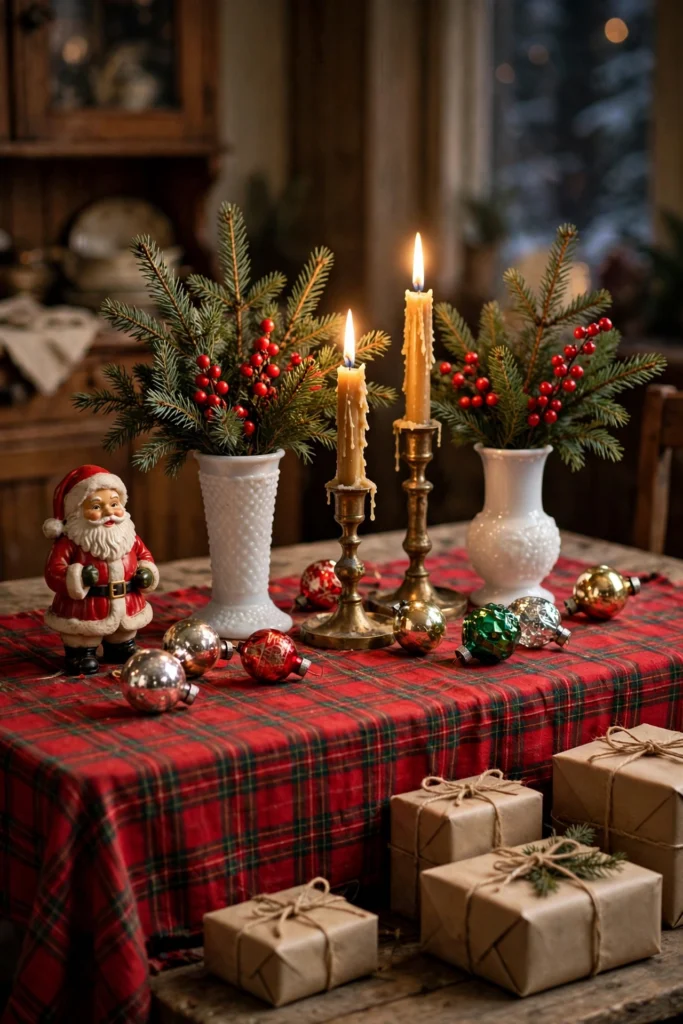
The dining table is where vintage Christmas is most forgiving, because a table is a flat surface and a flat surface forgives almost any collection. Start with the tablecloth, and let it set the era. A red plaid tablecloth is the classic vintage choice, and it does half the work by itself, because plaid repeats the tree, the wrapping paper and the throw on the armchair, and the whole house starts to feel like one room. A vintage poinsettia pattern tablecloth, or a simple cream linen cloth with a plaid runner down the middle, works the same way. Doilies under the candlesticks and the vases are the small touch that makes the table look old rather than just red, and they cost nothing if you already own them. The rule is one pattern on the table, not two. Plaid cloth plus a plaid runner plus plaid napkins is a costume. Plaid cloth, cream napkins, brass candlesticks is a table.
Build the centerpiece low, so guests can see each other across it. A vintage centerpiece is a collection of small things, not one big thing. Milk glass vases holding evergreen sprigs and red berries, two or three of them in different heights, down the middle of the table. Brass candlesticks with taper candles between the vases. A few retro glass ornaments scattered as table scatter, the same jewel tones as the tree, so the table and the tree talk to each other. One retro Santa figurine, the old fashioned kind, standing at the end of the table where it can be seen. A wooden crate or a tray under the whole arrangement, so the centerpiece lifts away in one move when dinner arrives. That lift away rule matters more at Christmas than at any other time of year, because a vintage table has to hold dinner, not just look good, and a centerpiece that cannot move is a centerpiece that gets knocked over.
Set the places simply. White plates, gold or brass cutlery, a red napkin tied with twine and a sprig of evergreen, and a place card if you have the time. The place card can be a small kraft tag with a name written in ink, which is both a decoration and a kindness, because nobody has to ask where to sit. A small wrapped gift or a single ornament at each place is the vintage touch that guests remember, and it does not need to be expensive: a candy cane, a small bag of cookies, a pinecone with a ribbon. The point is that the table feels given, not just set.
Wrap the gifts the vintage way, because the gifts under the tree and beside the table are part of the decoration. Wrap gifts in a mix of vintage patterns: kraft paper with twine, red plaid paper, cream paper with a sprig of evergreen tucked under the ribbon, and a handwritten tag. The mix is the point: a tree surrounded by matching glossy gift wrap looks like a shop, while a tree surrounded by kraft, plaid and cream looks like a family. And if you want the full table method, including the one tray centerpiece that lifts away when dinner arrives and the five low centerpieces that actually work for dinner, the Christmas Dining Table Decor Ideas guide on this site has it, and the tray rule in it is the single most useful table idea in this whole series.
Thrifted, Inherited and Made by Hand
Vintage Christmas is the cheapest decorating style there is, because the best pieces are already made, already owned, or already waiting in a thrift shop. The skill is not spending. The skill is looking, and knowing what to look for, and knowing what to leave behind.
Shop your own house first. Open the ornament box, the card drawer, the linen cupboard, the attic, the garage, and lay everything out on a table before you buy a single new thing. You will almost certainly find that you already own the core of a vintage Christmas: a box of glass ornaments, a ceramic tree, a tablecloth, a stack of cards, a brass candlestick, a Santa figurine that has been in the family for decades. The pieces you already own are also the pieces with the stories, and stories are what make a room vintage instead of just old looking. Write a note for the pieces whose story you know, who gave them, when, why, and keep the note in the box, so the story survives the person who remembers it.
Thrift second, and thrift with a list, not with a vague hope. The thrift shop vintage list is short: glass ornaments in jewel tones, milk glass vases, brass candlesticks, plaid textiles, old Christmas cards, ceramic trees, bottle brush trees, Santa figurines, wooden crates, and old books with red or green covers. Buy only what fits your era and your palette, and leave everything else, because a thrift shop is where a vintage room becomes a jumble sale if you buy by impulse. Check every piece before you pay: ornaments for cracks and missing caps, electrical pieces for frayed cords, ceramics for chips on the visible side, textiles for stains that will not wash out. A chipped ornament is still a beautiful ornament if the chip faces the tree. A frayed cord is never a bargain.
Make the third layer by hand, because handmade paper decorations are the most vintage decoration of all, and they cost almost nothing. Paper stars from old paper bags, dried orange slices strung on twine, popcorn and cranberry garlands, snowflakes cut from old wrapping paper, a paper chain in red and green made by a child, these are the decorations that were on family trees before anyone could buy a matching set, and they still work, because they are personal and imperfect in the right way. A handmade decoration also solves the problem of a room that feels too perfect: one paper star among the glass ornaments tells the eye that a family lives here, not a stylist.
The honest total for a vintage Christmas is low. A ceramic tree from a thrift shop, five to ten dollars. A box of glass ornaments, five to fifteen dollars. A plaid tablecloth, ten to twenty dollars. Bottle brush trees, a dollar each. Cards, photos, paper decorations, free. The whole look, done properly, costs less than a single modern matching set from a department store, and it looks better, because it looks like it was collected over a lifetime, which is exactly what it was.
Vintage Without the Museum Look, Editing and Safety
The difference between a vintage room and a museum is editing, and editing is a skill, not a talent. The rule is one focal area per room, one hero per surface, and one era per house. A living room with a vintage tree, a vintage mantel and a vintage table is a Christmas. A living room with a vintage tree, a vintage mantel, a vintage table, a vintage sideboard, a vintage windowsill, a vintage bookshelf and a vintage hallway is a shop, and nobody can relax in a shop. Pick the focal area, get it right, and let the rest of the room be quiet. Quiet is what makes the focal area glow.
The second editing rule is the one in, one out rule. Every time a new vintage piece comes into the house, one old piece leaves the display, into a box, to a friend, to a thrift shop, anywhere but onto a surface that is already full. A collection grows by replacement, not by accumulation, and a collection that grows by accumulation becomes clutter in about two Christmases. If a piece has no story, no function and no place in the palette, it does not go on display, no matter how cheap it was or how vintage it looks. The box in the attic is a fine home for it.
The third rule is the safety pass, and it is the rule that protects the whole idea. Walk the room like a child, or like a pet, and look for the dangers a vintage room hides. Heavy heirlooms hung the damaging way: stocking holders balanced on a mantel edge, frames on fresh nails, garlands on tape that peels paint, all of these are December shortcuts that become January deposit deductions, and the fix is weighted holders, leaning and removable hooks, which hold everything here. Old tinsel at child height, glass ornaments at pet height, real candles near dry greenery, old light strings with cracked insulation, each of these has a simple fix, and the fix is always the same: move it higher, swap it for a reproduction, or leave it out. A vintage room with children or pets is not a smaller vintage room. It is a vintage room with the fragile pieces above shoulder height and the sturdy pieces below it, and the children get their own unbreakable ornaments at the bottom of the tree, which is the tradition that makes them love Christmas in the first place.
The fourth rule is the small home rule. Vintage works in a small home, and it works well, because vintage pieces are mostly small: a ceramic tree, a bottle brush forest, a card garland, a milk glass vase. The mistake in a small home is the same as in a big one, only faster: too many pieces, too many colors, too many surfaces. One focal area, one palette, one hero per surface, and a small home will look more vintage than a big one, because the pieces are closer together and the glow is warmer. And when January comes, the pack away is simple: the ornaments go back in their box, the cards go back in their drawer, the ceramic tree goes back on its shelf, and the room goes back to being a home, with the memory of a Christmas that felt like childhood, which is the whole point.
Conclusion
Vintage Christmas decor is not about recreating one perfect decade. It is about rebuilding a feeling, and the feeling is warmth, memory, and a room that looks like it has been loved for a long time. Start with an era and a palette, three colors and one metal, repeated everywhere. Dress the tree the way childhood trees were dressed, with retro glass ornaments in jewel tones, tinsel in careful doses, and a classic star on top. Let the small heroes do their work: a ceramic tree on a side table, a bottle brush forest on the mantel, a village on a tray. Light the room warm and low, multi tone on the tree and warm white everywhere else, and keep the old wiring out of service. Let the mantel tell the family story with old cards and photos. Set the table with plaid, milk glass and Santas, and wrap the gifts in kraft and twine. Thrift, inherit and make by hand, and edit ruthlessly, so the meaningful pieces have room to breathe.
The best vintage piece in your house is probably already there, in a box, in a drawer, or on a shelf you stopped seeing years ago. Open the box. Hang the ornament. Light the ceramic tree. Christmas is not in the shop. It never was. It is in the pieces that carry a memory, and in the room that lets them shine.