Christmas Tree Topper Ideas That Finish the Tree
The topper is the last thing you put on the tree, and it is the first thing people see. You can spend a whole weekend on ornaments, lights, and garland, and if the top of the tree is bare, or if it is wearing a topper that leans like a tired flag, the whole tree looks unfinished. A good topper does the opposite. It gives the tree a clear ending, a point at the top that says the decorating is done, and it pulls the whole tree together from across the room.
Most people choose a topper last, in a hurry, and that is why so many toppers fail. They buy the prettiest star in the shop without checking its size against their tree, or they pick a heavy angel for a tree with a thin top branch, or they choose a bow that is too small to read from the sofa. The topper is not an afterthought. It is the crown of the tree, and it has its own rules, its own sizing, and its own way of matching the rest of the tree.
This guide starts with those rules, because every good choice in Christmas tree topper ideas follows from them. Then it covers the four families of toppers that actually work, the classic star, the angel, the oversized bow, and the rustic natural topper, plus the DIY toppers you can make in an evening, the small tree toppers for tabletop trees, and how to match the topper to the style of tree you already have. It finishes with a thirty minute plan that takes you from a bare treetop to a finished tree in one evening.
The Sizing Rule Comes First
Every topper decision starts with two measurements, the height of your tree and the strength of its top branch. Get these wrong and even the most beautiful topper will lean, slide, or fall off by Christmas Eve. Get them right and almost any topper will sit straight all season.
The height rule is simple, and every fresh 2026 guide agrees on it. For a 6 to 7 foot tree, choose a topper 8 to 12 inches tall. That is roughly one tenth of the height of the tree, big enough to read from across the room, small enough not to dominate the tree. For a 5 foot tree, 7 to 9 inches is right. For an 8 foot tree, 10 to 14 inches works. A topper under 6 inches on a full size tree disappears, and guests will wonder why the top of the tree looks bare. A topper over 14 inches on a 6 foot tree looks top heavy, and it will catch every draught in the room.
The second measurement is weight, and it matters more than most people think. A real tree has a thin, flexible top branch. An artificial tree has a stiffer top, but even that has a limit. Pick the topper up and feel its weight before you buy it. If it feels heavy in your hand, it will feel heavier on a thin branch. Hollow metal stars, fabric angels, felt stars, and bows are light, and they are the safe choices for most trees. Solid ceramic angels, heavy glass stars, and toppers with a big metal base need a strong top branch, or they need extra support.
That support is easy to add, and it is worth doing before the topper goes on. Trim the top few inches of the tree so the branch is short and stiff rather than long and floppy. A short branch holds a topper upright. A long thin branch bends under it. If the topper has a cone or clip base, slide it down over the branch until it grips firmly, then tuck a few branches up around the base to hide it. If the topper has no base, tie it on with floral wire or twine, in two places, so it cannot spin. A topper tied in one place will turn in the draught. A topper tied in two places stays facing the room.
Finally, check the ceiling. Measure from the top of the tree to the ceiling before you shop. If you have less than 12 inches of clearance, a tall topper will bend against the ceiling, or it will force you to shorten the tree. In a low ceiling room, a bow clipped to the front of the crown, or a miniature star set inside the top branches, finishes the tree without needing height above it. The guide called Christmas Tree Decor Ideas covers the whole tree in detail, and it is worth reading alongside this one, but the topper follows its own sizing, and the sizing comes first.
Classic Star Toppers
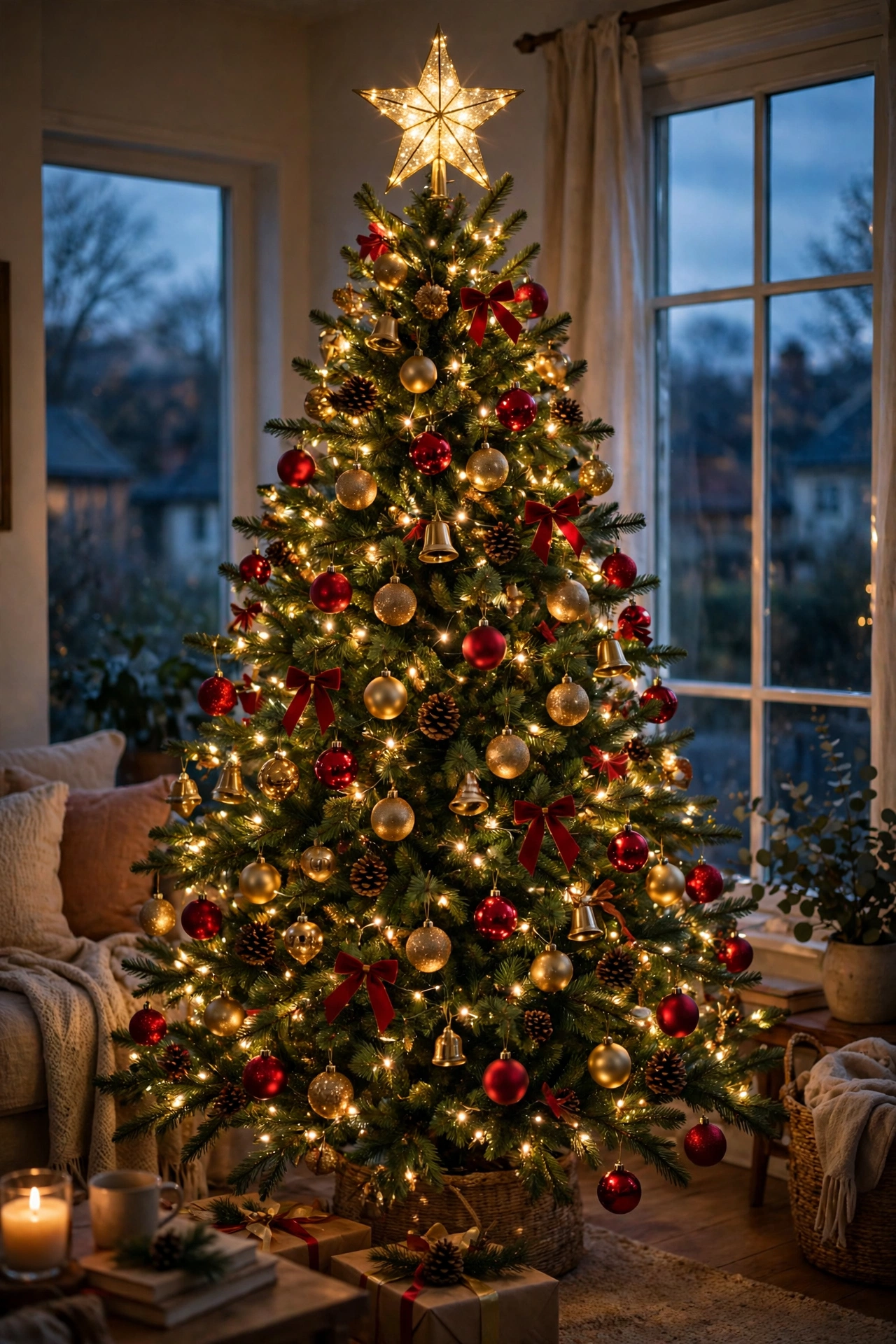
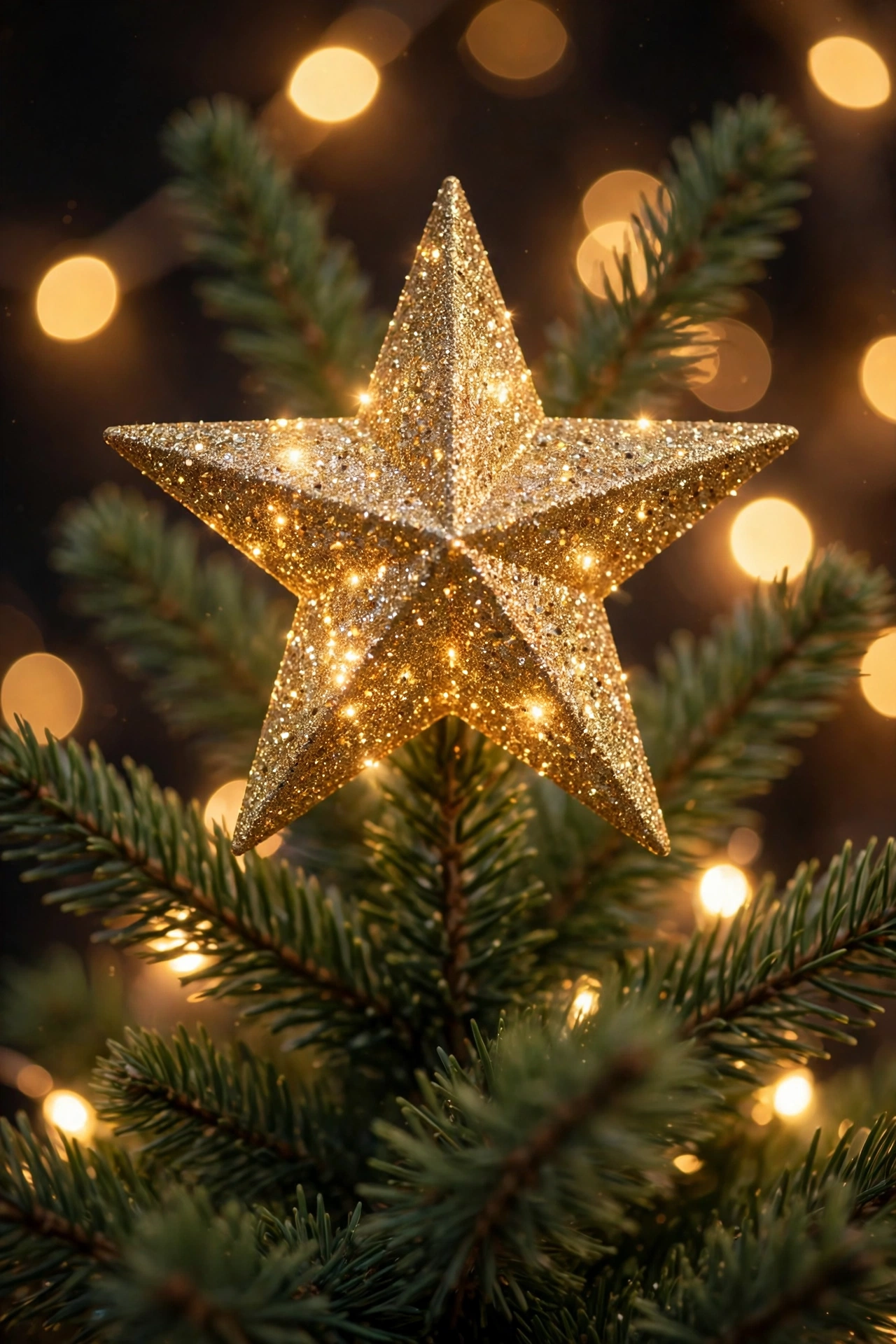
The star is the default topper for a reason. It reads from across the room, it suits almost every colour scheme, and it costs next to nothing. A five pointed star in gold, silver, or white is the most traditional topper there is, and it is the one that most people picture when they think of a finished tree. The star works because it is a simple shape with strong lines, and because it sits naturally on top of a tree, like the tree was always meant to end in a point.
The classic gold star is the safest choice. Look for a star 10 to 12 inches tall for a full size tree, in a matte or lightly glittered gold that will not shed all over the floor. A hollow metal star is light and bright, and it catches the fairy lights below it. A glittered star sparkles more, but it sheds glitter, so keep it away from food tables and small children who touch everything. A light up star, about 15 to 25 dollars, doubles as the crown light of the tree, and it saves you a string of lights near the top, where lights are hardest to wrap neatly.
A glass star is the elegant version. Frosted glass, clear glass with gold edging, or a star with a mercury glass finish looks expensive, and it glows beautifully when the tree lights hit it. Glass is heavier than metal, so it needs a strong top branch and a firm base, and it is not the right choice for a house with small children or a cat that climbs. If you love the glass look but worry about weight, choose a hollow glass star, which is much lighter than a solid one, and tie it on with wire so it cannot fall.
A wooden star is the rustic version, and it suits a tree decorated with natural materials. A twig star, a reclaimed wood star, or a whitewashed wooden star, about 12 to 20 dollars, adds texture at the top of the tree and pairs perfectly with dried oranges, pinecones, and burlap ribbon lower down. Wood is light, it never breaks if it falls, and it is the easiest star to make yourself if you enjoy a small craft project. Five sticks, tied at the points, make a star in ten minutes.
When you shop for a star, check three things. First, the base. A cone base slides over the branch and grips it. A clip base pinches the branch. A flat base needs wire to hold it. The cone base is the most secure. Second, the finish. Matte gold reads warm and calm. Bright glitter gold reads festive and loud. Pick the finish that matches the ornaments below it. Third, the weight. Hold it at arm’s length. If your arm gets tired, your tree branch will too. A star that is too heavy for the branch will lean within a day, and no amount of wire will make it look straight.
Angel Toppers
The angel is the softest topper, and it is the one with the most history. Angels have topped Christmas trees for generations, and they suit a traditional tree better than any other topper. A fabric angel, with a flowing dress, soft wings, and a halo, brings a gentle, old fashioned feeling to the top of the tree that a star cannot match. If your tree is full of heirloom ornaments and warm candlelight, an angel is probably the right crown for it.
Fabric angels are the lightest and the easiest to place. A fabric angel, 10 to 18 dollars, has a dress made from cloth or felt, wings from tulle or feathers, and a small halo from wire or gold ribbon. It sits on the top branch with a cone or a loop, and because it is soft, it never breaks if it falls. The dress can be any colour, but cream, white, and gold are the classics, and they suit a tree with warm white lights. A red dress suits a traditional red and green tree. A blue dress suits a winter white tree.
A vintage angel is the heirloom version. Porcelain angels, ceramic angels, and angels with hand painted faces are the ones that get passed down, and they are the ones that carry the most meaning. They are also the heaviest, so they need the strongest branch and the firmest fixing. If you have a vintage angel, do not trust a single clip. Wire it to the branch in two places, and tuck branches up around the base to hide the wire. A vintage angel that falls and breaks is a loss you cannot replace, so the extra five minutes of wiring is worth it.
A light up angel is the modern version, with a glowing halo or a light inside the dress. The halo is usually a small ring of LED lights, and it makes the angel visible from across a dark room, which is lovely at dusk. Check that the battery pack is small and light, because a heavy battery pack at the top of a tall angel will pull it forward. Hide the battery pack inside the dress if you can, and use a timer so the halo is on in the evening and off overnight.
The angel suits some trees and not others. It suits a traditional tree, a tree with soft ornaments, and a tree with warm white lights. It does not suit a modern tree with bold colours and sharp shapes, or a minimalist tree with only a few ornaments, because the angel will look out of place. If your tree is modern, a star or a bow will match it better. If your tree is traditional, the angel is the topper that makes it feel complete, and it is the one your family will remember when they think back to Christmas.
The Oversized Bow Topper
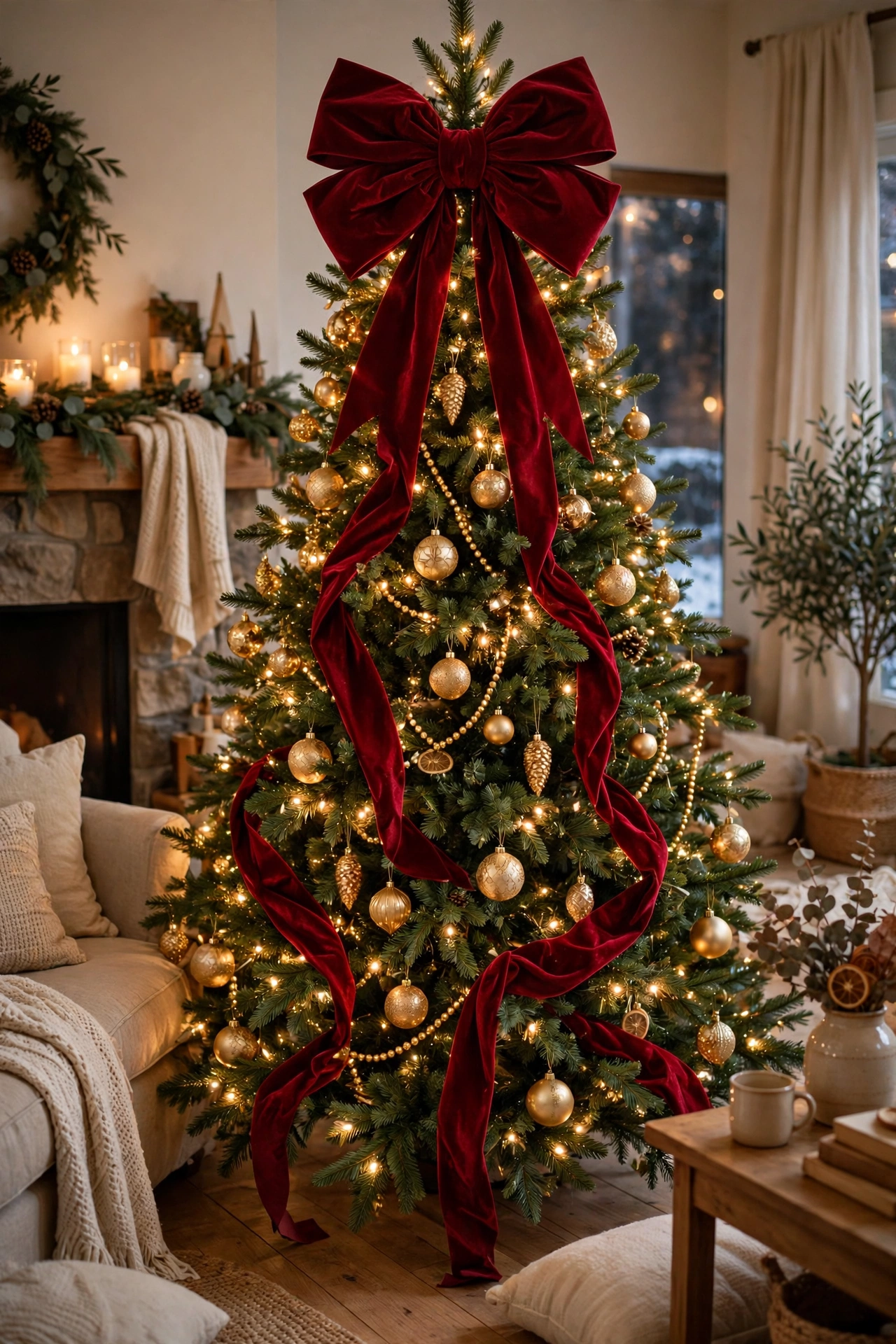
A big velvet bow is the easiest way to make a tree look styled rather than just decorated, and it is the topper that is having the biggest moment right now. A bow has no rigid shape to keep upright, no weight to balance, and it can be tied, pinned, or clipped onto the top branch in seconds. It packs flat in January, it works on trees of any colour, and it costs about 8 to 15 dollars in ribbon, which makes it the cheapest topper that looks deliberate rather than improvised.
The size rule for a bow is different from the size rule for a star. A bow topper should be big, much bigger than you think. Use 4 inch wide wired ribbon in deep red, emerald, or champagne gold, and build a bow with loops about 8 to 10 inches across. The whole bow should be 12 to 18 inches wide when it is finished. A small bow on top of a big tree looks like a gift tag. A big bow reads from across the room, and it gives the tree a soft, generous crown.
Wired ribbon is essential, because the wire holds the shape all season. Unwired ribbon will flop within a day, and no amount of fluffing will fix it. Velvet is the best fabric, because it catches the light beautifully and it looks expensive even when it is cheap. Satin is the second choice, and it suits a formal tree. Burlap is the rustic choice, and it suits a farmhouse tree. The guide called Christmas Ribbon Decor Ideas covers ribbon types and bow making in detail, and it is worth reading before you buy, because the ribbon you choose decides how the bow will look.
Making the bow takes about ten minutes. Cut a length of wired ribbon about 3 yards long. Form two loops, one on each side, and pinch them together in the middle. Wrap a short piece of wire or a zip tie around the centre to hold it, then fluff the loops out until they are full and even. Cut two long tails, about 18 inches each, and let them cascade down through the branches. The tails are the part most people skip, and they are the part that makes the bow look finished, because they carry the colour of the bow down into the tree.
To attach it, tie the bow to the top branch with floral wire, in two places, and tuck the tails into the branches so they flow naturally. If the tree is in a low ceiling room, clip the bow to the front of the crown instead of sitting it on top, so the bow finishes the tree without needing height above it. A bow clipped to the front, with its tails travelling down through the branches, looks intentional and modern, and it solves the headroom problem completely. One bow, no tools, five minutes, and the tree looks styled.
Rustic and Natural Toppers
Not every tree wants a shiny star or a velvet bow. A rustic tree, a farmhouse tree, or a tree decorated with natural materials needs a topper that matches, and the rustic family of toppers does that job beautifully. These toppers are made from wood, twigs, dried flowers, pinecones, and burlap, and they look like they grew on the tree rather than being bought for it.
The twig star is the simplest rustic topper. Five straight twigs, tied at the points with twine, make a star in ten minutes, and it costs nothing if you gather the twigs yourself. A twig star is light, it never breaks, and it suits a tree with dried orange slices, pinecones, and burlap ribbon. If you want it to look finished, wrap the joints with thin wire and add a small sprig of greenery at the centre. The twig star is also the best topper for a kids tree, because it is unbreakable and it looks handmade in the best way.
The wooden star is the sturdier version. A star cut from reclaimed wood, or a whitewashed wooden star bought for 7 to 14 dollars, has more presence than a twig star, and it suits a bigger tree. Wood is light for its size, it holds its shape, and it looks good with both warm white and multicolour lights. A wooden star with a light stain suits a farmhouse tree. A whitewashed wooden star suits a Scandinavian tree with pale wood and white ornaments. A dark stained wooden star suits a traditional tree with deep red ornaments.
The dried floral topper is the softest rustic choice. A small bundle of dried eucalyptus, dried lavender, or dried wheat, tied with twine and tucked into the top of the tree, makes a topper that smells wonderful and looks completely natural. Dried florals are light, they cost very little, and they are the cheapest topper on this list if you make them yourself. The bundle should be about 8 to 10 inches tall, and it should fan out slightly at the top, like a small bouquet. Tie it firmly to the branch, because dried stems are brittle and they will snap if they are bent.
The pinecone cluster topper is the woodland choice. Three or four pinecones, wired together with a few sprigs of greenery and a small bow, make a topper that suits a tree full of pinecones and woodland ornaments. The pinecones should be small, about 3 to 4 inches each, because large pinecones are heavy and they will pull the topper forward. Wire them tightly together, then wire the whole cluster to the branch. A pinecone cluster is also a good topper for a tree in a cabin or a lodge, where a shiny star would look out of place.
The rustic toppers share one rule. Keep the palette natural. Wood, twine, dried green, cream, and one warm metal, usually brass or copper, are enough. A rustic topper with glitter, bright red ribbon, and plastic berries is not rustic anymore, it is confused. Let the natural materials do the work, and the topper will look like it belongs on the tree.
DIY Christmas Tree Topper Ideas
Making your own topper is the most personal choice on this list, and it is the one that Pinterest loves most. A handmade topper is unique, it costs very little, and it becomes a keepsake that comes out every year. The best DIY toppers are also the simplest, because a topper has to survive being stored in a box for eleven months and then put on top of a tree in five minutes.
The felt star is the best family project on this list. Cut two star shapes from stiff felt, stitch or glue them together with a little stuffing inside, and add a loop at the bottom to slide over the top branch. Kids can pick the colour and add buttons or embroidery, and the whole thing costs under 5 dollars. Felt is forgiving, it never breaks, and it holds its shape. A felt star in cream, red, or deep green suits almost any tree, and it is light enough for the thinnest top branch. The guide called Christmas Ornament Decor Ideas covers felt ornaments in detail, and the same techniques work for a felt star topper.
The paper star is the quickest DIY topper. Fold heavier paper or light cardboard into a three dimensional star, using a printable template or a basic folding guide, then glue two star shapes together with a toilet paper tube or a rolled piece of cardstock between them as a sleeve to slide over the top branch. Cover the star with leftover wrapping paper, aluminium foil, brown kraft paper, or pages from an old book. Add glitter, paint, or marker details if you like. A paper star takes under an hour, it costs less than 5 dollars, and it is a perfect last minute project for the evening before the tree goes up.
The ornament cluster topper is the most glamorous DIY option. Take a handful of small ornaments, the shiny inexpensive baubles you already own, and glue them together with a hot glue gun into a cluster. Style them into a rough ball shape, about 8 to 10 inches across, and add a few sprigs of greenery between them. The cluster sits on top of the tree like a burst of ornaments, and it is completely one of a kind. Use ornaments in one colour family, gold and cream, or red and silver, so the cluster reads as one object rather than a pile of spare baubles. A cluster topper is light, because the ornaments are hollow, and it is a brilliant way to use the ornaments that never made it onto the tree.
The Santa hat topper is the easiest DIY of all, and it is the most fun. Take a small Santa hat, the kind everyone has in a drawer from last Christmas, and put it on top of the tree. That is the whole project. A miniature Santa hat, 5 to 10 dollars if you buy one, sits on the top branch like the tree is wearing it, and it makes everyone smile. It suits a kids tree, a playful tree, and a tree in a family room where the decorating is meant to be fun rather than formal. If the hat is too floppy, stuff the tip with a little tissue paper so it holds its shape.
The sewn topper is the heirloom DIY. A quilted star, a wool felt star with hand embroidery, or a stuffed angel made from cotton and linen, takes a few hours, but it becomes the topper that gets handed down. Sewing patterns for tree toppers are widely available, and the best ones include a dowel or a stiff inner frame so the topper stands upright on the branch. If you sew, make the topper in a fabric that matches the tree skirt, so the top and the bottom of the tree talk to each other. A handmade topper does not need to be perfect. The slightly wonky star your child made is the one you will keep for twenty years.
Small Tree and Tabletop Toppers
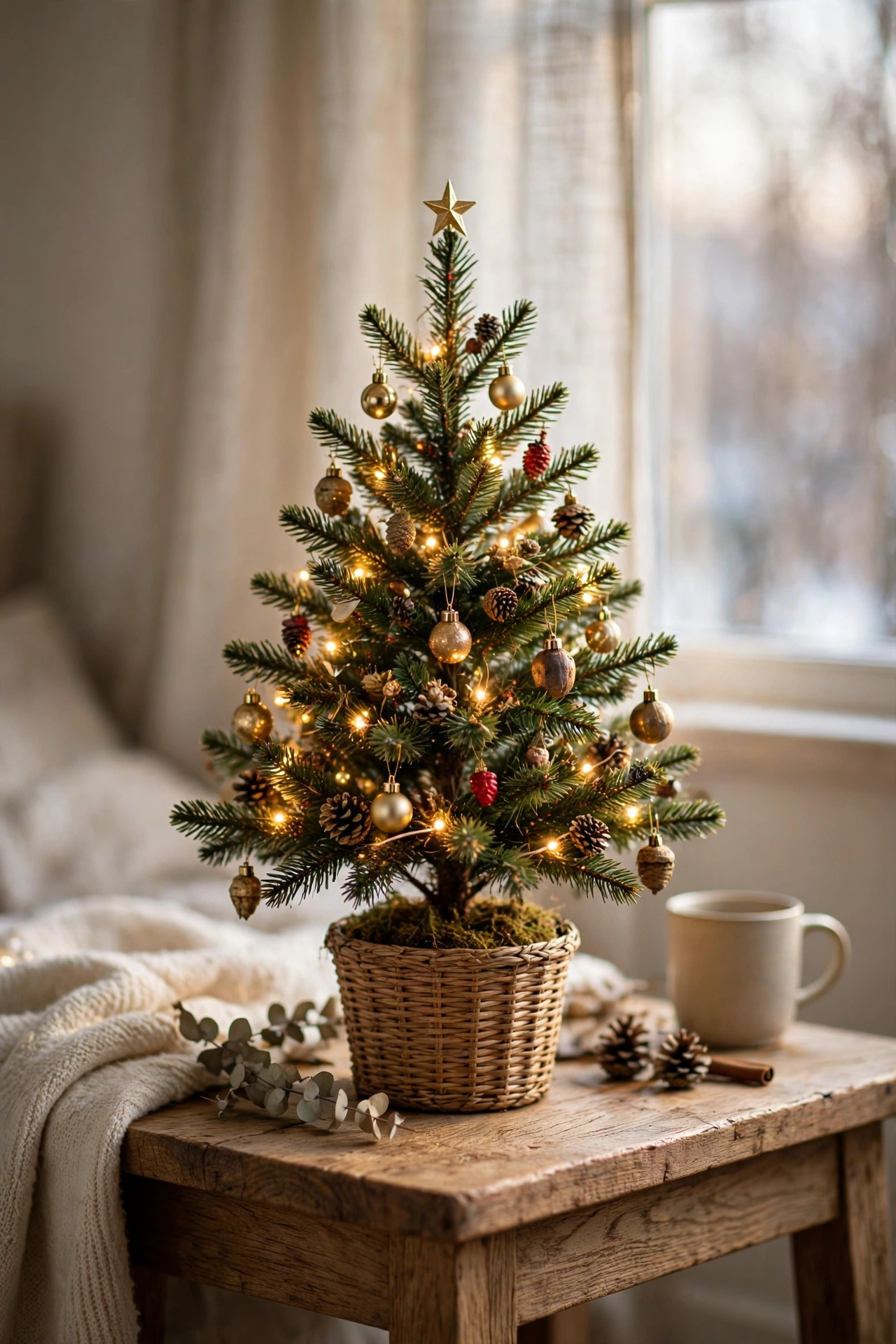
A small tree needs a small topper, and this is where most people go wrong. They put a full size star on a tabletop tree, and the star is bigger than the top third of the tree. The rule for a small tree is simple. For a tabletop tree under 4 feet, choose a topper under 6 inches tall, and as light as possible. Fabric, wood, or hollow metal are the right materials. Anything heavy will bend the thin top branch of a small tree within hours.
A miniature star is the safest choice for a small tree. A small gold metal star, 4 to 6 inches tall, about 8 to 15 dollars, is hollow and feather light, and the gold reads as warm rather than flashy against green branches. A silver glitter star, about 4 inches tall and roughly 8 dollars, is the budget option, and it is small enough to sit inside the crown of the tree rather than on top of it. Setting a miniature star inside the upper branches, so the branches hold it from below, is a better fix than balancing it on the tip.
A light up LED star is the practical choice for a small tree, because it has tiny LEDs built into the points, so the topper glows on its own and you do not need a string of lights to reach the very top of the tree. A light up star for a small tree costs 12 to 20 dollars, and it should be under 6 inches tall. Check that the battery pack is small, because a big battery pack will outweigh the star itself.
A bow is the most forgiving topper for a small tree, because it has no rigid shape to keep upright, no weight to balance, and it can be tied, pinned, or clipped onto the top branch in seconds. An oversized velvet bow is too big for a tabletop tree, but a small bow made from 2 inch wide ribbon, with loops about 4 inches across, is exactly right. Tie it to the front of the crown, with short tails, and the small tree looks deliberately styled rather than under decorated.
For a tabletop tree, trim the top few inches of the tree so the branch is short and stiff rather than long and floppy. Use the topper’s clip or cone base to grip the top branch, and for a bow or a dried bundle, tie it on with twine. A small tree on a side table, a kitchen counter, or a bedroom dresser is usually seen up close, so the topper will be examined. That is a good thing. A small topper, well chosen, is the detail that makes a small tree look like a real tree rather than a decoration that happens to be shaped like one.
Match the Topper to the Tree Style
A topper does not live on its own. It has to match the tree below it, and the easiest way to choose is to match the topper to the style of tree you already have. A topper that matches the tree looks inevitable, like it was always meant to be there. A topper that fights the tree looks like a mistake, even if the topper itself is beautiful.
A traditional tree, red and green, gold ornaments, warm white lights, wants a classic gold star or a fabric angel. The star is the safe choice, the angel is the softer choice, and either one will look right. Keep the finish warm, gold rather than silver, and keep the size generous, 10 to 12 inches, because a traditional tree is full and it needs a topper with presence.
A farmhouse tree, natural wood, burlap, dried oranges, pinecones, wants a wooden star, a twig star, or a burlap bow. The topper should be matte, not shiny, and it should be made from a natural material. A glittered star on a farmhouse tree looks like it wandered in from another house. A wooden star, a twig star, or a dried floral bundle looks like it grew there.
A modern tree, black and white, silver and navy, minimal ornaments, wants a simple topper with clean lines. A matte black star, a silver star, or a single oversized bow in one bold colour, deep green or black, suits a modern tree. Avoid frills, avoid glitter, and avoid anything with a face. A modern tree is about shape and colour, and the topper should be one strong shape in one strong colour.
A white winter tree, white ornaments, silver, pale blue, wants a white star, a silver star, or a snowflake topper. A snowflake topper, cut from white cardstock or made from popsicle sticks and painted white, suits a winter tree perfectly, because it repeats the theme of the tree. A gold star on a white winter tree can work, but it has to be pale gold, not bright gold, or it will fight the cool palette.
A kids tree, handmade ornaments, bright colours, playful shapes, wants a fun topper. A Santa hat, a felt star the kids made, a pom pom topper, or a cluster of bright ornaments suits a kids tree, because the topper should be as joyful as the rest of the tree. A formal gold star on a kids tree looks stiff. A handmade topper on a kids tree looks like the whole family made the tree together, which is the point.
The rule behind all of this is simple. Repeat one thing from the tree in the topper. If the tree has gold ornaments, the topper should have gold in it. If the tree has burlap ribbon, the topper should be burlap or wood. If the tree is red and green, the topper should be red, green, or gold. One repeated material, one repeated colour, is what makes the topper look like part of the tree rather than something placed on top of it.
The Thirty Minute Topper Plan
If you only have thirty minutes this evening, here is the plan that actually gets finished. First five minutes, measure the tree and the ceiling, and check the strength of the top branch. Trim the top few inches so the branch is short and stiff. Next ten minutes, choose the topper by the style of your tree, star for traditional, angel for soft traditional, bow for modern or low ceilings, wood or twig for farmhouse, handmade for a kids tree. Next ten minutes, put the topper on, wire it in two places if it has a rigid shape, tie it in two places if it is a bow or a bundle, and tuck branches up around the base to hide the fixing. Last five minutes, step back to the sofa, look at the tree from across the room, and check three things. Is the topper straight. Does it read clearly from the sofa. Does it match the tree below it. If the answer is yes three times, you are done.
The topper is a small job with a big return. It is the last thing on the tree and the first thing people see, and it is the difference between a tree that looks decorated and a tree that looks finished. Do it this evening, while the toppers are still in the shops and the tree is still waiting for its crown, and every time you walk into the room in December, the top of the tree will do what it is supposed to do. It will make you glad the tree is there, and it will make the whole room feel like Christmas.
FAQ
How big should a Christmas tree topper be?
About one tenth of the height of the tree. For a 6 to 7 foot tree, choose a topper 8 to 12 inches tall. For a tabletop tree under 4 feet, stay under 6 inches tall, and choose the lightest topper you can find.
How do I keep a tree topper from leaning?
Trim the top few inches of the tree so the branch is short and stiff, then fix the topper in two places, not one. Wire a rigid topper to the branch in two places, or tie a bow or a bundle in two places, and tuck branches up around the base to hide the fixing and support it from below.
What is the easiest Christmas tree topper?
An oversized velvet bow. It has no rigid shape to keep upright, no weight to balance, and it ties onto the top branch in seconds. Use 4 inch wide wired ribbon, make loops about 8 to 10 inches across, and let the tails cascade down through the branches.
Can I use a bow as a tree topper on a small tree?
Yes, and it is the most forgiving choice for a small tree. Use 2 inch wide ribbon, make loops about 4 inches across, and tie it to the front of the crown with short tails. A bow has no weight to balance, so it will not bend the thin top branch of a tabletop tree.
What topper should I use if my ceiling is low?
A bow clipped to the front of the crown, or a miniature star set inside the top branches. Both finish the tree without needing height above it. Measure from the top of the tree to the ceiling first, and if you have less than 12 inches of clearance, do not buy a tall topper.