Christmas Ribbon Decor Ideas for Every Room
Ribbon is the cheapest decoration in the whole Christmas box, and ribbon is also the fastest. A tree takes an afternoon. A mantel takes an hour. A roll of ribbon takes five minutes and changes the room the moment you tie the first bow. That is why ribbon is the decoration you reach for first when the house feels bare and the budget feels thin: one roll, one pair of scissors, and every surface in the house can carry the season.
This year ribbon is not a small accent. Ribbon is the look itself. The 2026 guides all say the same thing in different words: oversized velvet bows are the Christmas accessory of the season, the tree ends in a bow instead of a star, and the same ribbon repeats on the mantel, the wreath, and the staircase until the whole house reads as one planned home. A bow is no longer the finishing touch you add at the end. Ribbon is the starting point you build around.
The system in this guide is simple enough to remember: one ribbon, repeated everywhere. Pick one ribbon you love, in one colour and one fabric, buy enough of it, and use it on the tree, the wreath, the garland, the chairs, and the gifts, and the house will look coordinated without a single matching set. A second ribbon in a plain neutral, cream linen or plain gold, supports it where the first one would be too much. Two ribbons, one house, and every room speaks the same language.
You do not need a craft room or a special skill to do this well. You need wired ribbon, which holds its shape instead of flopping, a pair of sharp scissors, and the willingness to make a bow badly the first time and better the second. This guide starts with the one ribbon rule, then how to choose the right ribbon, then the tree, the wreath and the door, the mantel and the staircase, the dining table, the gifts and the small touches, and finally the budget, the storage, and the safety rules, because ribbon near candles needs a plan of its own. One roll of ribbon, one house, and a December that looks like you hired someone, when all you did was tie bows.
The One Ribbon Rule: Repeat It Everywhere
Every home that looks professionally decorated at Christmas uses one trick more than any other, and that trick is not expensive ornaments or a bigger tree. That trick is repetition. The same ribbon appears on the tree, on the wreath, on the mantel garland, on the stair banister, on the dining chairs, and on the gifts under the tree, and the eye reads that repetition as a plan. The house feels coordinated because one thing ties it together, literally.
The rule is simple: choose one hero ribbon and repeat it in at least five places. The hero ribbon is the one with the strongest character, usually a velvet in a deep colour, burgundy, forest green, chocolate brown, or champagne, or a classic plaid. It goes on the biggest moments: the tree topper, the wreath bow, the mantel center, the stair newel post, and the front door. Everywhere else it appears in smaller doses, a bow on a chair, a wrap around a candle, a tie on a gift, so the house never feels like one colour shouted from every corner.
The supporting ribbon is the quiet partner. It is a plain neutral, cream linen, natural burlap, or a thin gold satin, and it does the jobs where the hero ribbon would be too loud. It wraps the napkins. It ties the small gifts. It fills the gaps on the garland between the big hero bows. A house with only a hero ribbon looks dramatic but tiring. A house with a hero and a support looks layered, because the eye rests on the plain ribbon and returns to the rich one.
How much ribbon do you need? More than you think, and that is the one number worth getting right before you shop. A seven foot tree dressed with ribbon cascades and bows takes about 25 to 30 yards, and that number comes from the tree decorating guides published this season. A wreath bow with long tails takes about two yards. A mantel garland takes six to eight yards woven through, plus two yards per bow. A staircase takes about four yards per banister section, plus bows. Add the chairs, the gifts, and the planters, and a whole house takes roughly 50 to 60 yards of the hero ribbon, which sounds like a lot until you price it: ribbon by the roll is one of the cheapest decorations per yard you can buy, and a single large roll, 50 yards, often costs less than one box of ornaments.
Buy the ribbon before you buy anything else this season. Not because ribbon sells out first, though the best velvets do go early, but because the ribbon decides the palette. Once the ribbon is chosen, the ornaments, the wrapping paper, the candles, and the cushions all follow it, and shopping gets easy. Buy the ornaments first and you will spend December trying to find a ribbon that matches ornaments you already regret. Choose the ribbon, then let everything else fall in line behind it, and the house will look like it was decorated in one afternoon by one person with one idea, which is exactly what it was.
Choose Your Ribbon: Velvet, Satin, Wired, Plaid, Burlap
Ribbon is not one thing. It comes in five or six different materials that behave in completely different ways, and choosing the wrong one is the most common ribbon mistake. A satin ribbon on a tree flops. A burlap ribbon on a gift looks rough. A velvet ribbon on a wreath looks rich. Match the material to the job and the whole system gets easier.
Wired ribbon is the one rule that matters most. Wired ribbon has a thin wire sewn into each edge, and that wire is what lets a bow hold its loops open and a cascade hold its curve instead of collapsing into a flat strip. Every bow in this guide assumes wired ribbon. When you shop, pinch the edge of the ribbon between your fingers. If you feel the wire, it is wired. If you do not, put it back, because an unwired bow will look tired by the second week of December, and no amount of fluffing will fix it. Wired ribbon costs a little more per yard and it is worth every penny, because it is the difference between a bow and a knot.
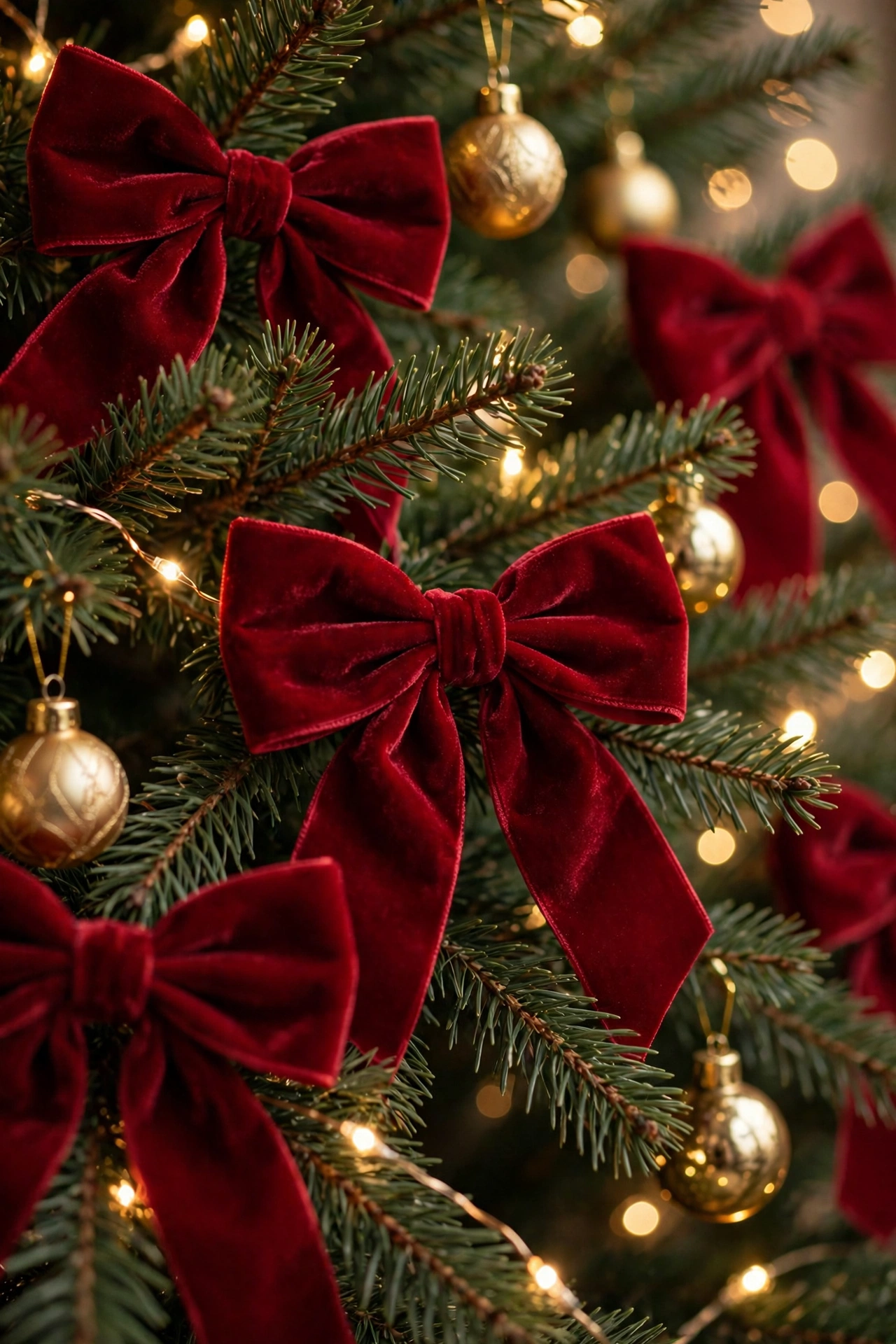
Velvet is the hero fabric of 2026. Deep burgundy velvet, forest green velvet, chocolate brown velvet, and champagne velvet are the colours the trend guides keep naming, and velvet earns its place because it photographs beautifully, it catches light without shining, and it looks expensive even on a cheap tree. Velvet is best for the big moments: the tree topper bow, the wreath bow, the mantel bows, and the stair newel bows. It is heavy, so it needs a firm anchor, a branch, a hook, or a wire, and it shows fingerprints when handled too much, so tie it once and leave it alone. One warning: velvet fades in direct sun, so keep velvet bows off sunny windows and save them for the tree, the mantel, and the interior doors.
Satin is the classic ribbon, smooth, shiny, and traditional. It suits gifts, napkins, and candle wraps, where its shine reads as celebration, and it suits a traditional red and gold tree, where shine is part of the look. Satin is harder to work with than velvet because it slips, so a satin bow needs a firmer knot and sometimes a hidden stitch or a dot of hot glue to hold its shape. Satin also frays at the cut ends, so seal the ends with a quick pass of a lighter flame or a dab of clear nail polish, and cut satin on the diagonal, which frays less than a straight cut.
Plaid is the pattern that makes a traditional house feel traditional. A burgundy, brown, and cream plaid, or a classic red and black buffalo check, carries the whole Christmas palette in one ribbon, and it works best as a garland weave on the tree, a table runner accent, and gift wrapping, where the pattern can show over a long length. Plaid is a strong voice, so use it in one or two places and let a plain ribbon support it elsewhere. A plaid tree with plaid chairs and plaid gifts is too much plaid. A plaid tree with plain velvet bows and plain cream gift ribbon is a plan.
Burlap and linen are the rustic ribbons. They suit a farmhouse tree, a wreath on a wooden door, and gifts wrapped in brown paper, and they cost very little, which makes them the best choice for a whole house on a tight budget. Burlap sheds fibres, so shake it outside before you bring it in, and keep it away from white sofas and pale cushions, because the fibres transfer. Linen is burlap’s tidier cousin, softer, less shedding, and better for napkins and chair bows, where fabric touches hands and clothes.
Width matters as much as material. The rule is three widths, widest first. A wide ribbon, two and a half to four inches, makes the big bows and the tree cascades. A medium ribbon, one and a half inches, makes the wreath bows and the garland weave. A narrow ribbon, half an inch to one inch, ties the gifts, the napkins, and the ornament clusters. Buy the wide ribbon in your hero colour, the medium in your support colour, and the narrow in a plain gold or cream that goes with both. Three widths, two colours, one house, and every bow has the right scale for its job.
The Tree: Bows, Cascades and the Bow Topper
The tree is where ribbon does its most visible work, and it is also where most people use too little of it. A tree with one small bow at the top and nothing else looks unfinished, because the eye expects ribbon to repeat down the tree the way ornaments do. A tree dressed with ribbon looks finished because the ribbon connects the ornaments, fills the gaps between branches, and gives the eye a path to follow from top to bottom.
Start with the lights, then the ribbon, then the ornaments. That order matters, because ribbon tucked under ornaments looks layered and ribbon laid over ornaments looks like an afterthought. With the lights on and the ornaments still in their boxes, you can see the tree’s shape clearly, and you can place the ribbon where the gaps are, which is exactly where it belongs. The Christmas Tree Decor Ideas guide on this site covers the full tree order in detail, and ribbon sits second in that order for a reason: it is the structure the ornaments hang on.
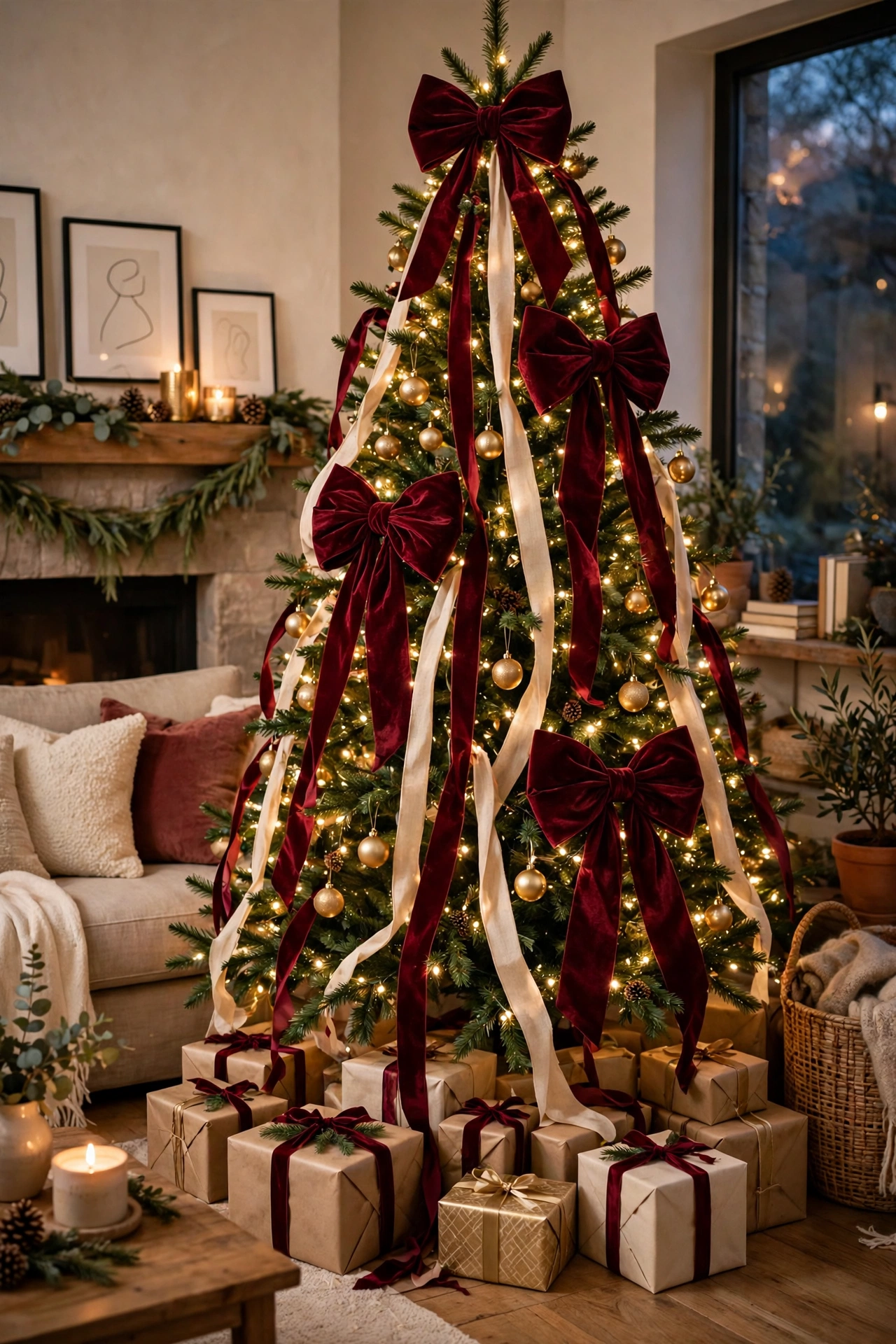
There are three ribbon methods for a tree, and each one suits a different tree and a different mood. The waterfall is the easiest and the most forgiving. Cut the ribbon into pieces two to three feet long, pinch each piece in the middle, and tuck it vertically into the branches from top to bottom, so the ribbon falls in short cascades down the tree. The pieces do not need to match, and they do not need to be straight, because the branches hide the tucks and the ribbon reads as movement. A seven foot tree takes about fifteen to twenty waterfall pieces, and the whole job takes twenty minutes.
The spiral is the classic method and the one that looks most like the trees in shop windows. Take one long length of ribbon, anchor it at the top, and wrap it loosely around the tree in a gentle spiral, tucking it into the branches every twelve to eighteen inches so it weaves rather than sits on top. Keep the spiral loose, because a tight spiral looks like a stripe and a loose spiral looks like a garland. A seven foot tree takes about 25 to 30 yards for a spiral, and it is the method that uses the most ribbon, so it suits a tree where ribbon is the main decoration and ornaments are the support.
The bows only method is the 2026 method, and it is the simplest of the three. Tie ten to twenty small to medium bows and place them evenly on the branch tips, spaced so the eye travels around the tree, with a few clustered at different heights for depth. No long lengths, no weaving, no measuring. Each bow is a moment, and the tree reads as a collection of moments rather than a wrapped object. This method suits a tree that already has strong ornaments, because the bows add texture without competing, and it suits a small tree, where a spiral would overwhelm the branches.
The topper is the bow that matters most, because it is the first thing the eye sees and the last thing you place. The 2026 tree does not end in a star. It ends in one oversized bow, burgundy velvet, taupe linen, or brown satin, with loops and long tails that trail a little down the top branches, wired at the crown where a topper would sit. Make the topper bow bigger than you think, with loops at least eight inches across, because a small bow on top of a tall tree disappears, and let the tails fall at least two feet, because the tails are what connect the topper to the rest of the tree. If you love your star, keep the star and tie the bow just below it, with the tails framing it. The star and the bow can share the crown, and the combination looks intentional when the bow matches the ribbon used lower down the tree.
One practical rule for the whole tree: use wire edged ribbon, and anchor every piece. A waterfall piece tucks into a branch and stays because the wire holds the curve. A spiral stays because it is tucked every foot and a half. A bow stays because it is wired to the branch with a short length of floral wire, not tied to it, because a tied bow slides and a wired bow holds. And keep ribbon away from real candles on or near the tree, because ribbon is fabric and fabric burns. Battery candles only, and no ribbon within a foot of any heat source, including a radiator behind the tree.
Wreaths and the Front Door: The Bow That Greets Guests
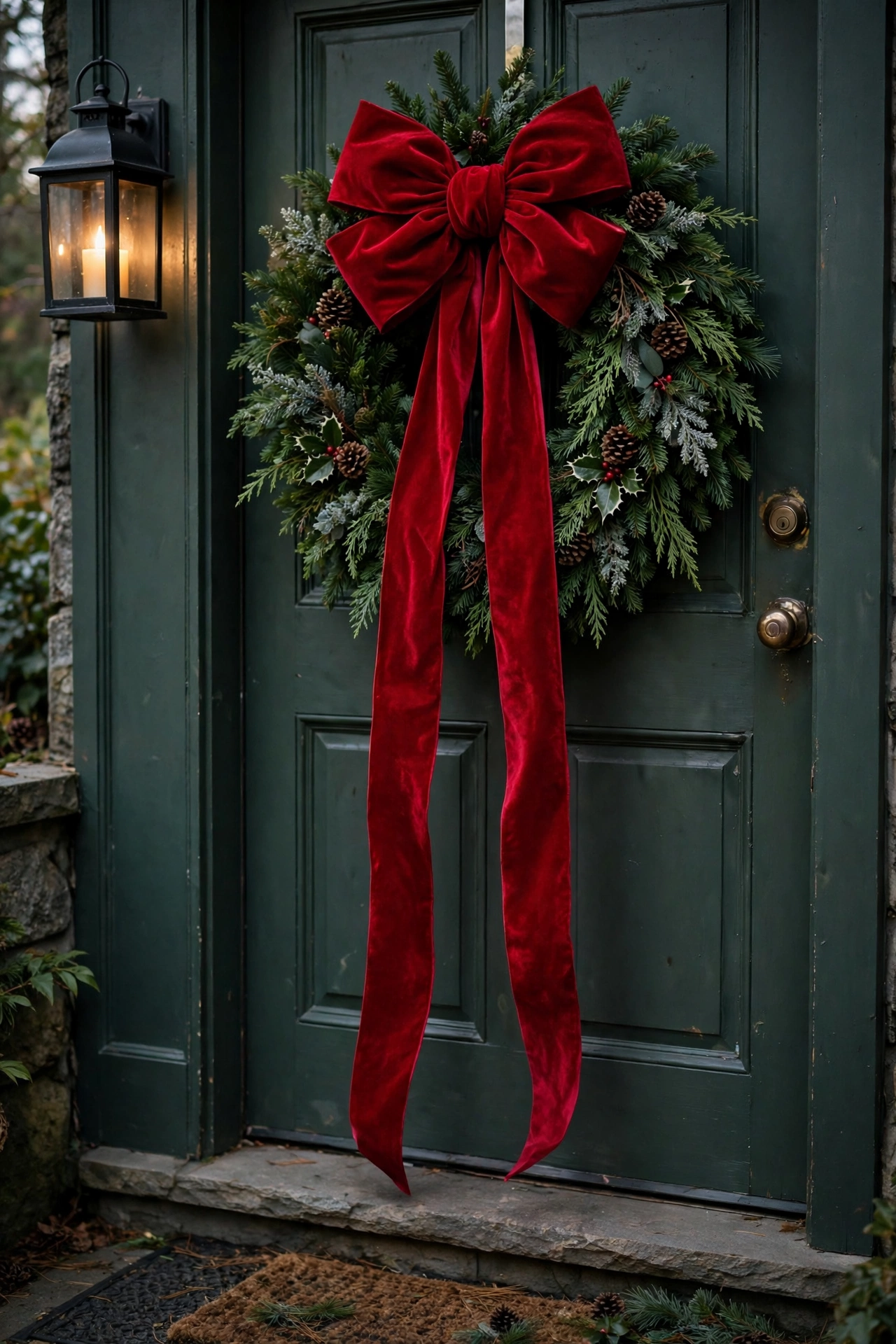
The wreath bow is the first decoration your guests touch, because it is at eye level on the front door, and it is the decoration your neighbours see most, because it faces the street. It deserves the best bow in the house, not a leftover. Make the wreath bow first, when your energy is fresh and your ribbon is uncreased, and let it set the standard for every other bow in the house.
Size is the rule here. A wreath bow should be about one third the width of the wreath itself. A twenty four inch wreath takes an eight inch bow, with loops about four inches across and tails at least twelve inches long. A smaller bow looks lost on a big wreath, and a bigger bow hides the greenery. Measure the wreath before you tie the bow, and if you are unsure, go bigger, because a bow that is slightly too big looks generous and a bow that is slightly too small looks like an afterthought.
The bow belongs at the bottom of the wreath, or at the top, but not on the side, and not in the middle. The bottom is the classic spot, because the tails fall naturally down the door and the bow reads as a finishing knot. The top is the modern spot, because the bow frames the wreath from above and the tails fall through the greenery. The side is a mistake, because a side bow makes the wreath look lopsided from the street. Pick the bottom or the top and commit to it, and use the same spot on every wreath in the house, so the wreaths feel like a set even when they are different sizes.
Velvet is the best wreath bow fabric, because it holds its loops in cold weather and it does not shine in a way that fights with the greenery. Deep red velvet on a green wreath is the traditional choice, and it works on every door colour. Forest green velvet on a green wreath is the elegant choice, because it reads as texture rather than colour, and it suits a door that already has a strong colour. Champagne velvet is the choice for a white or pale door, because it warms the door without shouting. Avoid satin on an outdoor wreath, because satin fades in sun and goes limp in damp weather, and avoid burlap on a front door wreath if your door faces a busy street, because burlap sheds and the fibres stick to coats.
Hang the wreath so the bow stays put. A wreath hanger over the door is the simplest fix, and it keeps the wreath at eye level without a nail. Wire the bow to the wreath frame with floral wire, not glue, because glue fails in cold weather and a bow that falls off a front door wreath on a windy night is a decoration lost to the street. If your door is glass, hang the wreath inside the glass with a suction hook rated for the weight, and tie the bow a little smaller, because a big bow between two panes of glass looks crowded. The Christmas Wreath Ideas guide on this site covers wreath styles and hanging in full, and the bow is the finishing layer on every one of those styles.
Do not stop at the front door. The same bow, smaller, belongs on every wreath in the house: the wreath on the mirror in the entryway, the wreath on the kitchen window, the small wreath on the bedroom door, and the wreath on the mantel mirror. Use the same hero ribbon in smaller bows, and the house feels connected, because the guest who sees the front door bow and then the entryway mirror bow knows, without thinking about it, that one person decorated this house with one idea. That is the whole point of the one ribbon rule, and the wreath is where it shows most clearly.
Mantel and Staircase: Weave Ribbon Through the Garland
Garland on its own is green and flat. Garland with ribbon woven through it is a decoration. The ribbon gives the garland its colour, its movement, and its reason to be looked at, and it is the cheapest way to make a plain garland look expensive. A ten dollar garland with a fifteen dollar ribbon looks like a fifty dollar garland, because the eye reads the ribbon, not the garland.
Weave the ribbon through the garland, do not lay it on top. Start at one end, tuck the ribbon into the greenery, let it run for about a foot, pull it out and let it drape for a few inches, then tuck it back in. The in and out rhythm is what makes the weave look natural, like the ribbon grew there, instead of looking like a stripe laid on top. Use the wide ribbon for this, two and a half to four inches, because a narrow ribbon disappears into the greenery and a wide ribbon reads from across the room. A mantel garland takes about six to eight yards woven through, and a staircase garland takes about four yards per banister section.
Add bows at the intervals, not at random. On a mantel, place a bow at each end and one in the center, three bows total, and let the woven ribbon connect them. On a staircase, place a bow at the newel post and one at each swag point where the garland dips, so the bows mark the rhythm of the stairs. The bows should match the wreath bow in fabric and colour, and they should be about the same size, because the mantel, the staircase, and the wreath are the three places the eye visits in one sweep when it enters the house, and matching bows make that sweep feel planned.
The newel post deserves its own bow, bigger than the rest, because it is the anchor of the staircase. Tie the largest bow in the house here, with loops at least six inches across and tails at least eighteen inches long, and wire it firmly to the post so it does not slide down the banister by the third day. If your staircase has two newel posts, top and bottom, dress both, with the bigger bow at the bottom where guests arrive and the smaller bow at the top where the stairs end. The Christmas Garland Decor Ideas guide on this site covers garland lengths and swag spacing in full, and the ribbon is the layer that finishes every one of those garlands.
One safety rule for the mantel, and it is not negotiable: keep ribbon away from real candles and away from the fireplace opening. Ribbon is fabric, and fabric near a flame is a fire risk. If your mantel has real candles, keep the ribbon at least a foot from every flame, and never drape a ribbon tail over a candle holder. Battery candles give the same warm light with no risk, and they let you drape ribbon as close to the candles as you like. The same rule applies to the staircase if you use real candles on the steps, which you should not, because a ribbon bow on a stair newel post and a real candle on a step is a combination that only needs one accident. Battery candles everywhere the ribbon goes, and the house stays warm and safe at the same time.
The Dining Table: Chair Bows, Napkins and Candle Wraps
The dining table is where ribbon earns its keep, because the table is where guests sit for hours, and ribbon is the decoration they actually touch. A chair bow is at hand height. A napkin ribbon is in the hand. A candle wrap is inches from the plate. Ribbon on the table is not background. It is part of the meal, and it should be chosen with the same care as the food.
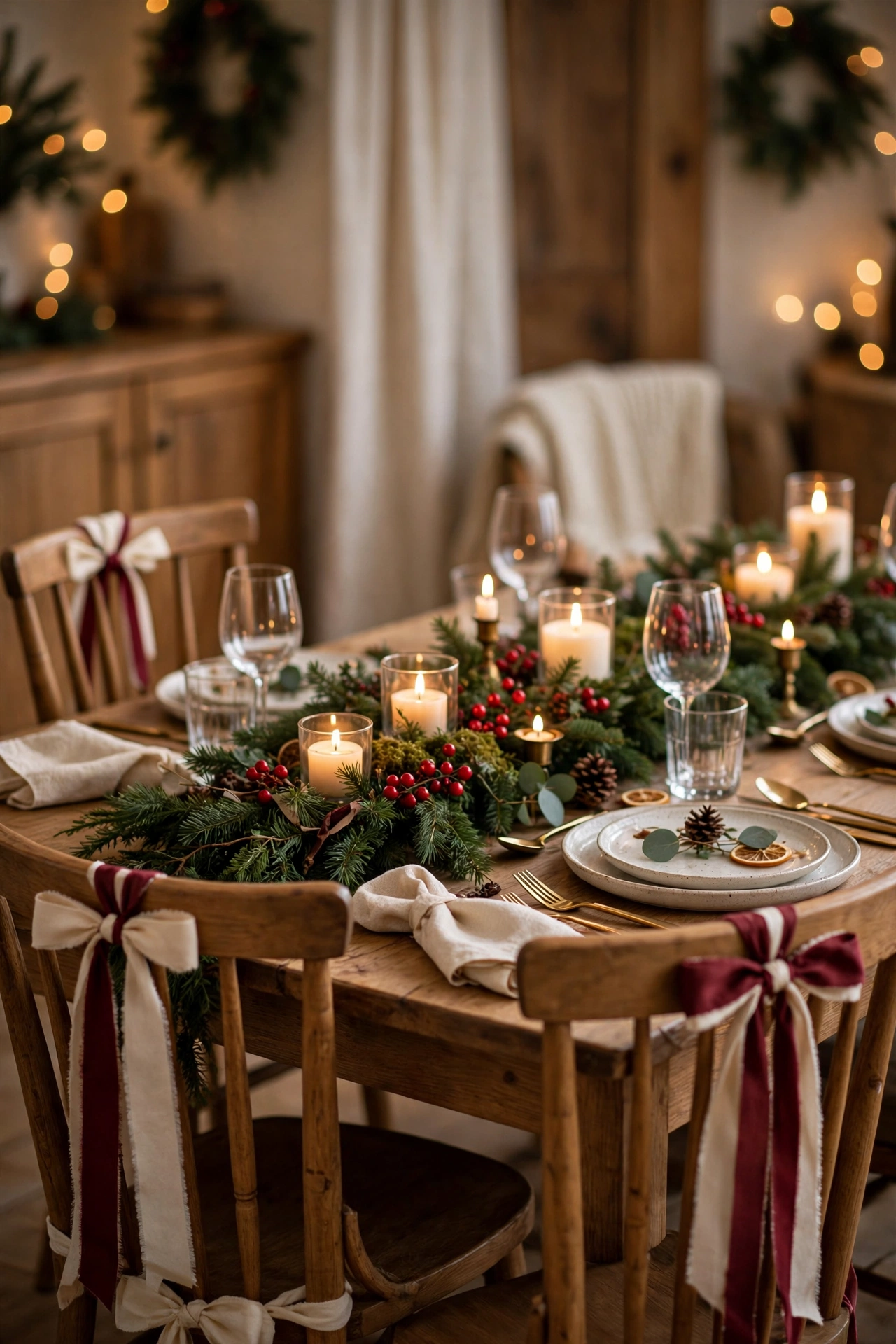
Chair bows are the simplest table decoration there is, and the most effective. Tie a bow around the back of each dining chair, at the top of the chair back, with the loops facing the room and the tails falling down the back of the chair. Use the medium ribbon, one and a half inches, in the hero colour, and tie every bow the same size, because matching chair bows read as a set and mismatched chair bows read as a mistake. If you have more than six chairs, dress every second chair instead of all of them, because a row of identical bows is elegant and a row of six identical bows can feel like a uniform. The chairs at the ends of the table, the host chairs, get the biggest bows, and the side chairs get the smaller ones, which gives the table a natural hierarchy without a word being said.
Napkin ribbons are the small touch that makes guests feel looked after. Roll each napkin, tie it with a narrow ribbon, half an inch to one inch, in the support colour, and tuck a sprig of greenery or a cinnamon stick under the knot. The ribbon should be easy to untie with one pull, because a guest struggling with a knot is a guest not enjoying dinner. Tie a simple bow, not a double knot, and test it yourself before the guests arrive. If you cannot untie it with one hand, it is too tight. A napkin ring does the same job, but a ribbon does it warmer, because ribbon is soft and a ring is hard, and the table already has enough hard things on it.
Candle wraps are the ribbon job that needs the most care, because candles and fabric are a combination that demands respect. Wrap the ribbon around the outside of a glass hurricane or a candle holder, never around a bare candle, and never where the ribbon can touch a flame. The safe method is a glass hurricane with a battery candle inside, the ribbon tied around the outside of the glass, where it catches the light through the glass and glows without any risk. A real candle in a glass holder with a ribbon wrapped around the outside of the glass is safe, because the glass is between the ribbon and the flame. A real candle with a ribbon tied directly around the wax is not safe, and it should never be done, no matter how pretty it looks in a photograph. Photographs do not show the fire that came after.
The table runner is the last ribbon on the table, and it is the one that ties the chairs and the napkins together. Run a wide ribbon down the center of the table, under the garland or the centerpiece, with the ends falling over the table edges by about six inches. The ribbon runner replaces a fabric runner, costs almost nothing, and carries the hero colour down the whole length of the table, so the chairs, the napkins, and the centerpiece all sit on the same colour story. Keep the runner flat and smooth, because a wrinkled ribbon runner looks like a mistake, and press it with a cool iron before the meal if it has been stored folded. A ribbon runner with a low garland on top of it is the whole tablescape, and it takes ten minutes to set up and thirty seconds to clear when dinner arrives.
Gifts, Planters and Small Touches: Ribbon Beyond the Big Spots
The big spots, the tree, the wreath, the mantel, the staircase, and the table, take most of the ribbon, but the small spots are where the house starts to feel truly decorated, because they are the places guests notice when they are not looking at the big things. A bow on a planter, a ribbon on a gift, a tie on a stocking, and the house feels finished in the corners as well as the center.
Gift wrapping is the ribbon job most people already know, and the one most worth doing well, because gifts sit under the tree for weeks and they are the first thing children look at on Christmas morning. Wrap the gifts in plain paper, brown kraft paper or plain cream paper, and let the ribbon do the work. A wide velvet ribbon around a plain box looks more expensive than a patterned paper with a thin ribbon, because the eye reads the ribbon as the decoration and the paper as the background. Tie the bow on top, with the loops generous and the tails long enough to curl, and match the ribbon to the hero ribbon on the tree, so the gifts under the tree look like they belong to the tree above them. The gift wrapping guide on this site covers paper and techniques in full, and the ribbon is the layer that makes every one of those techniques look finished.
Planters are the small spot most people forget, and the easiest to dress. Tie a bow around the pot of every plant in the house, the potted evergreen by the door, the rosemary on the kitchen windowsill, the poinsettia on the console, and the plants stop looking like houseplants and start looking like Christmas plants. Use the narrow ribbon for small pots and the medium ribbon for large pots, and tie the bow at the front of the pot, facing the room, with the tails short enough that they do not trail into the soil. A bow on a planter takes thirty seconds and it is the decoration guests notice when they are standing in the hallway waiting for the door to open.
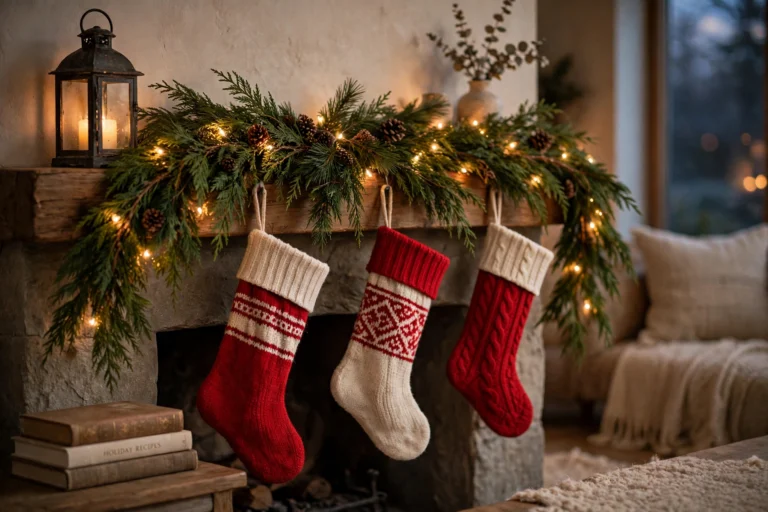
Stockings need ribbon too, and they need it in two places. Tie a small bow at the top of each stocking, where it hangs from the mantel, and the stockings look finished instead of hung. Then tie a narrow ribbon loop at the back of each stocking, to hang it from, because a ribbon loop is stronger than a thumbtack and gentler on the mantel than a nail. Use the support ribbon for the stocking loops, because the hero ribbon is too heavy for a small loop, and match the bow colour to the stocking colour, not to the hero ribbon, because a red bow on a red stocking disappears and a cream bow on a red stocking sings.
The small touches continue: a ribbon tied around the vase on the console, a ribbon around the basket of blankets by the sofa, a ribbon around the jar of candy canes on the kitchen counter, a ribbon around the photo frames on the hallway shelf. None of these takes more than a minute. All of them use the leftover ribbon from the big jobs, the short pieces too small for a tree cascade but perfect for a jar. Keep a basket of ribbon offcuts by the wrapping station, and every small touch in the house gets dressed from the same roll, which is how the whole house ends up speaking the same language without a single extra purchase.
Buy Once, Store Flat: Budget, Storage and Safety
Ribbon is the cheapest Christmas decoration per yard, and it is also the easiest to waste, because a tangled roll is a ruined roll and a creased ribbon is a ribbon that will never bow properly again. Buy well, store well, and one roll will last three Christmases, which is the real budget secret: ribbon is not a yearly purchase, it is a three year purchase, if you treat it right.
The budget is simple. A whole house takes about 50 to 60 yards of hero ribbon and about 20 yards of support ribbon, and a 50 yard roll of good wired velvet costs less than one box of quality ornaments. Buy the hero ribbon by the large roll, not by the small spool, because the price per yard drops sharply on the large roll, and a small spool runs out halfway through the tree, which is the worst place to run out. Buy the support ribbon by the medium roll, and the narrow ribbon by the small spool, because you use less of each. If the budget is very tight, buy one hero ribbon and use plain twine as the support, because twine costs almost nothing and it suits a rustic house perfectly. The house does not need three ribbons. It needs one good one, repeated well.
Storage is where ribbon lives or dies. Never stuff ribbon into a box. Roll it back onto its spool, or wrap it around a flat piece of cardboard, and store it flat, in a labelled bag, away from sun and damp. A ribbon stored flat keeps its shape. A ribbon stuffed into a box comes out creased, and a creased ribbon will not hold a bow, no matter how much you fluff it. Iron a creased ribbon on the lowest setting, with a cloth between the iron and the ribbon, and it will mostly recover, but prevention is better than repair. Label each roll with its colour and width, because next December you will not remember which burgundy is velvet and which is satin, and the label saves an hour of guessing.
Safety is the part of this guide that matters most, because ribbon is fabric and fabric burns. Keep ribbon at least a foot from every real flame, every candle, every fireplace opening, and every hot radiator. Use battery candles wherever ribbon and candles share a surface, which is the mantel, the dining table, and the staircase. Keep ribbon away from the stove in the kitchen, where a trailing tail can catch on a hot pan. Keep ribbon out of reach of small children and pets, because a long ribbon tail is a strangulation risk for a toddler and a chewing temptation for a cat, and a bow at a child’s height should have short tails, no longer than six inches. These rules are not decorations. They are the conditions that let the decorations stay up all December without an accident, and a house that is safe is a house that can be enjoyed.
One last budget note: buy the ribbon in November, not December. The best velvets sell out by the second week of December, and the ribbon that is left is the ribbon nobody wanted. Buy early, buy the large roll, store it flat, and the house will be dressed before the tree is even up, because the ribbon is the decoration that starts the season, and it is the decoration that finishes it too.
Conclusion
A roll of ribbon is the smallest Christmas purchase you will make, and it is the one that changes the most. One ribbon, repeated on the tree, the wreath, the mantel, the staircase, the chairs, and the gifts, turns a house full of separate decorations into a house with a plan. Two ribbons, a hero and a support, give the plan its depth. Three widths give every bow its scale. Wired ribbon gives every bow its shape. And a little care with candles and children keeps the whole thing safe all December.
Start with the wreath bow, because it is the first thing guests see. Then the tree, because it is the biggest job. Then the mantel and the staircase, because they connect the rooms. Then the table, because it is where everyone sits. Then the gifts and the planters, because they are the finishing touches. Work in that order, and the house will feel more decorated with every step, instead of feeling half finished until the last minute.
You do not need a bigger budget to have a better Christmas. You need one good ribbon, enough of it, and the patience to repeat it. Tie the first bow badly, tie the second one better, and by the fifth bow you will be tying bows like you have done it for years. The house will glow, the guests will ask where you bought the decorations, and the honest answer will be that you bought one roll of ribbon and used it everywhere. That is the whole secret, and it costs less than a single box of ornaments.