Christmas Napkin Ring Ideas That Finish Every Place Setting
A Christmas napkin ring is the smallest piece of decor on the whole table, and it is the one your guests notice first. Nobody remembers the tablecloth. Everybody remembers the tiny thing at their own place setting. A napkin ring is the detail that says this seat was set for you, not just set. It takes a folded napkin, which is a practical thing, and turns it into a finished thing, which is a welcoming thing. That is the whole job of a napkin ring, and it does it in about ten seconds per setting.
I learned this the year I hosted Christmas dinner and thought I had finished the table. The cloth was down, the runner was straight, the placemats were in place, the plates were stacked, the candles were lit. I stood back and the table looked good, but it looked like a photograph of a table, not a table waiting for people. My sister picked up a napkin, rolled it loosely, tied a short length of red velvet ribbon around the middle, and finished it with a soft bow. She did the same at every seat. It took her four minutes. The table changed completely. Every setting suddenly had a centre, a small point of colour and shape that pulled the eye to the plate. The napkins stopped looking like laundry and started looking like part of the decoration. Four minutes, one spool of ribbon, and the table went from staged to set.
That is the promise of this guide. Napkin rings are cheap, they are quick, and they are the highest impact detail on a Christmas table for the money and the time they take. You can buy them, you can make them in an afternoon, and you can make most of them from things already in your house. This guide covers the sizing rule that stops a ring looking wrong, wood bead rings, velvet ribbon bows, twine and greenery rings for a farmhouse table, gold and brass rings for an elegant table, mini wreath rings, rings made from things you already own, and how to set the whole table so the rings, the placemats, the runner and the cloth all work together. For the layers underneath the rings, our Christmas placemat guide covers the mat under every plate, our Christmas tablecloth guide covers the full cloth, and our Christmas table runner guide covers the strip down the middle.
1. The Sizing Rule: How a Napkin Ring Should Fit
Every napkin ring decision starts with size, because a ring that is too tight crushes the napkin into a hard little roll, and a ring that is too loose slides down to the plate and looks like a mistake. The standard inside diameter for a napkin ring is 4 to 5 centimetres, or about 1.5 to 2 inches, and that size fits a standard cloth napkin folded or rolled in the usual ways. If you buy one size and never think about it again, buy this one. It works for linen napkins, cotton napkins, and the thick paper napkins sold for Christmas dinner, and it works whether you roll the napkin or fold it flat and slip it through.
Before you buy or make a set, test the fit with the actual napkins you plan to use. Fold a napkin the way you will fold it on the night, slide the ring over it, and look at three things. First, the napkin should pass through without a fight. If you have to force it, the ring is too small, or the fold is too fat, and you should use a looser fold or a bigger ring. Second, the ring should sit in the middle of the napkin and stay there when you lift the napkin by one end. If it slides straight off, the ring is too big or the napkin is too thin, and a thicker napkin or a smaller ring will fix it. Third, the napkin should keep its shape. A good ring holds a loose roll open at both ends, like a scroll, and the ends should fan out a little on the plate. If the ends are squeezed shut, the ring is too tight.
The fold changes the fit more than most people expect. A napkin rolled loosely into a tube needs a ring at the wider end of the range, about 5 centimetres. A napkin folded flat into a rectangle and slipped through a ring needs a ring at the narrower end, about 4 centimetres, because the flat fold is thinner than a roll. A napkin folded into a tree shape or a fan needs no ring at all, because the fold is the decoration, and a ring would only crush it. Choose the fold first, then choose the ring to match it, not the other way round.
Paper napkins need a different approach. A paper napkin is thinner than cloth, so a standard ring will slide off it. If you want to use rings with paper napkins, fold the paper napkin twice so it is four layers thick, or wrap the paper napkin around a cloth napkin, or choose a ring with a grippy lining, like a fabric covered ring or a beaded ring whose beads catch the paper. The simplest answer is to save the rings for cloth napkins and let paper napkins stand on their own, folded into a tree or a fan. Rings are a cloth napkin detail, and that is fine.
One more sizing note, and it is the one people forget. Buy or make one more ring than you have chairs. A spare ring covers a last minute guest, a ring that rolls under the table, or a ring that breaks when a child pulls at it. Napkin rings are sold in sets of four and six, so buy the set that covers your usual table plus one, and keep the spare in the cupboard with the napkins. It costs almost nothing, and it saves the setting at least once every December.
2. Wood Bead Rings: Warm, Natural and Easy to Make
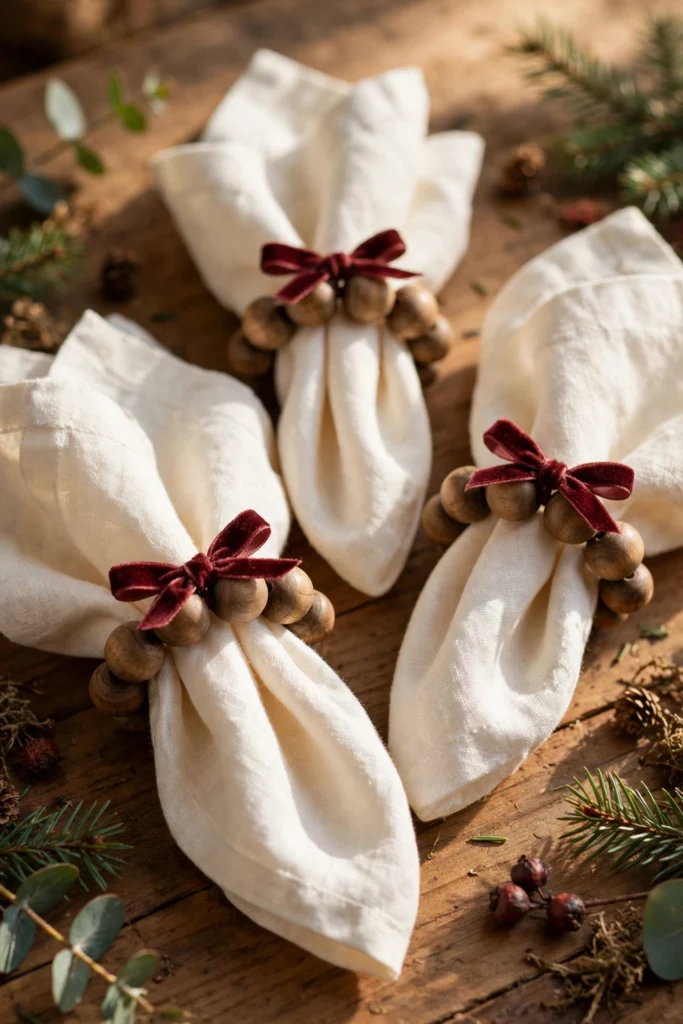
Wood bead napkin rings are the easiest DIY napkin rings you can make, and they are the warmest looking rings you can put on a Christmas table. A ring of natural wood beads, threaded on elastic cord and finished with a small burgundy bow, looks handmade in the best way, like something you made with care rather than something you bought in a hurry. The wood brings a natural texture to a table that is otherwise cloth, glass and metal, and the burgundy bow brings the Christmas colour without shouting.
Making a set of four takes about thirty to forty five minutes, and you need only a ruler, scissors, wood beads, elastic beading cord, ribbon, and the napkins themselves. Each ring uses eighteen beads, 8 millimetres wide, threaded on a 10 inch length of 0.8 millimetre elastic cord. Tie the cord in a firm knot, hide the knot inside a bead, and tie a 12 inch length of burgundy grosgrain ribbon around the ring in a small bow. The planned opening is about 1.5 inches, but the resting size may be smaller because the beads take up space, so test the fit with your napkin before you make all four. Fold the napkin loosely so it can pass through the ring without being squeezed into a tight roll, and a finished ring should sit on the napkin without a strained cord or a crushed fold.
The colour of the beads changes the feel of the ring completely. Natural unfinished wood beads feel warm and relaxed, and they suit a farmhouse table, a wooden table, and a table with a lot of greenery. Stained dark walnut beads feel richer and more formal, and they suit a table with gold cutlery and deep red linen. Painted beads in cream, sage green or dusty red let you match the rings to the rest of the table exactly, and a set of painted beads in the same red as your placemats ties the whole setting together without a single matching purchase. If you paint the beads, paint them before you thread them, let them dry fully, and seal them with a clear matt varnish so the paint does not rub off on the napkins.
The bow is where the Christmas comes in. A burgundy grosgrain bow is the classic choice, and it works with almost any table. A deep green velvet ribbon bow feels richer and suits a dressier table. A thin gold cord tied in a small knot feels modern and suits a table with a lot of metal. Keep the bow small. A bow wider than the ring itself looks like a gift tag, not a napkin ring, and it will flop forward onto the plate. Trim the tails on a diagonal so they do not fray, and tie the bow after the ring is on the napkin, so it sits on top where everyone can see it.
Wood bead rings are also the most forgiving rings to make with children. The threading is simple, the materials are cheap, and a bead dropped on the floor is a bead you can pick up and use again. Make the rings together the weekend before Christmas, let each child make their own set, and let them choose their own ribbon colour. The rings will not match perfectly, and that is the point. A table where every ring is slightly different, and every ring was made by someone at the table, is a table with a story, and that story is worth more than a perfect set from a shop.
3. Velvet Ribbon Bows: The Most Pinned Detail of the Season
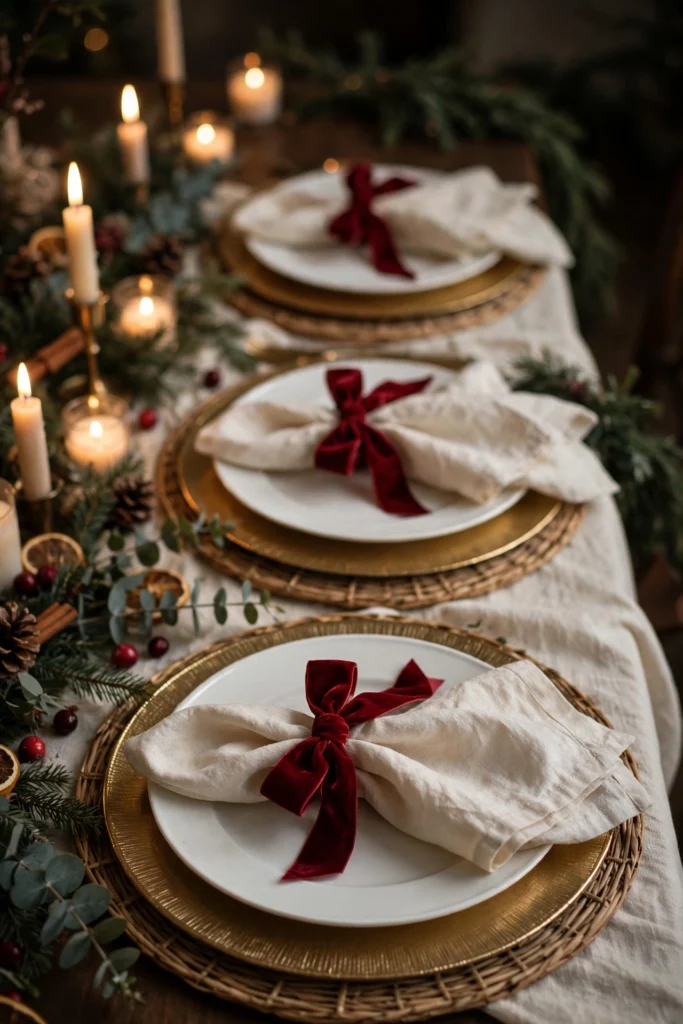
If one napkin detail defines Christmas tables this year, it is the velvet bow. Roll a napkin, tie it with a length of velvet ribbon, and finish with a soft bow, and you have the most pinned detail of the season, according to the roundups filling Pinterest boards right now. It is not a ring you buy. It is a ribbon you tie, and that is why it works so well. A velvet bow is soft, it is cheap, it repeats the ribbon story from your tree and your wreath, and it makes every guest feel the table was set for them personally.
The method is simple, and the simplicity is the point. Cut 30 inches of 1.5 inch velvet ribbon per napkin. Fold a cream napkin in thirds, then roll it loosely. Tie a single knot at the centre and pull it snug, then form the loops and trim the tails on a diagonal. Set the rolled napkin on the charger or the plate, slide in the gold flatware beside it, and you are done. Fifteen minutes for six settings and roughly eight dollars of ribbon, and the whole job can be done the night before. Rolled napkins relax overnight and the bows sit flatter in the morning, so the night before is actually the better time to do it.
The colour of the ribbon is where you make the table yours. Deep red velvet on a cream napkin is the classic Christmas look, and it works on almost any table. Deep green velvet on a white napkin feels cooler and more elegant, and it suits a table with a lot of greenery and gold. Black velvet on a cream napkin is the boldest choice, and it suits a modern table, a table with black cutlery, or a table where everything else is deliberately simple. Gold velvet on a deep red napkin is the richest choice, and it suits a candlelit dinner where the ribbon catches the light. Choose one ribbon colour and use it at every seat. Do not mix red bows at one end and green bows at the other, because the table will look like two different dinners.
The bow itself needs care. A velvet bow that is too big overwhelms the napkin and flops onto the plate. A bow that is too small disappears into the fold. The right size is a bow about as wide as the napkin is thick, with loops that stand up a little and tails that hang about two inches below the knot. Tie the knot firmly, because velvet is slippery and a loose knot will work itself undone during dinner. If the bow will not hold, a single stitch through the centre of the knot, or a tiny dot of fabric glue on the back of the knot, will hold it for the whole evening and wash out later.
Velvet ribbon bows also solve the problem of a plain table. If your tablecloth is plain cream, your plates are plain white, and your centrepiece is a simple row of candles, a red velvet bow at every seat adds the Christmas colour without you buying anything else. It is the cheapest way to make a table look like Christmas, because one spool of ribbon costs less than one set of napkin rings, and it changes the table more. If you are decorating on a budget, start here. Buy the ribbon first, then decide if you need anything else, and most years you will find you do not.
One practical note. Velvet ribbon creases if it is stored folded tightly, so store the cut lengths flat or rolled loosely around a cardboard tube, and steam them lightly before you tie them. A creased bow looks tired before dinner starts. A smooth bow looks like you planned it, and planning is the whole secret of a table that looks effortless.
4. Twine and Greenery Rings for a Farmhouse Table
Twine napkin rings are the five minute detail that makes a whole Christmas table look pulled together, and they cost almost nothing. A single ball of twine makes a dozen or more rings, each one takes about five minutes, and the whole set can be batched in one sitting while you watch a film. If you are setting a cozy farmhouse table this Christmas, these are the easiest win on the whole spread, and you will not buy a set of rings again once you have made them.
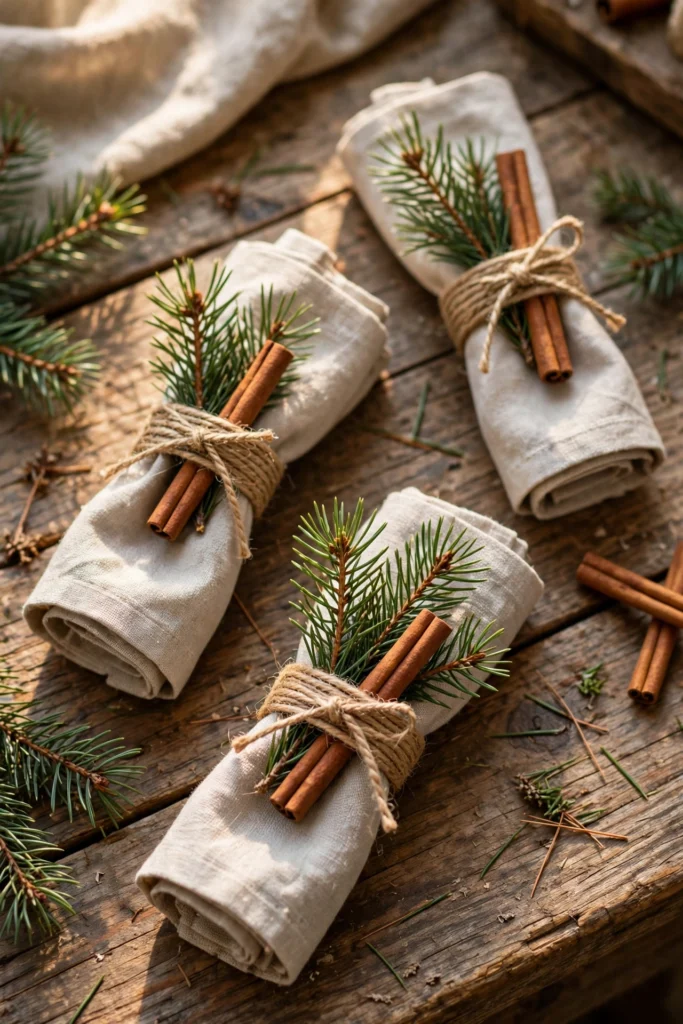
The method needs only twine or jute, a pair of scissors, a hot glue gun, and a few faux greenery sprigs. Size the loop by wrapping the twine around a rolled napkin, or around a spice jar, which is just about the right size, a few times to get the diameter you want. Wind the twine around itself six to eight times to make a sturdy band, then tie off the ends with a small knot. Snip a small sprig of faux greenery, eucalyptus, pine or boxwood all work beautifully, and hot glue it right over the knot to hide it. Add an accent if you like, a cinnamon stick, a mini pinecone, a berry pick, or a tiny jingle bell, and the ring is done.
The greenery is what makes the ring look finished. A bare twine band looks like a craft project. A twine band with a sprig of eucalyptus glued over the knot looks like a piece of decor, because the eye reads the greenery as the point of the ring and the twine as the frame that holds it. Use faux greenery, not fresh, because fresh greenery wilts in the warmth of a dining room and drops needles on the plate. Faux greenery lasts for years, not one dinner, and the same rings come back every Christmas looking exactly the same.
One base ring gives you four different looks, and that is the real value of the twine ring. Farmhouse is twine with a sprig of eucalyptus. Rustic cabin is jute with a cinnamon stick and a mini pinecone. Elegant is gold or metallic twine with boxwood. Festive is a tiny jingle bell or a red berry pick. Make one base ring, change the accent, and you have a different table. Make a different accent for each guest, and every setting feels personal. The cinnamon stick is the favourite accent for a reason. It looks rustic and the table smells amazing, which is a kind of decor no photograph can show.
Twine rings also pair beautifully with the rest of a farmhouse table. They sit naturally on a woven placemat, beside a linen napkin, under a wooden charger, and they do not fight with a garland centrepiece, because they are the same language. Twine, wood, greenery, candlelight. If your table already speaks that language, the rings will sound like they belong. If your table is formal, with gold chargers and crystal glasses, twine rings will sound like a guest who came to the wrong party, so save them for the farmhouse table and choose gold or brass for the formal one.
Store twine rings in a small box with tissue paper between them, and keep the box with the Christmas decorations. The greenery can be crushed if the rings are thrown in a bag, and a crushed sprig is the one thing that makes a twine ring look tired. Treated gently, a set of twine rings will last five Christmases or more, which makes them the cheapest rings on this list by a very long way.
5. Gold and Brass Rings for an Elegant Table
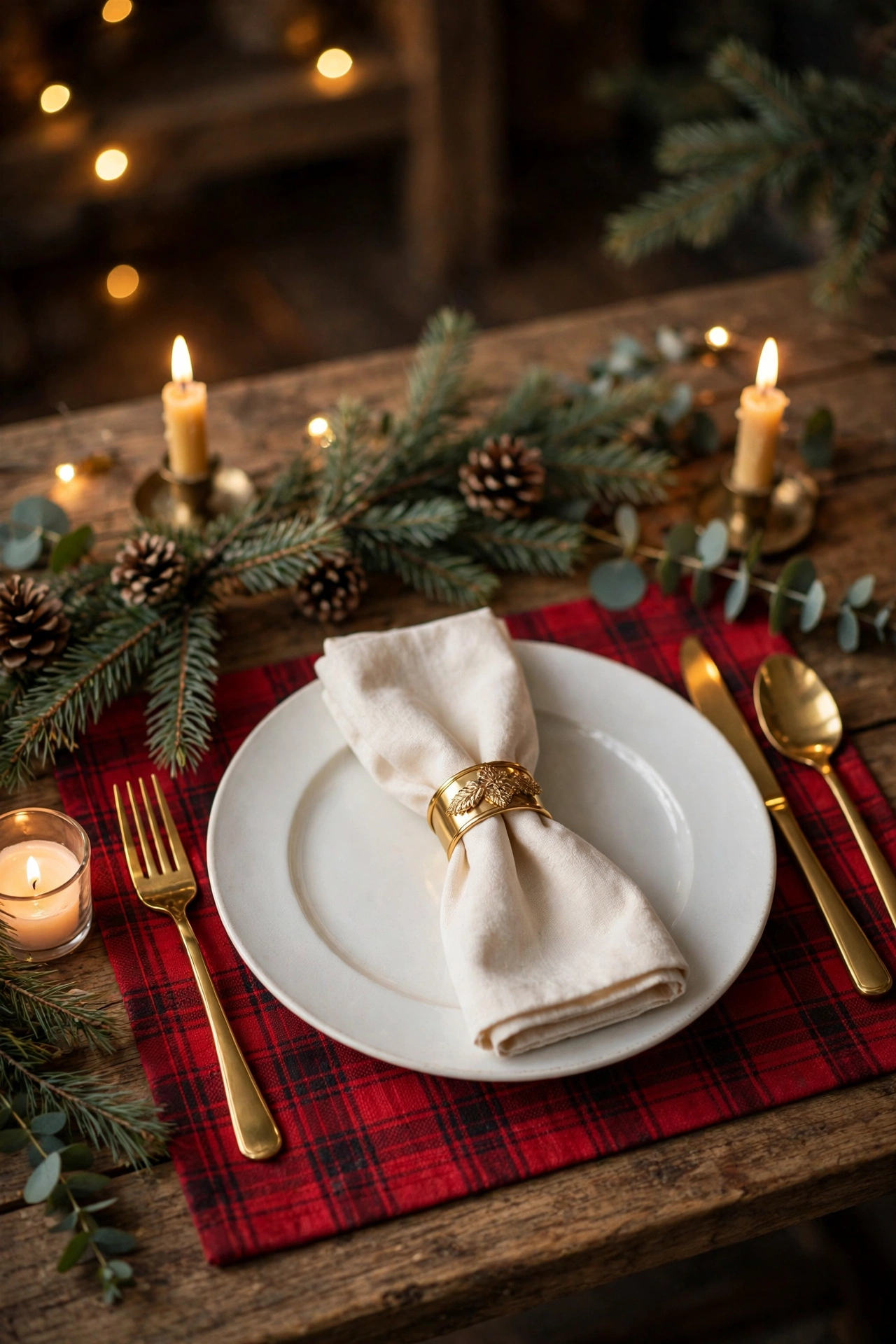
Some Christmas tables want to feel dressed up, and for those tables the napkin ring should be gold or brass, with no pattern and no craft supplies involved. A gold bow napkin ring, slipped over a plain white or cream napkin, gives each setting a finished, jewel like moment without any folding skills at all. It is a bow you do not have to tie, a piece of metal that does the work of a ribbon and a knot in one small sculpture. Gold bow rings are the retail led detail of the season, small, sculptural, endlessly reusable, and they look expensive because they catch the candlelight every time someone reaches for their glass.
The rule for metal rings is repetition. If you are mixing metals elsewhere on the table, let the rings be the one repeated finish at every place. Gold cutlery, brass candlesticks, a silver charger, a copper mug. A table can carry mixed metals, but only if one metal repeats at every seat and anchors the eye. The napkin ring is the perfect anchor, because it sits at every place, at the same height, in the same shape, and the eye reads that repetition as luxury. Mix the metals everywhere else, keep the rings the same, and the table will look collected, not confused.
Gold rings come in more shapes than most people expect. A plain smooth gold band is the quietest choice, and it suits a table where the plates are already patterned. A gold bow ring is the most festive choice, and it suits a plain white plate and a plain cream napkin, because the bow is the decoration. A gold snowflake ring, a small snowflake in gold metal that holds a folded linen napkin on top of each plate, is the detail guests actually notice, because it is the one piece of decor at their own place that is not a plate or a glass. A brass ring, which is warmer and less shiny than gold, suits a table with a lot of wood, a table with a red tablecloth, or a table where the gold would feel too bright.
The napkin matters as much as the ring. A gold ring on a white linen napkin is the classic elegant setting, and it has stayed classic because it works every single year. A gold ring on a deep red napkin is richer and moodier, and it suits a candlelit dinner. A gold ring on a plaid napkin is a mistake, because the plaid and the metal fight each other, and the eye does not know where to rest. Let the ring carry the shine, and let the napkin stay calm around it. Roll a cream linen napkin, slide the gold ring to the middle, and fan the ends out slightly on the plate. It takes ten seconds per setting, and it is the detail your guests will comment on.
Metal rings are the most durable rings on this list. They do not stain, they do not crush, they do not fade, and they do not need to be remade. Wipe them after dinner, dry them properly so water spots do not form, and store them in the box they came in, with tissue paper between them so they do not scratch each other. A set of six gold rings costs about twenty two dollars, and it will last twenty Christmases. That is about a dollar a year for the detail that makes the table look finished, which is the best value on this list after twine.
One warning about metal rings. Check the inside of the ring before you buy it. A cheap metal ring can have a rough seam or a sharp edge inside that snags a linen napkin and pulls a thread. Run your finger around the inside of the ring in the shop. If it feels rough, do not buy it, or line it with a thin strip of ribbon before you use it. A snagged napkin is a ruined napkin, and a ruined napkin is the one thing a guest will notice more than the ring.
6. Mini Wreath Rings: Greenery at Every Seat
Mini wreath napkin rings are the prettiest rings on this list, and they are also the most useful, because a mini wreath ring is a piece of the Christmas tree at every seat. Slip a folded napkin into a mini greenery wreath and you are done. It is polished, festive, endlessly customizable, and it takes no skill at all. A mini wreath ring is the ring for the host who wants the table to look like a lot of work went into it, when in fact almost none did.
You can buy mini wreath rings, or you can make them in about ten minutes each. Form a ring with floral wire, then wrap it with faux or fresh greenery and berries. Add a ribbon tail or a little bell for a charming finish. The wreath should be about 5 centimetres across, which is big enough to read as a wreath and small enough to sit on a plate without covering it. If the wreath is bigger than the plate, it is not a napkin ring. It is a centrepiece that got lost.
Fresh greenery looks better than faux for about three hours, and then it starts to wilt. Faux greenery looks good for three years. For a dinner that lasts all evening, in a warm room, with candles burning, faux is the practical choice. The one exception is a short lunch, where fresh greenery will hold its shape and smell wonderful. If you use fresh greenery, make the rings the morning of the dinner, keep them in a cool room until the table is set, and expect to throw them away after. If you use faux, make the rings once and keep them with the Christmas decorations.
The greenery you choose changes the feel of the ring. Pine and fir feel traditional and smell like Christmas, even in faux form. Eucalyptus feels softer and more modern, and it suits a table with a lot of white and cream. Boxwood feels neat and formal, and it suits an elegant table with gold rings elsewhere. Holly, with its red berries, is the most festive choice, but real holly is prickly, so use faux holly and keep it away from small children. Add one accent only. A red berry pick, a tiny bell, a small pinecone, or a short ribbon tail. Two accents make the wreath look busy, and a busy wreath on a small ring looks like a craft project that got away from you.
Mini wreath rings double as take home favours, which is a lovely touch for a family dinner. At the end of the meal, each guest takes their wreath home and hangs it on their own tree, or on a door handle, or on a present. It costs you nothing extra, and it turns a piece of table decor into a memory. If you plan this, make the wreaths sturdy, tie the ribbon tail firmly, and tell your guests as they sit down that the wreath is theirs to keep. A guest who knows the wreath is a gift will treat it gently. A guest who thinks it belongs to you will leave it on the plate.
Style mini wreath rings with gingham napkins for cozy cottage vibes, or with linen napkins for modern elegance. The gingham brings the pattern, the wreath brings the greenery, and together they make a setting that looks like it came from a magazine. The linen brings the calm, the wreath brings the colour, and together they make a setting that looks like it came from a restaurant. Either way, the wreath is the star, so keep everything else at that seat simple. A plain plate, plain cutlery, a plain glass, and a wreath that does all the talking.
7. Rings Made From Things You Already Own
The best Christmas napkin rings are often the ones you do not buy at all. Look around your house before you go shopping, because the materials for a beautiful set of rings are probably already in a drawer, a craft box, or the bottom of a Christmas decoration box. Rings made from things you already own cost nothing, they look personal, and they are the rings your guests will ask about, because nobody else has a set like them.
Leather is the most surprising material, and it makes the most expensive looking rings. An old leather bag, an old pair of boots, or a scrap of leather from a craft stash can become a set of high end napkin rings for a few dollars of hardware. Cut the leather into strips about 8 inches long, punch two holes, add a small button rivet, and you have a ring that looks like it cost a hundred dollars for a set of four. A thrifted leather bag costs a few dollars, the hardware costs about seven dollars, and a set of twelve rings can be made for around thirty dollars at the most. The finished ring is real leather, beautifully stitched if you want stitching, with a raised button that holds it closed. Skip the stitching if you are not a sewer. The ring still looks gorgeous, and it is beginner friendly. The Ralph Lauren style leather rings sell for a hundred and twenty five dollars a set, and the high low version you make at home will fool everyone at the table.
Fabric scraps make the softest rings. Twelve assorted strips of festive fabric, one inch by ten inches, sewn together along the long edges, backed with a small piece of interfacing, make a patchwork ring about two inches by six inches that uses up the treasured scraps you did not want to throw away. The project is a speedy little seasonal sewing job, it needs no large pieces of fabric, and it pairs beautifully with a matching patchwork placemat if you have the fabric for it. Fussy cut a small motif, a star, a tree, a reindeer, and applique it to a plain napkin to match, and the whole setting looks planned, not patched.
Ornaments make the quickest rings of all. A tiny Christmas ornament, a glitter reindeer, a small bell, a snowflake, tied to a napkin with a length of ribbon, turns the napkin into a little gift moment. Dollar store ornaments are perfect for this, because they are light, they are cheap, and they come in sets that match the tree. Thread the ribbon through the ornament loop, tie it around the rolled napkin, and finish with a bow. Each design takes only a few minutes to make, and you can choose to make all of the same design or mix it up with several different designs, one for each guest. A guest who finds a tiny reindeer on their napkin will remember it long after they forget the dinner.
Decoupage makes the most delicate rings. Cut a poinsettia from a paper napkin, glue it to a plain ring form, add six small beads in the centre with a drop of quick drying glue, and you have a ring that looks like it came from a craft fair. Paper napkins are only five inches square, but that is the perfect size for a napkin ring, and the poinsettia is the perfect flower for it, because it is the traditional Christmas flower and it brings the beauty of a real bloom to each place setting without a single real flower in the house. The decoupage ring is fragile, so it is a ring for adults, not for a table full of children, and it should be stored flat in tissue paper between Christmases.
The rule for rings made from things you own is to make one first and test it. Make a single ring, put it on a napkin, set it on a plate, and look at it from across the room. If it reads as a napkin ring, make the rest. If it reads as a craft project, change one thing, the size, the colour, the accent, and test again. One test ring saves you an evening of making a set nobody likes, and it is the difference between a ring that looks handmade and a ring that looks homemade.
8. Setting the Whole Table: Rings With Placemats, Runners and Cloths
A napkin ring does not sit on the table alone. It sits on a napkin, on a plate, on a placemat, on a tablecloth, with a runner down the middle and a centrepiece above it all, and the whole table only works when the layers work together. The ring is the smallest layer, and that is why it is the easiest layer to get wrong. A ring that fights the placemat will ruin a setting that everything else got right.
The layering order is simple, and it never changes. Tablecloth first, then runner down the centre, then placemat at each seat, then plate on the placemat, then napkin on the plate, then ring around the napkin. Each layer should be visible, and each layer should be a different texture or a different shade, so the eye can read the stack. A cream cloth, a narrow red runner, a woven placemat, a white plate, a cream napkin, a wood bead ring with a burgundy bow. Six layers, six different textures, one palette, and the table reads as set rather than themed.
The rule for patterns is to use one pattern per setting, not three. If the placemat is plaid, the napkin should be plain and the ring should be plain. If the napkin is plaid, the placemat should be plain and the ring should be plain. If the ring is patterned, a patchwork fabric ring or a decoupage poinsettia ring, the placemat and the napkin should both be plain. A pattern fight is the fastest way to make a table look messy, and the ring, being the smallest piece, is the first place the fight shows.
Colour should repeat in three places, no more. Count where red appears. The berries in the garland, the bows on the napkins, and the ornaments tucked into the greenery. Three places, no more. If red also appears on the placemats, the tablecloth, the plates and the glasses, the table stops looking festive and starts looking red. The same rule works for gold, for green, for any colour you choose. Three places, no more, and the ring is one of the three places, because it sits at every seat and the eye counts it every time.
Scale matters too. A big table with a big centrepiece can carry a big ring, a mini wreath ring, a chunky wood bead ring, a wide leather ring. A small table with a low centrepiece needs a small ring, a slim gold band, a thin ribbon bow, a simple twine ring. If the ring is the biggest thing on the plate, it is too big. The plate is the star of the setting. The ring is the frame. A frame should never be bigger than the picture.
Finally, set the table the night before, or at least the non perishable layers. The cloth, the runner, the placemats, the plates, the napkins and the rings can all be set a day or two before Christmas, and they will look better for it. Rolled napkins relax overnight and the bows sit flatter. Rings settle into place. The table stops looking like it was set in a hurry and starts looking like it was set with care. On the day itself, all you have to do is add the glasses, the cutlery and the centrepiece, and the table is ready before the first guest arrives. A table set the night before is a calm host, and a calm host is the best Christmas decoration of all.
Conclusion
A Christmas napkin ring is a small thing, and small things are easy to dismiss. But the table is made of small things, and the ring is the smallest and the most noticed of them all. It costs almost nothing, it takes almost no time, and it changes the table more than anything else you can buy or make for the same money. A beaded ring brings warmth. A velvet bow brings the most pinned detail of the season. A twine ring brings the farmhouse. A gold ring brings the elegance. A mini wreath brings the greenery. A ring made from things you already own brings the story. And a ring that fits, that sits in the middle of the napkin and stays there, brings the finish that makes the whole table look planned.
Choose one style, make or buy a set plus one spare, test the fit with your actual napkins, and set the table the night before. The rest of the table, the cloth, the runner, the placemats, the centrepiece, will do their jobs, and the rings will do theirs, quietly, at every seat, all evening. Your guests will not remember the tablecloth. They will remember the tiny thing at their own place, and they will feel, without knowing why, that the table was set for them.
FAQ
What size should a Christmas napkin ring be?
The standard inside diameter is 4 to 5 centimetres, or about 1.5 to 2 inches, and that size fits a standard cloth napkin folded or rolled in the usual ways. A loosely rolled napkin needs a ring at the wider end of the range, about 5 centimetres. A flat folded napkin needs a ring at the narrower end, about 4 centimetres. Test the fit with your actual napkins before you buy or make a set, because the fold changes the fit more than the ring size does.
Can I use napkin rings with paper napkins?
You can, but cloth napkins work much better. A paper napkin is thinner than cloth, so a standard ring will slide straight off it. If you want to use rings with paper napkins, fold the paper napkin twice so it is four layers thick, or wrap the paper napkin around a cloth napkin, or choose a ring with a grippy lining like a fabric covered ring or a beaded ring. The simplest answer is to save the rings for cloth napkins and let paper napkins stand on their own, folded into a tree or a fan.
How do I fold a napkin for a napkin ring?
The easiest fold is a loose roll. Fold the napkin in thirds, roll it loosely into a tube, and slide the ring to the middle so the ends fan out a little on the plate. The next easiest is a flat fold. Fold the napkin into a rectangle, slip the ring over one end, and lay it flat on the plate or across the cutlery. Do not use a ring with a tree fold or a fan fold, because the fold is the decoration and a ring would only crush it.
Are napkin rings still in style for Christmas?
Yes, and they are more popular than ever. The roundups filling Pinterest boards this year call the velvet bow on a napkin the most pinned detail of the season, and mini wreath rings, wood bead rings and gold bow rings all appear in the fresh 2026 Christmas table guides. The trend is toward small, handmade, personal details at every seat, and a napkin ring is exactly that. A table with a ring at every seat looks finished. A table without one looks like something is missing.
How do I store napkin rings after Christmas?
Wipe metal rings after dinner, dry them properly so water spots do not form, and store them in the box they came in with tissue paper between them so they do not scratch each other. Store twine and fabric rings in a small box with tissue paper between them, and keep the box with the Christmas decorations, because the greenery and the fabric can be crushed if they are thrown in a bag. Store decoupage rings flat in tissue paper. A set of rings treated gently will last five Christmases or more, and the wood bead and twine rings will last even longer.