Christmas Chandelier Decor Ideas That Light the Table
The chandelier is the one Christmas decoration your guests notice without trying. They sit down at the table, they look across at each other, and the light above them is already in every glance. Dress it well and the whole table glows. Dress it badly and the light is blocked, or a bauble swings at eye level all evening. That is why christmas chandelier decor ideas matter more than most table decorations. The chandelier is a light first and a decoration second, and every idea in this guide respects that order.
A small fixture over a four seat table can carry one slim garland and a few baubles and look just as festive as a grand fixture over a long dining table. The size of the fixture changes the scale of the decor, not the idea itself.
The rule that runs through this whole guide is simple. Pick one main layer, and let everything else stay small. Your main layer might be a garland draped over the arms, a wreath ring hanging below the fixture, a set of velvet bows, or a cluster of baubles at mixed heights. Choose one of those, do it well, and add only one small second layer, such as a few battery fairy lights or a handful of pinecones tucked into the greenery. When a chandelier carries five layers at once, the light cannot get out and the fixture looks heavy.
Christmas chandelier decor also has a safety side that table decor does not. A chandelier hangs over food and over people, so weight, heat, and height all matter. Greenery must stay clear of hot bulbs. Added decor must stay light, because most fixtures are rated to hold their own weight and little more. Nothing glass should hang above a table where people eat. Every section below gives you real measurements and real costs, and the last section gathers the safety rules in one place.
If you are dressing the whole dining room, these guides fit together. Start with Christmas Dining Table Decor Ideas for the table itself, then use Christmas Centerpiece Ideas for the low centrepiece that sits under the chandelier, and finish with Christmas Dining Room Decor Ideas for the walls, the sideboard, and the rest of the room.
Start With One Layer, Not Five
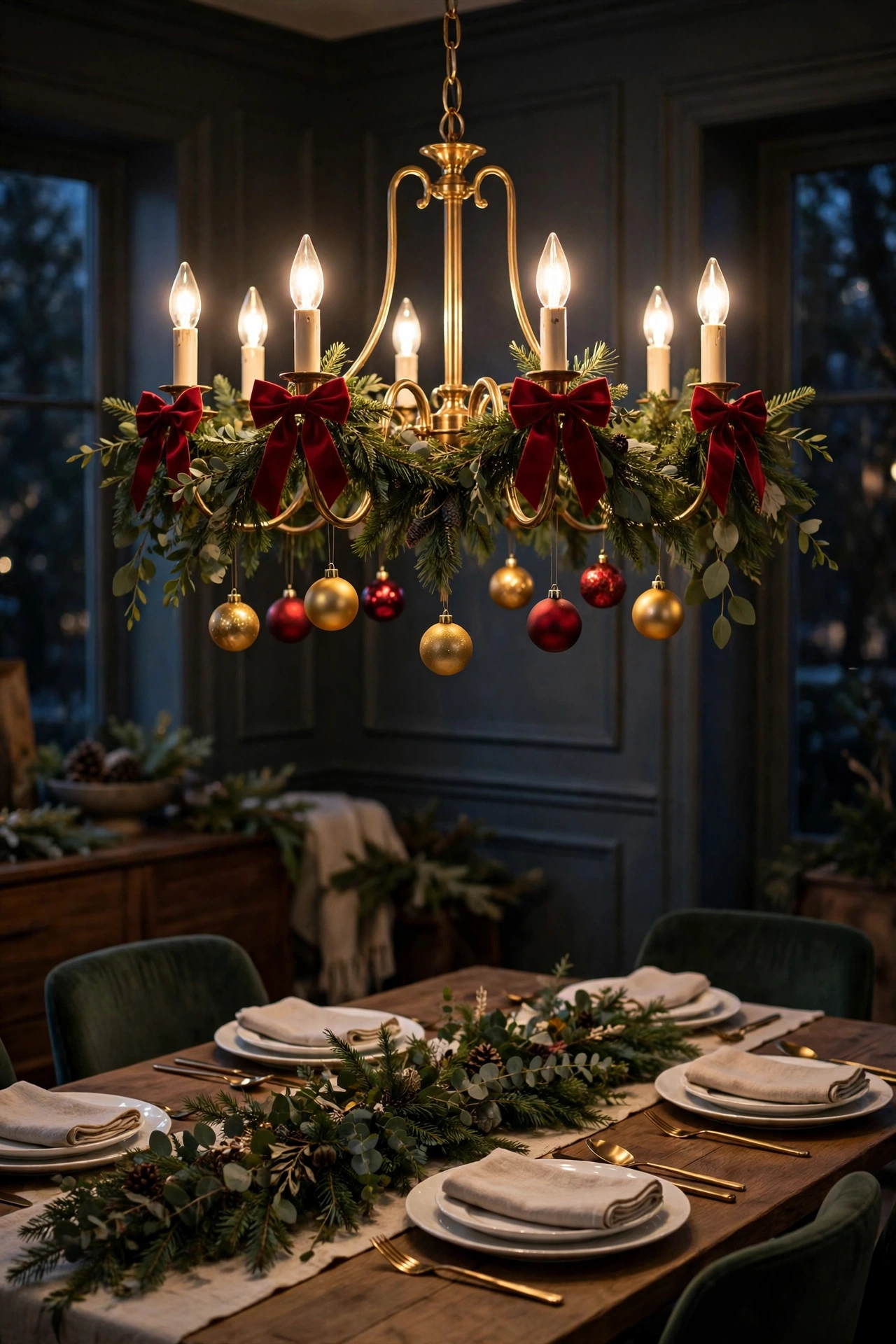
The most common chandelier mistake is not a bad idea. It is five good ideas at once. Garland over the arms, a wreath ring below, big bows on every arm, baubles at three heights, and a string of lights woven through all of it. Each piece is lovely on its own. Together they block the light and hide the shape of the fixture. Guests cannot see across the table, and the bulbs cannot throw light past the greenery. The fix is the one-layer rule, and it works on every chandelier, from a small four light fixture to a grand twelve light one.
Start by choosing your one main layer before you buy anything. If you love garland, the garland is the layer, and everything else stays small. If you love bows, the bows are the layer, and the garland stays out. If you love baubles, the baubles are the layer, and you skip the wreath ring. Decide before you shop, because every extra piece looks like a good idea in the store. A chandelier that carries one generous layer looks planned. A chandelier that carries five thin layers looks like leftovers from other projects.
Measurements keep the one layer from going wrong. First, measure the drop. A chandelier should hang so its lowest point sits 30 to 36 inches above the tabletop. If it hangs lower than 30 inches, your decor must sit flat against the fixture, with nothing hanging below it. If it hangs higher than 36 inches, you have room for decor that drops 4 to 6 inches below the fixture, such as a wreath ring or baubles on short ribbons. Second, measure the width. The decorated chandelier should stay at least 6 inches narrower than the table on each side. On a 72 inch table, that means the decorated fixture should span no more than 60 inches.
The second layer, if you add one, must be small and quiet. A few battery fairy lights woven through a garland add glow without bulk. A handful of pinecones tucked into the greenery adds texture without a new colour. What does not work as a second layer is a second big idea, such as a wreath ring plus a full garland, or bows on every arm plus baubles at every height. Two big ideas compete. One big idea and one small helper cooperate.
Cost is another reason to keep to one layer. A single 6 foot faux garland costs $20 to $45, and that is often the whole project. A spool of wide velvet ribbon costs $5 to $10, and a set of shatterproof baubles costs $10 to $20. The one-layer rule keeps the budget at $20 to $45, while the five-layer habit pushes the same chandelier past $100. The mistake to avoid is shopping without a chosen layer. Decide the layer first, buy only what serves it, and step back 6 feet. If the light still reaches the table and you can see the shape of the chandelier through the decor, you are done.
The DIY Wreath Ring Chandelier
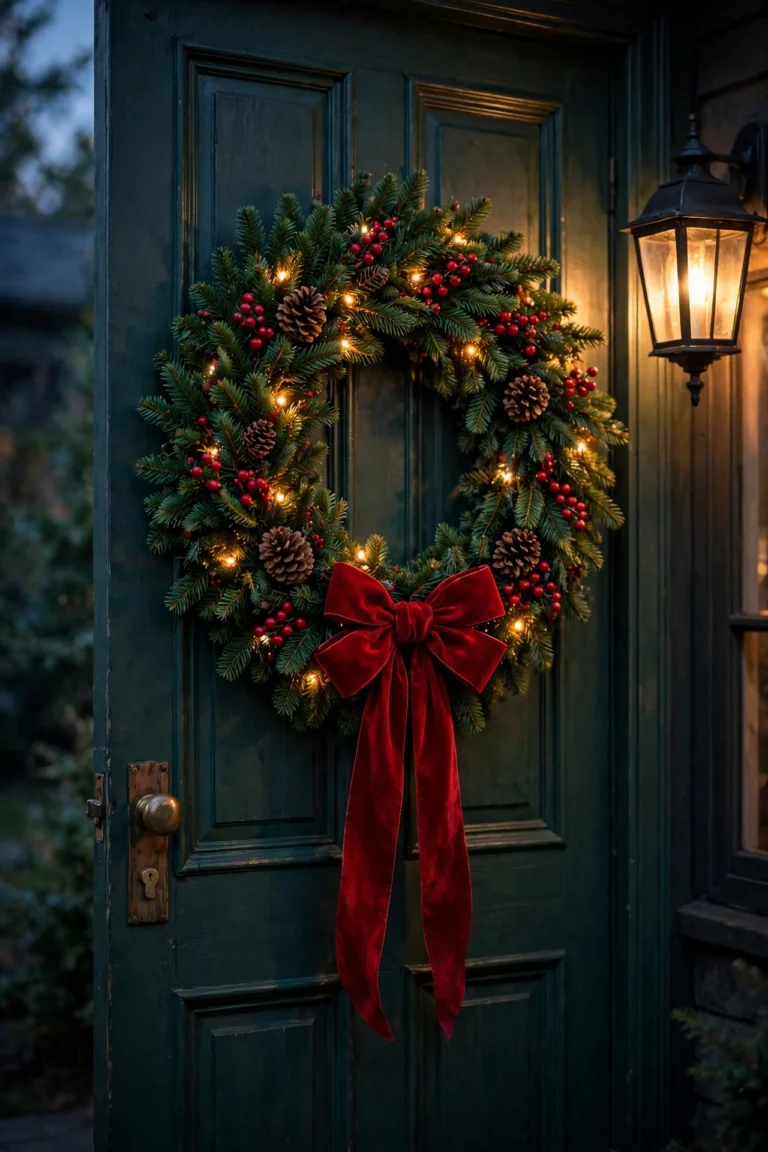
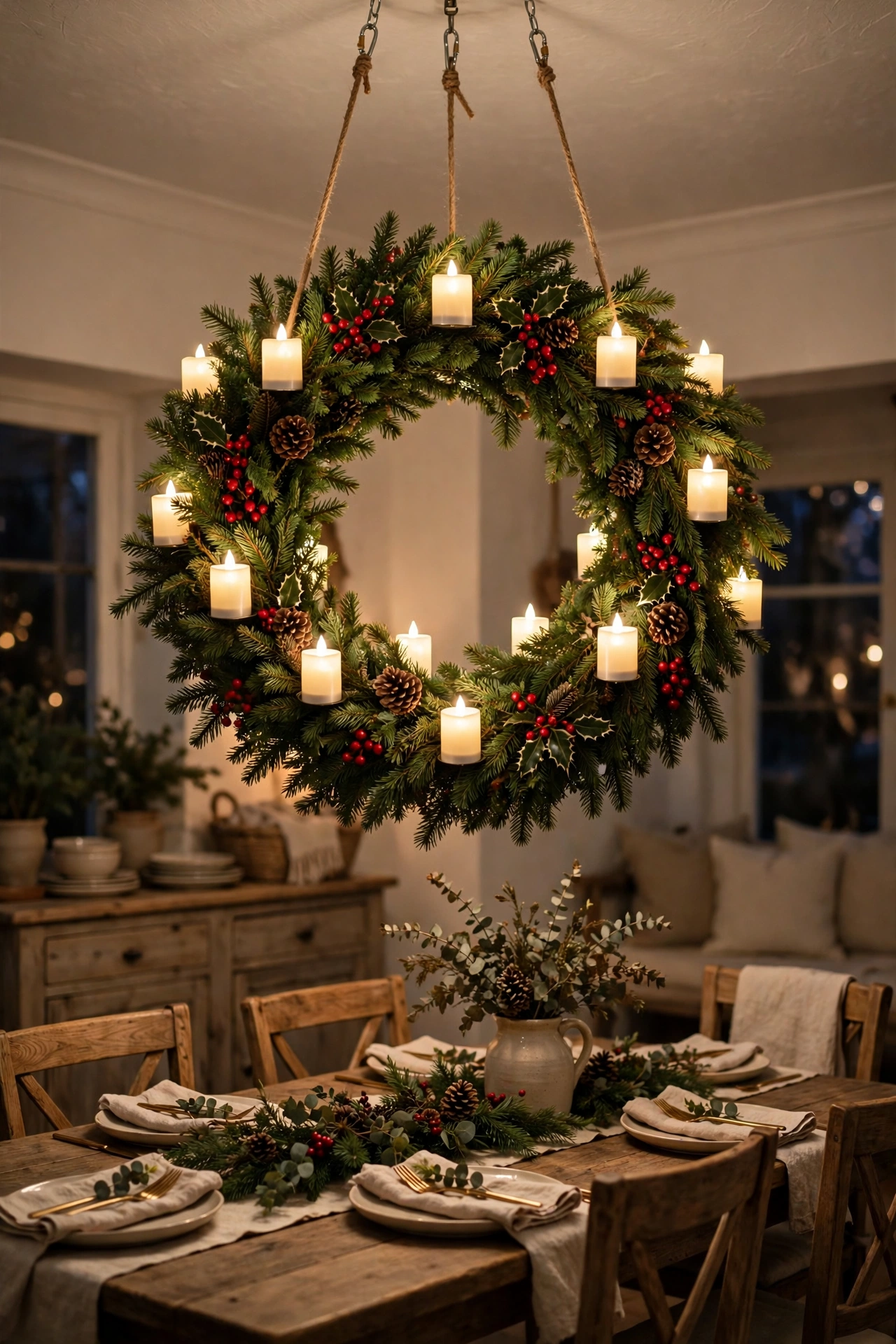
A wreath ring hanging below the chandelier is the most dramatic of the christmas chandelier decor ideas, and it is also the easiest to build yourself. The idea is simple. A ring of greenery hangs flat, like a halo, a few inches below the fixture, with the chandelier light shining down through the middle of it. From across the room it looks like a floating wreath. From the table it frames the light without blocking it, because the centre of the ring stays open. It suits a round chandelier best, and it repeats the wreath shape from the door or the mantel overhead.
Build it on a wire wreath frame, not on a foam ring. A wire frame is light, it holds its shape, and you can wire greenery to it firmly. Choose a frame that matches the width of your chandelier, or 2 inches smaller. For a 24 inch wide chandelier, use a 22 to 24 inch frame. A frame wider than the fixture will stick out past the light, and a much smaller frame will look lost underneath it. A wire frame costs $6 to $10. You will also need two or three bunches of faux greenery, cedar or pine, at $8 to $12 each, plus green floral wire for $3 to $5. Cut the greenery into pieces 6 to 8 inches long, lay them around the frame so they all point the same way, and wire each bunch on with two wraps, overlapping each bunch by 2 inches so no wire shows. Then add a few red berries, 3 to 5 small pinecones, and a short strand of battery fairy lights woven through the greenery.
Hanging the ring is the part that needs care. Hang it from the chandelier itself with three or four lengths of ribbon or thin chain, spaced evenly around the ring, so it hangs level. Ribbon is prettier and lighter, and deep red or forest green velvet ribbon 1 inch wide is the usual choice. Each hanger should be 6 to 8 inches long, so the ring sits 6 to 8 inches below the bottom of the fixture. Closer than 4 inches, it traps heat around the bulbs and hides the fixture. Lower than 10 inches, it drops into the sightline across the table. Tie the hangers to the frame of the chandelier, never to a bulb socket or a glass shade, and press gently on one side to check it sits level. Add three small battery candles in glass holders in the centre, $8 to $12 for the set, on a thin clear tray. Never use real candles in a hanging ring.
The total cost runs $35 to $55, and the ring takes about an hour to build. Store it flat when Christmas ends, so it keeps its shape for next year. The mistake to avoid is building the ring too heavy. Fresh greenery looks wonderful for a week, then it dries and sheds. Faux greenery stays light and stays put all December. If you do use fresh greenery, keep the ring under 2 pounds, check it every few days, and take it down the moment needles start to drop on the table. A ring that sheds onto dinner is worse than no ring at all.
Garland Draped Over the Arms
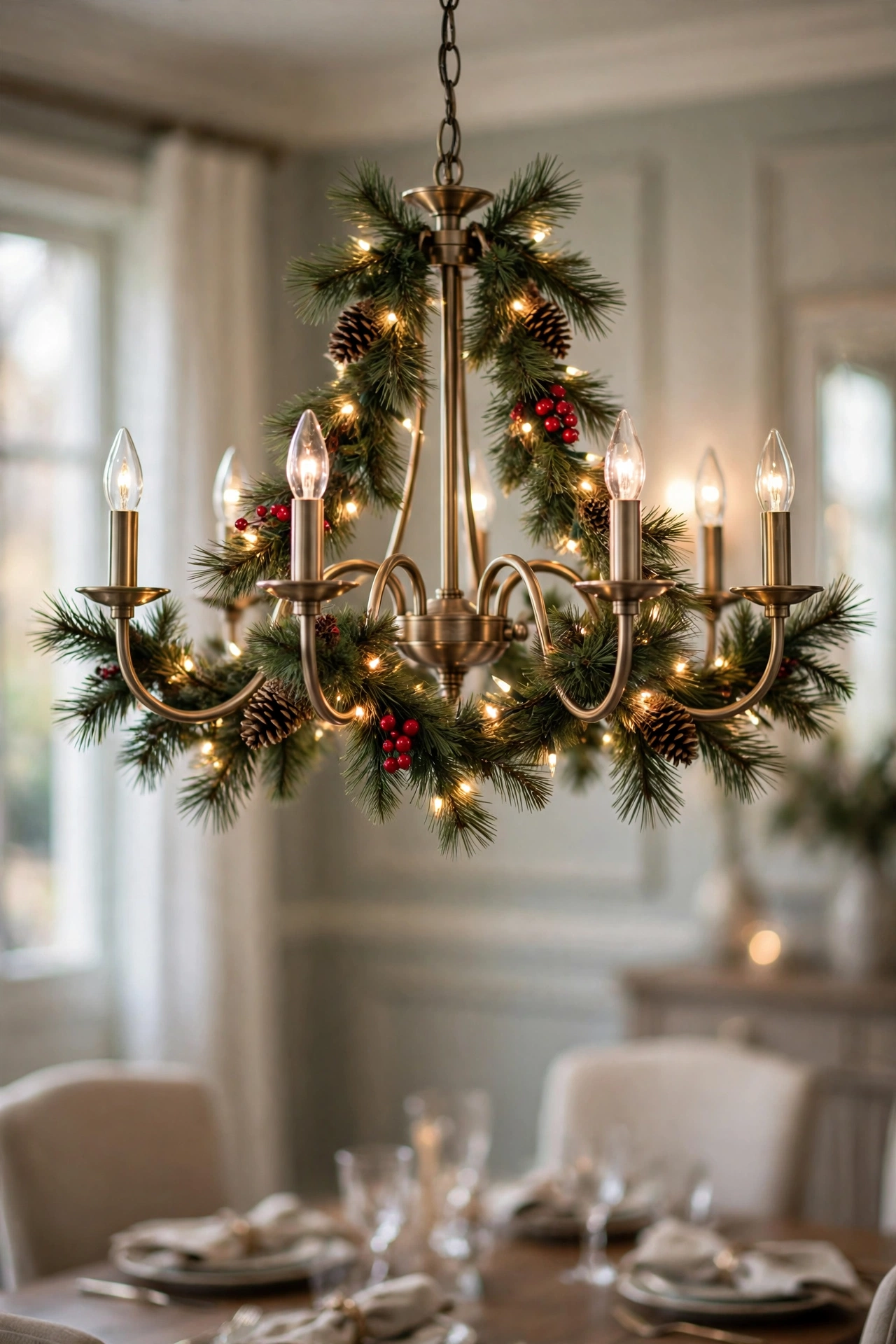
Garland draped over the arms is the classic christmas dining room chandelier decor look, and it is the one most people picture first. A soft line of greenery swags from arm to arm, dipping low between each light, with pinecones and red berries tucked into the dips. It follows the shape of the fixture instead of fighting it. Hung badly, it slides, sags, and covers the bulbs. Hung well, it stays put all December and lets the light through.
Choose faux garland for a chandelier, not fresh. Fresh garland is heavy, it dries out near warm bulbs, and it sheds needles onto the table below. Faux garland is light, it holds its shape, and you can bend it around the arms without it snapping. Buy a garland 6 to 9 feet long for a standard dining chandelier, and measure before you shop. For a six arm chandelier, a 6 foot garland gives a gentle swag between each arm, dipping 3 to 4 inches below the arm. For an eight arm chandelier, or for deeper swags of 5 to 6 inches, buy a 9 foot garland. A garland that is too short pulls tight, and one that is too long bunches up and hides the arms. A 6 foot faux garland costs $20 to $35, and a 9 foot garland costs $30 to $45.
Hang the garland from the arms, not from the bulbs. Start at the top centre of the fixture, drape the garland down to the end of the first arm, loop it once around the arm, then let it swag to the next arm. Secure each loop with green floral wire, twisted twice around the arm, with the ends tucked inside the greenery. Floral wire costs $3 to $5 a spool. Do not use tape, because tape fails when the fixture warms up, and do not tie the garland to a bulb socket or a glass shade, because the weight can crack the glass. Work your way around, keeping each swag the same depth. The finished garland should look like a neat row of scallops, all the same depth and fullness.
Tuck the extras in after the garland is hung. Wire 3 to 5 small pinecones, each 2 to 3 inches long, into the dips, and two or three small bunches of red berries the same way. Weave a short strand of battery fairy lights, 20 to 30 micro lights, through the top of the garland, with the battery pack hidden on top of the fixture. Keep all greenery at least 2 inches clear of any bulb. Pinecones cost $5 to $8 for a bag, or nothing if you gather them, and a berry bunch costs $4 to $6. The whole project usually totals $30 to $60.
The mistake to avoid is loading one side and leaving the other bare. It is tempting to use the full garland on the side you see from the doorway and leave the back side thin. From the table, guests see all sides, and a lopsided chandelier looks like it is slipping. Divide the garland evenly and give every arm the same length. Faux garland relaxes as the room warms up, and a swag that started 3 inches deep can sag to 6 inches by the weekend. Check the garland on the second morning and tighten any swag that has dropped more than an inch.
Ribbon Bows and Streamers
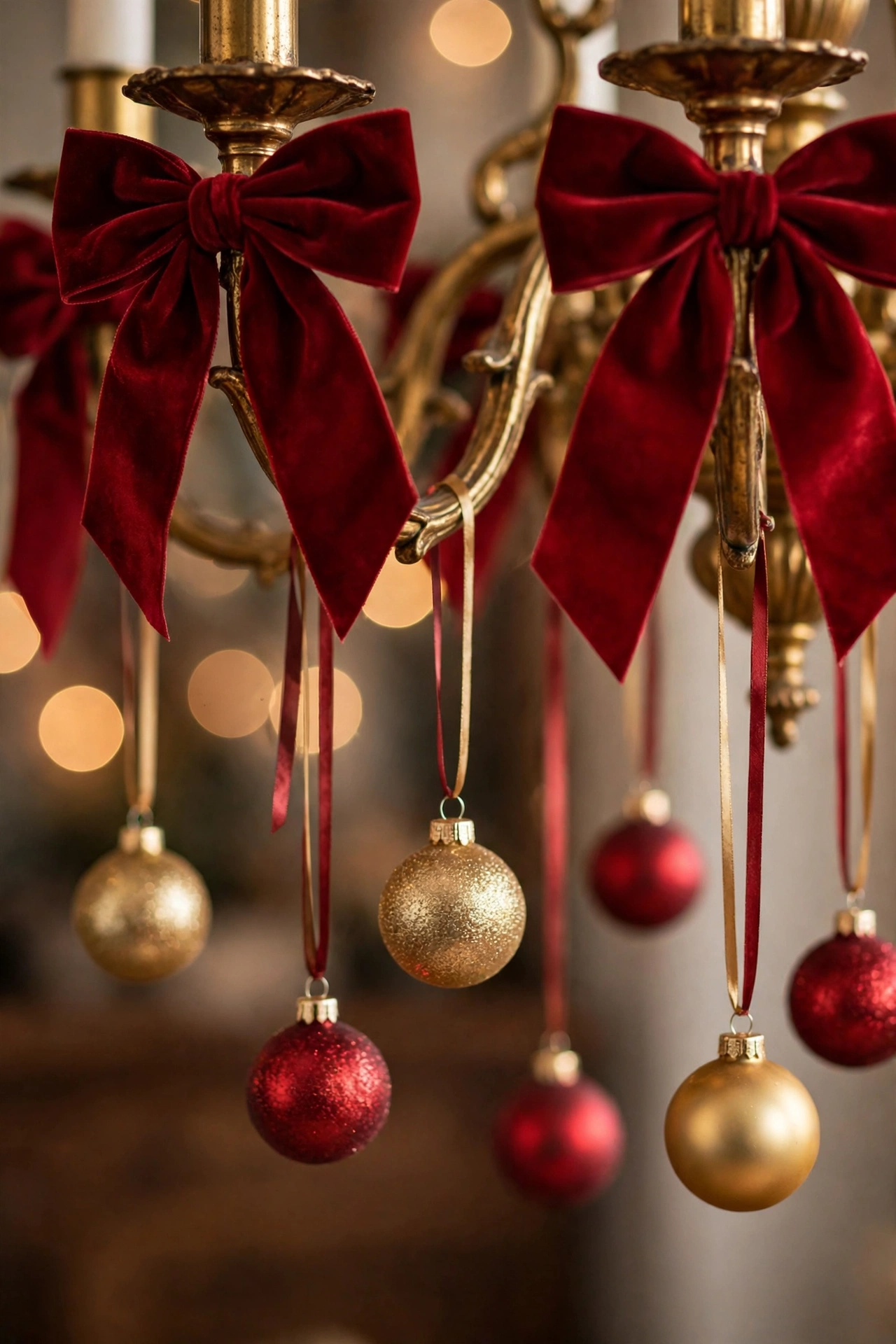
Ribbon bows are the cheapest way to dress a chandelier, and they are the fastest. A spool of velvet ribbon, a pair of scissors, and twenty minutes will give you a fixture that looks finished from every seat at the table. Bows suit a dining room that already has a lot of greenery, because they add colour without bulk, and they suit a small chandelier, where a full garland would be too heavy. The look is simple: a generous bow on each arm, or one large bow at the centre, with long tails that fall softly between the lights.
Choose wide velvet ribbon, 2.5 inches wide, for the best result. Narrow ribbon under 1.5 inches looks thin on a chandelier, and it will not hold a full bow. Velvet holds its shape, it does not slip on metal, and it catches the light softly. Satin is shinier, but it slides, and a satin bow on a smooth chandelier arm will creep down during the day. Buy one spool of 3 yards for a four arm chandelier, and two spools for six to eight arms. That gives you a bow on each arm with tails of 12 to 18 inches, plus a little spare. A 3 yard spool costs $5 to $8. Pre-tied velvet bows cost $8 to $12 each if you cannot tie your own. Pick one ribbon colour and use it everywhere. Deep red is classic with gold fixtures, forest green suits a room that already has a lot of red, and ivory suits a pale room. One colour keeps the look calm.
Tie the bow at the arm, not at the bulb. Loop the ribbon once around the arm, tie a firm knot, then form the bow with two loops of about 5 to 6 inches each and tails of 12 to 18 inches. Cut the tail ends in a V shape, which looks finished and stops the ribbon from fraying. If you prefer streamers, run a length of ribbon from the centre column out to each arm, letting it fall in a soft curve, and finish each streamer with a small bow at the arm. Streamers should be 18 to 24 inches long on a standard fixture. Longer than 24 inches, the tails will brush the plates. Shorter than 12 inches, they will look stubby. Keep every tail at least 6 inches above the tabletop and at least 2 inches clear of any bulb. Check the first bow from 6 feet away, then repeat it on the other arms at the same size.
The total cost for a bow dressed chandelier is $10 to $25, which makes it the cheapest project in this guide, and it takes only 20 to 30 minutes for a six arm fixture. The mistake to avoid is mixing ribbon colours and widths on one fixture. A red bow on one arm, a green bow on the next, and a gold bow on the third looks like three different decorations that met by accident. One colour, one width, and one bow size, repeated evenly, is what makes it look planned. The second mistake is tying bows to a bulb socket or a glass shade instead of the metal arm. The heat loosens the knot, the ribbon slides, and a bow can end up resting on a hot bulb. Tie to metal only, and retie any bow that has slipped more than an inch by the next morning.
Shatterproof Baubles at Mixed Heights
Baubles are the sparkle in christmas chandelier decor ideas, and the height you hang them at is what makes them work. Baubles all hung at the same height form a flat ring, and the eye reads it as a shelf, not as decoration. Baubles hung at three different heights, with the light shining through them, look like they are floating. The rule is simple: three heights, odd numbers, one finish family, and shatterproof only, because these baubles hang directly above food and people.
Buy shatterproof baubles, which are made of plastic, not glass. Glass baubles look beautiful in a shop, and they are a bad idea above a dining table. One knocked bauble, one bumped fixture, one bauble that slips its string, and glass falls onto plates and into food. Shatterproof baubles bounce, they do not break, and from 3 feet away they look the same as glass. Choose baubles 2 to 3 inches across. Smaller baubles disappear on a large chandelier, and larger baubles over 4 inches look heavy and block the light. A set of 12 shatterproof baubles in one colour family costs $10 to $20. Gold, deep red, and ivory are the classic Christmas families. Pick one finish family and stay with it.
Hang 7 to 9 baubles on a standard chandelier. Fewer than 5 looks sparse, and more than 12 looks crowded, because each bauble also casts a small shadow. Hang them on clear fishing line or on thin ribbon in your room colour. Fishing line is invisible, which makes the baubles look like they float, and it costs $3 to $5 a spool. Ribbon is prettier up close, and it suits a traditional room. Either way, tie the line firmly to the metal frame, never to a bulb socket. Use three heights: the highest baubles hang 6 inches below the fixture, the middle baubles hang 10 inches below, and the lowest hang 14 inches below. That 4 inch step gives you a clear, even cascade. Keep the lowest bauble at least 30 inches above the tabletop, so no one has to duck to see across the table. Space the baubles evenly, with a gap of at least 4 inches between any two, so they can move slightly without knocking together.
Check the hang from the chairs, not just from the ladder. Sit in each seat and look across. You should be able to see the faces opposite you between the baubles, not through a wall of them. If a bauble blocks your view, shorten its line by 2 inches or move it to a gap between two seats. The total cost for a bauble dressed chandelier is $15 to $30, including the line and a few spares. It takes about 30 minutes to hang, and it takes down in ten minutes in January. The mistake to avoid is hanging glass baubles above the table, and the second mistake is hanging every bauble at the same height. Glass above food is a risk you do not need, and a flat ring wastes the one thing a chandelier does best, showing decoration at different heights in the light.
Farmhouse and Vintage Looks
A farmhouse or vintage chandelier does not shout Christmas. It whispers it, with wood, dried fruit, muted colour, and old metal, and it suits a dining room that already has a wooden table, linen napkins, and a simple centrepiece. The look is warm and quiet, because the materials are natural and the colours are restrained. Where a traditional chandelier uses deep red velvet and shiny gold, a farmhouse chandelier uses burlap, wood beads, dried orange slices, cinnamon sticks, and aged brass.
Start with a wood bead garland, which is the farmhouse signature. A strand of natural wood beads, each bead about 0.75 inches across, draped in a soft swag between the arms, gives you texture without colour. A 6 foot wood bead garland costs $12 to $18, and it is light enough for any fixture. Drape it like greenery, looping it once around each arm and letting it swag 3 to 4 inches between arms. Add a second, shorter strand if the first looks thin, but do not add a third, or the beads will hide the fixture. Next, add dried orange slices. Slice oranges 0.25 inches thick and dry them at 200 degrees Fahrenheit for 2 to 3 hours, turning once, until they are dry and firm. Thread three or four slices onto twine and hang them between the arms. Dried oranges cost about $5 for the fruit. Add 3 to 5 cinnamon sticks, each 4 to 6 inches long, tied in small bundles of three with twine and wired into the garland. A bag of cinnamon sticks costs $4 to $6. Finish with a burlap ribbon bow, 2.5 inches wide, in natural tan, tied at the centre column or on one arm. A spool of burlap ribbon costs $5 to $8.
Vintage looks follow the same idea with older materials. Aged brass baubles, mercury glass style shatterproof baubles in soft gold and pewter, a little eucalyptus instead of pine, and a linen ribbon instead of velvet. Vintage style shatterproof baubles cost $12 to $20, and a small bunch of faux eucalyptus costs $8 to $12. The palette stays muted: cream, soft gold, sage green, and aged brass, with no bright red and no bright green. If your chandelier is already brass or aged bronze, the vintage look is almost free, because the fixture itself supplies the old metal. On chrome or black fixtures, use wood and linen to warm it up, and skip the brass baubles.
The total cost for a farmhouse or vintage chandelier is $30 to $55, and the pieces store well, because wood beads, dried oranges, and cinnamon sticks pack flat. The mistake to avoid is mixing too many vintage finishes at once. Aged brass plus pewter plus copper plus rusted iron looks like a jumble sale, not a vintage look. Pick one metal, brass or pewter, and use it everywhere. The second mistake is putting dried fruit near heat. Dried orange slices are safe at 2 inches from a cool LED bulb, but they will scorch if they touch a hot bulb, and they will go limp in a steamy kitchen. Keep them clear of the bulbs, check them weekly, and take them down if they start to curl or darken.
Modern Fixtures and Small Chandeliers
A modern chandelier needs a modern approach, and a small chandelier needs a small hand. A modern fixture is usually a thin ring, a set of bare globes, a linear bar, or a cluster of slim rods, with no arms to hold a garland. A small chandelier, under 20 inches across, has no room for a wreath ring and a garland and a set of baubles. The fix for both is the same: one slim element, in one finish, placed with restraint.
For a modern ring chandelier, use a single slim garland or a single strand of greenery, not a full one. A slim faux garland, 2 to 3 inches deep, wrapped once around the ring, gives you the Christmas line without hiding the shape. A 6 foot slim garland costs $15 to $25. Secure it with small clear zip ties, one every 12 inches, with the ends trimmed and tucked inside the greenery. Add 5 to 7 small shatterproof baubles, 2 inches across, in one metallic finish, gold or matte black, hung on short clear lines 4 to 6 inches below the ring. That is the whole project. A black ring with gold baubles is the classic modern Christmas look, and it costs $25 to $40 in total.
For a linear chandelier, a long bar over a rectangular table, the garland runs along the bar, not across it. Lay a slim garland along the top of the bar, so it reads as a green line from the doorway, and let 3 to 5 short tails of greenery, each 6 to 8 inches long, hang down at even intervals. A 36 inch bar needs a 4 foot garland, and a 48 inch bar needs a 6 foot garland. Keep the garland on top of the bar, never wrapped around the bulbs, and at least 2 inches clear of any light source. A linear fixture with a garland on top costs $20 to $35.
For a small chandelier, under 20 inches across, pick one element only. One slim garland, or 5 small baubles, or two small velvet bows, never two of those together. A small fixture carries about 1 pound of added decor before it starts to look crowded. A slim garland weighs about 0.5 pounds, five small baubles weigh about 0.5 pounds, and two small bows weigh almost nothing. Any one of those is enough. Two of them together will hide the fixture, block the light, and make a small dining nook feel cramped. The cost for a small chandelier is $15 to $30, and the time is under 20 minutes. Check from the doorway that you can still see the shape of the fixture. If you cannot, take half the decor away.
The mistake to avoid on a modern fixture is covering the light source. Many modern chandeliers use exposed LED panels, bare globes, or slim light bars, and greenery laid across them will block the light and trap heat. Keep all decor at least 2 inches clear of any LED panel or globe, and never drape a garland over a bare bulb. The second mistake is mixing a traditional element with a modern fixture, such as a big red velvet bow on a slim black ring. One finish, one element, and the modern chandelier will look dressed, not buried.
The Safety Rules That Keep It Beautiful
Christmas chandelier decor is the one decoration where safety is not a footnote. It is the main job, because the decor hangs over food, over people, and next to live bulbs. Every accident comes from skipping one of these rules. Read this section before you climb the ladder, and check each rule again when the decor is up. It takes five minutes.
Weight comes first. Most chandeliers are rated to hold their own weight and little more. The mounting, the chain, and the ceiling hook were sized for the fixture alone. Keep all added decor under 2 to 3 pounds in total. A faux garland weighs 1 to 1.5 pounds, a wreath ring weighs 1 to 2 pounds, and seven shatterproof baubles weigh under 0.5 pounds. If your total passes 3 pounds, take something away. If the fixture wobbles when you press it gently, or the chain looks stretched, add no decor until an electrician has checked it.
Heat comes second. Keep all greenery, ribbon, and paper at least 2 inches clear of any bulb, and further from a hot bulb. Old style incandescent bulbs run hot enough to scorch dry greenery. LED bulbs run cooler, but they still warm up, so the 2 inch rule stays. Never drape a garland over a bare bulb, and never let a ribbon tail rest on a bulb. If your chandelier still uses incandescent bulbs, swap them for warm white LEDs at 2200K to 2700K before you decorate. A set costs $8 to $15.
Lights come third, and the rule is short: battery fairy lights only, never plug-in garland lights on the fixture. A plug-in strand adds a cord that has to go somewhere, and on a chandelier it usually ends up draped across the fixture or hanging down where someone can catch it. Battery fairy lights, 20 to 40 micro lights on a 6 to 10 foot strand, cost $8 to $15, and the battery pack hides on top of the fixture. Set the timer to 6 hours on and 18 hours off. Use warm white only, at 2200K to 2700K, because cool white looks blue against greenery and makes the table feel cold.
Ladder safety comes fourth. Use a proper step ladder, not a chair, and not a stack of books on a chair. Set the ladder on a flat floor, open it fully, and lock the spreader bar. Have someone hold the ladder, and keep three points of contact at all times. Never stand on the top rung, and never lean out sideways to reach the far side of the chandelier. Wear shoes with grip, and keep the floor clear of wrapping paper and ribbon offcuts. If you live alone, ask a neighbour to hold the ladder, or decorate in two short sessions, so you are never rushing at height.
The last rules are about what hangs above the table and when it comes down. Use shatterproof baubles only above a dining table, never glass, because glass and food do not mix. Keep the lowest piece of decor at least 30 inches above the tabletop. Take the decor down in the first week of January, before the greenery dries out and the dust builds up. Fresh greenery dries fast near warm bulbs, and dry greenery near a hot bulb is a fire risk. Take it down and store the decor flat. The mistake to avoid is treating safety as a job for later. Check the weight, the heat, the lights, the ladder, and the take-down date before you hang the first piece.
Conclusion
Christmas chandelier decor works best when you do less, not more. The one-layer rule will serve you well on almost every fixture. One garland, or one wreath ring, or one set of bows, or one cluster of baubles, done generously, is enough. Start with the measurements, then choose the layer that suits your fixture. Hang it level, keep it clear of the bulbs, and check it from every seat at the table before you add anything else. If the light still reaches the table and you can see the shape of the chandelier through the decor, you are done.
The order matters too. Decorate the chandelier before you set the table, because the chandelier sets the height and the colour for everything below it. A red bow overhead calls for red napkins below, and a cedar garland calls for cedar sprigs in the centrepiece. When the chandelier and the table share one ribbon colour and one greenery, the whole dining room looks planned, even if you bought the pieces in different shops on different days. In January, take the decor down in the first week and store it flat.
Frequently Asked Questions
How much weight can I hang on a chandelier?
Keep all added decor under 2 to 3 pounds in total, and weigh it first. A faux garland weighs 1 to 1.5 pounds, a wreath ring weighs 1 to 2 pounds, and seven shatterproof baubles weigh under 0.5 pounds. If the fixture wobbles when you press it, add no decor until an electrician has checked the mounting.
How low should chandelier decor hang above the table?
The lowest piece of decor should stay at least 30 inches above the tabletop, and the chandelier itself should hang 30 to 36 inches above the table. Measure from the table surface to the lowest bauble, bow tail, or ring edge, and shorten anything that hangs lower.
Can I use real candles on a chandelier?
No, never use real candles on a chandelier. A flame next to dry greenery, ribbon, and paper is a fire risk. Use battery flameless candles instead, three small ones in glass holders for a wreath ring, or battery fairy lights woven through a garland. They give you the same warm glow with no flame and no risk.
What length of garland fits my chandelier?
Measure the fixture before you shop. For a six arm chandelier, a 6 foot garland gives a gentle swag between each arm. For an eight arm chandelier, or for deeper swags, buy a 9 foot garland. For a linear bar, buy a garland 6 to 12 inches longer than the bar. A garland that is too short pulls tight and looks thin, and one that is too long bunches up and hides the fixture.
Are glass baubles safe above a dining table?
No, glass baubles are not safe above a dining table. One slipped bauble will drop glass onto plates and into food. Use shatterproof baubles made of plastic instead. A set of 12 costs $10 to $20. Hang them on clear fishing line or thin ribbon, tied to the metal frame, never to a bulb socket.
When should I take chandelier decor down?
Take it down in the first week of January. Fresh greenery dries fast near warm bulbs, and dry greenery near a hot bulb is a fire risk. Faux greenery still collects kitchen grease and dust, and it looks tired after a month. Wipe the fixture and store the pieces flat, so next Christmas is easy.
Budget Table
| Item | Cost |
|---|---|
| Wreath ring kit | $25-40 |
| Garland | $20-45 |
| Velvet ribbon and bows | $5-15 |
| Shatterproof baubles | $10-20 |
| Battery fairy lights | $8-15 |
| Farmhouse accents | $15-25 |
| Total | $83-160 |
Note: Most chandeliers need only 2 to 3 of these items, so a finished look usually costs $30 to $70, not the full total above.