
Christmas Coffee Table Decor Ideas That Keep the Table Usable
I think the coffee table is the spot where Christmas really takes place in most living rooms. It holds mugs of cocoa, a board game, wrapping paper, and a book someone is halfway through. It is also the surface most people decorate last, and the one that ends up cluttered first, because every small decoration in the house seems to drift toward it.
A good Christmas coffee table does two jobs at once. It looks festive from the sofa and from the doorway, and it still works as a table. The trick is not buying more decorations. It is choosing one anchor, keeping the height low, and leaving real space for everyday life. This guide walks through the whole system: the half clear rule, the tray formula, low centerpieces, candlelight, greenery, books, the four styles that look current in 2026, and what to do when the table is small, round, or glass.
Everything here uses pieces you probably already own, or things that cost very little. Most ideas take five to fifteen minutes. Start with the rule in section one, and the rest falls into place.
The Half Clear Rule
Before you buy or move a single decoration, decide how much of the table stays empty. The rule that shows up in nearly every good 2026 guide is simple: keep at least half of the top clear. A tray, a bowl, or a candle group can claim one half. The other half stays open for mugs, plates, a book, and a board game.
This rule matters because a coffee table is not a mantel. Nobody looks at it from across the room and leaves it alone. People reach for it all evening. When every inch is decorated, the decorations get pushed aside, knocked over, or piled on the floor, and the table looks worse than if it had been left bare.
Measure the table first. A standard rectangular coffee table is about 45 to 48 inches long and 18 to 24 inches deep. Half of that is plenty of room for a display that reads as generous. On a table that size, one tray about a third of the table length, roughly 16 to 18 inches, is the right anchor. Anything bigger starts to eat into the clear half.
The other half of the rule is height. Keep the tallest piece under about 12 inches, so people sitting on opposite sides of the sofa can still see each other. A mini tree, a lantern, or a candle cluster all fit under that line. A tall vase of branches does not, and it will be moved within a day. Low and wide beats tall and narrow on a coffee table every time.
If the table is shared with children or pets, the rule gets even simpler. Keep breakables off the edge, keep candles battery powered, and keep the display in the middle of the table, where little hands reach last. A tray helps here too, because the whole display lifts away in one move when the table needs to become a homework desk or a wrapping station.
Start With a Tray
Every good Christmas coffee table starts with a tray. The tray turns a scatter of small objects into one intentional arrangement, it protects the wood top from candle wax and mug rings, and it lets you lift the whole display away when you need the full surface. Choose a tray about a third of the table length, so a hand width of table shows on each side.
Wood, brass, woven seagrass, and plain black metal all work. Match the tray to the room rather than to Christmas: a warm wood tray suits a rustic room, a brass tray suits a glam room, and a woven tray suits a neutral room. The tray itself is not a Christmas decoration, which is the point. It stays out all year, and only its contents change with the season.
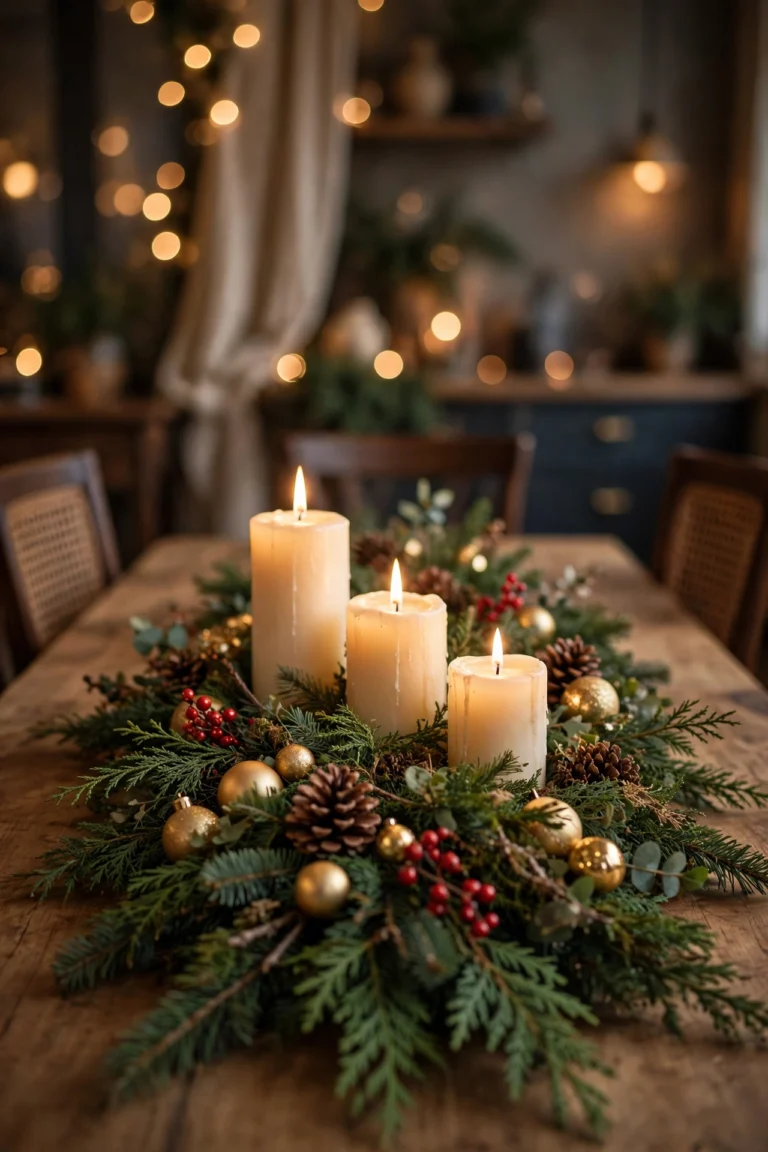
Build the tray in layers. Start with something flat and green at the bottom, a short pine garland or a few loose sprigs laid in a loose curve. Add one taller piece in the middle, a small lantern, a mini tree in a pot, or a cluster of three pillar candles. Then add two or three small pieces around it: pinecones, a small bowl of ornaments, a sprig of berries. Stop at five or six objects. A tray with three objects looks styled. A tray with ten looks like a drawer that was emptied onto it.
The tray also solves the storage problem. When guests arrive and the table needs to hold plates, lift the tray onto a sideboard or a shelf. When the evening ends, lift it back. Nothing gets broken in the move, because everything inside the tray moves as one piece. If you buy only one thing for the coffee table this year, make it a tray.
A tray costs very little if you shop at home first. A baking sheet lined with a tea towel works in a pinch. A large serving platter, a shallow basket, or a cutting board can all stand in. The tray does not need to be new. It needs to be the right size and sturdy enough to carry.

Low Centerpieces That Do Not Block the View
The centerpiece is the hero of the coffee table, and on this table the hero stays low. Three classic options work, and each one fits a different kind of room.
The ornament bowl is the fastest. Fill a wide, shallow bowl with ornaments in two or three colors, red and gold, silver and white, or deep green and copper, and set it in the middle of the tray. Large ornaments look better than small ones here, because they read from the sofa. Add a few pine sprigs between them so the bowl looks gathered rather than poured. This takes about two minutes and costs nothing if the ornaments are spares from the tree box.
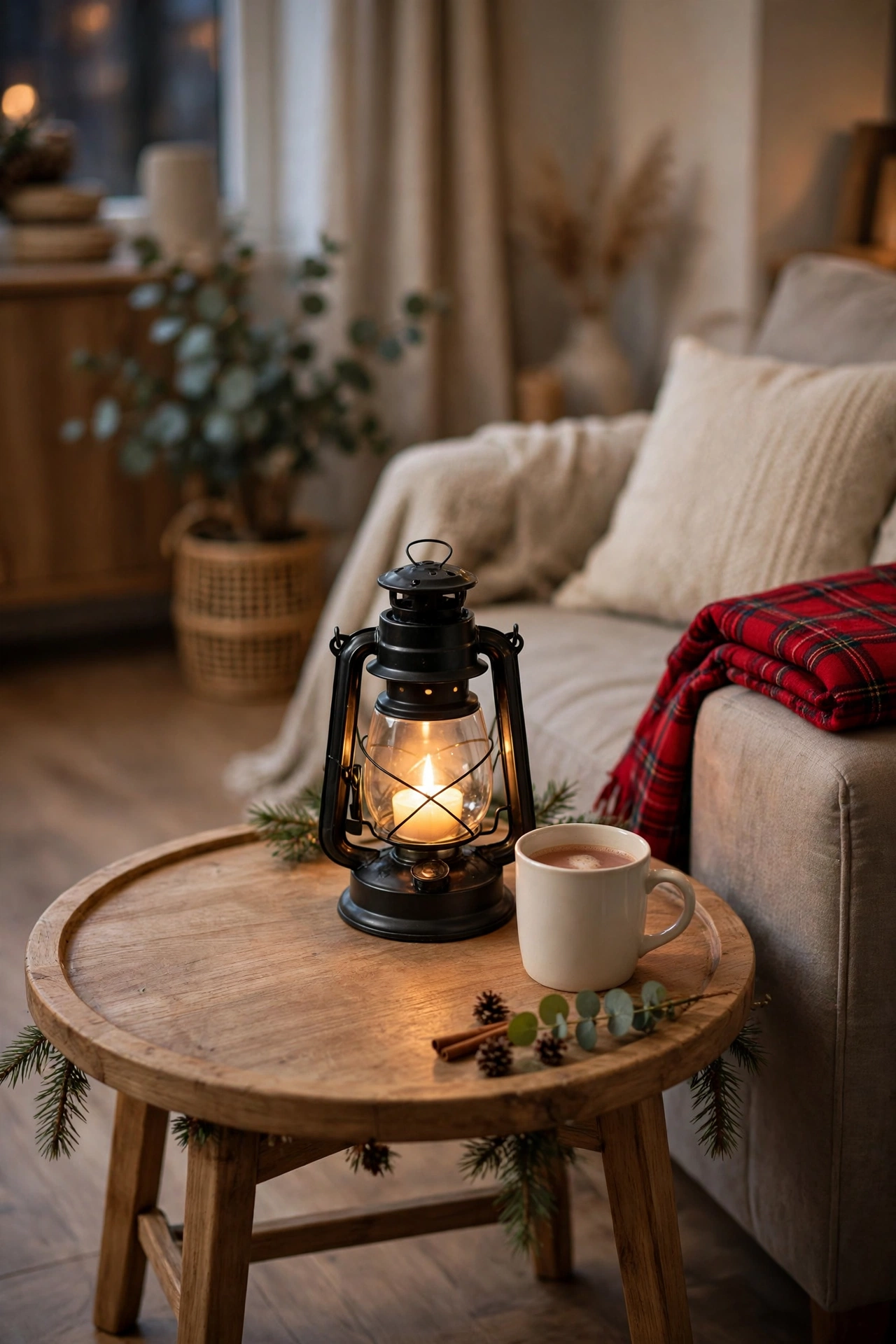
The lantern is the warmest. Set one lantern in the middle of the table with a pillar candle glowing inside, then scatter pine sprigs, pinecones, and a few small ornaments around its base. Black metal suits a farmhouse room, brass suits a glam room, and wood suits a rustic room. Use a battery candle inside, so the lantern can sit near wrapping paper and pine without worry, and put it on a timer so it glows every evening without anyone remembering to switch it on.
The mini tree is the most cheerful. A small potted tree, real or faux, set on a tray or a low cake stand, brings the shape of the big tree down to tabletop scale. Add a short string of warm lights and a handful of miniature ornaments, and keep it under 12 inches tall including the pot. A mini tree works best on a table that is not already crowded by a large sofa tree nearby. If the big tree is in the same room, pick the bowl or the lantern instead, so the room does not repeat the same shape twice.
Whichever centerpiece you choose, give it one job and let it do it. A bowl, a lantern, and a mini tree all on one table fight each other, and the table ends up looking like a shop display. One hero, a little greenery, and space around it. That is the whole formula. For more centerpiece ideas that also work on a dining table, see our guide to Christmas centerpiece ideas.
Candlelight at Three Heights
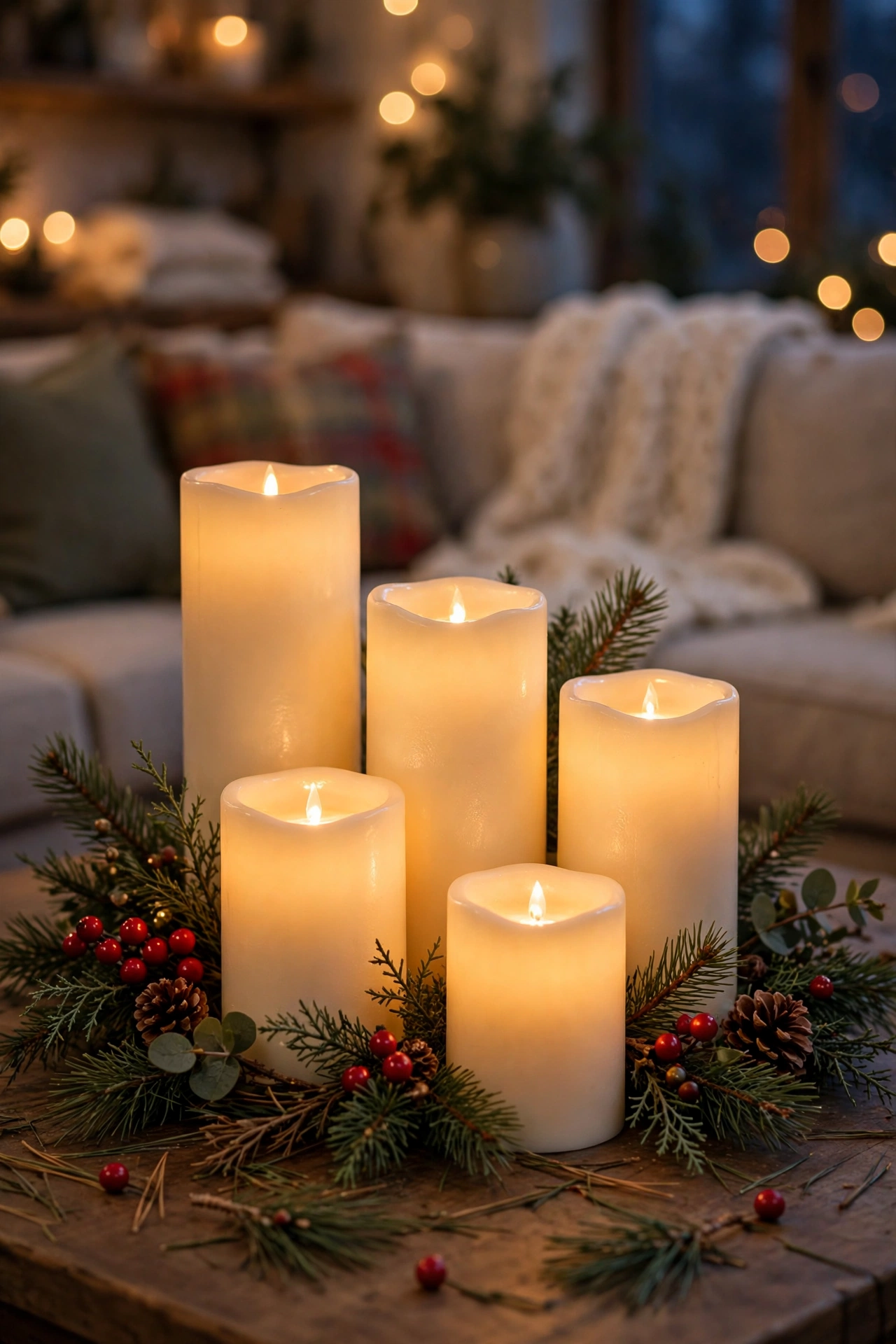
Candlelight is what makes a Christmas coffee table glow after dark, and the safest way to get it is with battery candles. Group three or five candles of different heights in the middle of the table, tucking pine sprigs and a few red berries between them. Odd numbers look more natural than even ones, and varying the heights by two or three inches keeps the group from looking like a row.
Real flames have no place on a coffee table in December. The table holds paper, pine, ribbon, and wrapping, and people reach across it all evening. Battery pillar candles give the same warm flicker, they can sit inside a lantern or a glass hurricane, and they can run on a timer so the table glows at dusk without anyone touching it. Keep one real candle, if you love the scent, on a high shelf instead, where nobody reaches past it.
Height matters as much as light. Place the tallest candle at the back of the group, nearest the sofa, and the shortest at the front, so the group reads as a slope rather than a wall. If the candles sit on a tray, the tray edge hides the battery bases and the group looks finished. A single votive on its own looks lost on a big table, so always group candles, or pair one candle with a lantern or a small stack of books.
Glass hurricanes and mason jars filled with fairy lights are a good alternative when you want light without any candle shape at all. A jar of warm white fairy lights on the tray gives a soft glow that photographs beautifully, and it costs less than a set of pillar candles. Two jars, one tall and one short, are enough. Three starts to look like a collection.
One safety note that every guide repeats: never put a real flame near dried orange slices, pine, or paper, and never leave any candle burning in a room nobody is in. Battery candles remove the risk entirely, which is why they are the standard choice for coffee tables now.
Greenery, Dried Orange and Pinecones
Greenery is the cheapest layer on a Christmas coffee table, and it does the most work. A loose runner of pine greenery down the center of the table, or a few sprigs tucked around the tray, connects the coffee table to the tree, the garland, and the wreath in the rest of the room. Faux greenery is the practical choice here, because real pine drops needles onto a surface where people set mugs and books.
Dried orange slices are the classic partner for greenery. Lay three or four slices along the runner, or tuck them into the tray beside the candles, and the table gets color and a faint scent without any extra spending. Cinnamon sticks do the same job: tie two or three together with twine and lay them across the greenery. Both are cheap, both last the whole season, and both look better with age than plastic decorations do.
Pinecones fill the gaps. Three pinecones of different sizes, set in a small group rather than scattered one by one, look intentional. A light dusting of white paint on the tips, or a roll in Epsom salt while the paint is wet, gives a frosted look for almost no money. Keep pinecones away from the candle group if you use real flames, and keep them inside the tray so they do not roll off the table edge.
The rule for natural pieces is the same as for everything else on this table: one material repeated beats five materials competing. Pine plus dried orange is a complete look. Pine plus orange plus cinnamon plus eucalyptus plus berries is a craft store shelf. Pick two natural elements, repeat them in two or three spots, and stop.
If you want the room to feel coordinated, carry the same greenery from the coffee table to the mantel or the staircase. Our guide to Christmas garland ideas shows how one strand of greenery can dress the mantel, the doorway, and the table without buying anything twice.
Books, a Figurine and a Mug
A Christmas coffee table should look lived in, not staged. Books are the easiest way to get that feeling. Stack two or three hardcover books, plain covers or ones in deep red and green, and top them with a small figurine, a ceramic reindeer, a tiny bottle brush tree, or a small snow globe. The stack adds height without blocking the view, and it gives guests something to pick up.
Choose books people will actually open. A holiday cookbook, a photo book of winter landscapes, or a magazine’s holiday edition all work. Avoid stacking books nobody reads just for their covers, because guests can tell, and the stack becomes clutter instead of decor. One book left open on the clear half of the table, with a mug beside it, is the most welcoming sight a coffee table can offer.
The figurine should be small, one piece, and sturdy. A ceramic reindeer, a wooden star, or a small Santa that has been in the family for years all work. Two figurines start to look like a collection, and a collection belongs on a shelf, not on a table people use. If the figurine is breakable, keep it on the book stack near the middle of the table, where elbows do not reach.
Coasters are the unglamorous piece that saves the table. Set out four coasters, cork, wood, or felt, in a small stack on the clear half, and people will use them without being asked. A ring mark on a wood coffee table in January is the price of a December without coasters. Keep a folded plaid throw draped over one corner of the table, or over the arm of the sofa beside it, so the table and the seating feel like one cozy corner. For pillow and throw ideas that match this look, see our guide to Christmas throw pillow ideas.
Four Styles That Look Current in 2026
The same coffee table can wear four different styles, and the difference is mostly color and texture. Pick one style for the whole living room, then let the coffee table follow it, so the room feels planned rather than assembled from separate sales.
Rustic and farmhouse is the warmest. A wood tray, pine greenery, pinecones, a burlap or plaid runner, and a lantern with a battery candle. Colors stay in red, deep green, and natural wood. Nothing shiny, nothing fragile. This style is the most forgiving, because a slightly messy tray still looks intentional when the materials are natural.
Nordic and minimalist is the calmest. White and pale wood, a single small tree or a white ceramic house, one candle, and a lot of empty table. The Nordic coffee table has the fewest objects, often just three, and the most clear space. If the room already feels busy, this is the style that calms it down. Keep the palette to white, pale green, and natural wood, and let one red accent, a single ornament or a ribbon, do the Christmas work.
Glam and sparkly is the brightest. A brass or mirrored tray, gold ornaments in a glass bowl, mercury glass candle holders, and a touch of sparkle in the ribbon. Colors run champagne gold, cream, and deep green. Glam works best on a dark wood or black table, where the metallics have something to shine against. Keep the sparkle to the tray, so the clear half of the table stays calm and usable.
Neutral and modern is the most flexible. Cream, sage green, warm wood, and black, with texture doing the work instead of color. A chunky knit coaster, a linen runner, a ceramic vase with eucalyptus, and one brass candle holder. This style carries easily into January, because removing the red berries and the mini tree leaves a winter table that still looks finished. If you decorate once and hate redecorating, neutral is the style to choose.
This year’s guides agree on one shift: the bright primary red of past years is giving way to deeper heritage colors, navy and copper, deep burgundy and merlot, with emerald and champagne gold close behind. You do not need to buy a new palette to follow the shift. Swap the red ornaments for burgundy ones, or the gold ribbon for copper, and the table looks current without a single new purchase.
Small, Round and Glass Tables
Not every coffee table is a big rectangle, and the formula changes with the shape. The half clear rule stays the same, but the anchor moves.
A small table, under 36 inches long, needs only one thing. A single lantern, a single bowl of ornaments, or a single tray with three objects is the whole display. Do not try to fit a tray, a candle group, and a book stack on a small table. Pick the hero, add one sprig of greenery, and leave the rest clear. A small table with one confident piece looks styled. A small table with five pieces looks crowded.
A round table has no corners to anchor a tray, so use a round tray or a low bowl as the centerpiece and build outward in a circle. Keep the display to the middle third of the table, so mugs can sit around the edge. A round tray about half the table diameter is the right size. If the table is glass topped, a tray is even more important, because it hides the clutter underneath and gives the display a base. A woven or wood tray warms up a glass top better than a metal one, which can look cold.
A glass top table shows everything underneath, so keep the underside tidy too. A low shelf under a glass top is a good place for a folded plaid throw or a stack of books, where they look intentional rather than stored. On the top itself, fewer objects look better, because each one casts a shadow through the glass. One lantern and a sprig of greenery can be the whole display on a glass table, and it will look complete.
For any shape, the test is the same. Sit on the sofa, set down a mug, open a book, and see whether the table still works. If you have to move a decoration to set down a mug, the table is over decorated. Move one thing to a shelf, and the table is fixed. That is the whole secret: decorate the table for the people who use it, not for the photo, and the photo will take care of itself.
Conclusion
A Christmas coffee table needs one tray, one low hero piece, a little candlelight, a touch of greenery, and half the top left clear. That is the whole system, and it works on a big rectangle, a small round table, and a glass top alike.
Start today with the fifteen minute version. Clear the table completely. Set down a tray on one half. Add a bowl of ornaments or a lantern, three battery candles, a few pine sprigs, and a pinecone. Stack two books on the clear half with a coaster on top. Step back, sit down, and set a mug on the table. If the mug fits without moving anything, the table is done.
The rest of the season is just small swaps. Change the ornament colors when you want a new look. Swap the mini tree for a bowl of dried oranges in January. Keep the tray, keep the candles, keep the clear half, and the coffee table will stay the warmest spot in the room all winter.