Christmas Farmhouse Decor Ideas for a Warm Rustic Home
When people hear the name Farmhouse Christmas, a lot of them picture a white tree, burlap on every surface, and a living room so neutral it could belong to anyone. That version exists. It deserves the reputation. But it is not the real version, and it is not the version people are actually saving and copying this year.
The real farmhouse Christmas is warmer than that. It still has plenty of Christmas in it. It just decides where the Christmas goes instead of putting it everywhere. The style is built on honest materials that already belong in a country house: rough wood, linen, wool, iron, glass, and greenery cut from the garden or bought for a few dollars. The decorations are the things themselves, not a layer of glitter pasted on top. A wooden crate holding firewood is decoration. A mason jar with a candle in it is decoration. A plaid throw folded over the arm of a chair is decoration. Nothing needs to shout, because the materials are doing the work.
This year the style has shifted in a way that makes it easier, not harder. Farmhouse has gotten warmer, with more berry reds, soft greens and vintage pieces than the bright white look of a few years ago. The 2026 palette is deep evergreen, not fire engine red, with cream, warm wood and one metal around it, and red used as an accent in one place rather than as a second main colour. The trend in rustic decorating is toward fewer pieces chosen more deliberately, with texture doing the visual work that colour overload used to do. That is good news for your budget and your sanity. You need less stuff, and the stuff you need is mostly stuff you already own.
This guide covers the whole house, room by room, in the order that matters. You will learn the palette and the materials first, so every purchase after that is an easy yes or no. You will get the farmhouse Christmas tree, with burlap, wood beads and buffalo check, and how to add a little colour without starting over. You will get the mantel, the dining table, and the small touches for the kitchen, bedroom, bathroom and entryway. You will get DIY projects that cost almost nothing, including a wood bead garland, burlap stockings and mason jar luminaries. And you will get an honest budget order, what to buy first and what to skip entirely, with real prices. Most ideas here cost under twenty dollars, most take less than an hour, and every one of them works in a real house where people actually live, cook, and sit down.
What Farmhouse Christmas Actually Means in 2026
Farmhouse style is the look of a working country house, edited. That one sentence explains almost everything. The rooms are practical first. The furniture is built to be used, not looked at. The materials are honest: wood that shows its grain, linen that wrinkles, iron that darkens, glass that is a little wobbly. Nothing is pretending to be something it is not. When December comes, the same rules apply. You do not redecorate the house. You add the season to the house you already have.
That is why farmhouse Christmas is the most forgiving style there is. A modern glamorous Christmas needs matching ornaments and a colour scheme planned in October. A farmhouse Christmas needs a tree, some greenery, warm light, and a few textiles, and it looks right even when the pieces do not match, because they were never supposed to match. A thrifted wooden sign next to a new garland looks intentional. A plaid throw from five years ago next to a fresh burlap runner looks layered, not messy. The style absorbs old things gracefully, which is why it is also the most secondhand friendly style there is. Thrift stores and estate sales deliver wooden crates, old sleds, brass bells and iron lanterns for a few dollars each, and every one of them looks like it has always been there.
The 2026 version of the style has one clear change, and it is worth understanding before you buy anything. The all white, all neutral farmhouse of a few years ago is fading. In its place is a warmer farmhouse: berry reds, soft greens, vintage pieces, and deep evergreen carrying the season, with cream and warm wood around it. The National Kitchen and Bath Association 2026 trends report puts earthy neutrals at the top of the list, sage greens, chocolate browns, warm tans and creamy whites, with matte natural finishes replacing high shine. The practical version for your living room is simple. Pick one place for red, like the tree or the table, and let it be the brightest thing in the room. Let evergreen do the rest. The result reads as Christmas without reading as a Christmas shop.
There is also a discipline to the style that beginners miss, and it is the difference between a farmhouse room and a farmhouse storage unit. The rule is three colours, strictly, plus the natural tones of wood and greenery. For most rooms that means cream, warm wood, and one accent, usually deep red or deep green, with a small allowance for one metal, brass or black iron, that is already in the room. When a room starts to look cluttered, it is almost always because a fourth or fifth colour crept in. Remove the odd one out and the room calms down at once. The same discipline applies to objects. Every surface gets one grouping, not three. One mantel display, one table centrepiece, one tree. The empty space around the objects is part of the look, and it is what makes the room feel calm instead of crowded.
The Palette and the Materials, Start Here and Buy Last
Every farmhouse Christmas starts in the same place, and it is not a shop. It starts with a walk around your own house, collecting the materials you already own. Open the cupboards and the garage before you open a shopping app. Most houses already contain half a farmhouse Christmas: a wooden crate, a wicker basket, a couple of mason jars, a plaid throw, a linen tablecloth, a galvanised bucket, some twine, a few candles, and a stack of old books. Gather them in one place and look at them together. That pile is your palette, and it tells you what to buy, because you only need to fill the gaps.
The materials list is short, and it is worth learning by heart, because it is also your shopping filter. If something is not on this list, you probably do not need it. Natural greenery is the foundation: pine, cedar, eucalyptus and holly in wreaths, garlands and centrepieces, real if you can get it, good faux if you cannot. Wood is next: crates, signs, beads, bowls, and any rough cut timber you can find. Textiles are burlap, linen, wool, cotton and plaid, in throws, runners, stockings and cushion covers. Metal is brass, black iron and galvanised steel, in bells, lanterns, buckets and tree collars. Glass is mason jars, old bottles and hurricane lanterns. And the small natural details are pinecones, dried orange slices, cinnamon sticks, berries and cotton bolls. That is the whole list. Everything else is optional.
Colour follows the materials. Cream, warm white and soft beige are the base. Warm wood tones, from pale pine to dark walnut, are the middle. Deep evergreen is the main seasonal colour. Red, in berry or brick tones, is the accent, used in one place at a time. Black appears in small doses, usually in iron or in buffalo check, which is black and white or red and black, and works almost like a neutral because it is a pattern rather than a colour. Gold and brass appear as hardware and candlelight, never as glitter. If you are choosing paint or fabric this year, sage green and chocolate brown are the safe fashionable choices, and a deep muted green is the colour of the year. None of this needs to be bought at once. A room that is cream, wood and green with one red throw is already a farmhouse Christmas room.
Light is the last material, and it does more work than any object. Warm light, 2700 to 3000 Kelvin, enhances wooden textures more effectively than cool toned light, which is why farmhouse Christmas always looks better in warmer hues. That means warm white fairy lights, never cool white, candles in jars and lanterns, and lamps on instead of the ceiling light in the evening. A string of warm lights in a mason jar on a sideboard does more for a room than a shelf full of ornaments. Buy the lights first, before the ornaments, because light is what makes everything else look good.
One practical note before we go room by room. Measure your spaces before you buy garlands, runners and tree skirts. A garland that is too short looks like a mistake, and a runner that is too long looks like a tablecloth. The tree needs a collar or skirt that is wider than the stand. The mantel garland needs to be at least a third longer than the mantel so it can swag. Write the measurements on your phone before you shop, and the shopping takes ten minutes.
The Farmhouse Christmas Tree, Burlap, Wood Beads and Buffalo Check
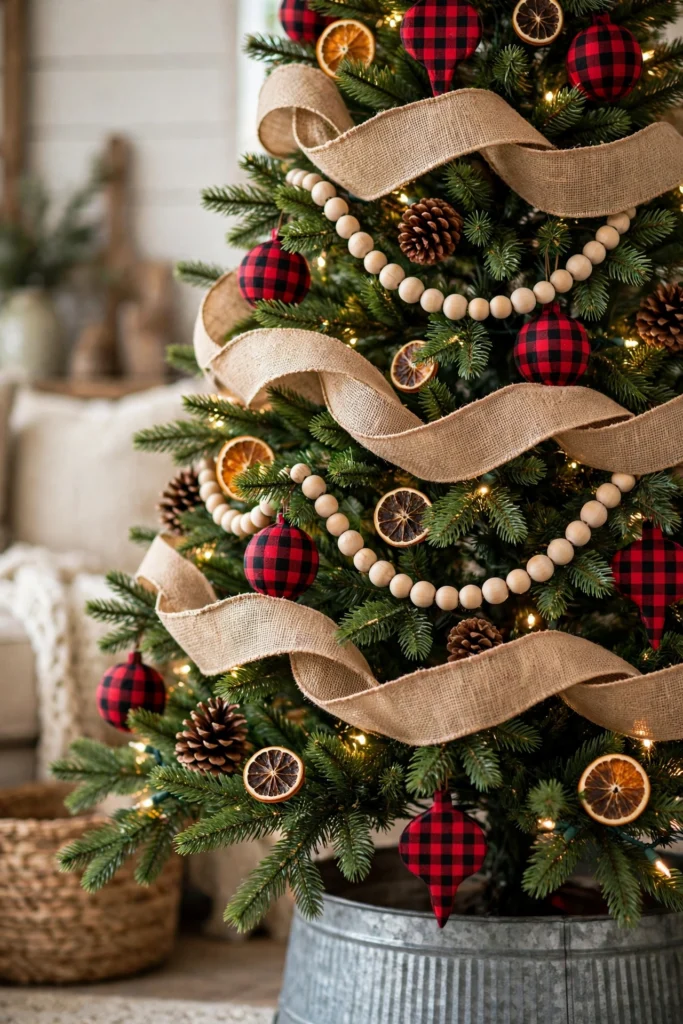
The tree is the anchor of a farmhouse Christmas, and it is also where the style is easiest to get right, because the formula is so simple. Start with the tree, then let the rest of the room grow out from it. The tree decorations and the big farmhouse pieces, wood beads, burlap and a galvanised collar, are the classic bones. Everything else in the room should echo them, not compete with them.
Choose the tree first. A flocked tree, white or lightly frosted, is the classic farmhouse choice, because it makes the greenery read as snow and lets the warm wood tones stand out. A plain green tree works just as well, and it is the better choice if your room is small, because a flocked tree in a small room can look washed out. Real or faux does not matter nearly as much as shape. A full tree with strong branches holds heavy ornaments and garlands. A slim tree suits a corner and a small room. Measure the ceiling, then buy a tree at least thirty centimetres shorter than the room, so the topper has space and the tree does not look cramped.
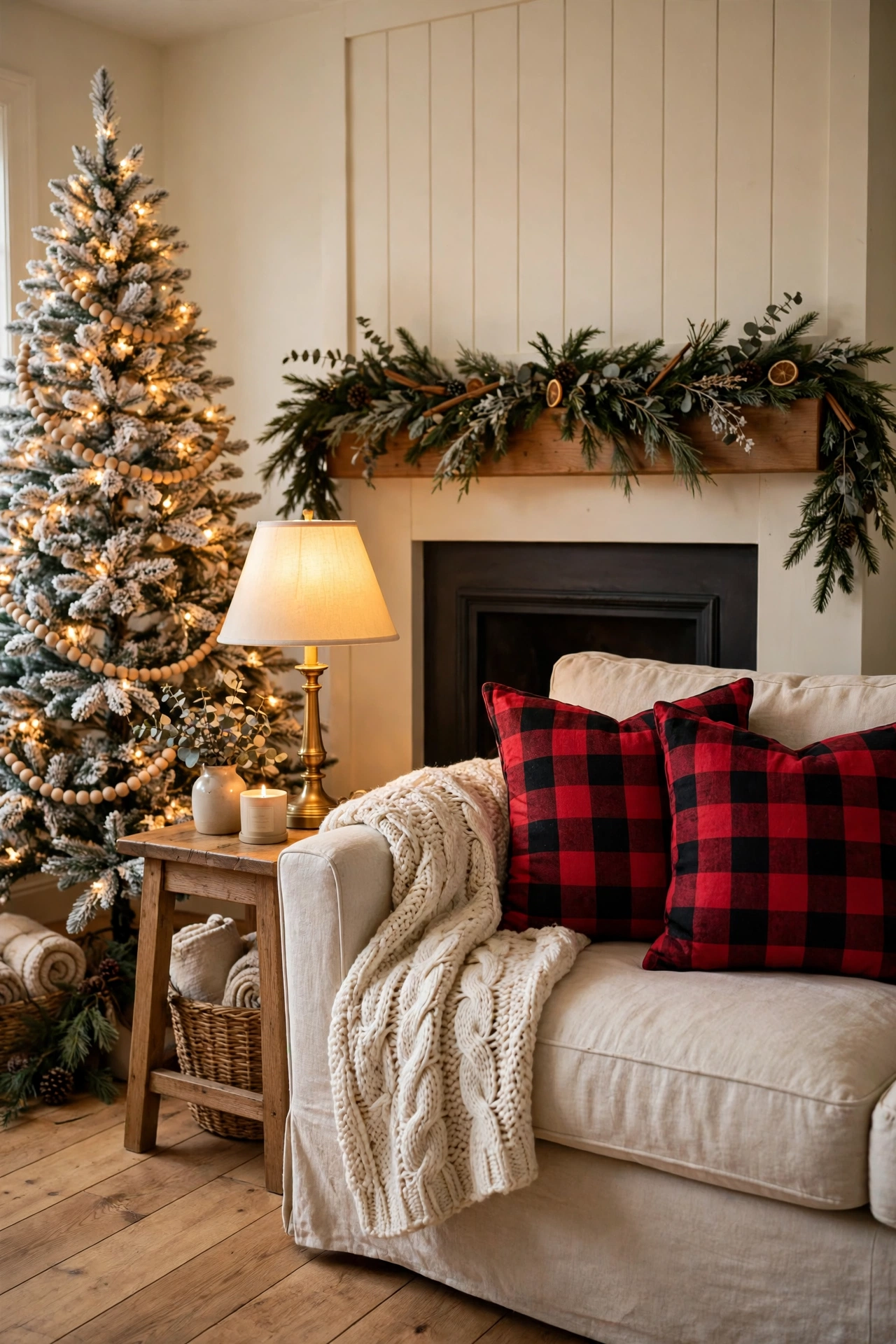
Dress the tree in layers, in this order, and do not skip a step. Lights go on first, warm white, wrapped from the inside of the branches outward, so the glow comes from inside the tree rather than sitting on the surface. A good rule is one hundred lights per foot of tree height, which sounds like a lot until you see how much better a well lit tree looks. Next comes the garland, and in a farmhouse tree the garland is usually wood beads, a long strand of natural wooden beads that drapes in soft swags around the tree. Wood bead garland is the single most farmhouse object you can put on a tree, and it costs very little. Drape it loosely, in three or four swags, and let it hang naturally rather than pulling it tight.
Then the ribbon. Burlap ribbon is the farmhouse classic, wide, wired if you can find it, tucked into the branches in loops rather than wrapped flat around the tree. Cut it into metre lengths and tuck each piece in separately, which gives you the billowing look without fighting one long piece. Buffalo check ribbon, red and black or black and white, is the second choice, and it is the one that adds the most Christmas feeling for the least money. A buffalo check bow at the top, or a few check ornaments scattered through the tree, is enough. You do not need both burlap and buffalo check everywhere. Pick one as the main ribbon and use the other as a small accent.
Ornaments come last, and the farmhouse rule is natural and handmade first, shop bought second. Wooden ornaments, dried orange slices, pinecones, cinnamon stick bundles tied with twine, small bells, and simple white or cream baubles fill most of the tree. Add a few vintage pieces if you have them, and a few handmade ones from the kids, because a farmhouse tree is supposed to look collected over years, not bought in one afternoon. If you want to sneak in a little colour, this is the place. A few berry red ornaments, or a handful of soft green ones, against the cream and wood will read as deliberate and fresh. The mistake is to add colour everywhere. Add it in one place, on the tree, and let the rest of the room stay neutral.
Finish the base, because the base is part of the tree. A galvanised metal tree collar is the farmhouse standard, and it hides the stand completely while adding an industrial note that balances the softness of the tree. A burlap or linen tree skirt is the softer choice, and it works well in a room with a lot of textiles. A wicker basket, with the tree pot set inside it, is the most rustic option and the cheapest, because most houses already own a basket. Whichever you choose, make sure it is wider than the stand and stable, especially if you have children or pets. A tree that wobbles is not charming.
If you want a deeper guide to tree decorating in general, including light counts, ornament placement and small tree ideas, our Christmas Tree Decor Ideas guide covers the full method step by step, and the farmhouse rules here sit on top of it.
The Mantel, Garland, Wooden Signs and One Big Moment
The mantel is the second anchor of a farmhouse Christmas, and it is the place where most people overdecorate. The rule for a farmhouse mantel is the same as for the tree: one big moment, a few supporting pieces, and empty space around them. A mantel crowded with twenty small objects looks like a shop shelf. A mantel with a full garland, one sign, and two lanterns looks like a home.
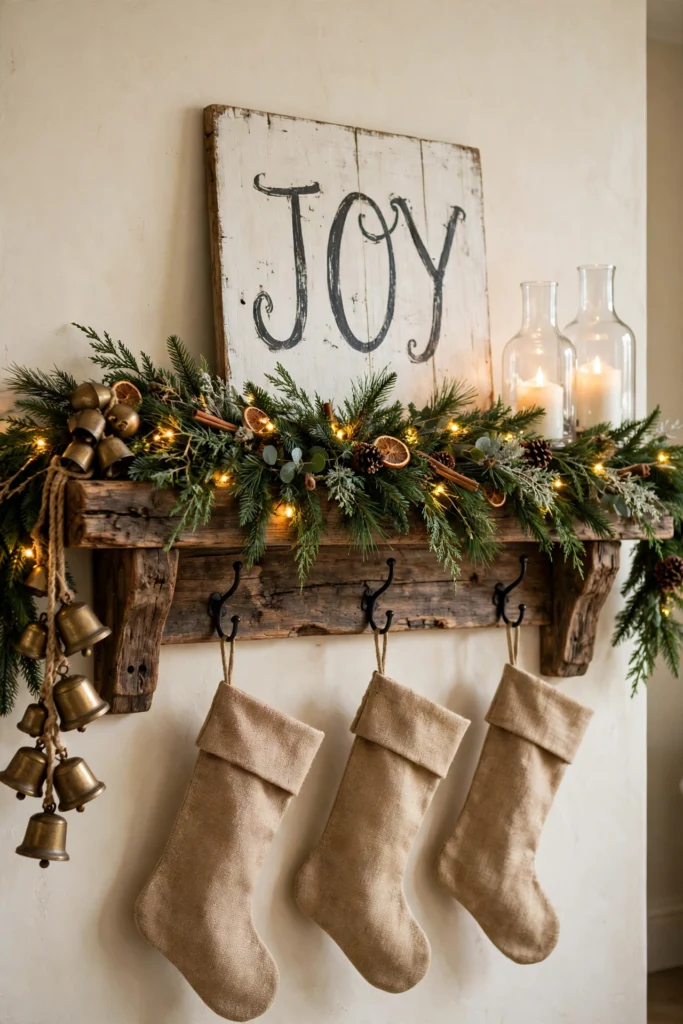
Start with the garland, because it is the frame for everything else. A full evergreen garland, real or good faux, layered if you can manage it, with pine and cedar mixed for depth, is the base. Drape it along the mantel with a gentle swag in the middle, and let the ends hang down the sides by about thirty centimetres. The garland should be at least a third longer than the mantel so it can swag properly. Tuck in eucalyptus sprigs for a softer texture, and a few pinecones wired in place. Add warm white fairy lights woven through the garland, on a timer so they come on every evening without anyone remembering. The lights are not optional. A garland without lights looks flat in the evening, and the evening is when the mantel matters most.
The sign is the farmhouse signature. A hand painted wooden sign, JOY, Noel, Merry Christmas, or a simple Believe, hung above the mantel or leaned against the wall on it, gives the whole display its voice. Reclaimed wood is best, and a sign you make yourself from a plank and a stencil looks better than a bought one, because the paint is a little uneven and the wood shows through. Keep the sign to one or two words. A long sentence on a sign is hard to read from across the room and it competes with everything else. Hang the sign at the centre, or lean it slightly off centre with a small wreath beside it, and let it be the tallest thing on the mantel.
The supporting pieces are small and functional. Two lanterns, one on each end of the mantel, with battery candles inside, give you warm light at face height and balance the garland. A cluster of brass bells on a rope, hung from a hook or draped along the garland, adds the farmhouse sound and texture. Pillar candles in different heights, in glass hurricanes, sit in the middle of the garland and draw the eye. Stockings hang from the mantel edge on simple iron hooks, one per person, in burlap or knit, and they should be the same style, not a mixed set, because matching stockings make the mantel look planned.
If you do not have a fireplace, none of this is wasted. A console table, a sideboard, or even a wide shelf takes the same treatment: garland along the top, a sign above it, lanterns at the ends. The mantel is a shape, not a room, and the shape works anywhere you have a long horizontal surface with a wall above it. The same goes for a bedroom dresser or a hallway console, which is how the style spreads through the house without buying anything new.
One safety note that matters more than it sounds. Keep candles, even battery ones, away from the garland, and never put a real flame near dry greenery. Battery candles look identical from across the room and they are the reason farmhouse mantels can be left lit all evening. Real candles belong on the dining table, in glass, where someone is watching them.
The Farmhouse Dining Table, Plaid Runner, Mason Jars and Candlelight
The farmhouse dining table is where the style is at its most useful, because a farmhouse table has to hold dinner. That is the test every centrepiece has to pass. If it cannot be lifted away in one move when the platters arrive, it is in the way. The best farmhouse centrepieces are low, narrow and movable, and they look better for it, because a low centrepiece lets people see each other across the table.
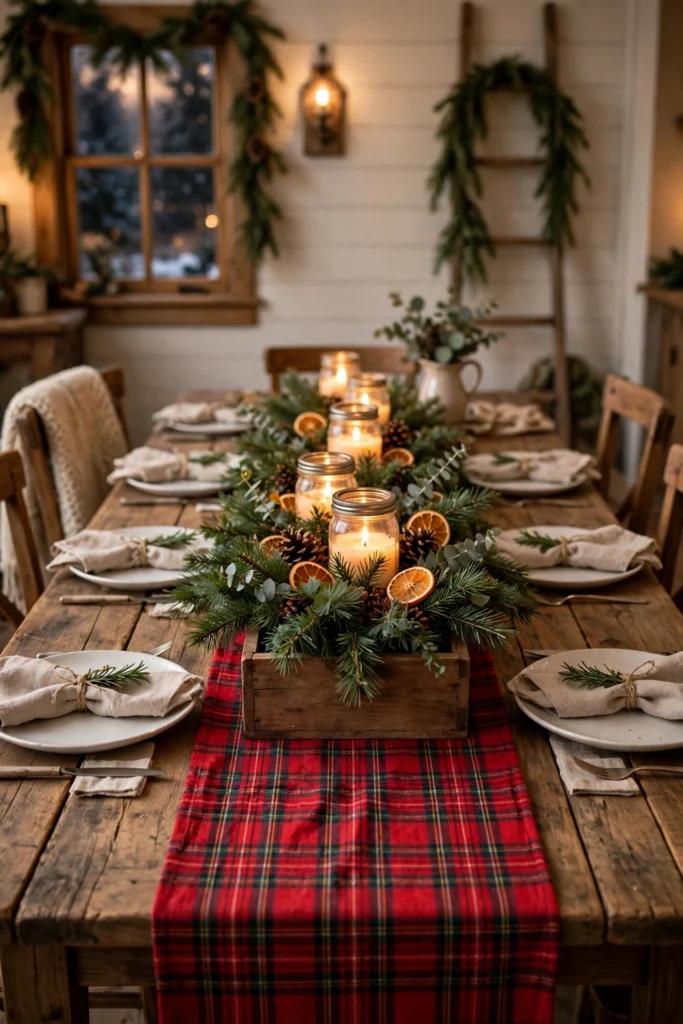
Start with the runner. A red plaid runner is the classic farmhouse choice, and it does half the decorating work on its own. It should hang about fifteen centimetres over each end of the table, and it should be narrower than the table by at least thirty centimetres on each side, so plates and glasses still have room. A burlap runner is the quieter choice, and it works well if your room already has a lot of red. A linen runner in cream, with a plaid throw folded at the end of the table, is the third option, and it is the one that looks most expensive for the least money. Whichever you choose, iron it before it goes on the table. A wrinkled runner is the one detail guests notice, and it takes two minutes to fix.
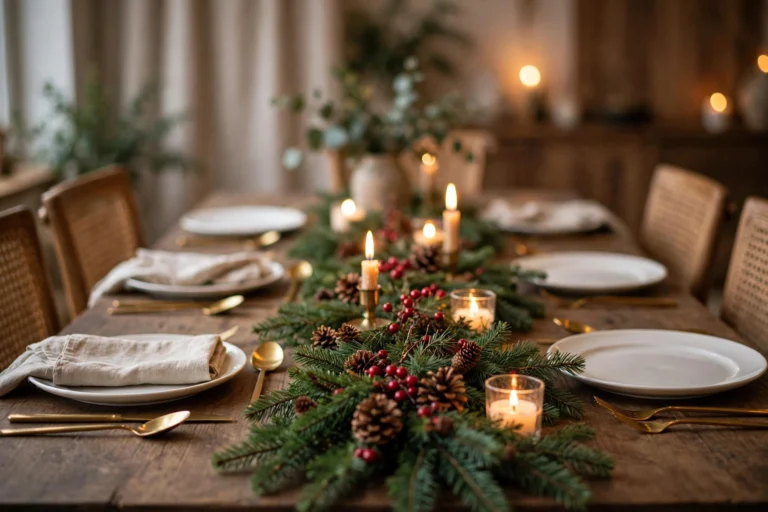
The centrepiece is built on a tray or a wooden crate, because a tray makes the whole thing movable. A long wooden box, a vintage crate, or a simple tray holds the centrepiece together and stops it spreading across the table. Inside it, lay a bed of greenery, pine or cedar, then add the height: three pillar candles in different heights, in glass hurricanes or mason jars, down the middle. Then the texture: pinecones, a few dried orange slices, a small cluster of berries, and a sprinkle of cinnamon sticks. That is the whole centrepiece, and it costs almost nothing if you already own the tray and the jars. The greenery should be low, no higher than the candles, so nobody has to peer over it to talk.
Mason jars are the farmhouse workhorse on a table, and they earn their place in three ways. As candle holders, a jar with a tea light inside gives you a safe, windproof flame that can sit right next to a plate. As vases, a jar with three pine sprigs and a sprig of berries is a centrepiece in itself. As place settings, a small jar with a name tag tied around it in twine is a favour and a place card in one. Fill a jar with cranberries and water and float a tea light on top, and you have the prettiest thing on the table for the price of a handful of berries. Keep one rule in mind: jars on a table should be in odd numbers, three or five, and they should be different heights, because matching jars in a straight line look like a laboratory.
Place settings stay simple. White plates, because white lets the food and the runner do the work. A linen napkin, tied with twine and a sprig of rosemary, on each plate. A wooden charger or a woven placemat under the plate if you own them. Cutlery in the usual places, nothing fancy, and a small sprig of greenery laid across the plate. The whole setting takes about a minute per place, and it photographs beautifully, which is why it shows up in so many saved farmhouse table pictures. The secret is that it is also the cheapest setting to make, because the decoration is a sprig from the garden and a piece of string.
For the full method on table decorating, including the tray formula, the small table version and the five centrepieces that actually work for dinner, our Christmas Dining Table Decor Ideas guide covers it in detail, and the farmhouse version here is the same method with plaid and wood instead of gold and glass.
Small Farmhouse Touches Room by Room
Farmhouse Christmas works because it spreads. The living room gets the tree and the mantel, but the rest of the house gets small touches that cost almost nothing and make the whole home feel dressed, not just one room. The rule for every room is the same: one grouping, one material repeated, and nothing that gets in the way of using the room.
The kitchen is the easiest room, because it is already full of farmhouse materials. A wooden tray on the counter with a small ceramic tree, a battery candle and a cookbook is the whole decoration, and it lifts off in one move when real cooking starts. Mini wreaths on the cabinet doors, hung with ribbon and a hidden hook, so there is zero damage and the doors still open properly. A rosemary tree in a pot on the windowsill, which doubles as seasoning. Red mugs and green glasses brought to the front of the open shelves, one bottle brush tree per shelf, maximum. A garland on top of the cabinets if you have the height, and a plaid tea towel swapped in for the usual one. The kitchen has to make dinner all December, so the decor has to earn its place, and the test is simple: if it is in the way of cooking, it goes.
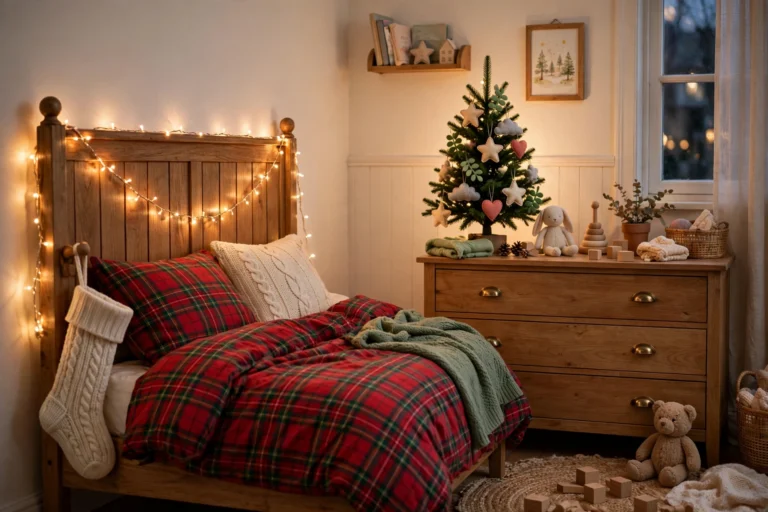
The bedroom gets the textiles. A plaid throw folded across the foot of the bed, a chunky knit throw over the chair, and one cushion in buffalo check. A small tree on the dresser, or a garland along the headboard if the bed is against the wall. A tray on the bedside table with a candle and a small pine plant, and a water carafe for guests. The bedroom is the room where farmhouse is at its cosiest, because the materials are already soft: wool, linen, cotton, and warm light. Keep the colours to cream and wood with one red accent, and the room will feel like a winter stay rather than a photo shoot.
The bathroom gets the smallest touch, and it matters more than people think, because it is the room guests visit alone. A faux garland around the mirror, held with removable hooks, transforms the room without taking a single inch of counter. A small potted evergreen on the windowsill. Red plaid hand towels, folded neatly, and a tray on the vanity with a candle and a pine sprig. That is the whole bathroom, and it takes ten minutes. Keep everything steam safe and keep the sink usable. A bathroom that looks pretty but has nowhere to put a toothbrush is a failed decoration.
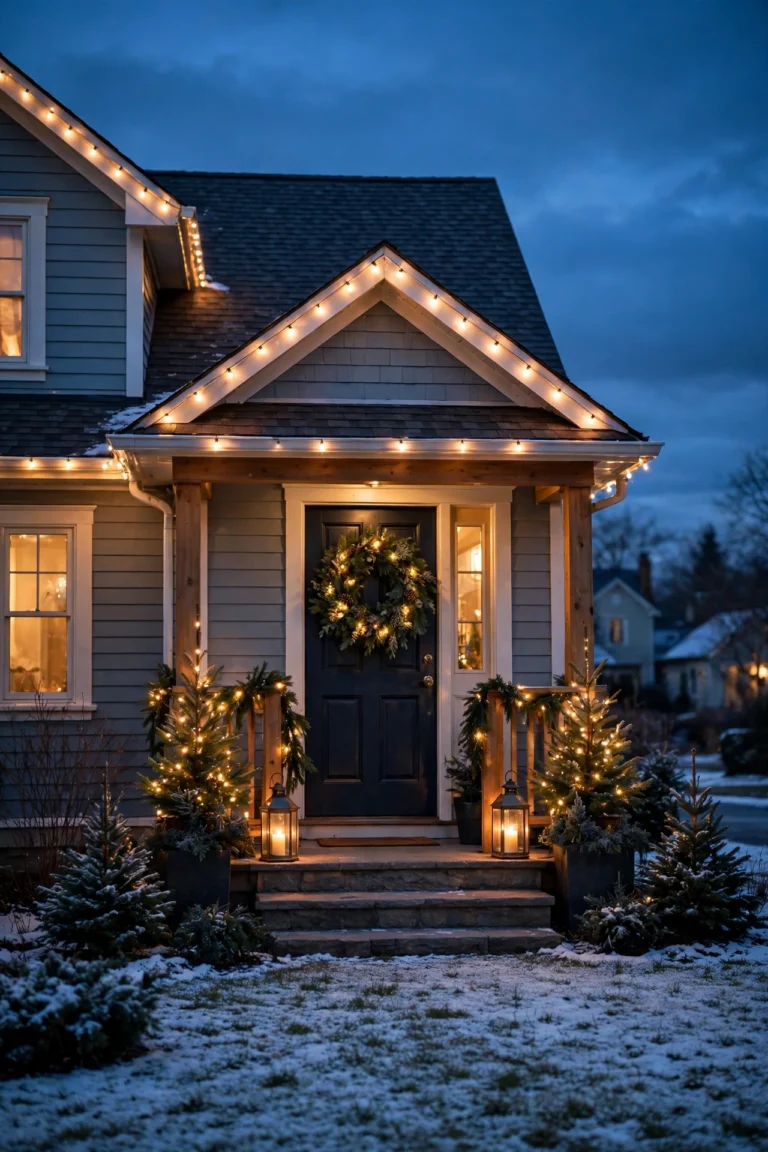
The entryway gets the welcome. A wreath on the inside of the front door, or on the mirror if you have one. A garland on the console, with a lantern and a bowl for keys. A boot tray by the door, a basket for hats and gloves, and one hook per person plus one spare. A plaid doormat outside and a small tree in a galvanised bucket in the corner if the hall is wide enough. The entryway decides how guests feel in the first ten seconds after the door opens, and a farmhouse entryway feels warm because it is practical first: somewhere to put your coat, somewhere to put your boots, and something green to look at while you do it.
The home office gets one corner. One Christmas corner, warm light, a small tree and a shelf village, and the desk stays a desk. A garland on the shelf above the desk, a mug with a candy cane in it, and a small wreath on the wall. The office is the room where the discipline matters most, because clutter on a desk is not decoration, it is a distraction. One corner, one tray, and the working surface stays free.
DIY Farmhouse Decor That Costs Almost Nothing
The best farmhouse decorations are the ones you make, and not because making them saves money, although it does. It is because handmade things look handmade, and handmade is the whole point of the style. A garland you strung yourself, a sign you painted yourself, a stocking you sewed yourself, all of them carry the texture and the small imperfections that make a room feel like a home rather than a display. These five projects are the ones worth your time. Each takes under an hour, each costs under ten dollars, and each one gets used every year.
First, the wood bead garland. Buy a bag of natural wooden beads, in two sizes if you can, and a length of jute twine. Thread the beads onto the twine, alternating sizes, with a knot every ten beads so they do not all slide to one end. Add a small tassel at each end, made from the same twine. That is the whole project. A wood bead garland works on the tree, on the mantel, along a shelf, or draped over a mirror, and it is the single most versatile farmhouse object you can own. Make two, because you will want one on the tree and one on the mantel, and they take about twenty minutes each.
Second, burlap stockings. Cut two stocking shapes from burlap, sew them together inside out, turn them right side out, and fold a cuff at the top. Add a loop of twine for hanging, and a small sprig of greenery tucked into the cuff. Burlap is a material often associated with simpler times, which makes it perfect for farmhouse or rustic decor, and a burlap stocking costs about a dollar in fabric. Make them all the same, in the same burlap, so the mantel looks planned. If sewing is not your thing, a fabric glue gun does the same job, and nobody will ever check the seams.
Third, mason jar luminaries. Take a mason jar, any size, and fill the bottom with Epsom salt for snow, or cranberries for colour. Set a battery tea light in the middle, tie twine around the neck, and tuck a sprig of pine under the twine. Put three of them together on a tray, in different heights, and you have a centrepiece. Put one on every windowsill and the whole house glows in the evening. The jars are already in your cupboard, the salt is already in your bathroom, and the whole project costs the price of the tea lights.
Fourth, the dried orange garland. Slice oranges thin, lay them on a baking tray, and dry them low and slow in the oven until they are firm and translucent. String them on twine with cinnamon sticks and a few pinecones between them, and hang the garland on the tree, the mantel or the window. Your kitchen will smell like December for a week while you make them, and the garland lasts the whole season. This is also the project to do with children, because threading oranges is easy, safe, and genuinely useful, unlike most craft projects that end up in a drawer.
Fifth, the reclaimed wood sign. Find a plank, a pallet board, or a piece of old shelving. Sand the rough edges lightly, paint it cream or leave it bare, and stencil one word on it in black or deep green: JOY, Noel, Peace, or your family name with an established date. Distress the paint lightly with sandpaper so the wood shows through. Hang it above the mantel or lean it on the sideboard. A sign made from wood you already own costs nothing, and it is the piece guests ask about, because it looks like it has a history, and it does. Yours.
Farmhouse Christmas on a Budget, What to Buy First and What to Skip
Farmhouse Christmas is the cheapest Christmas style to do well, and the most expensive to do badly, because the expensive version is buying everything new at once. The cheap version is buying three things, making three things, and using what you already own for the rest. This section is the honest budget order, with real prices, so you can spend fifty dollars and have a house that looks like you spent five hundred.
Buy first, in this order. Warm white fairy lights, one long string for the tree and one short string for the mantel, about eight to twelve dollars for both. One chunky knit throw or one plaid throw, twenty two to twenty eight dollars, which lives on the sofa all winter, not just at Christmas. Two velvet or linen cushion covers in your accent colour, twelve to sixteen dollars for the pair. That is the whole first purchase, about fifty dollars, and it changes the living room completely. Lights, a throw, and two cushions are the only three things worth buying first, because they are the only three things that work in January as well as December.
Buy second, only if the first three are done. A wood bead garland, about ten dollars, or make it for three dollars in beads and twine. A roll of burlap ribbon, about six dollars. A galvanised tree collar, about twenty dollars, or a wicker basket you already own. A set of battery candles, about ten dollars. That is the second purchase, about forty dollars, and it finishes the tree and the mantel.
Make instead of buying. The wood bead garland, the burlap stockings, the mason jar luminaries, the dried orange garland, and the wooden sign, all from the previous section, cost under ten dollars each and most cost under three. The garland on the mantel can be real greenery cut from the garden, or a good faux garland bought once and used for ten years. The wreath can be a plain evergreen wreath, about fifteen dollars, dressed with a bow and a few pinecones you already own, instead of a finished wreath for forty.
Skip these entirely. Matching ornament sets, because a farmhouse tree is supposed to look collected, not matched. Anything with glitter, because glitter is the opposite of the natural material rule and it gets everywhere for months. Pre decorated garlands and wreaths, because you pay three times the price for someone else to add the same pinecones and ribbon you could add in ten minutes. Novelty ornaments that only work for one year. And any decoration that needs batteries you cannot replace, storage you do not have, or a ladder you do not own.
Shop secondhand first. Thrift stores and estate sales deliver wooden crates, old sleds, brass bells, iron lanterns, wicker baskets and vintage ornaments for a few dollars each, and these are the pieces that make a farmhouse room look real, because they are real. Buy the lights and the ribbon new, because those wear out. Buy everything else secondhand, or make it, and the house will look like it has been decorated this way for years, which is exactly the point.
For the kitchen version of this budget, including the cabinet wreath trick and the whole kitchen for under fifty dollars, our Christmas Kitchen Decor Ideas guide has the itemised list, and the same shop at home rule applies: bring what you already own to the front before you buy anything new.
Conclusion
Farmhouse Christmas is not a shopping list. It is a way of looking at the house you already have and seeing the Christmas in it. The wood is already there, in the floors and the furniture. The textiles are already there, in the throws and the towels. The glass is already there, in the jars and the bottles. The greenery is outside, or in the garden centre for a few dollars. All the style asks you to do is bring those things to the front, add warm light, and leave enough empty space for the room to breathe.
Start with the palette, not the shop. Cream, warm wood, deep evergreen, and one place for red. Then the tree, dressed in layers, lights first, wood beads next, burlap or buffalo check, and ornaments that look collected over years. Then the mantel, one garland, one sign, and two lanterns. Then the table, a plaid runner, a tray centrepiece, and mason jars doing three jobs at once. Then the small touches, one grouping per room, in the kitchen, the bedroom, the bathroom, the entryway and the office. Then the DIY projects, the garland, the stockings, the luminaries, the oranges and the sign, which cost almost nothing and get used every year. And the budget, fifty dollars for the three things worth buying first, and secondhand or handmade for the rest.
The result is a house that feels warm in the way only farmhouse can, not because it is full of things, but because the things in it are honest, useful and loved. The tree smells like pine. The mantel glows in the evening. The table is set and ready for dinner. The stockings are hung and waiting. That is the whole style, and it has been the whole style for years, which is why it still works, and why it will still work next December, when you take the same garland, the same beads, the same sign out of the box and hang them up again. Save this guide, start with the lights and the throw, and let the rest of the house follow.