Christmas Placemat Ideas That Dress Every Place
A Christmas placemat is the smallest piece of table decor you will buy, and it is the one that does the most work for its size. It frames the plate, it carries the colour of the whole table, it protects the wood from hot dishes and red wine, and it tells every guest where to sit before a single word is spoken. A table without placemats can be beautiful, but it is a table where the plates float on bare cloth and the settings blur together. Add a placemat under each plate, and the same table suddenly looks planned, finished, and ready for dinner.
I learned this the first Christmas I hosted dinner for my family. I had spent a week on the table. I had bought a red tablecloth, a garland for the centre, candles, new napkins, and a set of gold cutlery I could barely afford. I set it all out on Christmas Eve, stepped back, and something was missing. The table looked like a beautiful centrepiece with plates dropped on it. My mother looked at it, went to the cupboard, and pulled out six plain woven placemats I had forgotten we owned. She slid one under each plate, and the whole table changed in thirty seconds. Every setting had a border. Every plate had a home. The red of the cloth stopped bleeding into the white of the plates, because the woven mat sat between them and gave the eye a place to rest. That is what a placemat does. It is a frame, and a framed picture always looks better than an unframed one.
The other thing a placemat does is forgive. Christmas dinner is messy. Gravy drips. Cranberry sauce escapes. A glass of red wine tips toward the edge of the table. A placemat takes the spill that would have stained the tablecloth, and a wipe-clean placemat takes it and asks for nothing in return. On the night itself, that matters more than any styling rule. You can wipe a placemat in five seconds and keep eating. A stained tablecloth sits there all evening, getting worse, and you notice it every time you look down.
This guide covers the sizing rule that stops a placemat looking wrong, the classic red plaid setting, velvet and linen for a dressier table, burlap and woven mats for a farmhouse table, DIY Christmas placemats you can make in an afternoon, how to layer placemats with a tablecloth and a runner, what to do for kids, small tables and round tables, and how to clean and store your mats so they come back next year looking new. For the layers underneath, our Christmas tablecloth guide covers the full cloth, our Christmas table runner guide covers the strip down the middle, and our Christmas tiered tray guide covers the small display that sits on top of it all.
1. The Sizing Rule: How Big Should a Christmas Placemat Be?
Every placemat decision starts with size, because a placemat that is too small looks like a coaster, and a placemat that is too big crowds the table and fights the centrepiece. The standard size for a dinner placemat is 30 by 45 centimetres, or 12 by 18 inches, and that size fits almost every dining table and almost every dinner plate. It gives the plate a border of about five centimetres on each side, which is enough to frame the plate without wasting table space. If you buy one size and never think about it again, buy this one.
Round placemats follow a different rule. A round placemat should be 38 centimetres across, or 15 inches, and that size fits a standard dinner plate with a border of about five centimetres all round. Round mats suit round tables, farmhouse tables, and any table where you want a softer look than the sharp corners of a rectangle. They also suit woven and burlap mats, which are usually sold round, and they stack neatly in a cupboard when the season ends.
Before you buy, measure two things. First, measure your table. A placemat needs about 60 centimetres of table width per person when the plate, the glass, and the cutlery are all in place, and if your table is narrower than that per seat, you need a smaller mat, not a bigger one. Second, measure your plates. A dinner plate is usually 27 centimetres across, and the placemat must be at least 5 centimetres wider on every side. Put a plate on the mat in the shop, or on a piece of paper cut to the mat size at home, and look at the border. If the border is thinner than two fingers, the mat is too small. If the border is wider than a hand, the mat is too big.
Spacing matters as much as size. Leave at least 5 centimetres between neighbouring placemats, so the settings do not touch and the table does not look crowded. Leave at least 5 centimetres between the placemat and the edge of the table, so a guest does not pull the mat off the table when they sit down. If your table is short, do not try to fit six large mats on a table that seats four comfortably. Use smaller mats, or use a tablecloth and skip the mats at the ends, or move two guests to a side table. A crowded table is a miserable table, and no placemat is worth a guest eating with their elbows tucked in.
One more sizing note, and it is the one people forget. Buy one more placemat than you have chairs. A spare mat covers a last minute guest, a spill that needs a swap mid-meal, or a mat that comes out of the wash with a stain you did not see. Placemats are sold in sets of four and six, so buy the set that covers your usual table plus one, and keep the spare in the cupboard with the napkins. It costs almost nothing, and it saves the evening at least once every December.
2. Red Plaid Placemats: The Classic Christmas Place Setting
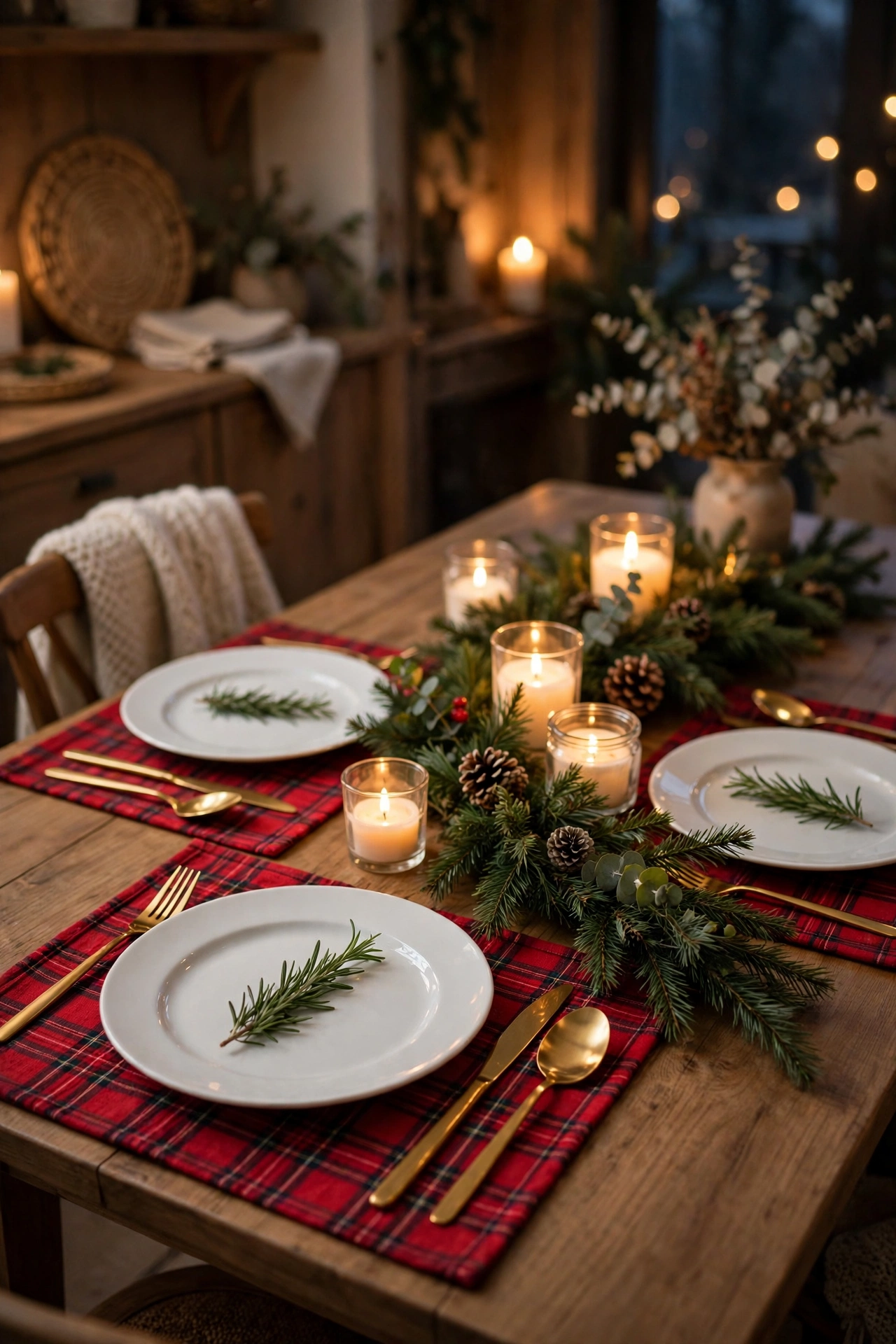
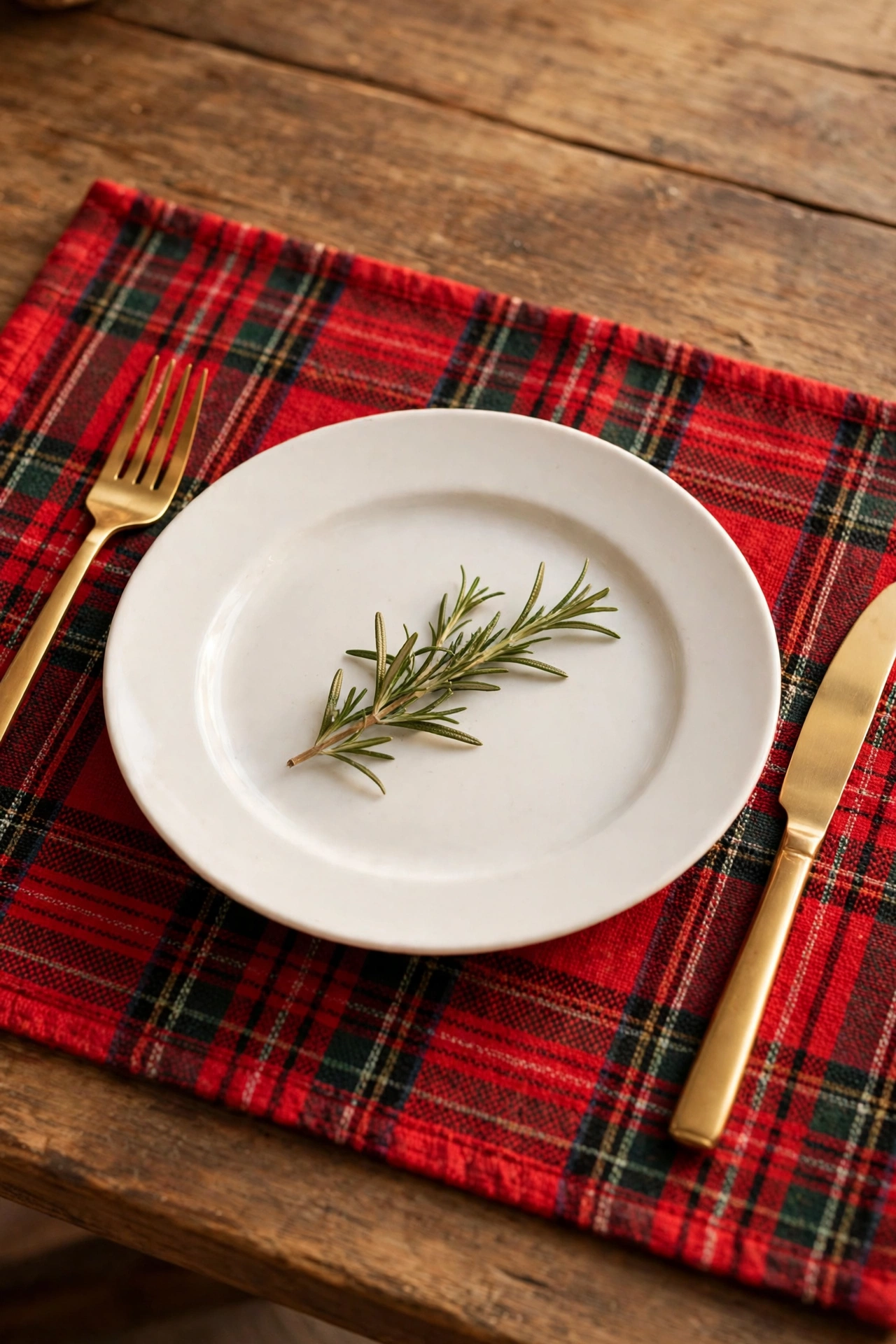
Red plaid is the first placemat most people picture when they think of Christmas, and it earns that place honestly. A red plaid placemat does three things at once. It brings the red of the season to every seat, it repeats the pattern of the tablecloth or the runner without matching it exactly, and it looks good with almost any plate you already own. White plates on red plaid is the classic Christmas table, and it has stayed classic because it works every single year.
The rule for plaid is to use it once per setting, not three times. If the placemat is plaid, the napkin should be plain, and the tablecloth should be plain or lightly patterned. A plaid placemat on a plaid tablecloth with a plaid napkin is not festive. It is a pattern fight, and the eye does not know where to rest. Let the placemat carry the pattern, and let everything else stay calm around it. A white plate, plain gold or silver cutlery, a plain linen napkin folded flat or rolled with a sprig of rosemary, and the red plaid mat underneath does all the talking.
Plaid comes in many sizes of check, and the size of the check changes the feel of the table. A large, bold check, red and green with wide bands, feels rustic and warm, and it suits a farmhouse table, a wooden table, and a casual family dinner. A small, tight check, red and cream with thin lines, feels neater and dressier, and it suits a smaller table, a formal dinner, and a table where the plates are already patterned. If your plates have a pattern of their own, choose the small check. If your plates are plain white, choose the bold check and let it do the work.
The material matters too. Cotton plaid placemats wash well, iron well, and soften with every wash, which makes them the practical choice for a family table. Linen plaid placemats look more expensive, wrinkle more, and suit a dinner where the table is set early and nobody is eating with children. Felt plaid placemats, the thick kind sold as sets in craft shops, do not wash at all, but they wipe clean, they grip the plate so it does not slide, and they are the best choice if your table is glass or polished wood and plates tend to wander. Pick the material for the dinner you are actually hosting, not the dinner in the photograph.
A red plaid placemat also solves the problem of a plain table. If your tablecloth is plain cream or plain white, a red plaid mat at every seat adds the Christmas colour without you buying anything else. It is the cheapest way to make a table look like Christmas, because one set of six mats costs less than one new tablecloth, and it changes the table more. If you are decorating on a budget, start here. Buy the placemats first, then decide if you need anything else, and most years you will find you do not.
3. Velvet and Linen Placemats for a Dressier Table
Not every Christmas table wants plaid. Some tables want to feel dressed up, and for those tables the placemat should be velvet or linen, in a deep colour, with no pattern at all. A deep green velvet placemat under a white plate, with gold cutlery and a glass candle holder, is the most elegant Christmas table you can set without buying a single new plate. The velvet does the work. It catches the light, it softens the edge of the plate, and it makes the whole table feel like an occasion.
Velvet placemats come in the colours Christmas loves best. Deep green, deep red, and a dark gold that reads as bronze in candlelight. Choose one colour and use it at every seat. Do not mix green velvet at one end and red velvet at the other, because the table will look like two different dinners. If you want a second colour, bring it in through the napkin, a red napkin on a green velvet mat, or a gold napkin ring on a red velvet mat, and keep the placemat itself the same everywhere.
Linen is the quieter cousin of velvet. A linen placemat in cream, natural flax, or a soft sage green feels calm and expensive, and it suits a table where the centrepiece is already bold. If your centrepiece is a tall garland with red berries and gold ornaments, a plain linen placemat lets the centrepiece shine without competing. If your centrepiece is a simple row of candles, a linen placemat in a stronger colour, deep green or charcoal, gives the table the weight it needs. Linen wrinkles, and that is part of its charm. Iron it if you like a crisp look, or leave the wrinkles if you like a relaxed one. Either way is correct.
The practical rule for velvet and linen is to keep them away from the messiest dishes. Velvet does not wipe clean. It spots, it marks, and a gravy spill on a velvet mat is a stain you will see all evening. If your Christmas dinner is a buffet where guests carry plates, velvet is fine, because the mat never meets the food. If your dinner is served at the table with shared dishes passed hand to hand, choose linen, which washes, or choose a wipe-clean mat in a velvet colour instead of real velvet. The look you want is velvet. The material you need is the one that survives your dinner.
For a dressier table, the details around the placemat matter more than the placemat itself. A charger plate, a large decorative plate that sits under the dinner plate, turns a velvet placemat into a layered setting. The order from the table up is placemat, charger, dinner plate, and the charger should be wider than the plate by about five centimetres on each side, in gold, silver, or a plain colour that matches the cutlery. Add a folded napkin on the plate with a sprig of rosemary, and a place card if you are seating guests formally, and the table is done. Nothing else is needed, and anything else is clutter.
4. Burlap, Woven and Natural Placemats for a Farmhouse Table
A farmhouse Christmas table does not want velvet. It wants texture, natural fibre, and the look of something made rather than bought. Burlap, woven seagrass, jute, and rattan placemats give a farmhouse table exactly that, and they are the most forgiving placemats you can own, because they hide crumbs, they wipe clean, and they look better slightly worn than they do brand new.
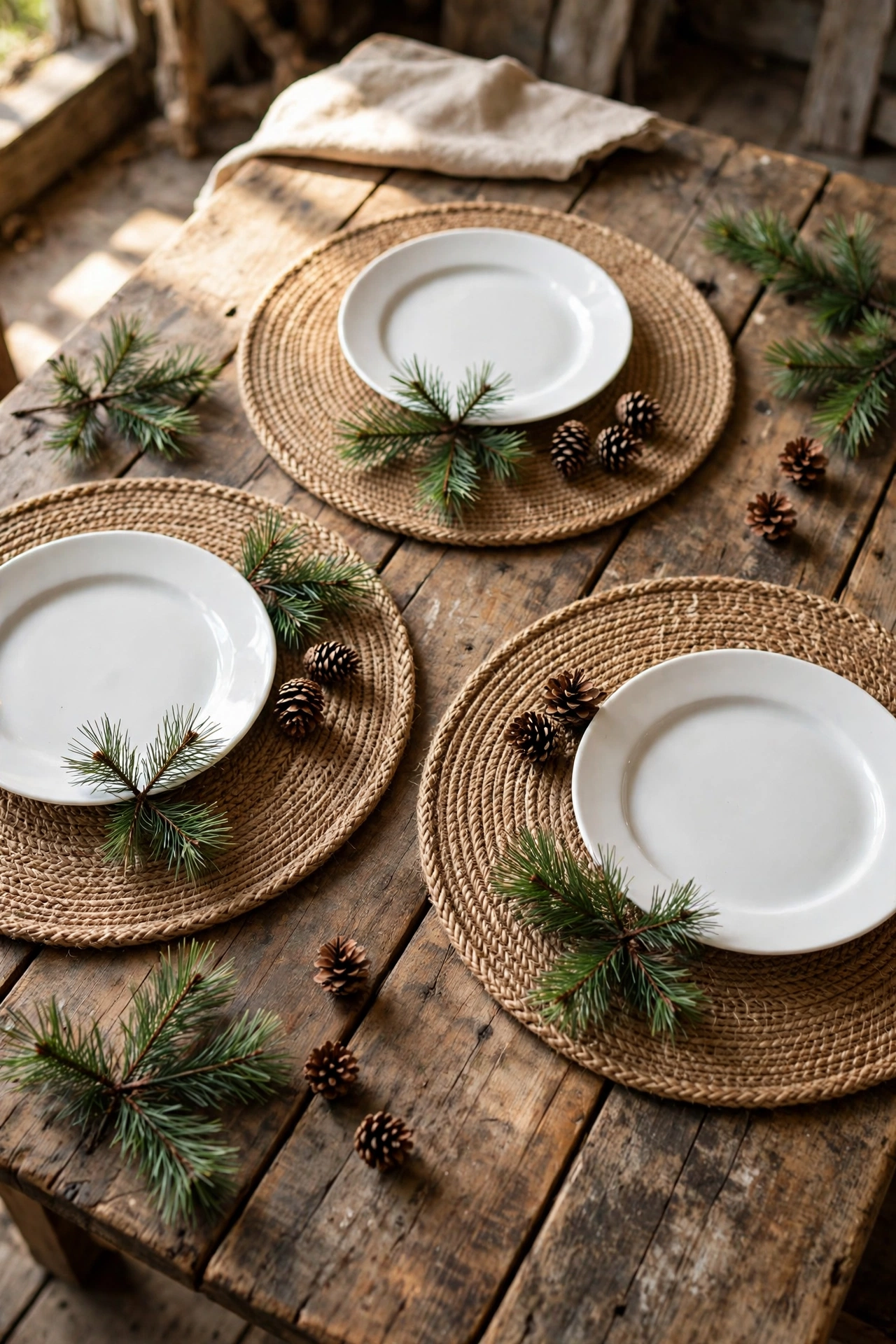
Round woven placemats are the farmhouse classic. A round jute or seagrass mat, about 38 centimetres across, under a white or cream plate, with a sprig of pine on the plate and a linen napkin underneath the cutlery, is the table you see in every farmhouse Christmas photograph, and it works because the circle of the mat breaks up the straight lines of the table and the plates. Woven mats also grip. A plate on a woven mat does not slide when a child bumps the table, and a glass on a woven mat does not ring against the wood. That grip is a practical gift on a busy Christmas evening.
Burlap is the cheaper cousin, and it has one job it does better than anything else. A burlap placemat, plain or with a stencilled snowflake or a red stripe, adds texture without adding colour, which makes it the right mat when the table already has a lot of colour. If your tablecloth is red, your runner is green, and your centrepiece is full of berries, a plain burlap mat calms the table down. It is the neutral piece that lets the loud pieces be loud. Burlap frays, so buy mats with a finished edge, or fold the raw edge under and iron it flat before the first use.
Wooden chargers and wooden placemats, the slice of a tree trunk kind, are the rustic extreme, and they work best as a single accent, not at every seat. One wooden slice under the serving dishes in the centre, with woven mats at the seats, gives the table a woodland feel without making dinner feel like eating off a log. If you do use wooden slices at every seat, make sure they are flat, sanded, and sealed, or plates will wobble and glasses will tip. A wobbling plate is not rustic. It is a spill waiting to happen.
The farmhouse table also loves a handmade touch, and the placemat is the easiest place to add it. A crocheted edge on a plain mat, a sprig of dried orange tied to the napkin with twine, a small pinecone at each place, or a handwritten place card on a piece of brown kraft card. None of these cost anything, all of them take five minutes, and together they make a table of shop-bought mats feel personal. Our Christmas farmhouse guide covers the rest of the room, and the same rule applies there. One handmade touch per seat is enough. Two is charming. Three is clutter.
5. DIY Christmas Placemats You Can Make in an Afternoon
This is the golden idea in this guide, because DIY Christmas placemats are the version people search for when they want a table that nobody else has, and they are far easier to make than they look. A set of six placemats takes one afternoon, a few pounds of fabric, and no sewing skill beyond a straight line. If you can iron a shirt, you can make a placemat.
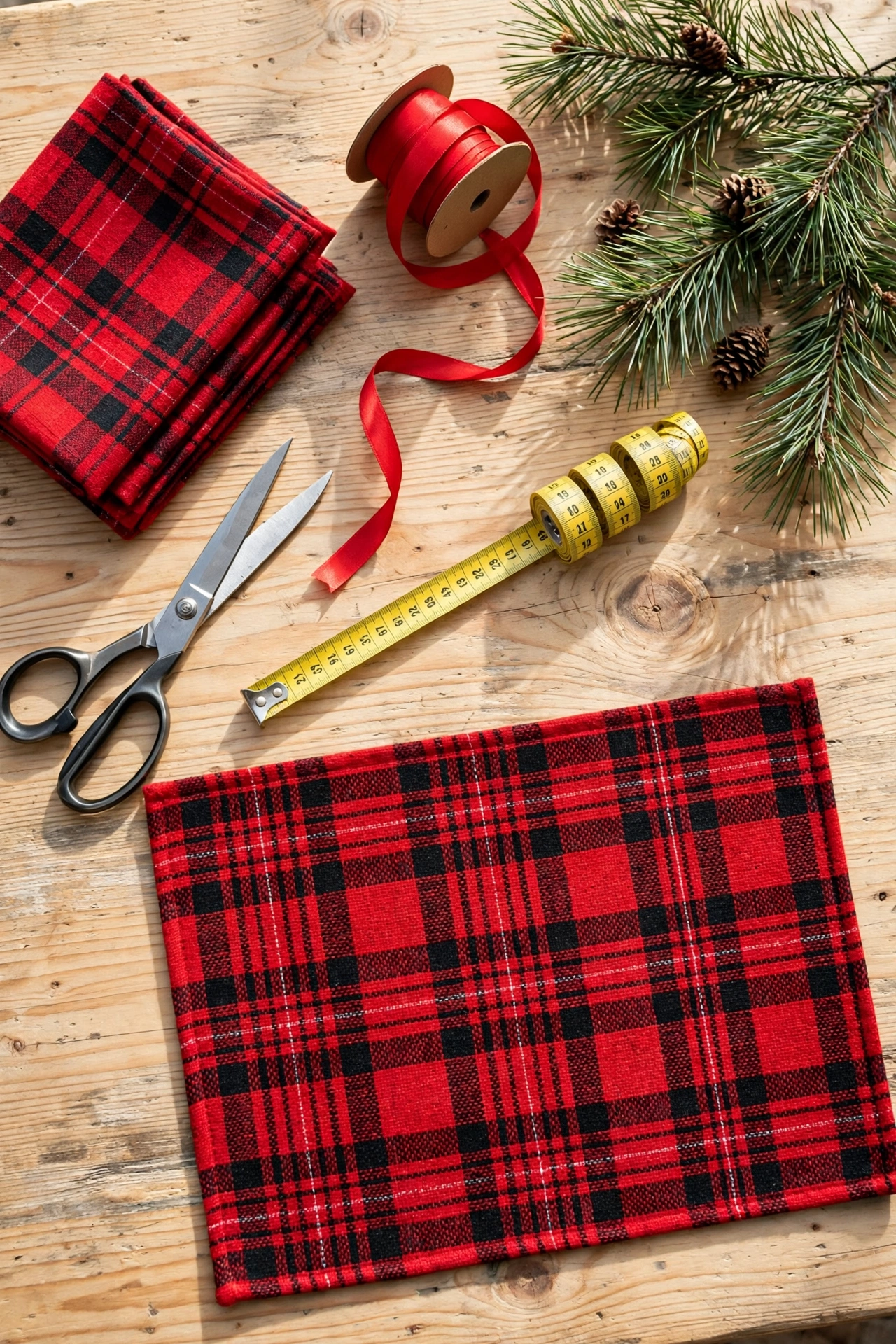
The simplest DIY placemat is the no-sew fabric mat. Buy a metre of Christmas fabric, cotton or linen, in the pattern you love, and a metre of fusible interfacing, the iron-on kind sold in every craft shop. Cut the fabric into rectangles 32 by 47 centimetres, which leaves room for a hem, and cut the interfacing slightly smaller. Iron the interfacing onto the back of the fabric, fold the edges under by one centimetre on all four sides, iron them flat, and finish the edge with iron-on hem tape. No sewing machine, no needle, no thread. One afternoon, six mats, and a table that looks like it came from a shop that charges ten times what you spent. Wash them on a gentle cycle and iron them flat, and they will last for years.
The sew-your-own version is the same build with a stitched edge instead of hem tape, and it lasts longer. Cut the fabric as above, cut a backing fabric in the same size, place the two right sides together, sew around three sides and most of the fourth, turn the mat right side out through the gap, iron it flat, and close the gap with a line of topstitching. The backing can be plain, so the mat is reversible, one side Christmas, one side plain, and you have a mat that works in January too. A beginner can sew six of these in two hours, and the only skill needed is sewing in a straight line. If your line wobbles, nobody will notice once the plate is on top.
Crocheted placemats are the slowest DIY, and the most loved, because they are the ones people keep. A simple round crocheted mat in cream or red, worked in double crochet with a scalloped edge, takes an evening per mat, so start in November, not on Christmas Eve. A full set is a project for the whole month, and it is the kind of project you do in front of the television, one mat at a time. The pattern does not need to be complicated. A plain round mat with a red border and a small holly applique in one corner is enough, and it will be the mat your family asks for by name next year.
For a no-sew craft that children can join, make paper placemats for the kids table. A sheet of thick kraft paper, a potato stamp cut into a star, red and green paint, and a child’s handprint in the corner, and each child has a placemat with their name on it. Laminate the paper with clear contact paper, or cover it with a sheet of clear vinyl, and it wipes clean and survives the meal. The children feel included, the adults get a quiet laugh, and the paper mats cost almost nothing. Keep one from each year in a folder, and you have a Christmas tradition that grows with the children.
Two warnings for DIY placemats. First, always wash and iron the fabric before you cut it, because cotton shrinks, and a mat that fits the table in November will be too small by Christmas if you skip the wash. Second, always make one test mat before you cut the whole set, and put a plate on it, a glass beside it, and cutlery on it, to check the size. A test mat takes twenty minutes. A set of six wrong-sized mats takes an afternoon you will not get back.
6. Layering Placemats With a Tablecloth and Runner
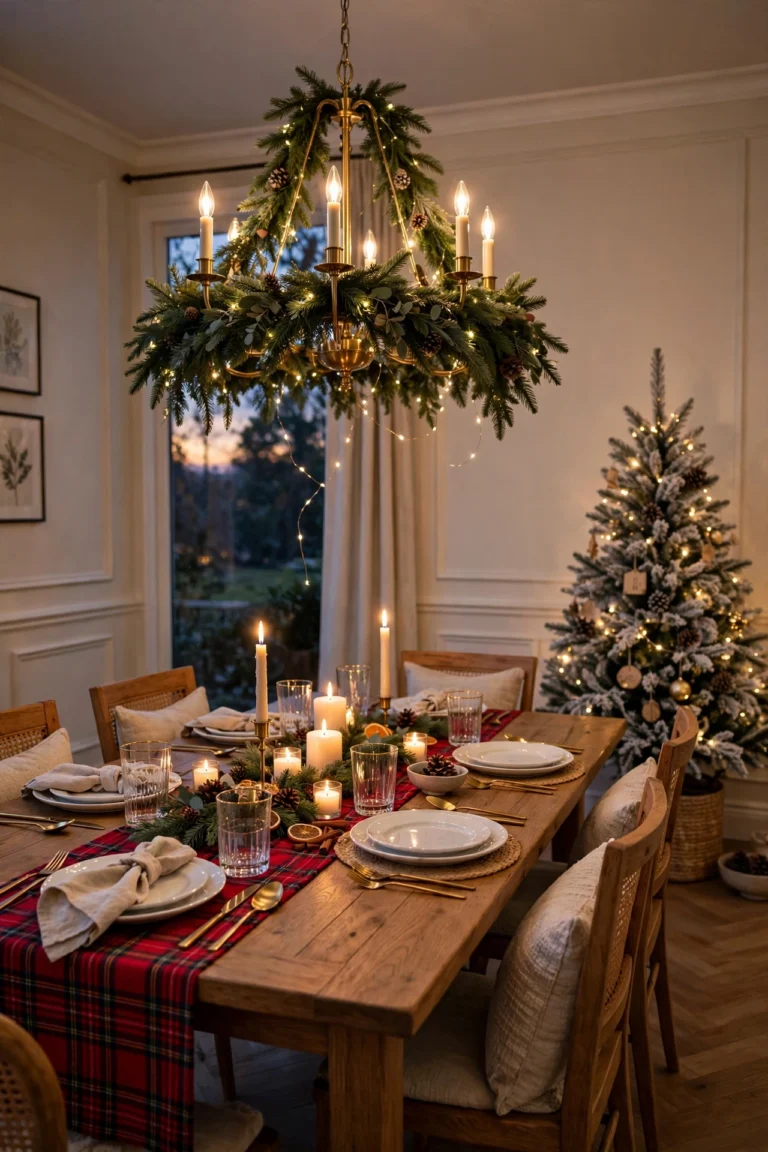
A placemat is one layer of a table, and the best tables layer three of them. The tablecloth is the base. The runner is the middle. The placemat is the top layer at each seat. When the three layers work together, the table looks deep and finished. When they fight, the table looks like a fabric shop exploded on it. The rule that keeps them working together is simple. One pattern, two plains. If the runner is patterned, the tablecloth and the placemats are plain. If the placemat is patterned, the tablecloth and the runner are plain. Never pattern all three.
The most reliable combination is a plain tablecloth, a patterned runner, and plain placemats in a colour pulled from the runner. A white linen tablecloth, a red plaid runner down the middle, and plain deep green placemats at every seat. The runner carries the pattern, the placemats carry the colour, and the tablecloth stays quiet underneath. The second reliable combination is the reverse. A patterned tablecloth, no runner, and plain placemats. A red tablecloth with a small white pattern, plain cream placemats, and a low garland down the middle instead of a runner. The tablecloth carries the pattern, the placemats stay plain, and the garland does the job the runner would have done.
Colour is the thread that ties the layers together. Pick two colours for the whole table, and let every layer use one or both of them. Red and green. Cream and gold. White and silver. If the placemat is red, the runner should have red in it, and the napkin should have red in it, or the placemat will look like it wandered in from a different table. If the placemat is green, the greenery in the centrepiece should be green, and the candles should be cream or white, not a third colour. Two colours is a table. Three colours is a table trying too hard.
The order of setting matters. Lay the tablecloth first, and smooth it so it hangs evenly on all sides. Lay the runner second, centred on the table, with the same amount hanging over each end. Then place the placemats, one per seat, aligned with the chairs, not with the runner. A placemat that is centred on its chair is correct even if it sits slightly off the runner, because the guest sits in the chair, not in the middle of the table. Finally, put the plates on the mats, the cutlery beside the plates, and the glasses above the knife. Setting in that order takes five minutes longer than throwing everything on at once, and it looks like it took an hour.
If your table is small, you may not have room for all three layers, and that is fine. On a small table, choose two. A tablecloth and placemats, with no runner, is the right choice for a table that seats four. A runner and placemats, with no tablecloth, is the right choice for a wooden table you want to show off. A tablecloth and a runner, with no placemats, is the right choice for a buffet, where guests carry plates and a placemat would only get in the way. The layers are tools, not rules, and a small table with two layers done well beats a small table with three layers squeezed on.
7. Placemats for Kids, Small Tables and Round Tables
A Christmas table is not always a long dining table with six matching chairs. Sometimes it is a kids table in the corner, a small table for two, or a round table that seats four. Each of these needs a different placemat plan, and each of them is easier than the big table, not harder.
For the kids table, choose placemats that wipe clean, because the kids table is where the gravy goes. A vinyl or oilcloth placemat, in a bright Christmas pattern, wipes clean in one pass and survives being folded, sat on, and drawn on. Felt placemats are the second choice, because they do not slide, they muffle the sound of cutlery, and they come in bright colours children love. Avoid white linen and velvet at the kids table, because they will be stained before the starter arrives, and nobody will enjoy the meal while guarding a placemat. Let the children choose their own placemat from a small pile, and they will sit down happily, because the mat is theirs.
For a small table, a table for two or four, choose a smaller placemat. A standard 30 by 45 centimetre mat can overwhelm a small table, because four large mats leave no room for the centrepiece. A smaller mat, 25 by 35 centimetres, or a round mat 30 centimetres across, gives each setting a border without eating the middle of the table. A small table also suits a single layer. Skip the runner, keep the tablecloth and the placemats, and put a single candle and a small sprig of greenery in the middle. The table will look spacious, which is the one thing a small table needs most.
For a round table, round placemats are the obvious choice, and they are the right one. A round mat follows the curve of the table, it lines up with the curve of the plate, and it makes the setting feel intentional. Place the mats so the edge of each mat is the same distance from the edge of the table, and the settings will look even even if the chairs are not perfectly spaced. A round table also suits a lazy Susan in the centre, a turntable for the serving dishes, and the placemats should stop short of it, so the turntable can spin without catching a mat. Leave a clear ring of table between the mats and the centrepiece, and the table works.
One more special case, and it is the one people forget until the guests arrive. The extra leaf. If your table extends, set the placemats after the leaf is in, not before, because a mat placed on a closed table will be in the wrong place on an open one. Set the table last, after the chairs are out, after the leaf is in, and after you know exactly how many people are coming. It is the last job before dinner, and it takes ten minutes. Everything else can be done the day before.
8. Cleaning, Storing and Reusing Your Christmas Placemats
A good set of Christmas placemats should last ten years, not one, and the difference between one year and ten years is how you clean and store them. The cleaning rule is simple. Read the label, and if there is no label, assume the gentlest option. Cotton and linen placemats wash on a gentle cycle in cold water, and they should be hung to dry, not tumble dried, because heat shrinks cotton and sets stains. Velvet placemats should be spot cleaned with a damp cloth, never soaked, and never put in a washing machine. Woven and burlap mats should be shaken outside, brushed clean, and wiped with a damp cloth. Vinyl and oilcloth mats wipe clean with a soapy cloth and need nothing else.
Stains are a Christmas fact, and the faster you act, the better the result. Red wine on a fabric mat needs cold water immediately, not hot, because hot water sets a wine stain. Blot, never rub, because rubbing pushes the stain into the fibres. Gravy and cranberry sauce need the solid scraped off first, then cold water, then a gentle wash. Candle wax needs the opposite. Let it harden, scrape it off with a blunt knife, then iron the spot through a piece of brown paper, and the wax lifts into the paper. A mat with a stain you cannot remove is not ruined. Turn it over, use the plain side, or keep it as the spare for the end of the table where nobody looks closely.
Storage is where most placemats die. Do not fold a placemat into a small square and stuff it in a drawer, because the creases will be there next December, and no amount of ironing will fully remove a crease that has sat for eleven months. Store placemats flat, stacked in a pile, in a box or on a shelf, with a sheet of tissue paper between each one if they are velvet or linen. Woven mats can be rolled, not folded, and stored upright in a basket. Round mats stack neatly and take up almost no space. Label the box, Christmas placemats, six, red plaid, so you find them in thirty seconds next year instead of hunting through every cupboard in the house.
Finally, buy for the long term. A set of six plain placemats in a classic colour, deep green or natural linen, will work with every tablecloth, every runner, and every centrepiece you own for the next decade. A set in a novelty pattern, reindeer faces or a joke slogan, will feel tired after one Christmas. Buy the classic set first, then add one fun set for the kids table if you like. The classic set is the investment. The fun set is the decoration. And when you open the box next December and the mats look as good as the day you bought them, you will be glad you stored them flat.
Conclusion
A Christmas placemat is a small thing, and that is exactly why it matters. It is the frame around the plate, the colour at every seat, the layer that protects the table and finishes the setting, and it costs less than almost anything else on the table. Choose the right size, one pattern and two plains, a material that survives your dinner, and a classic colour you will love for ten years, and the table will look planned without looking fussy.
Start with the size rule, because everything else follows from it. Then choose the style that fits your table, red plaid for the classic table, velvet or linen for the dressy table, burlap or woven for the farmhouse table, or a DIY set you made yourself in one afternoon. Layer it with the tablecloth and the runner, one pattern at a time, and keep the colour to two. Set the kids table with mats that wipe clean, the small table with mats that leave room, and the round table with round mats. Clean them gently, store them flat, and they will come back next year ready to work again.
The table is where Christmas dinner happens, and Christmas dinner is where the memories are made. A placemat will not make the dinner, but it will frame it, protect it, and make it look like the occasion it is. Set the table, lay the mats, put the plates down, and sit down to dinner. The table is ready.
FAQ
What size placemat is best for Christmas dinner?
A standard dinner placemat is 30 by 45 centimetres, or 12 by 18 inches, and it fits almost every table and every dinner plate, with a border of about five centimetres on each side. A round placemat should be 38 centimetres across, or 15 inches. Measure your plates before you buy, and buy one more mat than you have chairs, so a spare is always ready.
Can you use placemats on a tablecloth?
Yes, and you should. A placemat on a tablecloth frames the plate, protects the cloth from spills, and adds a layer of colour or texture to the table. The rule is one pattern and two plains. If the tablecloth is patterned, choose plain placemats. If the tablecloth is plain, the placemats can carry the pattern.
What placemats go with a red tablecloth?
Plain placemats in cream, natural linen, deep green, or woven burlap go best with a red tablecloth, because they calm the table down instead of adding a second red. Avoid a red placemat on a red tablecloth, because the setting disappears into the cloth. A cream or woven mat gives the plate a border the eye can see.
Are Christmas placemats washable?
Cotton and linen placemats wash on a gentle cold cycle and should be hung to dry. Velvet placemats should only be spot cleaned, never soaked or machine washed. Woven, burlap, vinyl and oilcloth mats wipe clean with a damp cloth. Always read the label first, and treat red wine with cold water immediately, blotting, never rubbing.
How many placemats do I need for Christmas?
Count your chairs, add one spare, and buy that many. A set of six covers a table for six, and a set of four covers a table for four, but the spare matters, because it covers a last minute guest or a mid-meal spill. If you host a big Christmas and a small Boxing Day, buy the set that covers the big day, and use fewer mats on the small day.