Christmas Decor Ideas for Small Spaces That Feel Big
A small home does not need less Christmas. It needs Christmas in better places. That is the whole secret, and once you understand it, decorating a studio, a one-bedroom apartment, or a small living room stops feeling like a puzzle and starts feeling like a plan. Most people make one mistake. They try to fit a big house Christmas into a small room. They buy a full tree, fill every surface, and hang things on every wall. Then they wonder why the room feels crowded instead of cozy. The room was never the problem. The plan was.
Small spaces reward a different kind of decorating. The rule is simple: decorate up, not out. Walls, sills, shelves, door frames, curtain rods and the tops of furniture are free real estate in a small home, and they hold most of the Christmas feeling without taking a single inch of floor. The floor is for walking, sitting and living. The season lives on the edges. Move the decor off the floor and onto the edges, and a small room suddenly has room to breathe. The Christmas in it looks deliberate instead of squeezed in.
This guide is built for real small homes. Rentals with leases that forbid nails. Studios under 800 square feet. One-bedroom apartments with no mantel and no spare corner. Living rooms where the sofa, the television and the tree all have to share the same wall. Every idea here is renter friendly, which means nothing is drilled, nailed or glued to paint, and everything comes down clean in January. Most ideas cost under twenty dollars. Most take less than an hour. None of them needs a drill.
You will learn the one rule that protects your deposit and your sanity. Then the tree question, because the tree is the biggest decision in any small home, and it is mostly a floor space decision. You will get a palette rule that keeps a small room calm, a plan for walls and windows, a lighting plan that works without floor lamps, tray vignettes for the surfaces you already own, a room-by-room pass through the living room, kitchen, bedroom and entryway, and a January pack-away system that fits the whole season into one box. By the end, your small space will feel like Christmas, and it will still feel like your home.
The Small Space Rule, Decorate Up, Not Out
Every small space Christmas starts with one decision, and it is not about the tree or the colour scheme. It is about where the decor is allowed to live. In a big house, the floor holds most of the season. A full tree. A stack of presents. A fireplace display. A sideboard full of village houses. In a small home, the floor is already spoken for. It holds the sofa, the table, the walkway from the door to the kitchen, and the space you need to actually live. Every decoration that lands on the floor competes with daily life, and daily life always wins, usually by knocking something over.
So the rule is this: decorate up, not out. The vertical surfaces in your home are mostly empty, and they are the best Christmas real estate you own. The wall above the sofa. The window glass. The top of a bookshelf. The curtain rod. The door frame. The mirror. The windowsill. The narrow ledge above the kitchen cabinets. None of these take floor space. All of them are visible from the sofa, which is where Christmas is actually enjoyed. A garland on a curtain rod is seen every evening. A tree squeezed behind the door is seen by nobody.
Start by walking your home with fresh eyes and listing the edges. Stand in the doorway of each room and look at the walls, not the floor. You will find more space than you expected. The wall above the television is usually blank. The top of the wardrobe is usually blank. The side of the fridge holds magnets already, so it can hold a small wreath. The bathroom mirror has a frame that can hold a thin garland. Write the list down, five or six edges per room, and that list becomes your decorating plan. When you shop, you shop for the edges on the list, not for a vague idea of Christmas.
There is a second half to the rule, and it matters just as much. In a small room, one strong moment beats ten small ones. A full tree in a corner. A lit window. A candle tray on the coffee table. Pick one hero per room and let it carry the season. The rest of the room gets small supporting touches. A cushion cover. A throw. A sprig of greenery on a shelf. Nothing else. Three intentional touches per room beat a dozen scattered ones, because a small room reads clutter fast. When in doubt, take one thing away. If the room still feels like Christmas after you remove it, it did not need to be there.
The practical payoff is real. Decorating the edges means the floor stays clear for walking, the surfaces stay clear for daily life, and the January pack-away takes an hour instead of a weekend, because everything that went up on a hook comes down from a hook. It also protects your deposit, because edge decorating uses adhesive hooks, suction cups, ribbon and leaning pieces, not nails. Your landlord will never know Christmas was there, except that the place looks loved.
The Tree Question, Slim, Tabletop, Half or Wall
The tree is the biggest decision in a small home, and it is mostly a floor space decision. A standard tree needs a circle about four feet across, and in a small living room, that circle is the walkway, the coffee table zone, or the space where the sofa should go. The question is not which tree you like best. It is which tree your floor can spare. There are four honest answers, and one of them fits almost every small home.
The slim pencil tree is the first answer, and it is the renter favourite for a reason. A pencil tree stands five to six feet tall but only about two feet wide at the base, often under twenty inches, which is barely wider than a standard lamp. Tucked into a dead corner, the corner by the window or the corner beside the television, it reads as a full tree from the sofa while giving up almost no floor. It carries the whole room’s Christmas feeling on its own. Measure the corner before you order. Height. Base width. And the distance to the nearest wall, because a pencil tree needs a little breathing room on the sides or the branches squash flat. A pre-lit pencil tree with warm white lights saves you the hardest job in a small room, which is wrapping lights around a tree you cannot walk around.
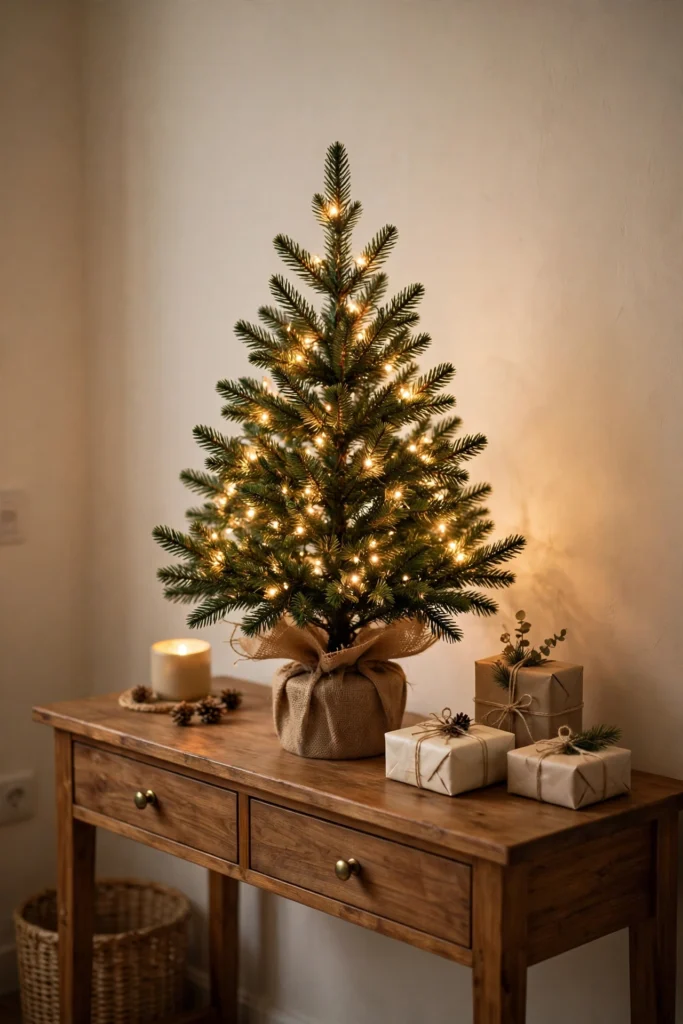
The tabletop tree is the second answer, and it is the best one for studios and one-bedroom apartments where the floor has no corner to spare. A tabletop tree runs two to four feet tall and lives on furniture, not the floor. A console. A side table. A dresser. A sturdy shelf. Even the top of a bookcase. It brings Christmas up to eye level, where it is actually seen, and leaves the floor entirely free. A two-foot pre-lit tree with a burlap base on a console looks like a deliberate design choice, not a compromise, especially when you put a few wrapped gifts or a small basket beside it. The trick is to give it a proper home, not a random surface. Clear the console first, then place the tree, then add one or two small things around it, and stop.
The flat-back half tree is the third answer, and it is the cleverest. A half tree is made with a straight rear edge, so it sits flush against the wall. From the front, it looks complete and round. From the side, you see the trick, but nobody stands at the side of a tree in a small room. It takes half the floor depth of a full tree, which is often the difference between having a tree and not having one. It works best against a plain wall with a little space around it, and it looks great with a slim garland on the wall above it, which fills the space the missing half would have taken.
The wall tree is the fourth answer, and it takes no floor at all. Build the tree shape directly on the wall with garland and lights, using removable adhesive hooks. Outline a triangle with a green garland zigzagged between hooks, weave in battery fairy lights, and hang lightweight ornaments from the branches. It reads as a tree from across the room, it photographs beautifully, and it costs almost nothing. It is also the best answer for a home with pets or toddlers, because there is nothing on the floor to knock over and nothing within reach to pull down. A wall tree above a small stack of wrapped gifts on the floor gives you the whole Christmas picture in about two square feet.
Whichever tree you choose, dress it the same way, and keep it simple. Lights first, deep inside the branches. Warm white, about 2700 Kelvin, so the glow comes from inside the tree. Then one garland, wood beads or a thin ribbon, draped loosely. Then ornaments, fewer than you think, in one colour story, with the biggest ornaments lowest and the smallest highest. A small tree with twenty good ornaments looks better than a big tree with a hundred random ones. And if you want the full guide to dressing a tree properly, including lights, depth and ornament placement, the Christmas Tree Decor Ideas guide on this site walks through it step by step.
One Palette, Three Colours, No Clutter
A small room can feel chaotic in no time, especially when Christmas decorations pour in at once. Red, green, gold, silver, blue, pink, white and wood, every colour, all in one tiny space, reads as noise, not as Christmas. The fix is a palette rule, and it is the single most powerful tool in small space decorating. Pick three colours and one metal or wood tone, and repeat them everywhere. That is the whole rule. Repetition is what makes a tiny room look designed instead of decorated by accident.
Start with a base that keeps the room bright. Cream, warm white, soft beige and light wood are the small space base, because they bounce daylight around and keep the room feeling open. Then add one deep colour for the season. Deep green is the safest, because greenery is already green, and a deep green garland, a green cushion cover and green wrapping paper tie the room together without any new purchases. Or pick berry red, but use it in small doses. One throw. One ribbon. A few ornaments, because red is loud in a small room and a little goes a long way. Then add one accent, usually a metal, brass or gold, in candle holders, ornament hooks and ribbon edges. That is the palette: cream, deep green, berry red, brass. Or cream, warm wood, deep green, gold. Any three colours plus one metal works, as long as you commit to them and stop adding new ones.
The practical way to do this is to shop your own home first. Pull out the throws, cushion covers, candles, trays and baskets you already own, and sort them into the palette. The cream throw stays. The green cushion covers stay. The red throw stays if it matches the berry red. The bright pink cushion cover goes back in the cupboard until January, because it fights the palette. This is not about buying a new room. It is about editing the room you have until it has one clear colour story.
Textiles do most of the palette work in a small home, because they are big, cheap and easy to change. A cushion cover swap is the fastest Christmas change you can make. Two green or red covers on the sofa, and the room is dressed. A throw folded over the arm of the sofa does the same job. A table runner on the coffee table or the dining table adds colour at eye level without taking space. And a rug, if you have one, can be layered with a smaller plaid or deep red rug on top for the season, which changes the whole floor without buying furniture.
The other half of the palette rule is editing, and it is the part people skip. A small room looks cluttered when a fourth or fifth colour creeps in, and the fix is always removal, not addition. When a corner starts to look busy, find the odd colour out and remove it. A blue ornament on a red and green tree. A silver candle holder in a brass room. A bright gift bag on a cream shelf. Take it out and the room calms down at once. The empty space around your decorations is part of the look, and in a small room it is what makes the room feel calm instead of crowded. Leave gaps. Let the walls breathe. A room with three well placed Christmas moments and plenty of empty space feels bigger and more festive than a room with Christmas on every surface.
Walls and Windows, Your Biggest Free Surface
In a small home, the walls and windows are the biggest decorating surface you own, and they are almost always empty. A wall of warm fairy lights changes a room more than any ornament, and it costs about ten dollars and twenty minutes. The trick is to treat the wall like a canvas, not like a place to stick random things. One wall, one idea, done well, beats five walls with a little bit of everything.
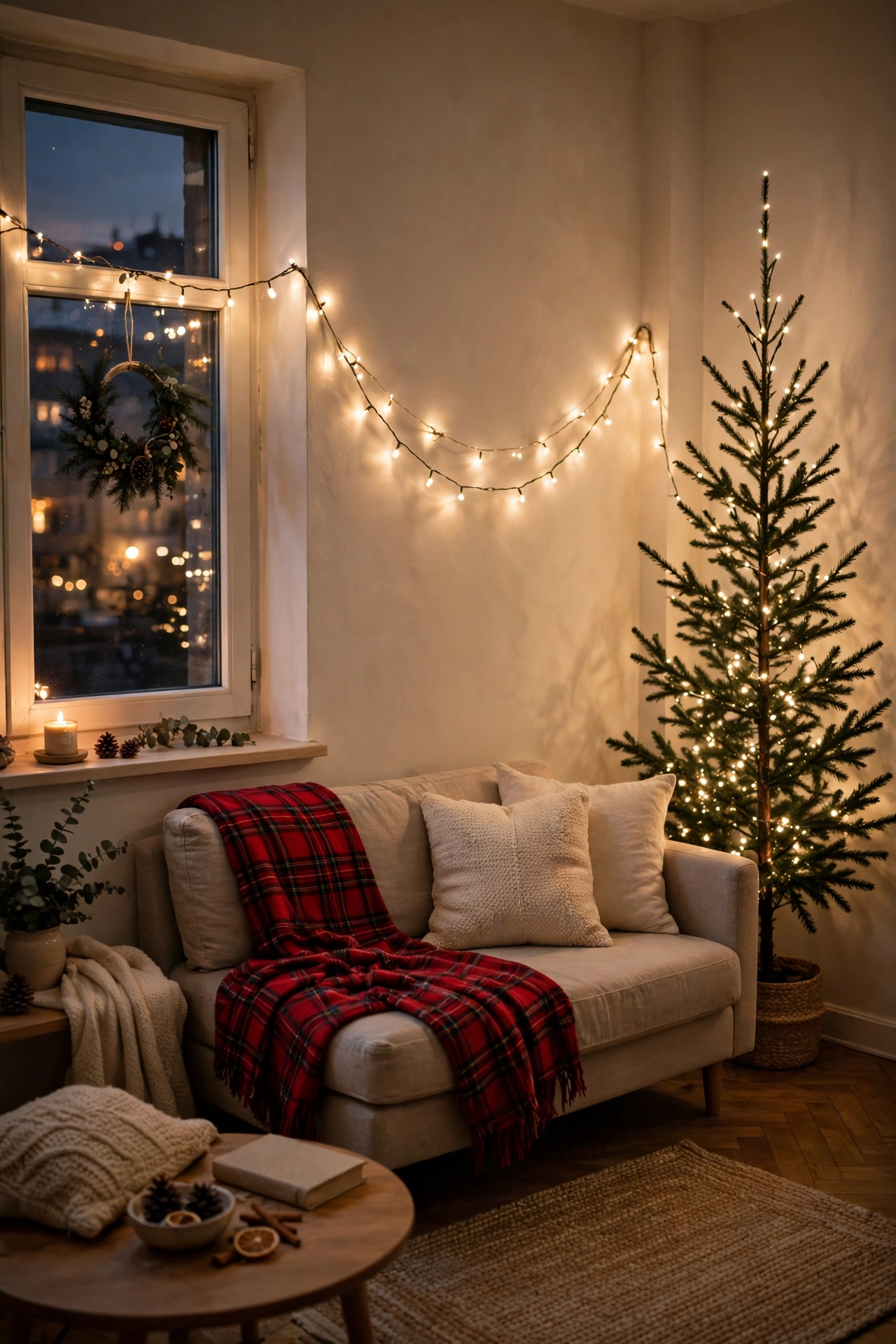
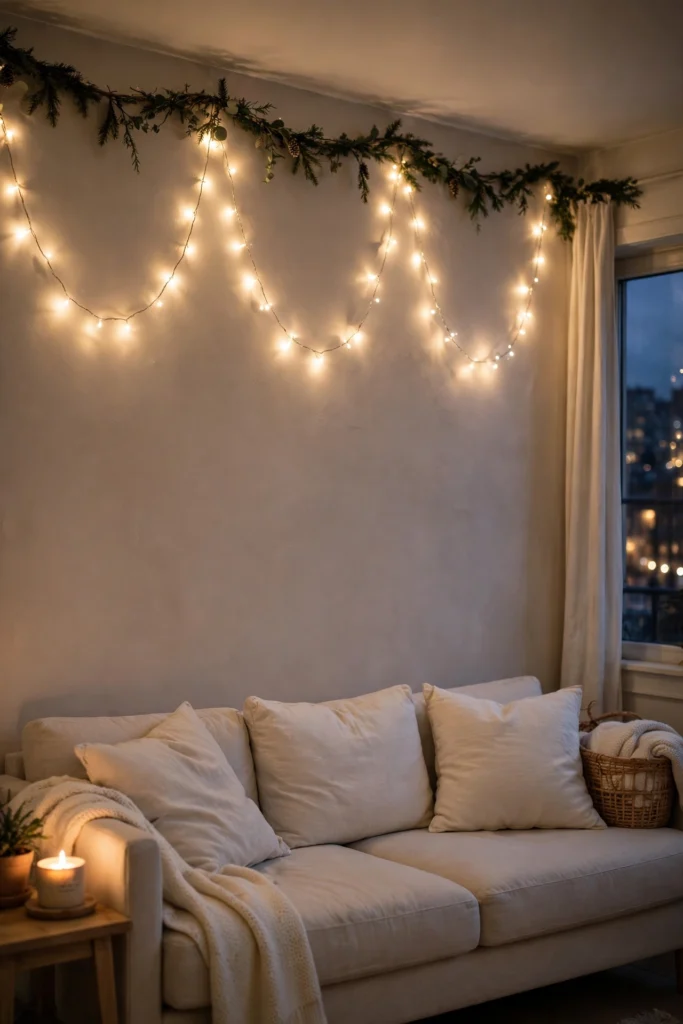
The light wall is the classic small space move, and it deserves its reputation. Pick the wall the sofa faces, or the wall behind the sofa, and hang one strand of warm white fairy lights in soft swags, using removable adhesive hooks. The swags should dip gently, like a smile, not hang straight across like a washing line. Two or three swags across a sofa-length wall is enough. Add a slim evergreen garland along the top of the same wall, or drape it over the curtain rod, and the wall is dressed. Keep the lights warm white, around 2700 Kelvin, because cool white reads as office lighting and kills the cozy feeling. Battery lights with a timer are worth the small extra cost in a rental, because there is no cord to run across the floor and no plug to hunt for behind the sofa.
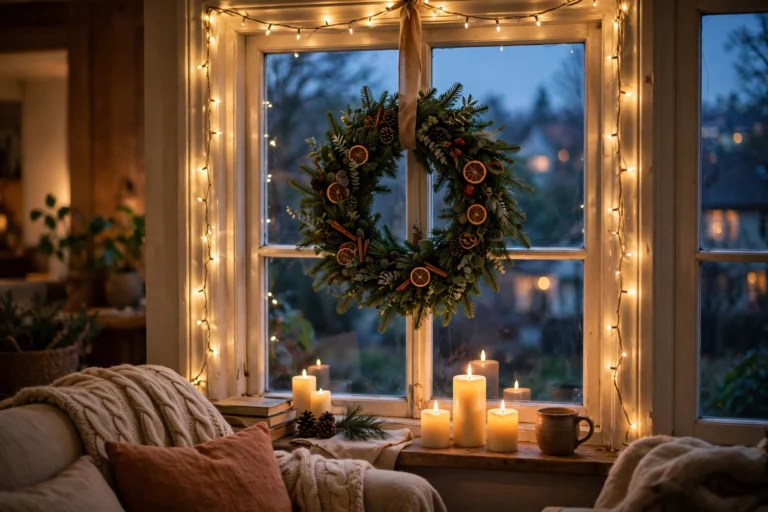
Windows do double duty in a small home, because they decorate the room and the street at the same time. A small wreath on a clear suction hook in the centre of each window pane gives you green circles that catch the daylight, and the street gets a festive facade. The window frame is never touched, the lease is safe, and the wreath comes down with a pull in January. A garland across the top of the window frame, hung from adhesive hooks on the wall above, frames the view and catches the light. Battery candles on the windowsill, two or three at different heights, glow all evening and cost almost nothing to run. And a tray village on the sill, tiny lit houses, small bottle brush trees and a little fake snow on a tray, is the one Christmas scene that lifts off in one move for cleaning, which matters when the sill is also where you put your coffee in the morning.
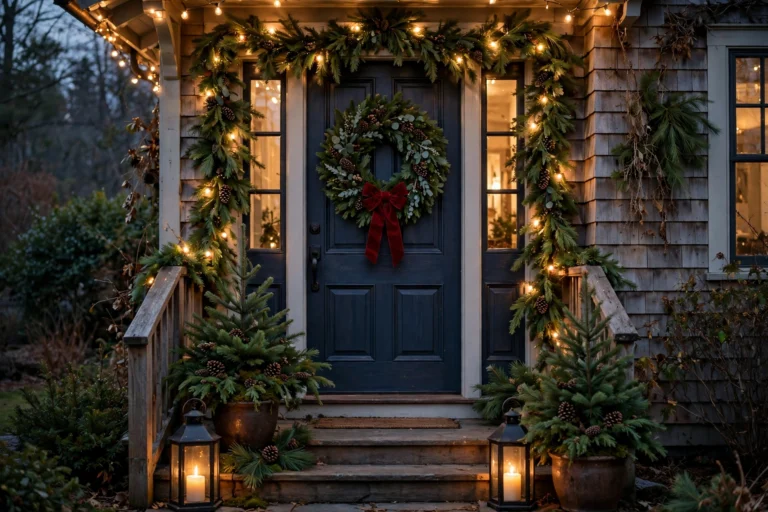
The door is another free surface. A wreath hung on ribbon looped over the top of the door needs no nail and no hook at all. Loop the ribbon over the door, tie it on the inside, and the wreath hangs at eye level on the outside. The same trick works on the inside of the front door, on a bedroom door, and on a wardrobe door. A paper snowflake garland across a doorway, made from folded paper and strung on twine, is a ten-minute project that fills a whole doorway with Christmas and folds flat into a drawer in January.
Mirrors are the small space secret weapon, because they double whatever is in front of them. A thin garland around a mirror frame, held by adhesive hooks, doubles the greenery and the light in the room. A wreath hung on a mirror reflects the room back at itself and makes the room feel deeper. If you have a leaning floor mirror, lean a small wreath against its base, or hang a strand of lights along its frame. The mirror does the work of a whole second decoration for free.
One warning about walls, and it is worth taking seriously. Adhesive hooks are wonderful, but they have limits. Use them on smooth, painted walls, and follow the weight limit on the package. Do not hang anything heavy from them, and do not stick them on textured walls, fresh paint, or wallpaper, because they can pull paint off on removal. Test one hook in a hidden spot first, and always follow the removal steps on the package, pulling the tab slowly down the wall, not out from it. Your deposit will thank you.
Light in Layers, Warm Glow Without Floor Lamps
Light does more work than any object in a small room, and it takes no floor space at all. A small room that is well lit feels warm and generous. The same room with one harsh ceiling light feels flat and small. The fix is light in layers, at three heights, with the ceiling light off. Tree lights at standing height. A lamp or a ceramic tree at table height. And candles below eighteen inches. Five light sources is plenty for a small living room, and keeping every bulb in the warm range is what makes the room feel like Christmas instead of a shop window.
The first layer is the tree, or the wall tree, or the light wall, whichever focal point you chose. Warm white lights, woven deep into the branches or swagged on the wall, give you the big glow that the room is built around. Push the lights deep into the branches so the glow comes from inside, not from bulbs sitting on the surface. A good rule is one hundred lights per foot of tree height, which sounds like a lot until you see how much better a well-lit tree looks. If your tree is pre-lit, check the colour before you buy. Warm white, never cool white, and never multi-colour in a small room, because multi-colour lights fight the palette and make the room look busy.
The second layer is table height, and it is where the cozy feeling lives. A lamp you already own, with a warm bulb, on a side table or a console, does more than any decoration. A ceramic Christmas tree on a side table, the kind with the little coloured lights inside, glows all evening and takes up six inches of surface. A string of fairy lights in a glass jar on a bookshelf, or in a lantern on the floor beside the sofa, gives you a low warm pool of light that makes the whole room feel softer. Keep the lampshades warm, cream or linen, not white, because a white shade throws a harder light.
The third layer is candle height, below eighteen inches, on the coffee table, the windowsill and the dining table. In a rental, or a home with pets or children, use flameless LED candles, which are now good enough to fool anyone from across the room. A set of eight flameless candles with a remote and a timer costs very little, and you can put them anywhere. In a tray on the coffee table. On the windowsill. Inside a lantern. On the bathroom vanity. They give you the flicker without the fire risk, and the timer means they turn themselves off. If you do use real candles, keep them in glass holders, away from curtains, greenery and paper, and never leave them burning in an empty room.
The one thing to avoid is cords across the floor. In a small room, a cord across the walkway is a trip hazard and a visual mess. Use battery lights wherever you can, and where you need mains power, run the cord along the wall, behind furniture, or under a rug edge, never across open floor. Extension leads are a last resort, and if you use one, tape it flat to the skirting board. A small room with no visible cords looks bigger, calmer and safer, and the light feels like it comes from the room itself, not from a tangle of wires.
Surfaces That Work, Tray Vignettes for Tables and Shelves
In a small home, every surface has a job. The coffee table holds cups and books. The shelf holds the things you use every day. The console holds keys and mail. Christmas decor has to respect that, or it gets in the way and gets moved, usually to the floor, where it becomes clutter. The answer is the tray vignette. One tray, one small scene, that lifts off in one move when real life needs the surface back.
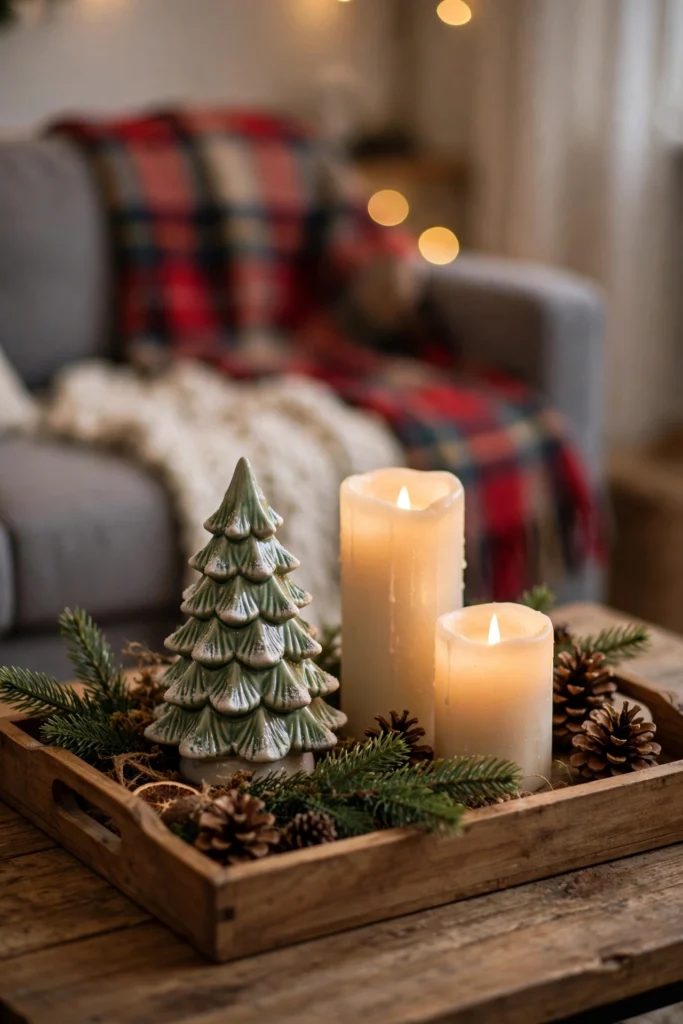
The tray is the hero of small space decorating, because it contains the mess. A wooden tray. A round metal tray. A shallow basket. Even a baking tray lined with a tea towel becomes a stage. On it, you build one small scene. A mini ceramic tree. Two candles at different heights. A few pinecones. And one unexpected piece, like a vintage book or a small brass bell. That is the whole vignette. It sits on the coffee table, the dining table, or the console, and when dinner arrives or guests need the table, the whole thing lifts away in one hand. Nothing is scattered. Nothing is lost. And the surface is clear in five seconds.
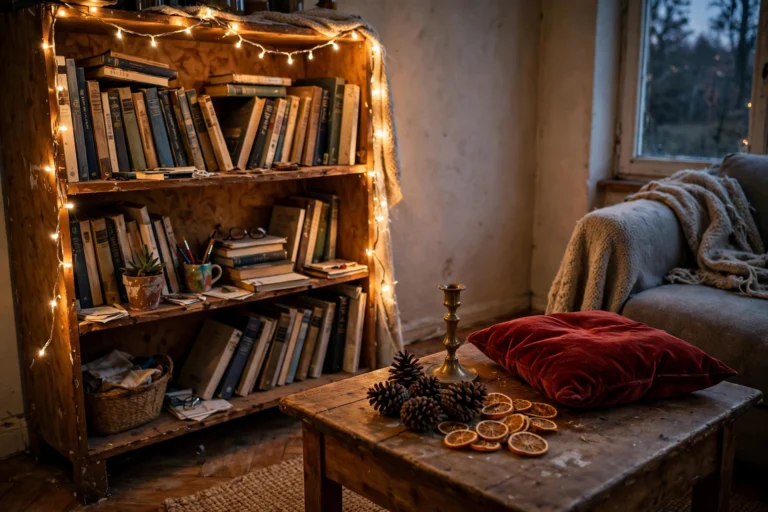
The same idea works on shelves, and shelves are the best Christmas surface in a small home, because they are already there and they hold decor at eye level. The rule for a shelf is one grouping per shelf, not three. A shelf with a small tree, a candle and a sprig of greenery looks curated. A shelf with seven small objects looks like a jumble sale. Pick the shelf you see most from the sofa, and dress that one. The others can stay as they are, or get one small touch each. A sprig of evergreen. A single candle. A red ribbon tied around a book. And if you want the full shelf method, including how to layer height and leave breathing room, the Christmas Shelf Decor Ideas guide on this site covers it in detail.
The coffee table deserves its own plan, because it is the surface you use most. The one tray rule applies here too, and the tray should leave at least half the table clear for cups, books and feet. A low tray with a mini tree, two flameless candles and pinecones is enough. Add a folded plaid throw over the arm of the sofa beside it, and the living room is dressed. If you want more coffee table ideas, including tray formulas for different table shapes, the Christmas Coffee Table Decor Ideas guide on this site has them.
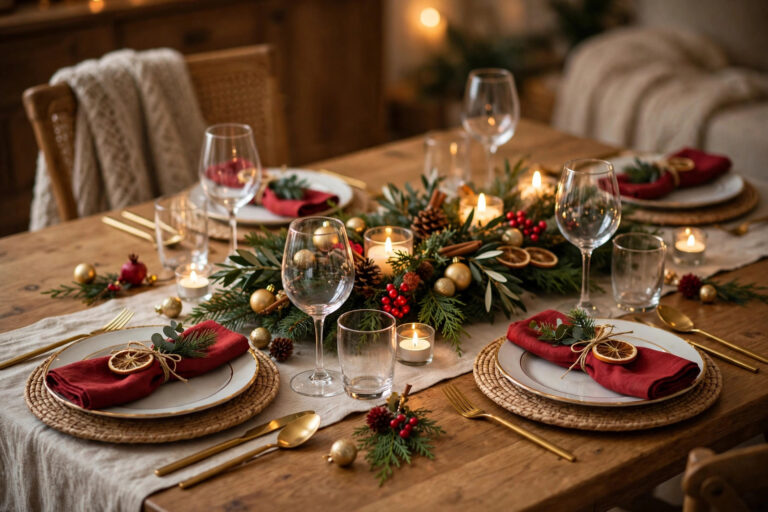
The dining table in a small home is often also the desk, the homework table, or the place where parcels get opened. So the centrepiece has to be low, small and movable. A short garland runner down the centre, two candles in glass holders, and a few pinecones is enough for dinner. A tray centrepiece, three pillar candles, a few evergreen sprigs and a scattering of ornaments on one tray, moves in one hand when the platters arrive. Keep the centrepiece below eye level across the table, so guests can see each other, and keep the ends of the table clear for serving dishes.
The last surface rule is the one surface rule: leave one surface completely clear. The kitchen counter, or the desk, or the bedside table, pick one and keep it empty of Christmas. Daily life needs somewhere to happen, and a home with one clear surface feels like a home, not a display. Christmas is a guest in your house. Give it a beautiful room, but keep one room for yourself.
Room by Room, Living Room, Kitchen, Bedroom, Entryway
A small home is decorated one room at a time, thirty minutes each, and the order matters. Start with the living room, because that is where Christmas is enjoyed. Then the entryway, because that is where guests arrive. Then the kitchen and the bedroom, which need the least. Three intentional touches per room beat a dozen scattered ones, and if you run out of energy after two rooms, the house still feels like Christmas, because the two rooms that matter most are done.
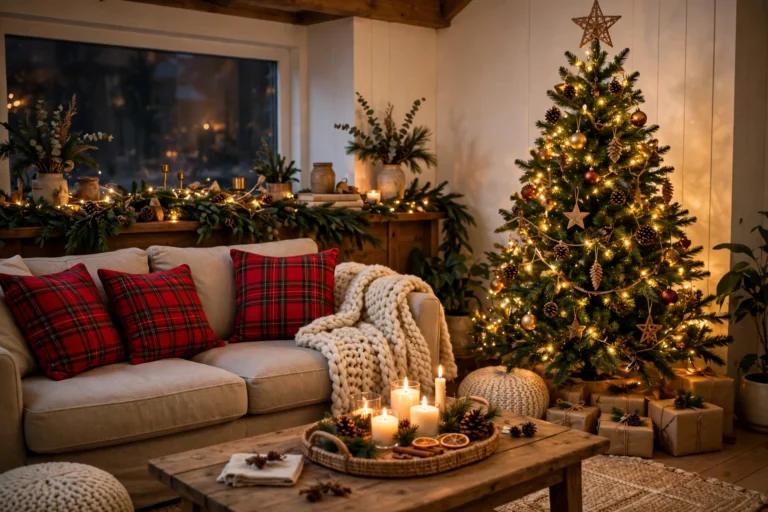
The living room carries the season. The tree. The light wall. And one surface moment. Put the tree in its corner, hang the light wall, and build the coffee table tray, and the living room is finished. Add a cushion cover swap, two covers in the palette, and a throw folded over the sofa arm, and it is dressed, not just decorated. Keep the floor clear. No presents stacked by the tree until Christmas Eve. No extra baskets on the floor. No garland draped over the television. The television can be your faux mantel if you have no fireplace. A short garland along the top edge of the TV stand. Two mini bottle brush trees at the ends. And candles in front, and the stand becomes the focal point the mantel would have been.
The entryway is small, so decorate up, not out. One wreath on the inside of the front door, hung on ribbon over the top. One garland strand on a hook above the door. One lantern on the floor by the wall, and the floor stays clear for walking. A boot tray by the door keeps wet shoes off the floor, and a small basket for scarves and gloves keeps the coats from ending up on the sofa. If the entryway is just a corner by the door, that is enough. One wreath. One light. And the welcome is warm. Guests will remember the warmth, not the size.
The kitchen has to make dinner all December, so the decor has to earn its place. One tray vignette on the counter. A mini tree. A battery candle and a sprig of greenery, that lifts off in one move when real cooking starts. A garland over the top of the kitchen cabinets, where it is out of the way and catches the light, is the one big kitchen gesture that costs nothing in counter space. Red mugs and green glasses brought to the front of open shelves. One bottle brush tree per shelf. And a small wreath on the pantry door, and the kitchen feels festive without losing a single inch of work surface. Keep the stove sides, the prep zone and the kettle corner completely clear, because garland over the range hood collects grease by week two, and decor in the prep zone is in the way by the second day.
The bedroom is the quiet room, and it should stay quiet. A small tree on the dresser, or a garland over the headboard, warm lights on the bedside table, and a red or green throw folded at the foot of the bed, and the bedroom is dressed. A tray on the bedside table with a battery candle and a small pine sprig is the one luxury that makes the room feel like a winter stay. Keep it to three touches, because the bedroom is for sleeping, and a bedroom that looks like a Christmas shop is hard to rest in.
The bathroom gets one touch, and only one. A small wreath on the mirror, or a sprig of greenery in a jar on the vanity, or a red hand towel swapped in for the usual one. That is enough. A bathroom is a small, steamy room, and anything more than one touch gets damp, falls down, or gets in the way. One touch, done well, makes guests smile, and that is the whole job.
Renter Safe Hanging and the One Box January Pack Away
Everything in this guide is renter safe, but renter safe is a method, not a hope, and it is worth learning properly before you hang anything. The toolkit is small. Removable adhesive hooks in two sizes. Clear suction hooks for windows and mirrors. Ribbon and twine. Decorating clips for lights. And a few small nails only if your lease allows them, which most do not. That is the whole toolkit, and it hangs everything in this guide.
Adhesive hooks are the workhorse. They hold lightweight garland, stockings, string lights and small wreaths without a single hole. Use the size that matches the weight. Small hooks for lights and ribbon. Medium hooks for garland and wreaths. Clean the wall first with a dry cloth, press the hook on firmly, and wait an hour before you hang anything from it. The hour matters, because the adhesive needs time to bond, and a hook loaded too early will slide down the wall overnight. When January comes, remove the hook by pulling the tab slowly straight down the wall, never out from it, and the paint stays where it belongs. Test one hook in a hidden spot first if your paint is old or your walls are textured, because old paint and textured walls change the result, and a test costs you nothing.
Suction hooks are for glass and mirrors. A clear suction hook in the centre of a window pane holds a small wreath, and the same hook on a mirror holds a strand of lights. Wet the suction cup lightly before you press it on, and check it after a day, because temperature changes can loosen the seal. Decorating clips, the clear kind with stretch release strips, hold lights on windows, shelves and door frames, and they come off clean. Ribbon looped over the top of a door holds a wreath with no hardware at all. And for anything that leans, a leaning frame, a leaning mirror, a small tree on a shelf, gravity is the hanging method, and it is free.
The January pack-away is the part nobody plans, and it is the part that decides whether next December starts calm or chaotic. The rule is one box. Buy one storage box, around 24 by 16 by 12 inches, which holds garland, ornaments in a divided tray, ribbon, stockings and lights for most small living rooms, and still slides onto a single shelf. Pack it in zones. Lights wound on cardboard, one strand per labelled bag. Ornaments wrapped in tissue in a divided box. Ribbon rolled, not folded. And stockings flat on top. Label the box, write the contents on the lid, and tape a note inside for next year. What worked. What to buy. What to skip. The whole season in one box, on one shelf, is the real small space victory, because a small home has no spare cupboard for three boxes of decor.
And when the box is packed and the hooks are off the wall, the room goes back to itself. The cream throw stays. The warm lights stay a little longer if you like them, because January is dark and a string of warm lights in a jar is not Christmas, it is just a nice light. Take the red away first, then the ribbon, then the tree, and keep the greenery and the warm light for the winter room that follows. A small home that is decorated well in December is easy to undecorate in January, and that is the final test of a good small space plan.
Conclusion
A small home does not need less Christmas. It needs Christmas in better places, on the walls, the windows, the shelves and the sills. Leave the floor clear for living. Pick one tree that fits your floor, one palette of three colours, one wall of warm light and one tray per surface. Then the whole house feels festive without feeling crowded. Do it room by room, thirty minutes each. Start with the living room. Stop when it feels cozy. A small room that is done is better than a big room that is half finished.
The best part of decorating a small space is how little it takes. A slim tree in a corner. A light wall. A tray on the coffee table. A wreath on the door. That is all you need. The room still feels like your home, only warmer, and the season fits in one box on one shelf when January comes. That is not a compromise. That is a plan that works. In a real home. For real people. With real leases and real budgets. Start with the tree, then the wall, then the tray, and let the rest of the room grow out from there.