Christmas Sofa Decor Ideas
Your sofa is the biggest piece of furniture in your living room, and it is also the comfiest. It is where the family gathers on Christmas Eve, where someone always ends up with a plate of food on their lap, where the dog claims the best corner, and where the presents get opened in a happy mess on Christmas morning. So it makes sense to start your Christmas decorating there. Dress the sofa well and the whole room reads as festive, even if you do almost nothing else. Leave it bare and the tree can be perfect and the room will still feel unfinished, like a party outfit with no shoes.
That is the good news, too. You do not need a new sofa, and you do not need to spend a fortune to make the one you have look like Christmas. You need a pillow formula that works every time, one throw folded the right way, and one colour story that you repeat in small touches around the room. That is the whole plan in this guide. We will cover how many pillows a sofa really needs, why pillow covers beat new pillows, how to drape a throw so it looks relaxed instead of staged, which colours work with grey, brown, cream and green sofas, what to do when your sofa is small, a few tricks that cost about five dollars, and the mistakes that make a sofa look crowded instead of cosy.
If you want the wider room picture, start with Cozy Winter Living Room Ideas for the winter base, then Christmas Throw Pillow Ideas for more pillow detail, and Christmas Living Room Decor Ideas when you are ready to dress the rest of the room. This guide stays focused on the sofa itself, because that is where the money and the effort pay off fastest.

The Three Pillow Formula: Velvet, Plaid and One Lumbar
The easiest way to decorate a sofa for Christmas is to stop choosing pillows one at a time and start using a formula. The formula that works on almost every sofa is simple. Velvet, plaid and one lumbar. One velvet pillow for softness and richness, one plaid pillow for pattern and Christmas feeling, and one long lumbar pillow in the middle to tie them together. That is three pillows, three textures, one clear idea. It works because each pillow has a job, and none of them is trying to do all the jobs at once.
Start with odd numbers. Odd numbers look relaxed and natural on a sofa, while even numbers can look stiff and matched, like a hotel lobby. Three pillows on a loveseat, five on a deep three seat sofa, and a grouped five or six on a sectional all follow the same idea. The eye likes a little asymmetry. It reads as a home, not a showroom. If you already have four pillows and they look fine, you do not need to throw one away. Just take one off for December and see how the sofa breathes. You will probably like the extra space.
Size matters more than most people think. Big pillows at the ends anchor the sofa. Smaller pillows move toward the centre. A good working set for a standard three seat sofa is two 22 inch square pillows at the ends, two 18 or 20 inch squares next to them, and one lumbar pillow about 12 by 20 inches in the very middle. The large pillows give the sofa its shape. The medium pillows add colour and texture. The lumbar pillow finishes the arrangement and gives your lower back something to lean on. If your sofa is deep, go a little bigger. If it is shallow, go a little smaller. The point is the step down in size from the ends to the centre, not the exact numbers on the label.
Place the anchor pillows at both ends first. Push them into the corners where the arm meets the back, and let them lean at a slight angle. They should look settled, not propped. Then add the middle pillows, leaning them against the anchors. Then place the lumbar pillow in front, in the centre. The lumbar pillow is the star of the show in a quiet way. It is the one that can carry a pattern, a colour, or a small Christmas motif, while the rest support it. One star pillow is enough. If every pillow is a star, there is no star. The room gets noisy and the eye does not know where to rest.
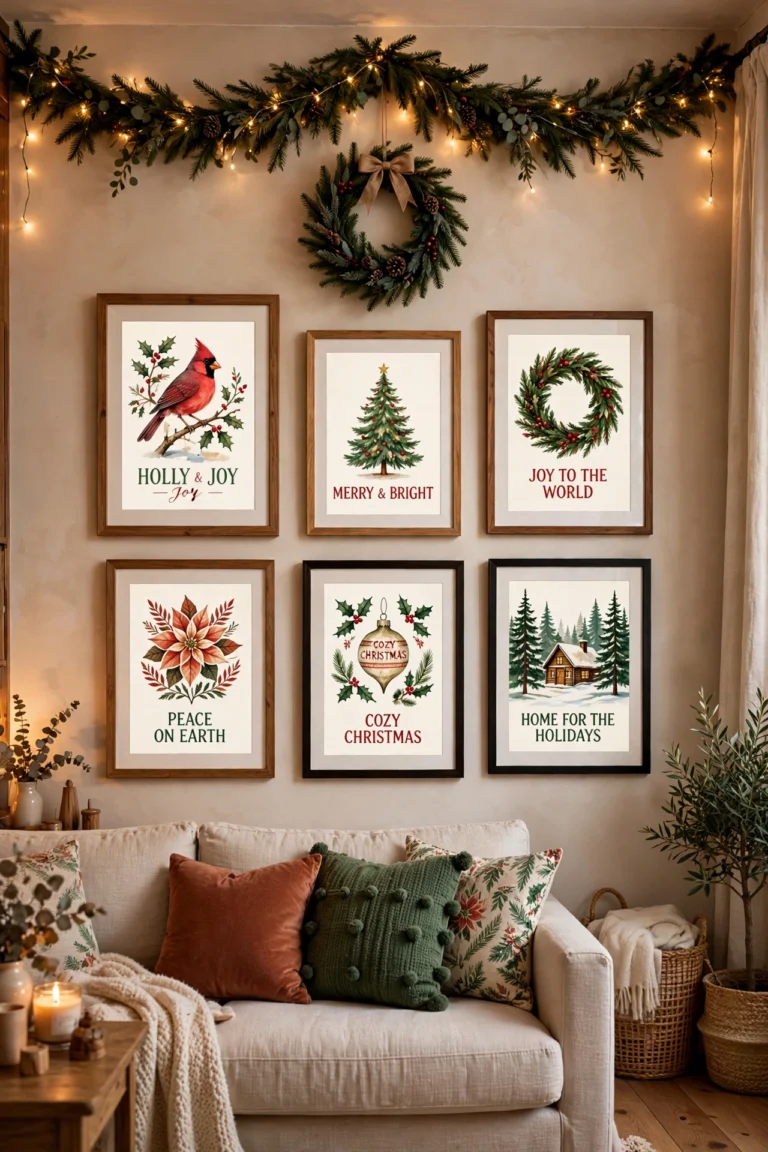
Texture is what makes this formula feel like Christmas instead of just a new set of cushions. Velvet catches the light and looks rich even in a plain colour. Plaid brings in the Christmas pattern without needing words or pictures on it. The lumbar pillow can be the bridge between them, perhaps in a solid colour pulled from the plaid, or in a soft knit that adds warmth. A velvet pillow in deep red, a plaid in red and cream, and a lumbar in cream cable knit is a classic combination for a reason. It is warm, it is readable from across the room, and it does not need anything else to explain itself.
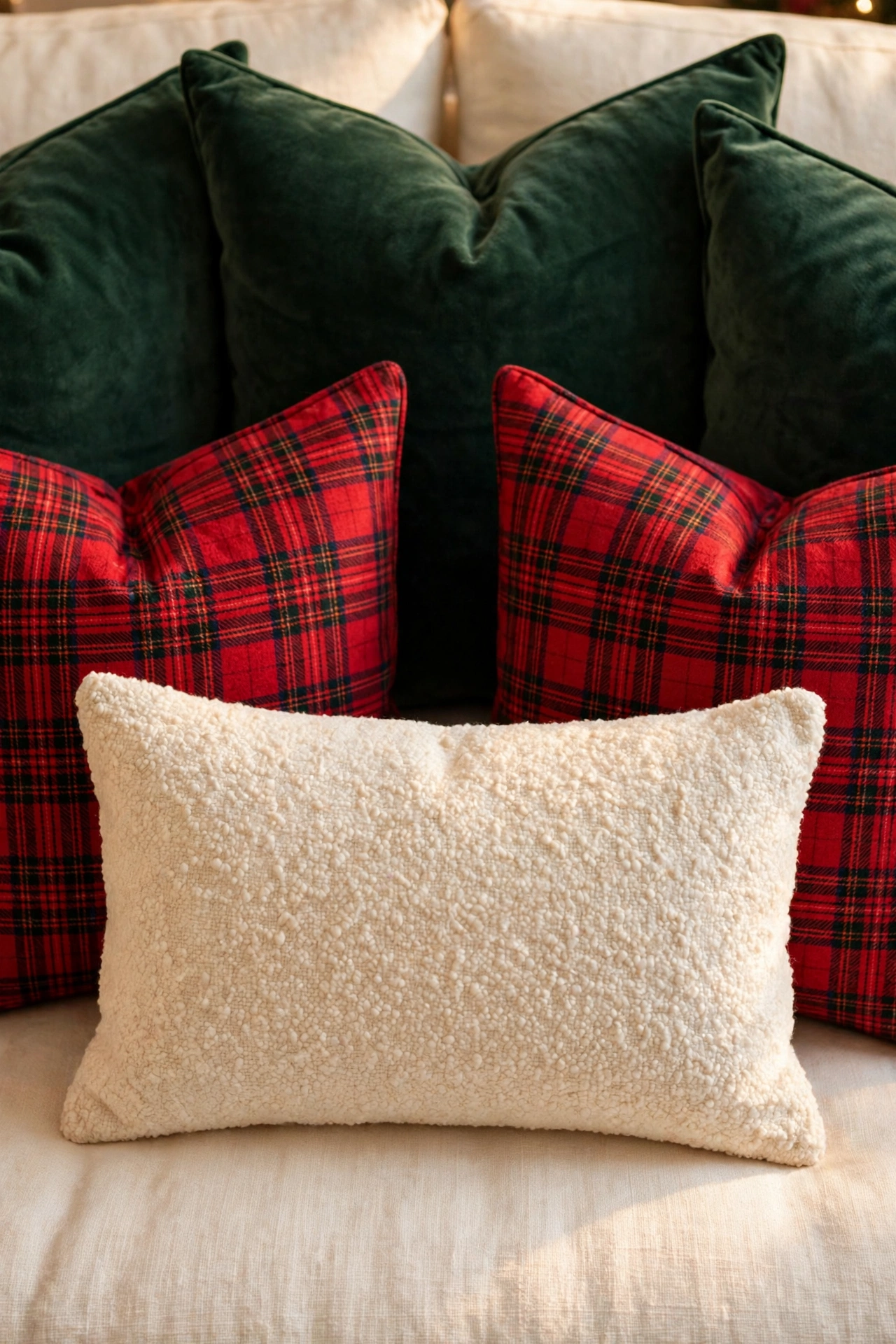
Pillow Covers, Not Pillows: The Cheap Swap
Here is the money saving idea that changes everything about Christmas sofa decor. Buy pillow covers, not pillows. A good pillow cover costs about eight to fifteen dollars. A new pillow with an insert costs two or three times that, and then you have to store the whole bulky pillow in January. A cover slips over a cushion you already own, changes the look of the sofa in five minutes, washes easily, and folds flat into a drawer or a small box when Christmas is over. It is the cheapest swap in the whole house, and it is also the tidiest.
Start with the cushions you already have. Most sofas come with two or four plain cushions, and most homes have a few extra cushions in a bedroom or a cupboard. Those are your inserts for December. Measure them before you shop, because a cover that is too big will sag and a cover that is too small will pull at the zip. A 22 inch cushion wants a 22 inch cover, or a 20 inch cover if you like a plump look. A 20 inch cushion wants a 20 inch cover. Write the sizes down on your phone before you go to the shop or open the website, so you do not guess and order the wrong size twice.
One strong Christmas pillow is enough. This is the rule that saves both money and taste. Buy one cover with a clear Christmas feeling, perhaps a plaid, a Fair Isle pattern, or a deep velvet in red or green. Let the rest of the covers support it. Cream, soft gold, plain green, plain burgundy, a quiet knit, or a simple stripe all work as supporting players. They make the strong pillow look intentional instead of random. When every pillow is shouting Christmas, with words on one, Santa on another, trees on a third and reindeer on a fourth, the sofa stops looking festive and starts looking like a gift shop shelf. One voice, clearly heard, is better than four voices talking at once.
Washable matters more at Christmas than at any other time of year. Hot chocolate spills. Candle wax drips. A child with sticky hands leans on the sofa. A dog jumps up with muddy paws. If your covers cannot go in the washing machine, you will spend December worrying about them instead of enjoying them. Check the label before you buy. Cotton, linen blends, velvet that is marked washable, and most polyester covers will wash well on a gentle cycle. Dry them flat or on a low heat, and they will be ready to use again next year. Keep the receipt and the washing instructions in the box with the covers in January, so you do not have to guess next December.
Storage is the other reason covers win. In January, take the covers off, wash them, fold them flat, and put them in a labelled box or a zip bag with the ribbon and the small decorations from the sofa. The box takes up less space than one spare pillow. Your inserts go back to their normal covers, and the sofa returns to its everyday look in ten minutes. Next year, you open the box and you are ready. No hunting through the loft, no wondering where the Christmas pillows went, no buying the same thing again because you forgot you owned it.
One Throw, Folded Right
If pillows are the jewellery of the sofa, the throw is the soft layer that makes it feel like Christmas. But here is the rule that most guides get wrong. One throw, not three. Three throws on one sofa make it look heavy, cluttered and hard to sit on. They slide off, they bunch up, and they hide the pillows you just arranged. One good throw, folded right and placed in one spot, does more work than three throws fighting for attention. Choose your best throw, the softest and warmest one you own, and give it the starring role.
Fold it in thirds lengthwise first. Lay the throw flat on a bed or a table, fold one long side into the middle, then fold the other long side over it, so you have a long, neat band about a third as wide as it was. Then drape that band over one arm of the sofa, or over one corner of the back, and let the ends hang down at slightly different lengths. The fold gives the throw structure, so it stays where you put it. The uneven ends give it a relaxed feeling, so it does not look like a shop display. That contrast, neat fold plus uneven ends, is the whole trick. It looks cared for and comfortable at the same time.
The drop, not fold, trick is the other way to get a relaxed look, and it works best with a chunky knit or a soft fleece throw. Hold the throw by one corner, lift it up, and let it drop over the arm or the back of the sofa so it falls in a loose triangle. Do not smooth it out. Do not straighten the edges. Just tuck one corner lightly behind a cushion so it does not slide to the floor, and leave the rest as it fell. The folds and shadows that form naturally are what make it look inviting. If it looks too perfect, it looks staged. If it looks like someone just got up from a nap under it, it looks like home.
Where you place the throw matters. Over one arm is the classic spot, because it is easy to reach when you sit down and it frames the sofa nicely from the front. Over one corner of the back is better if your sofa has low arms or if children and pets keep pulling the throw off the arm. Draped across the back in the middle is the least useful spot, because it hides the pillows and it slides down every time someone leans back. Pick one end, not the middle, and let the other end stay clear. The sofa should still show its shape. A throw is an accent, not a slipcover.
Finally, think about the basket. A basket of rolled throws at the end of the sofa is one of the most useful Christmas touches, and it costs nothing if you already own a basket. Roll two or three spare throws, stand them upright in the basket, and put the basket where someone sitting on the sofa can reach it. On a cold evening, nobody has to get up and hunt for a blanket. They just reach down and take one. The basket also solves the storage problem. When the throws are not on the sofa, they have a home, and the living room stays tidy. We will come back to the basket in Section 7, because it is part of how the sofa connects to the rest of the room.
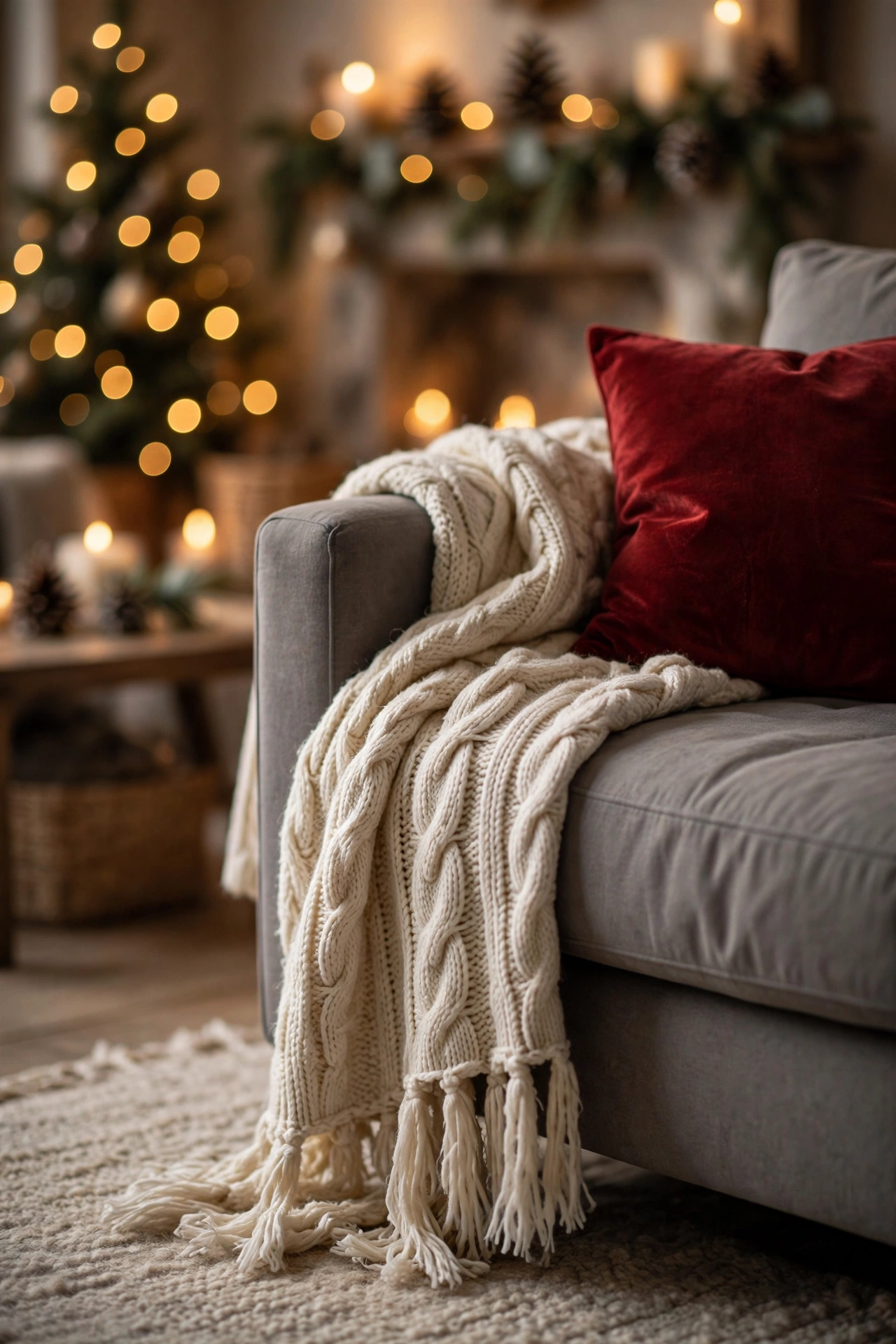
Sofa Colour Stories: Grey, Brown, Cream and Green
The fastest way to choose Christmas colours for your sofa is to start with the colour of the sofa itself. A colour story that fights the sofa will always look wrong, no matter how pretty the pillows are in the shop. A colour story that works with the sofa will look effortless, even if you only change two cushions. So before you buy anything, look at your sofa in daylight, note its real colour, and pick from the story below that matches it. The sofa is the background. The pillows and the throw are the accents. Get the background right first.
A grey sofa is the easiest to dress for Christmas, because grey goes with almost everything. Warm it up with red, burgundy, forest green, cream and soft gold. A deep red velvet pillow, a plaid that mixes red and cream, and a cream lumbar pillow will make a grey sofa look warm and festive without making it look dark. If your grey is cool and blue toned, lean toward burgundy and forest green rather than bright red, because bright red can look harsh against cool grey. If your grey is warm, with a hint of brown in it, bright red and gold will look wonderful. Add a throw in cream or soft gold, and the grey will read as a calm background instead of a cold one. Avoid black and white only, because that combination can look stark in December, when you want warmth. A little gold, even just in the throw or in a ribbon, softens the whole look.
A brown sofa needs colours that are rich enough to stand next to it. Burgundy, forest green, cream, camel and gold all work well. Plaid is your best friend on a brown sofa, because it mixes several of those colours together and ties the sofa to the pillows. A plaid in burgundy, green and cream, a velvet pillow in forest green, and a lumbar in cream is a combination that looks expensive and feels warm. Camel is the quiet hero here. A camel throw or a camel lumbar pillow picks up the warmth in the brown leather or fabric and keeps the sofa from looking too dark. Avoid pale pink or pale blue on a brown sofa at Christmas, because they can look washed out against the brown. If you love pink, save it for another room. For the sofa, stay with the rich, warm colours that brown loves.
A cream or white sofa is a gift at Christmas, because it can go full winter white with no red at all. Faux fur, cable knit and sheepskin are the textures that make a cream sofa look like a snowy cabin, even without a single red pillow. A cream velvet pillow, a white cable knit throw, a sheepskin draped over the back, and a lumbar in soft gold or pale green will make the sofa look calm, bright and luxurious. If you do want a little colour, add it in one place only. A single deep green pillow, or a single red lumbar, is enough. More than that, and the winter white feeling is lost. The other advantage of a cream sofa is that it shows texture beautifully. A chunky knit throw that might disappear on a dark sofa will stand out on a cream one. Let texture do the work that colour does on a darker sofa.
A green sofa, whether it is forest green, sage green or a deep olive, looks wonderful with cream and red at Christmas. Cream softens the green and stops it from looking too dark. Red picks up the Christmas feeling and makes the green read as festive rather than just green. A cream lumbar pillow, a red velvet pillow, and a plaid that mixes red, green and cream is a simple, strong combination. A throw in cream or in a soft plaid will finish it. Avoid adding more green in the pillows, because the sofa is already green and the pillows will blend into it. The pillows need to contrast with the sofa to be seen. Cream is the contrast that works best here. If your green sofa is pale sage, you can use deeper colours, burgundy and forest green, to add depth. If it is dark forest green, keep the pillows light, cream and gold, so the sofa does not look heavy.
The Small Sofa Formula
Small sofas deserve Christmas decor too, and they often look better than big sofas when they are dressed well, because every choice shows. The small sofa formula is the heart of this guide. The idea is simple. Fewer pillows, better placed, one throw, and nothing that stops people from sitting down. A small sofa that is overdecorated is not cosy. It is crowded. A small sofa that is dressed with restraint looks intentional, calm and inviting.
Start with the numbers. A loveseat, which seats two people, wants two or three pillows. Two anchors, one at each end, plus one lumbar in the middle is the classic loveseat plan, and it leaves both seats free. A standard three seat sofa wants four or five pillows, as we covered in Section 1. A sectional wants five or six pillows, grouped at the ends and in the corner, with a clear gap in the middle seats so people can sit without moving a pile first. The gap is not wasted space. It is the space where people actually sit. Leave it clear, and the sectional will be used all through December. Fill it with pillows, and the sectional will become a display that nobody touches.
For a small living room, the sofa is often the main piece of Christmas decor, because there is no room for a big tree or a large display. That is fine. Dress the sofa with two cushions and one throw, and let that be the Christmas moment. Two cushions, one in a Christmas plaid or velvet and one in a supporting colour, plus one folded throw over one arm, is enough to make the whole room feel festive. The guides that focus on small spaces say the same thing in different words. Dress the sofa with two cushions and one throw, and keep the rest of the room simple. The sofa does the work. The room follows.
The basket trick matters even more in a small room. A basket of rolled throws at the end of the sofa gives you extra blankets without extra furniture, and it adds texture and warmth to a corner that might otherwise look bare. Put the basket on the floor at the end of the sofa, where it does not block the walkway. Roll the throws tightly so they stand upright, and let the tops show. A basket in a natural material, seagrass, wicker or cotton rope, adds a soft, natural texture that balances the velvet and plaid on the sofa. If you have no basket, a large tote bag or a wooden crate works just as well. The point is a home for the throws, not a perfect shopping list.
Keep the seats sittable. This is the rule that matters most on a small sofa. Before you add a pillow, sit in the seat it will go in. If your back touches the pillow and your knees touch the coffee table, the pillow is in the way. Move it to the end, make it smaller, or take it off. A small sofa has less room to spare, so every pillow has to earn its place. A lumbar pillow earns its place because it supports your back. An anchor pillow earns its place because it fills the corner and frames the sofa. A third decorative pillow that just sits in the middle and gets moved every time someone sits down does not earn its place. Take it off and put it on a chair instead.
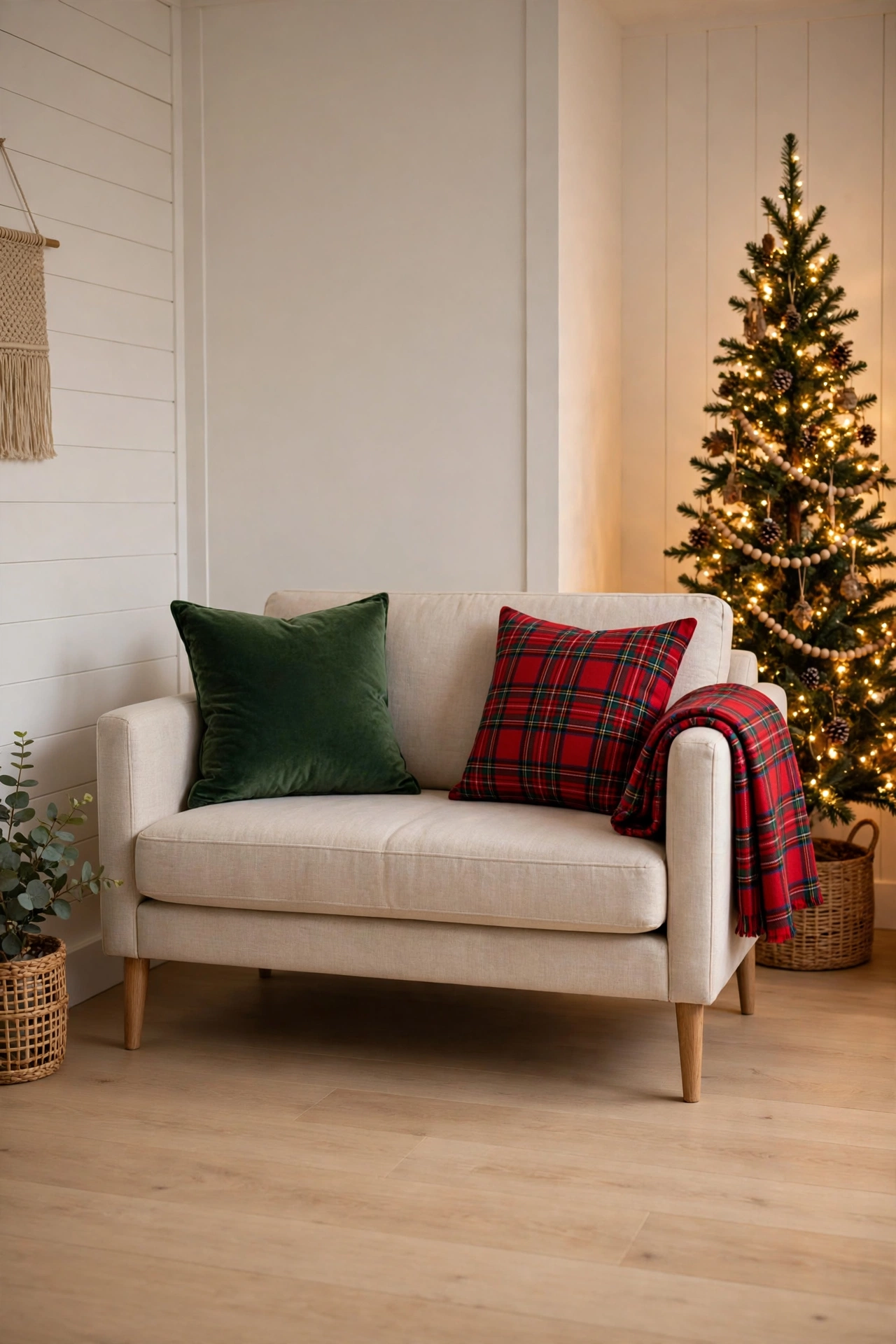
Pillows Tied Like Presents and Other $5 Tricks
Not every Christmas sofa idea needs a shopping trip. Some of the best tricks cost about five dollars, take ten minutes, and use things you already own. The most charming of them is also the simplest. Tie a plain pillow like a present. Take a wide velvet ribbon, in red, green or gold, wrap it around a plain cushion, cross it at the back, bring it to the front, and tie it in a bow. The pillow suddenly looks like a gift sitting on the sofa. It costs less than a new pillow, it takes no closet space in January, because the ribbon folds flat into a drawer, and it can be untied in seconds if you want the plain pillow back. One or two ribbon tied pillows is enough. Tie every pillow and the sofa starts to look like a wrapping station. Tie one or two, and they become a sweet detail that guests notice and smile at.
One nutcracker pillow and nothing else loud is another trick that costs little and looks like a lot. A single pillow with a nutcracker, a small tree, or a simple Christmas motif can carry the whole Christmas feeling for the sofa, as long as the other pillows stay quiet. The mistake is to buy the nutcracker pillow and then add a Santa pillow, a reindeer pillow and a pillow with words on it, because then the nutcracker is not special any more. It is just one more loud voice. Let the one loud pillow be loud, and let the rest be calm. Cream, plain green, plain red, or a soft knit will all let the nutcracker pillow shine.
Old Fair Isle sweaters make wonderful pillow covers, and they cost nothing if the sweater is already in your cupboard. A sweater that is too small, too worn at the elbows, or just out of style can be cut and sewn into a simple envelope cover in an evening. The pattern is already there, the wool is already soft, and the cover will look handmade in the best way. If you do not sew, ask a friend who does, or use fabric glue and a simple fold that does not need stitching. The sweater cover will be a little imperfect, and that is part of its charm. It looks like it belongs in a home, not in a shop. Just check that the sweater is washable, or be ready to hand wash the cover, because wool needs gentler care than cotton.
Sheepskin draped over the back of the sofa is another low cost, high impact trick, especially on a cream or grey sofa. A small sheepskin, real or faux, draped over one corner of the back adds softness, warmth and a winter feeling in seconds. It does not need to cover the whole sofa. One corner is enough. The sheepskin also gives you a soft layer to lean against, and it looks lovely in photos. If you do not own a sheepskin, a faux fur throw folded in half and draped the same way does a similar job. The point is a soft, textured layer that contrasts with the smooth fabric of the sofa.
The Sofa in the Room: Repeat One Colour
A sofa does not live alone. It lives in a room with a tree, a coffee table, a rug, lamps and chairs, and the way to make the whole room feel connected is to repeat one colour from the sofa in one or two other places. This is the designer trick that makes a room look pulled together without any extra spending. Pick one colour from your sofa pillows, perhaps the red from the velvet pillow, the green from the plaid, or the gold from the lumbar, and repeat it once in the tree ribbon, once in the garland, or once on the coffee table. One repetition is enough. Two is plenty. Three starts to look matched, and matched is not the goal. Connected is the goal.
Start with the tree ribbon, because it is the biggest surface in the room after the sofa. If your sofa pillows are red and cream, a red ribbon on the tree will tie the tree to the sofa in a way that guests will feel even if they cannot name it. If your sofa is green and cream, a green ribbon, or a ribbon that mixes green and cream, will do the same job. The ribbon does not need to match the pillows exactly. It just needs to be in the same colour family. A deep red ribbon and a burgundy pillow are close enough. A forest green ribbon and a sage pillow are close enough. The eye reads them as related, and the room feels calm.
The garland is the second place to repeat the colour. A garland over a fireplace, a doorway, or a window can carry a few red berries, a few gold ornaments, or a ribbon in your sofa colour, and that small touch will link the garland to the sofa across the room. You do not need to redecorate the whole garland. Just tuck in a few berries or a short length of ribbon in the sofa colour, and the link is made. The same idea works on the coffee table. A book with a red cover, a small green plant, a gold tray, or a plaid coaster in the sofa colours will connect the table to the sofa without any new purchase.
Think of the sofa as the focal point, plus one textile layer, plus one or two supporting moments. The focal point is the sofa itself, dressed with pillows and a throw. The textile layer is the basket of throws, or the sheepskin, or the rug under the coffee table. The supporting moments are the tree ribbon, the garland touch, or the coffee table detail. That is the whole room plan. Focal point, textile layer, supporting moments. No more is needed. When you step back and look at the room, you should see the sofa first, then notice the colour repeated once or twice, and feel that the room is connected. If you see ten separate decorations competing for attention, take two away. The room will look better, and the sofa will shine more.
The Budget Finish and the Mistakes to Avoid
Christmas sofa decor does not need to cost a lot, and it is worth knowing the real numbers before you shop. The budget below is based on the prices in the sections above. Pillow covers at eight to fifteen dollars each, a lumbar pillow if you need one, a throw you may already own, a roll of velvet ribbon for about five dollars, a basket you may already own, and a faux fur or sheepskin layer if you want one. The total for a full look is about forty to seventy dollars, and the total for a simple look, two covers and a ribbon, can be under thirty dollars. That is the honest range. If a guide tells you that a whole Christmas sofa costs ten dollars, it is probably counting only one item. If it tells you it costs two hundred dollars, it is probably selling you new pillows you do not need.
Now the mistakes to avoid, because avoiding a mistake saves more money than any sale. The first mistake is ten pillows that nobody can sit past. A sofa with ten pillows looks like a pillow shop, not a living room. Guests will move the pillows to the floor, the dog will knock them off, and you will spend December putting them back. Five pillows on a three seat sofa is enough. Three on a loveseat is enough. Leave room to sit.
The second mistake is three throws making the sofa visually heavy. One throw is enough. Three throws hide the pillows, slide to the floor, and make the sofa look like a laundry pile. If you own three lovely throws, put two of them in the basket and keep one on the sofa. The basket shows them off better, and the sofa stays clean.
The third mistake is perfect square staged folds. A throw folded into a perfect square and placed dead centre on the sofa looks like a shop display, not a home. Fold it in thirds, drape it over one arm or one corner, let the ends hang unevenly, and leave it a little relaxed. The drop, not fold, trick from Section 3 will help here. A little imperfection is what makes a sofa look inviting.
The fourth mistake is every pillow shouting Christmas. Words on one pillow, Santa on another, trees on a third, reindeer on a fourth, and suddenly the sofa is shouting. One strong Christmas pillow, the rest supporting, is the rule from Section 2. Follow it, and the sofa will look festive without looking noisy. Your guests will notice the one beautiful pillow. They will not remember four loud ones.
The fifth mistake is non washable covers with cocoa and candle wax in the house. Christmas is a messy season. Hot chocolate spills, wax drips, and sticky hands happen. If your covers cannot be washed, you will either ruin them or spend December protecting them. Check the label before you buy. Washable is not a luxury at Christmas. It is a necessity.
The sixth mistake is buying new inserts instead of covers. New inserts cost two or three times as much as covers, and they take up storage space in January. Covers slip over cushions you already own, wash easily, and fold flat. Unless your old cushions are flat and lumpy and truly need replacing, buy covers. Your wallet and your cupboard will thank you.
Conclusion
Your sofa is ready for Christmas, and you do not need a new sofa or a big budget to get there. Start this weekend with the three things that matter most. One pillow formula, velvet, plaid and one lumbar, placed with the big pillows at the ends and the light pillow in the middle. One throw habit, folded in thirds and draped over one arm or one corner, with the ends left uneven so it looks relaxed. And one colour story, picked from your sofa colour first, grey, brown, cream or green, and repeated once in the tree ribbon or on the coffee table so the whole room feels connected.
If your sofa is small, trust the small sofa formula. Two or three pillows, one throw, seats left free, and a basket of rolled throws nearby. That is enough to make the whole room feel festive, and it is the plan that works in real living rooms, not just in photos. If you want a little extra charm, tie one plain pillow like a present with wide velvet ribbon, and let that be the detail guests smile at. It costs about five dollars, it takes ten minutes, and it looks personal in a way that a new pillow never will.
Do not try to do everything in one day. Do the pillows on Saturday, the throw on Sunday, and the colour repetition when you put the tree up. Let the sofa settle, sit on it, watch a film, and see how it feels. If a pillow pokes you, move it. If the throw slides, tuck it. If the room feels calm and warm, you are done. Christmas decorating is not a test. It is a way to make the room where your family gathers feel a little more special for a few weeks. Dress the sofa, keep it sittable, and enjoy it. The rest of the room will follow.
FAQ
How many pillows should a three-seat sofa have at Christmas?
Five pillows is the sweet spot for a deep three seat sofa. Two 22 inch anchors at the ends, two 18 or 20 inch mids next to them, and one 12 by 20 inch lumbar in the centre. That leaves the middle seat free enough to sit on. A loveseat wants two or three pillows, and a sectional wants five or six grouped at the ends and in the corner, with a gap in the middle seats.
Pillow covers or new pillows?
Pillow covers, almost every time. Covers cost about eight to fifteen dollars each, slip over cushions you already own, wash easily, and fold flat in January. New pillows cost two or three times as much and take up storage space. Buy covers, keep your inserts, and spend the saving on a good throw or a roll of velvet ribbon.
How do I drape a throw so it looks relaxed, not staged?
Fold the throw in thirds lengthwise, drape it over one arm or one corner of the back, and let the ends hang at slightly different lengths. Or hold it by one corner and let it drop in a loose triangle, then tuck one corner lightly behind a cushion. Do not smooth it into a perfect square. A little unevenness is what makes it look relaxed and inviting.
What colours work on a grey sofa?
Red, burgundy, forest green, cream and soft gold all warm up a grey sofa. A deep red velvet pillow, a plaid that mixes red and cream, and a cream lumbar pillow is a classic combination. If your grey is cool and blue toned, lean toward burgundy and forest green rather than bright red. Add a throw in cream or soft gold to finish the look.
What works on a small sofa in a small living room?
Two cushions and one throw is enough. Dress the sofa with one Christmas plaid or velvet cushion and one supporting cushion, plus one folded throw over one arm. Keep the seats sittable, group any extra pillows at the ends, and put a basket of rolled throws at the end of the sofa. Let the sofa be the Christmas moment, and keep the rest of the room simple.
How much does Christmas sofa decor cost?
A full look costs about forty to seventy dollars, based on the budget table below. Two pillow covers and a roll of ribbon can be under thirty dollars, especially if you already own a throw and a basket. Start with what you own, buy the one strong pillow cover first, and add supporting pieces only if you need them.
Budget Table
| Item | What to buy | Typical cost |
|---|---|---|
| Pillow covers | 3 covers, velvet, plaid and solid, washable | $24 to $45 |
| Lumbar pillow | 1 lumbar cover, 12 by 20 inches, or a filled lumbar if you have no insert | $10 to $15 |
| Throw | 1 chunky knit, faux fur, plaid or velvet throw, washable if possible | $0 to $20, free if you already own one |
| Velvet ribbon | 1 roll wide velvet ribbon, red, green or gold, for tying pillows like presents | $5 |
| Basket of throws | 1 natural basket, seagrass, wicker or cotton rope, plus rolled spare throws | $0 to $10, free if you already own a basket |
| Sheepskin or faux fur layer | 1 small sheepskin or faux fur layer draped over one corner of the back | $0 to $15, free if you already own one |
| Total | Full sofa look, using what you own where you can | About $40 to $70 |