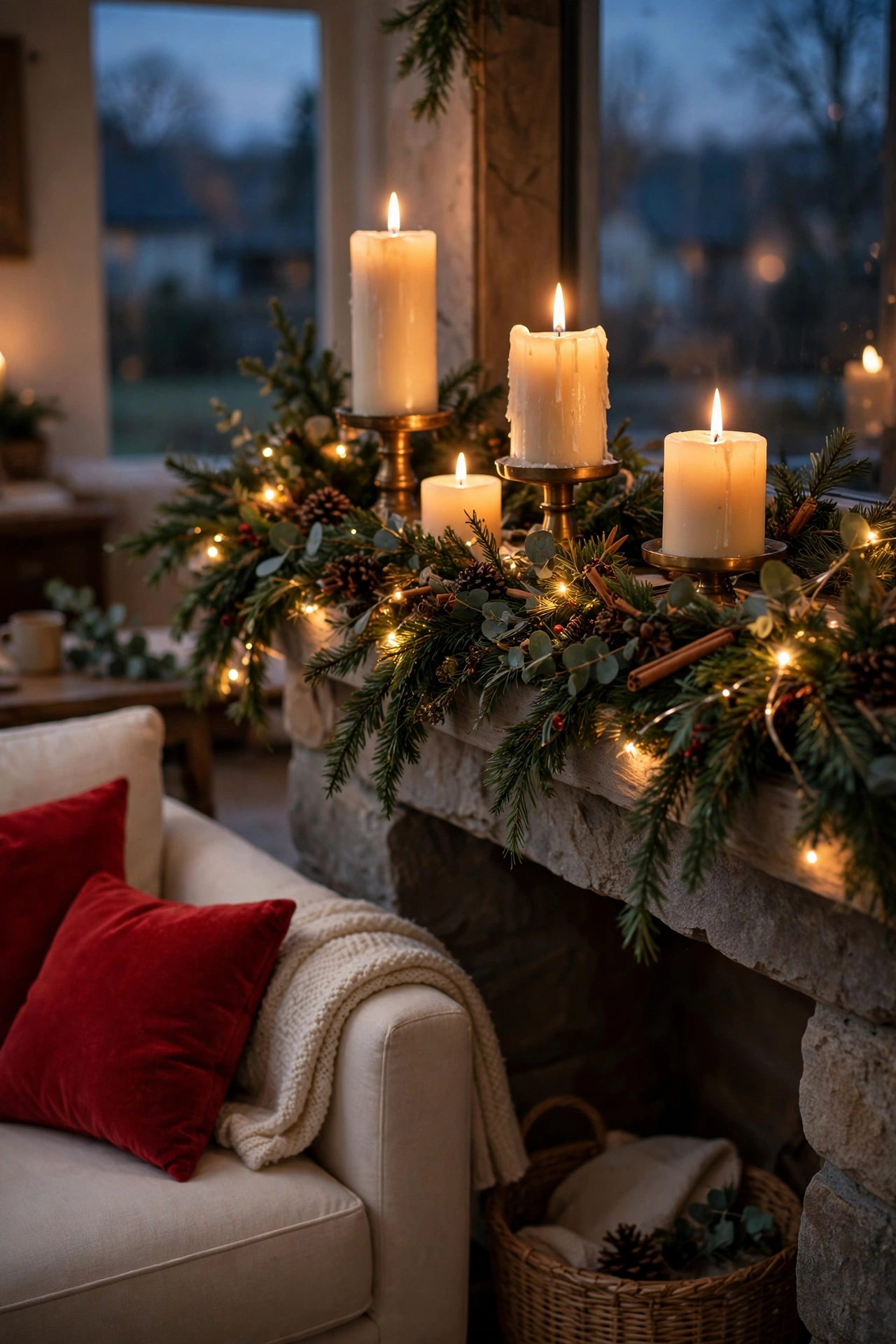
Christmas Candle Decor Ideas That Warm Every Room
There is a moment on a December evening when the main lights go off, the candles are lit, and the whole house changes. The room does not get brighter. It gets warmer, softer and smaller in the best possible way. Corners that looked plain in daylight suddenly look intentional. The garland on the mantel looks richer. The tree looks deeper. Faces look kinder. Nothing else you can buy for Christmas does this for so little money, and nothing else works so fast.
Candles are the oldest Christmas decoration in the house, older than electric lights, older than store bought ornaments, older than the tree itself in many homes. Families lit real candles on trees for generations before anyone thought to wrap a wire around a branch. That history is part of the appeal. A candle is not a gadget. It does not need an app or a remote or a spare outlet. You strike a match. The room is different. It is the simplest decoration you own, and in December it is also the most powerful.
Yet candles are also the decoration most people use badly, usually because they buy them in a hurry and scatter them around the house with no plan. A single lonely candle on a sideboard does almost nothing. Five candles of different heights grouped on one tray changes the whole room. A real flame on a mantel with dry garland above it is a fire risk, while the same flame on a dining table where someone is watching it is perfectly safe. A strongly scented candle in a small bedroom gives you a headache by nine in the evening, while the same candle in a big open living room smells faintly wonderful all night. The details matter. They are all easy once you know them.
This guide gives you the full plan. You will learn the safety rules that let you enjoy real flame without worry, and where flameless candles are actually the better choice. You will learn the one tray formula that turns any group of candles into a display that looks designed rather than accidental. You will get christmas candle centerpiece ideas for the dining table that leave room for dinner, mantel and shelf displays that layer light properly, five minute DIY candle crafts using cinnamon, dried oranges and pinecones, how to pick a Christmas scent without overdoing it, and how to use candles in small spaces, rented homes and rooms where a real flame is not allowed. Most ideas here cost under fifteen dollars, most take less than half an hour, and every one of them works tonight, the same evening you try it.
Why Candlelight Beats Every Other Decoration
Candlelight flatters everything it touches, and that is the first reason it beats every other decoration in the house. Electric light comes from above and shows every flaw in a room. It shows the scuff on the wall, the dust on the shelf, the wrinkle in the curtain. Candlelight comes from below, at eye level or lower, and it hides flaws instead of showing them. It softens edges, warms skin tones, makes wood look richer and fabric look deeper. A room lit by candles looks like a photograph with a warm filter on it, and it costs nothing extra to get that effect.
The second reason is scale. A Christmas tree costs money and takes up floor space. A garland needs hooks and a ladder. A new set of cushions costs forty dollars and changes one sofa. Three pillar candles on a tray cost about twelve dollars, take up less space than a dinner plate, and change the whole room from the moment they are lit. No other decoration gives you that much change per dollar and per square inch. If your decorating budget is small this year, candles are where the money should go first, because they make everything else you already own look better.
The third reason is mood, and it is the one people underestimate until they try it. Electric lights, even warm fairy lights, are steady and even. They do not move. A real flame flickers, and the flicker is what the eye loves. It gives the room a pulse, a tiny bit of life in the corner of your vision, and that movement is what makes a room feel alive rather than staged. Flameless candles try to copy the flicker with a small moving wick or a changing LED, and the good ones are surprisingly convincing, but a real flame still moves in a way no circuit can quite match. If you have never eaten dinner by candlelight at Christmas, try it once, and you will understand why families kept the habit for centuries.
Candles also solve the problem of a room that feels finished but flat. Many homes reach a point in December where the tree is up, the garland is hung, the cushions are swapped, and the room still feels like a display rather than a home. The missing piece is almost always light at a low level. Everything else in the room is lit from above or from the tree. Candles add light at table height and shelf height, where people actually sit and look. That low light is what makes a room feel occupied and welcoming instead of photographed and empty.
One honest warning belongs here too. Candles are the only Christmas decoration that can burn your house down, and the safety rules in the next section are not optional extras. They are the price of using the prettiest decoration in the house. Follow them, and candles are perfectly safe. Ignore them, and no amount of beauty is worth the risk. The good news is that the rules are simple, they take five minutes to learn, and half of them are about where you put the candle rather than what you buy.
The Safety Rules First, Real Flame Versus Flameless
Before you buy a single candle, decide where each one will live, because the place decides whether it should be a real flame or a flameless candle. Real flames belong only where an adult can see them the whole time they are burning, and where nothing flammable hangs above or beside them. That means the dining table during dinner, a coffee table while you are sitting in the room, and a kitchen counter while you are cooking. Real flames do not belong on a mantel under a dry garland, on a shelf under a wooden cabinet, on a windowsill behind a curtain, in a bedroom while you sleep, or anywhere near a Christmas tree. Those are flameless candle places, and flameless candles are not a compromise there. They are the right tool.
Flameless candles have improved enormously in the last few years, and the good ones are worth the small extra cost. Look for three features: a flickering flame tip rather than a steady glow, a warm white colour around 2700 Kelvin so it matches your other lights, and a remote with a timer, so the candle switches itself on for six hours and off for eighteen. A set of three flameless pillars with a remote costs about fifteen dollars, and it will last for years. Battery operated taper candles are the newest option, and they are the best choice for candlesticks and candelabras, where a real taper would drip wax on the tablecloth. Choose warm white or amber toned flames, never cool white, because a cool white fake flame looks like a torch and ruins the effect.
For real candles, the rules are short and worth memorising. Never leave a burning candle unattended, not even for five minutes. Keep the flame at least twelve inches from anything that can burn, including garland, curtains, books, paper decorations and the Christmas tree. Keep candles out of reach of children and pets, and out of draughts, because a draught makes the flame lean and the wax drip and the soot build up. Trim the wick to about a quarter of an inch before every lighting, because a long wick makes a tall flame that smokes and soots the wall. Burn a pillar candle for at least one hour and no more than four hours at a time, so the wax melts evenly and the candle does not tunnel down the middle. Put every candle on a stable, heat resistant surface, a tray, a plate, a tile, never directly on wood or fabric. And keep a glass of water or a small fire extinguisher in the room, not because you expect a fire, but because the one time you need it, you will need it in seconds.
Mixing real and flameless candles in the same room is fine, and it is actually the best approach, because the real candles give you the movement and the flameless ones give you the volume. Put two real candles on the dining table where you can watch them, and put flameless candles everywhere else, on the mantel, the shelf, the sideboard and the windowsill. The room will look as if it is full of candlelight, and only the dining table will need watching.
Scented candles add one more rule. Never burn a strongly scented candle in a room where people are eating, because the scent fights with the food. Save scented candles for the living room, the hallway and the bathroom, and use unscented candles on the dining table. This one rule fixes the most common scented candle complaint, which is that the house smells like a candle shop instead of a home.
The Candle Tray Formula, One Tray and Three Heights
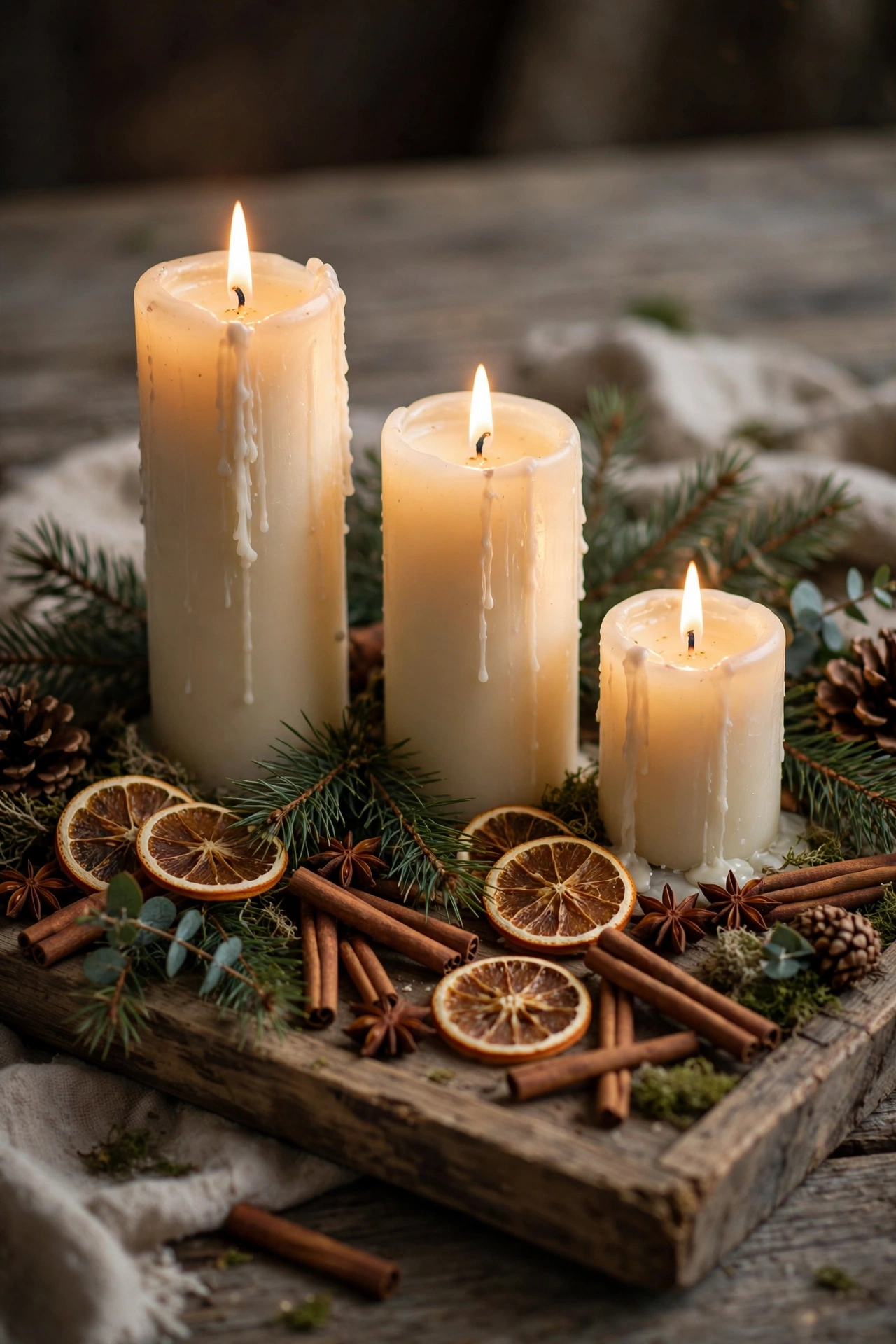
If you remember only one idea from this whole guide, make it the candle tray formula, because it turns any group of candles into a display that looks designed. The formula is simple: one tray, three candles of different heights, and a little greenery. That is the whole recipe, and it works on a coffee table, a sideboard, a mantel, a dining table, a windowsill, and even a bathroom counter. The tray is what makes it work. Without a tray, three candles on a table look like three candles that happen to be on a table. With a tray, they look like a display someone planned.
Start with the tray. Wood is the warmest choice and suits almost every Christmas style, from farmhouse to traditional. Brass or gold metal trays look more formal and catch the candlelight beautifully, which makes the whole display glow a little brighter. Ceramic trays in cream or deep green suit a calm, modern room. A simple wooden chopping board works perfectly if you do not own a tray, and a large dinner plate works in a pinch. The tray should be big enough to hold the candles with at least an inch of space around each one, and small enough that the candles fill it rather than rattling around in it. About twelve to fourteen inches across is right for three pillar candles.
Next, the three heights. This is the detail that separates a display from a row. Three candles of the same height look like a shop shelf. Three candles of different heights look like a landscape. Use a tall pillar, a medium pillar and a short pillar, or two pillars and one taper in a holder, or a tall lantern with two small votives beside it. The rule is that the tallest candle should be about twice the height of the shortest one. That range gives the eye something to travel across. If you only own candles of one height, cheat: stand one candle on a small stack of books, or on an upside down bowl, or on a short wooden block, and the heights are fixed for free.
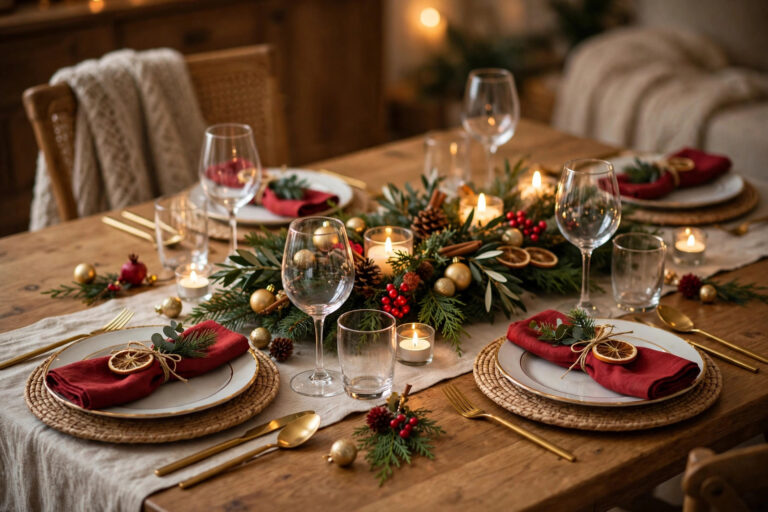
Then the greenery, and this is where the display becomes Christmas rather than just candles. Tuck a few sprigs of faux pine or cedar around the bases of the candles, flat on the tray, not standing up where they can catch a flame. Add three or four pinecones, a few dried orange slices, a scattering of small gold ornaments, or a handful of cranberries. Keep the greenery low and flat and well clear of the flames, at least three inches from any wick. The greenery should frame the candles, not compete with them. If you are using real flames, use faux greenery only, because real dried greenery on a tray with open flames is a fire risk. If you are using flameless candles, real greenery is fine.
The tray formula has one more advantage that people only discover after they try it. It makes the display movable. A tray full of candles lifts off the dining table in one hand when dinner arrives, moves to the sideboard while you eat, and comes back to the table for dessert. A tray on the coffee table lifts off in one move when you need the space. A tray on the mantel lifts down for dusting. Candles without a tray are stuck where they are. Candles on a tray go where the evening goes, and that is why the tray is the most useful ten dollars you will spend on Christmas decor this year.
Make two trays, not one, if your budget allows it. One tray lives on the dining table or coffee table, the place people gather. The second tray lives in the place people pass through, the hallway console, the entryway table, or the sideboard. Two trays of candlelight, one where people sit and one where people arrive, make the whole house feel lit, and the cost is still less than one new cushion.
Christmas Candle Centerpieces for the Dining Table
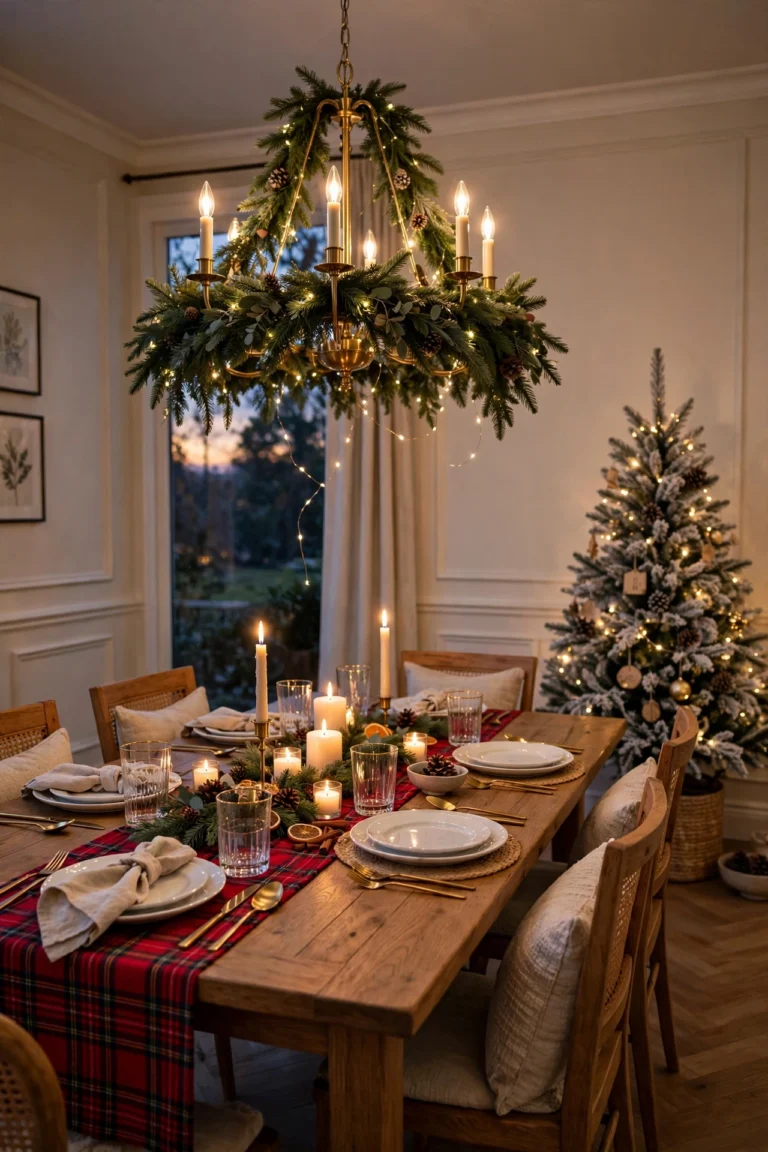
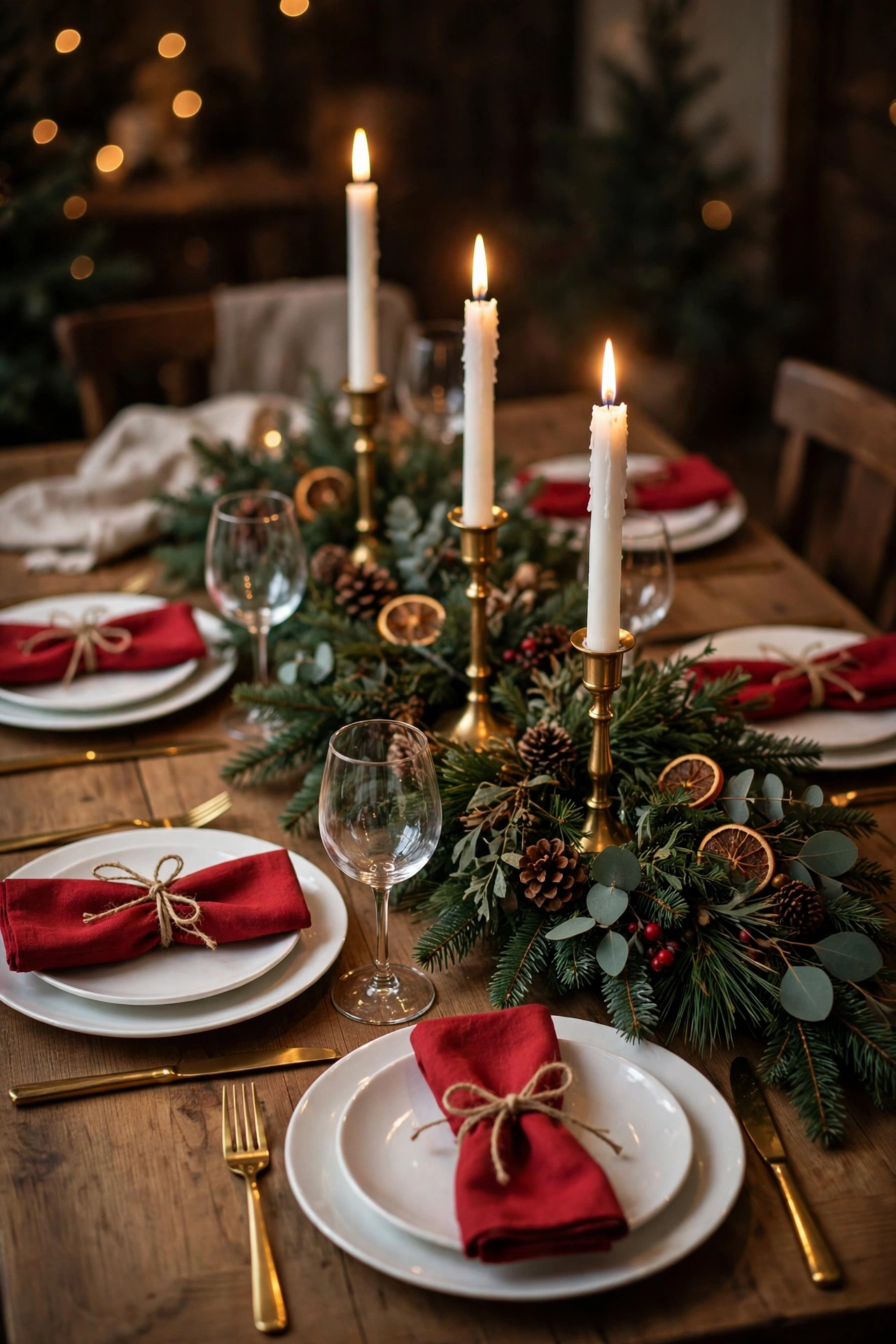
The dining table is where christmas candle centerpiece ideas matter most, because it is the one place where candles are both the decoration and the lighting for the meal itself. A good table centerpiece does three jobs at once: it looks beautiful when guests sit down, it stays out of the way while they eat, and it lights their faces warmly while they talk. Most centerpieces fail at the second job. They are too tall, too wide, or too fragile, and by the main course someone has moved them to the sideboard in annoyance. The rules in this section stop that from happening.
Keep the centerpiece low. The top of the tallest candle should sit below eye level when guests are seated, which usually means nothing taller than about twelve inches in the middle of the table. Tall taper candles are the exception, because they are thin and you can see past them, but a tall pillar candle in the middle of the table blocks the view across it. If you love tall candles, put them at the ends of the table rather than the middle, or use a candelabra with slim tapers that guests can talk around. The test is simple: sit down, look across the table, and check whether you can see the person opposite you. If you cannot, the centerpiece is too tall.
Keep the centerpiece narrow. A dining table has to hold plates, glasses, serving dishes and elbows. The centerpiece gets a strip down the middle, about twelve inches wide at most, and everything else belongs to the meal. A low garland runner with candles tucked into it is the classic solution, because it fills the middle strip without spreading onto the plates. A single tray with three candles is the simpler solution, and it has the advantage of lifting away in one move when the serving dishes arrive. Either way, measure the strip before you build the display, not after.
Use unscented candles on the dining table, always. This is the rule from the safety section, and it matters most here. A strongly scented candle beside a plate of food makes the food taste like the candle, and guests will not know why the meal tastes odd. They will only know that something is off. Unscented pillars and tapers give you all the glow with none of the competition, and if you want scent at dinner, put a scented candle in the hallway instead, so guests smell it when they arrive and not when they eat.
Three centerpiece styles work for almost every table. The first is the tray of three pillars, the formula from the last section, dressed with a little greenery and a few ornaments. It suits a casual family dinner and it is the easiest to move. The second is the taper row: three brass candlesticks of different heights down the centre of the table, with a low garland runner underneath and a few pinecones scattered between the holders. It suits a more formal dinner and it looks wonderful in photographs. The third is the jar cluster: three or five mason jars or glass hurricanes of different heights, each holding a small pillar or a tea light, with faux snow or Epsom salt in the bottom of each jar. It suits a small table, because the jars are narrow, and it suits a rented home, because nothing is nailed or glued. All three cost under twenty dollars if you already own the holders, and all three lift away in one move.
If you want the full dining room plan around the centerpiece, including the table setting, the sideboard and the chairs, our Christmas Centerpiece Ideas covers the centrepiece styles in more detail, and our Christmas Dining Table Decor Ideas covers the whole table. The candles in this section are the lighting that makes those guides glow.
Mantel and Shelf Candle Displays That Layer Light Properly
The mantel is the most photographed spot in a Christmas home, and it is also the spot where candles go most wrong, because people treat it like a shelf and line candles up in a row. A row of identical candles on a mantel looks like a shop display. A layered mantel looks like a home. Layering means building the display in three depths: something tall at the back, something medium in the middle, and something low at the front, so the eye moves through the display instead of sliding across it.
Start at the back with height. A mirror, a framed print, or a large wreath hung above the mantel gives you a backdrop, and the candles sit in front of it. A pair of tall candlesticks or a tall lantern at each end of the mantel frames the whole display and stops it from looking like it is sliding off the edges. The ends are the anchors. If the ends are empty, the display looks unfinished, however pretty the middle is. If the ends are strong, the middle can be simple and the mantel still looks complete.
The middle layer is the garland, and the rule here is that the garland goes behind the candles, not under them. Lay the garland along the back edge of the mantel, let it drape slightly over the ends, and put the candles in front of it. The candles then stand out against the green, and their light falls on the greenery behind them, which makes the garland glow. If the candles sit on top of the garland, they sink into it, the flames sit too close to the dry leaves, and the whole thing looks messy. Behind, not on top. That one change fixes most mantel displays.
The front layer is the low stuff: small votives, tiny ornaments, a few pinecones, a string of wooden beads draped along the front edge. This layer is what makes the mantel feel finished when you look at it from across the room, because it fills the gap between the candles and the edge of the mantel. Keep it low, under four inches, so it never blocks the candles behind it.
Now the safety rule that matters most on a mantel: use flameless candles here, not real ones. A mantel has dry garland above it, often a mirror or a picture above that, and a fire burning below it in the fireplace. A real flame on a mantel is a flame under dry leaves above a fire, and that is too many risks in one place. Flameless pillars and tapers with a remote look wonderful on a mantel, they switch on with the same remote as the rest of the room, and nobody standing across the room can tell they are not real. Save your real flames for the dining table, where you can watch them.
Shelves follow the same layering idea on a smaller scale. One candle per shelf is the rule, never a group, because a shelf is narrow and a group looks crowded. Put the candle at one end of the shelf, group a small ornament or a tiny plant at the other end, and leave the middle empty so the eye can rest. A flameless votive inside a glass hurricane on a bookshelf, with a few small ornaments beside it, makes the whole shelf glow like a shop window, and it costs about five dollars. Repeat it on two or three shelves in the same room, and the room has candlelight at three different heights, which is exactly what makes it feel warm rather than staged.
DIY Christmas Candle Crafts, Five Minutes Each
The best Christmas candle crafts are the ones that take five minutes, cost almost nothing, and look as if they took an hour. They all work the same way: take a plain candle you already own, dress it with something natural, and tie it or set it in a way that looks deliberate. Five of them are worth doing this year, and they all use things you probably have in the kitchen already.
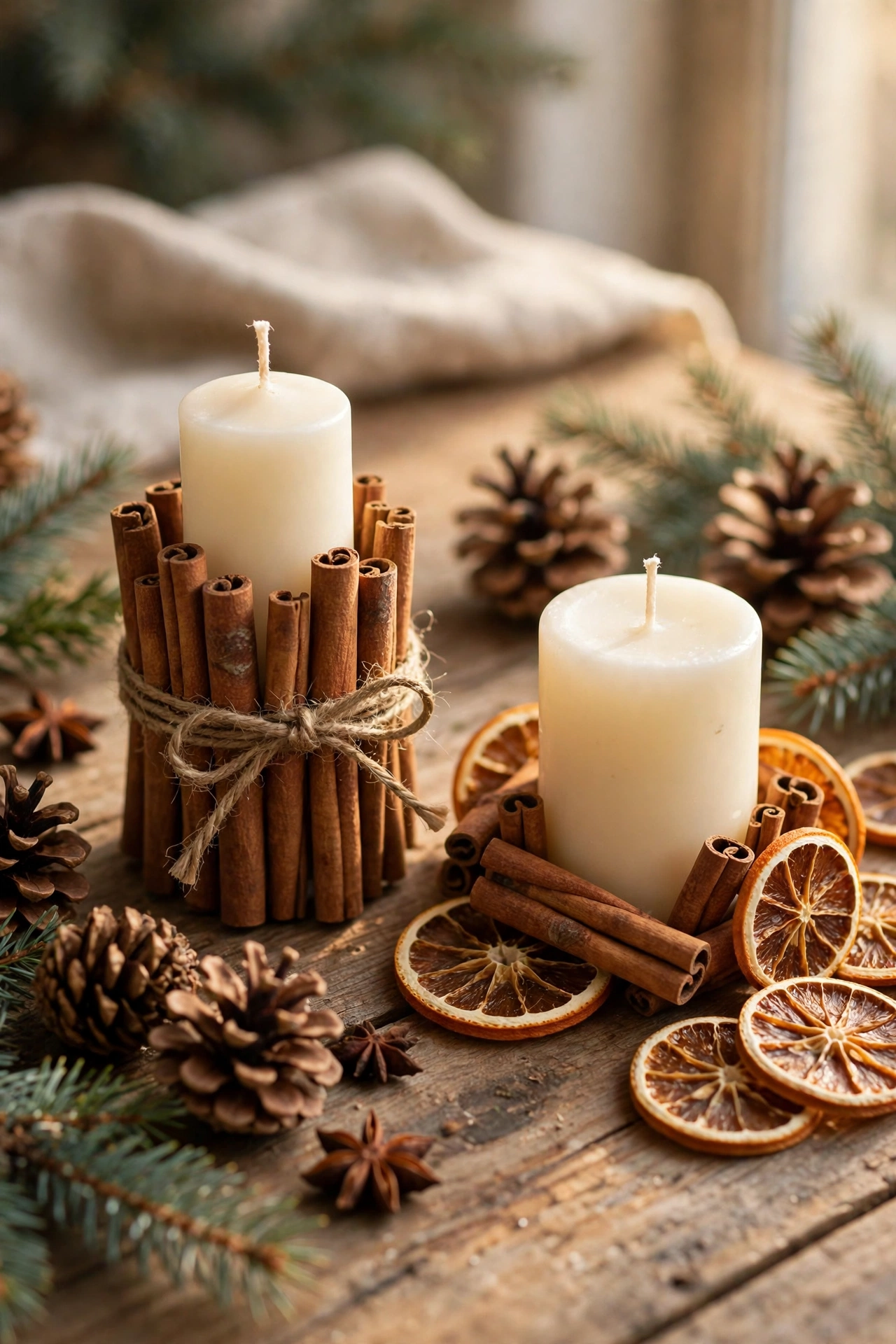
The cinnamon stick wrap is the most famous, and it deserves the fame. Take a plain pillar candle, stand cinnamon sticks upright around it, and tie them in place with twine or a thin ribbon. The sticks should cover the candle from base to top, packed tightly so no wax shows between them. The result smells wonderful when the candle warms up, it looks rustic and expensive, and it takes about five minutes. One warning: this craft is for flameless pillar candles or for a real pillar that you will light only while you are watching it closely, because cinnamon sticks are dry and flammable. With a flameless candle inside, the wrap is completely safe, it lasts all season, and you can reuse it next year.
The dried orange candle ring is the prettiest of the five. Dry orange slices in a low oven, about two hours at a low heat, until they are crisp and translucent. Arrange three or four slices flat on a tray around the base of a pillar candle, tuck in a few sprigs of pine and a couple of cinnamon sticks, and you have a centerpiece that looks like it came from a shop. The orange slices catch the candlelight and glow amber from inside, which is a colour no shop bought decoration quite manages. The same slices work on a windowsill display, where the daylight shines through them during the day and the candlelight shines through them at night.
The pinecone candle holder is the simplest. Take a few pinecones, glue them together in a small ring or cluster, and nestle a votive candle in the middle. The pinecones hold the votive steady, they hide the glass holder, and they make the candle look like it grew there. This one is for flameless votives only, because pinecones are dry and a real flame in the middle of them is a fire risk. With a flameless votive, the holder is safe, and it is also the craft most children can help with, since there is no flame and no hot wax involved.
The cranberry jar candle is the fastest. Fill a clear jar halfway with fresh cranberries, tuck in a few sprigs of rosemary or eucalyptus, fill the jar with water until the cranberries float, and set a floating tea light on top. The red and green against the glass, lit from above by the tiny flame, looks like a snow globe that you can make in two minutes. Make three jars of different heights and line them along a windowsill or a sideboard, and they glow like a row of tiny lanterns. Replace the water every few days and the cranberries last about a week.
The mason jar snow candle is the one for the mantel or the shelf. Fill a mason jar one third full with Epsom salt, which looks exactly like snow, press a small pillar or a tea light into the salt so it stands upright, and tie a ribbon or a sprig of pine around the neck of the jar. Three jars of different sizes grouped together, with a little faux snow scattered on the tray beneath them, make a winter scene that costs about three dollars. The Epsom salt also holds the candle steady, so the jars are safe on a shelf where a plain candle might tip.
Choosing a Christmas Scent Without Overdoing It
A Christmas scent should be noticed when you walk into a room and forgotten five minutes later. If you can still smell it strongly after ten minutes, it is too much. If guests comment on the smell before they comment on the room, it is too much. If you have a headache by nine in the evening, it is definitely too much. The goal is a background note, not a perfume, and the easiest way to get it right is to use fewer scented candles than you think you need, in fewer rooms than you think you need.
One scented candle per floor is the rule for a normal house. Put it in the living room, where people spend the most time, and leave the rest of the house unscented. The scent will drift into the hallway on its own, and that drift is enough. If you put a scented candle in every room, the scents mix in the hallways into something no candle maker ever intended, and the house smells like a shop instead of a home. One candle, one room, one scent. That is the whole system.
Choosing the scent is a matter of taste, but a few guidelines help. The classic Christmas scents are pine, cinnamon, orange, clove and vanilla. Pine smells like a fresh tree and suits a living room with a real tree in it. Cinnamon and clove smell warm and spicy and suit an evening room where people are sitting and talking. Orange smells bright and clean and suits a hallway or an entryway, where it greets people as they arrive. Vanilla smells soft and sweet and suits a bedroom, where it helps the room feel calm. A candle that mixes two of these, pine and cinnamon, or orange and clove, usually smells better than a candle that tries to mix four or five. Simple scents smell like Christmas. Complicated scents smell like a candle shop.
Never mix two different scented candles in the same room. The scents do not blend, they compete, and the result is always worse than either scent on its own. If you want variety, use one scent in the living room and a different scent in the bathroom, where the door stays shut and the scents never meet. And never burn a scented candle in the kitchen while you are cooking, because the candle scent fights with the food smells, and both lose.
The safest way to try a new scent is to buy the smallest size first, a votive or a tea light, and burn it for one evening. If you still like it at the end of the evening, buy the big one. If you are tired of it after an hour, you have spent two dollars finding out instead of twenty. And remember that a scented candle does not need to be lit to scent a small room. An unlit scented candle in a bathroom or a small bedroom gives off a gentle scent all day without any flame at all, which is the safest scented candle there is.
Candles in Small Spaces, Rentals and No Flame Rooms
Small spaces are where candles work hardest, because a small room needs less light to feel full, and one candle changes a small room more than five candles change a big one. A studio flat with one tray of candles on the coffee table and one flameless candle on the windowsill feels completely decorated for Christmas, and the total cost is under twenty dollars. The trick in a small space is to use fewer candles, but to place them where the eye goes: the windowsill, the top of a bookshelf, and the bedside table.
The windowsill is the best candle spot in a small home, because it does two jobs at once. From inside, the candle lights the room. From outside, the candle in the window is the classic Christmas image, and it makes the whole flat look festive from the street. Use flameless candles on a windowsill, always, because a real flame beside a curtain is a risk even in a big room, and in a small room the curtain is always close to the candle. A row of three flameless pillars of different heights along a windowsill, with a little faux greenery at their bases, is the whole decoration for that window, and it works day and night.
Renters have one extra rule, which is that nothing can be nailed, glued or drilled. Candles are the perfect renter decoration for exactly that reason. They need no holes and no hooks. A tray of candles needs no permission from a landlord. Battery operated candles need no outlet, and they need no wiring, which matters in a rented flat where the outlets are always in the wrong place. If your rental agreement bans real flames, and many do, flameless candles give you the whole look with none of the risk, and your deposit stays safe. For more ideas that work without damaging a rented home, including fairy lights and removable hooks, see our Christmas Lights Decor Ideas.
Bedrooms and bathrooms are the two rooms where candles feel most luxurious and where the rules are strictest. In a bedroom, use flameless candles only, and put them on a tray on the bedside table or the dresser, never on the bed itself. A flameless candle on the bedside table, switched on by remote as you get into bed, makes the bedroom feel like a small hotel, and there is no flame to worry about if you fall asleep. In a bathroom, a real candle is fine while you are in the room, and a candle beside the bath is the classic luxury, but it must be on a stable surface away from towels and it must be blown out when you leave the room. A flameless candle in the bathroom is simpler, and it stays lit safely while you are in the shower. Never put any candle, real or flameless, on the edge of a bath where it can be knocked into the water.
The smallest candle display of all is a single votive in a glass jar on a bedside table, and it is worth mentioning because it is the display most people actually live with. You do not need a mantel, a dining table, or a tray to enjoy Christmas candlelight. One candle, lit in the evening, in the room where you sit, is enough. Start there tonight, and add the trays and the centerpieces when you feel like it. Candlelight does not need a big plan. It needs a match.
Conclusion
Christmas candle decor is not about buying more candles. It is about placing the candles you have where they can do the most work, and choosing real flame or flameless based on the room rather than on habit. One tray with three heights on the coffee table. One low centerpiece on the dining table that leaves room for dinner. Flameless candles on the mantel and the windowsill where real flames do not belong. A five minute cinnamon wrap or a cranberry jar for the price of a coffee. One scent, in one room, noticed on arrival and forgotten five minutes later.
Light one candle tonight, in the room where you will spend the evening, and see what changes. The room will look warmer, the evening will feel slower, and the rest of the Christmas decorating will suddenly feel easier, because the hardest part of a festive home was never the decorations. It was the light. Candles give you that light for a few dollars and a single match, and no other decoration in the house does so much for so little. That is why families have lit them at Christmas for centuries, and why your home will feel more like Christmas the moment you do.