Christmas Bar Cart Decor Ideas for Festive Hosting
A bar cart is the smallest room in the house that can still host a party. It takes up less floor than a side chair, it rolls wherever the guests are, and when it is styled well it does two jobs at once: it serves the drinks and it decorates the corner it stands in. That is why the Christmas bar cart has become one of the most saved decorating ideas of the season. It is a project you can finish in an afternoon, it costs almost nothing if you shop your own shelves first, and it makes the whole house feel ready for guests even before the tree is finished.
Most bar carts fail in one of two ways. The first is the storage dump, where every bottle, glass and tool you own gets piled on three shelves until the cart looks like a drinks cupboard on wheels and nobody can find anything. The second is the museum shelf, where the cart is so carefully arranged that nobody dares touch it, and the glasses stay clean because they are never used. A good Christmas bar cart sits between those two. It is beautiful enough to photograph and practical enough to pour from, and the test is simple: a guest should be able to walk up, find a glass, and make a drink without moving three decorations out of the way.
This guide builds a Christmas bar cart shelf by shelf, the way you would actually use it. You will start with the formula that keeps any cart looking intentional, then the cart itself, its size, its finish and where it should live in the room. Then the top shelf, where the glasses, the decanter and one hero bottle do the visual work. Then the middle shelf, where the tools, the garnishes and the napkins live. Then the bottom shelf, the quiet layer that holds the backstock and keeps the cart honest. Then the Christmas layer, garland, lights and a mini wreath, applied with restraint so the cart still works. Then three color stories you can copy in one shopping trip. And finally the small cart problem, the no cart problem, and the coffee bar twin that uses the same rules for a house that does not drink.
You do not need a new cart to start. You do not need matching glassware, and you do not need a full bar. A cart you already own, five or six bottles you already like, one set of glasses, one tray, one string of battery lights and a short piece of garland will carry the whole look. The rest of this guide is about placement, proportion and restraint, which cost nothing and matter more than anything you can buy.
The Bar Cart Formula, One Hero, One Light, One Green
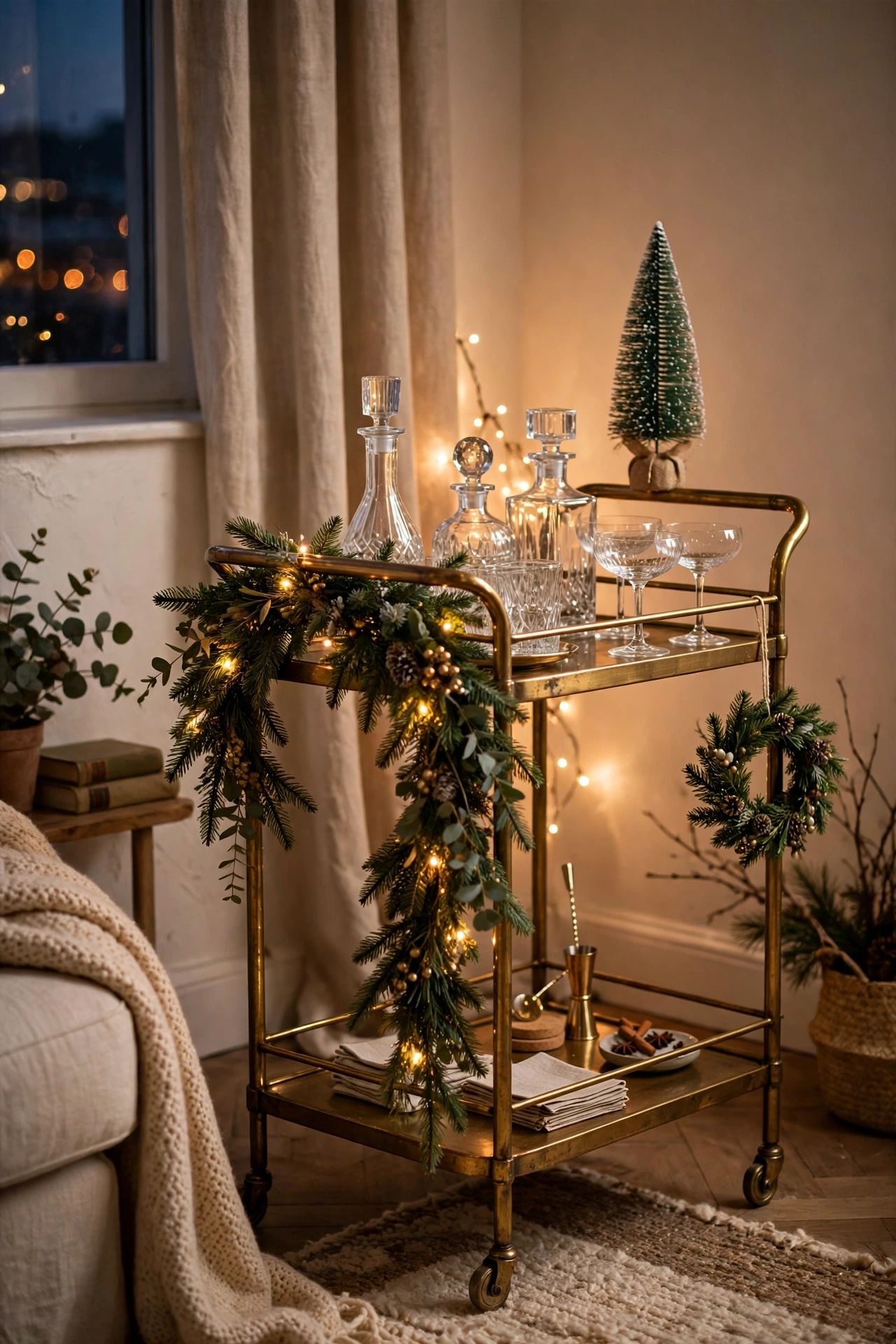
Every good bar cart follows the same formula, and once you know it you can style any cart in any room without a second thought. One hero, one light, one green. The hero is the single piece that draws the eye first, usually a decanter, a beautiful bottle, or a small tree. The light is one warm light source, a string of battery fairy lights or one low candle, never both at full strength. The green is one evergreen element, a short garland, a sprig of rosemary, or a small potted plant. Everything else on the cart is support: glasses, tools, napkins and bottles arranged around those three, never competing with them.
The formula works because a bar cart is small, and small surfaces punish excess. Three shelves, each about two feet wide, hold less than you think, and the moment you add a second hero the cart stops reading as a design and starts reading as a shelf that needs clearing. Pick the hero before you touch anything else. If you own a cut crystal decanter, that is the hero. If you own a beautiful bottle with a label you love, that is the hero. If you own neither, a small bottle brush tree in a brass pot is the hero, and it costs less than a sandwich. Place the hero on the top shelf, slightly off center, toward the side of the room where guests will approach from, and build everything else around it.
The light comes next, and the rule is warm and low. Battery fairy lights in warm white, 2700 Kelvin if the packet says so, wound once around the handle or tucked behind the bottles on the top shelf, give the glass something to reflect and make the whole cart glow after dark. One string of 20 to 30 lights is enough for a standard cart. More than that and the cart looks lit up like a tree, which fights the rest of the room. A flameless pillar candle on the bottom shelf is the other option, and it works well on a cart with a mirror back, because the mirror doubles the glow. Never use a real flame on a bar cart. Bottles, paper napkins, garland and alcohol do not belong near an open flame, and a battery candle gives the same warmth with none of the risk.
The green is the cheapest part of the formula and the one people skip most often, which is a mistake, because green is what makes a bar cart read as Christmas instead of just a drinks trolley. A short piece of faux evergreen garland, about three feet, draped over the handle or along the back edge of the top shelf, is enough. A sprig of fresh rosemary in a small glass does the same job for a single evening, and it doubles as a garnish. A small potted evergreen, a rosemary plant or a dwarf pine in a heavy pot, can sit on the bottom shelf all December and move to a windowsill in January. One green element, repeated once more in a small way, is the whole trick. A garland on the handle plus a rosemary sprig in a glass is a repetition. A garland, a wreath, a potted tree and a bowl of pinecones is a garden center.
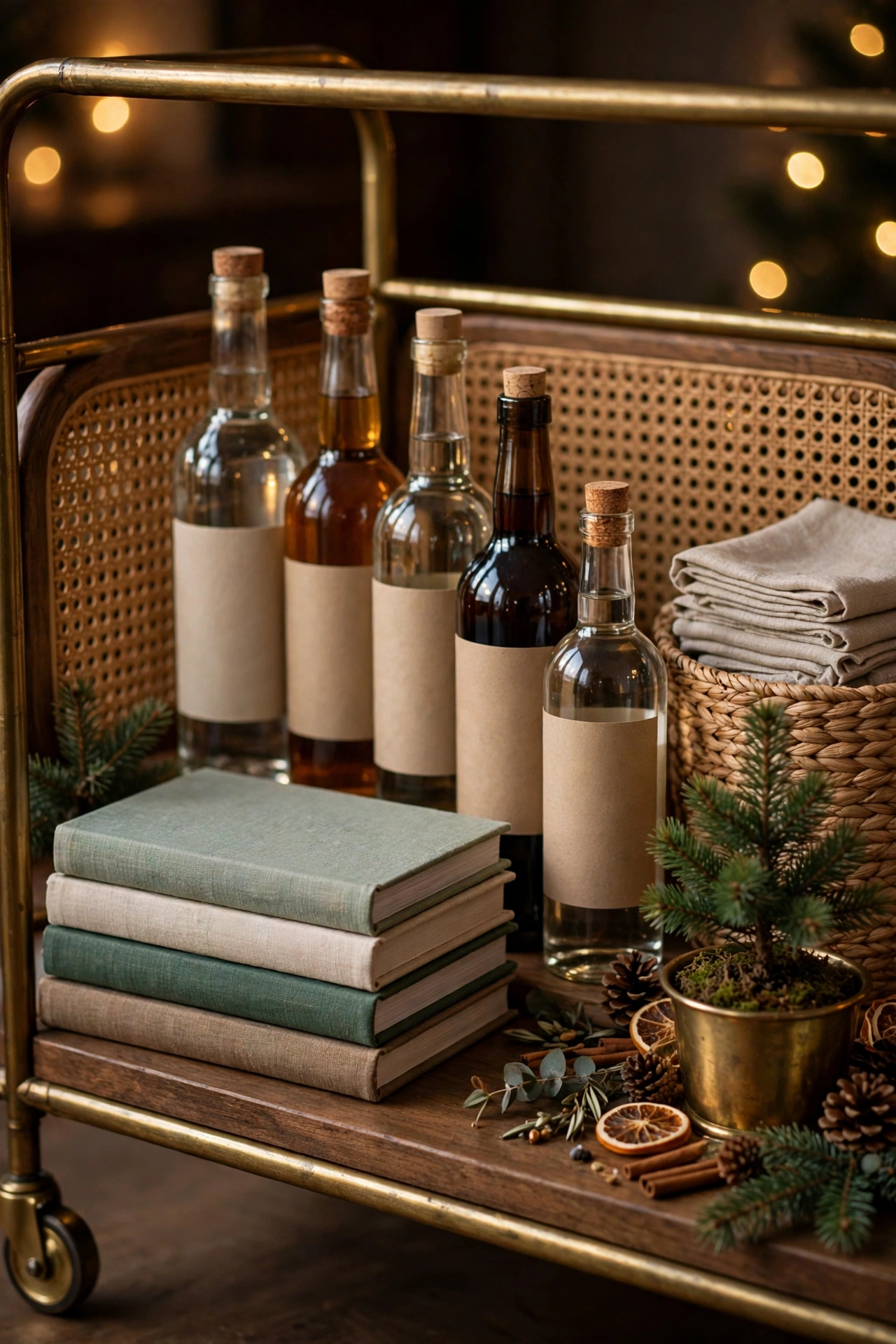
The support pieces follow the same discipline. Glasses go in one matched set, or in two sets at most, grouped by type and by height, tallest at the back. Bottles go in a short row, three to five, labels facing out, grouped by height. Tools go in one small container, a shaker, a jigger and a bar spoon, not a drawer full of gadgets spread across the shelf. Napkins go in one stack, tied with ribbon or held in a small basket. Everything has a home, everything is reachable, and at least a third of each shelf stays empty, because empty space is what makes a cart look expensive. If a shelf is full edge to edge, take a third of it off and put it in a cupboard. The cart will look better immediately, and you will find the thing you need in one reach instead of three.
Finally, step back and look at the cart from the doorway, not from two feet away. A bar cart is viewed from across the room, in low light, by people holding a drink and talking. From that distance the formula should read clearly: one hero catching the eye, one warm glow, one touch of green, and everything else calm and tidy behind it. If you cannot see the hero from the doorway, it is not the hero. Move it, raise it on a small stack of books, or choose a different one. If the cart looks busy from the doorway, remove the smallest third of what is on it. The doorway test takes ten seconds and it never lies.
Start With the Cart, Size, Finish and Where It Lives
Before you style anything, look at the cart itself, because the cart decides what the styling can be. Most bar carts are two or three tiers, about 24 to 36 inches wide, on four wheels, with a handle at one end and a rail around each shelf. The width matters more than the height. A cart under 24 inches wide is a small cart, and it needs the small cart rules in Section 8: fewer bottles, one hero, no bottom shelf styling at all. A cart 30 to 36 inches wide is the standard, and it takes the full formula in Section 1 without crowding. A cart wider than 36 inches is really a drinks table, and it needs a second hero or a long low arrangement to fill it, or it will look empty on one end.
The finish sets the color story before you buy a single ornament. Brass and gold carts are the easiest to decorate for Christmas, because gold warms up red, green, cranberry and cream equally, and it reflects fairy lights beautifully. A brass cart with clear glass and green garland is the classic Christmas bar cart, and it photographs well in any light. Black metal carts suit a moody look, dark berries, black ornaments, gold glasses, and they need more light than a brass cart, because black absorbs it. Add a second string of lights or a mirror tile on the back of the top shelf. Wood carts, walnut or oak, suit a farmhouse or vintage look, plaid napkins, a ceramic tree, milk glass, and they need a lighter hand with the garland, because wood plus green plus red can turn heavy fast. Glass and mirrored carts look the most festive with the least effort, because the mirror doubles everything on it, but they also show every fingerprint and every drip, so keep a cloth nearby and wipe the shelves once a day during party week.
Where the cart lives matters as much as what is on it. The best spot is against a wall in the living room or dining room, within a few steps of where guests sit, with a clear path to it from two directions. A cart tucked behind a sofa is a cart nobody uses. A cart blocking a doorway is a cart someone will knock over. If you have a fireplace, the cart goes on the opposite wall, never beside the fire, because heat and alcohol do not mix and the garland will dry out. If you have a dining table, the cart goes at the end of the room, not beside the table, so it does not compete with the centerpiece. The Christmas Dining Table Decor Ideas guide on this site shows how a low centerpiece and warm candlelight carry a table, and the cart should echo that table, not fight it: same garland, same ribbon, same metal finish, so the two pieces read as one room.
The wheels are not decoration, they are the point of a cart, and the cart should roll. Lock the wheels once it is in place for the evening, and unlock them when you move it to where the guests are. A cart that never moves is a sideboard with wheels, and a sideboard does not need wheels. The most useful move is the party move: roll the cart to the end of the sofa, or to the dining room door, for the first hour, when everyone wants a drink, then roll it back to its corner when the food comes out. The second most useful move is the morning move: roll it to the kitchen, clear the glasses, wipe the shelves, restock, and roll it back. A cart that rolls is a cart that stays clean, because cleaning it is a two minute job instead of a furniture moving job.
If you do not own a cart yet, buy the simplest one you can find, and buy it for the room, not for Christmas. A plain two tier brass cart with a handle and a rail costs less than a set of matching glasses, it works in every season, and it is the easiest cart to decorate, because it does not fight the decorations. Avoid carts with built in wine racks unless you drink a lot of wine, because the rack eats a whole shelf and dictates the layout. Avoid carts with patterned glass shelves unless you love cleaning them, because every drip shows. And measure the doorway it has to pass through before you buy it, because a cart that cannot get from the kitchen to the living room is a cart that will never move, and a cart that never moves is a shelf.
The cart also needs a home for December that is not its year round home. If the cart usually lives in a hallway or a bedroom, bring it into the living room or dining room for the season, and put something else in its old spot, a plant, a stack of books, a basket. The cart earns its place in the main room by being useful there, and it stops being useful the moment it is out of reach. When January comes, the cart goes back, the garland comes off, and the cart goes back to being a cart, which is exactly how a seasonal decoration should work: in for the season, out when the season ends, no storage unit required.
The Top Shelf, Glasses, Decanters and the Hero Bottle
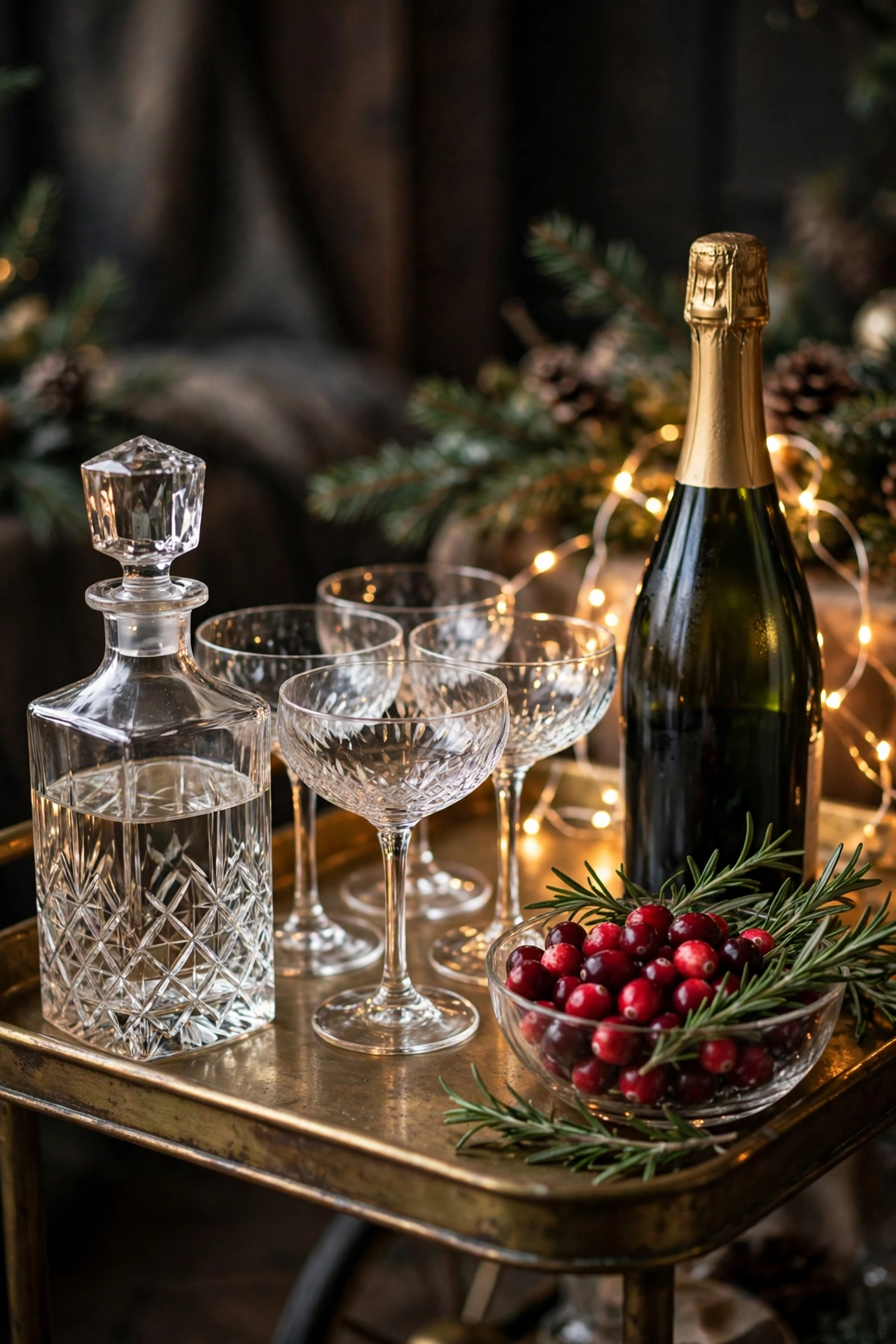
The top shelf is the stage, and it carries the whole look, because it is the shelf at eye level and the shelf the camera sees. Everything on it should be beautiful, reachable, and used. Start with the glasses, because glasses are the largest visual element on a cart and the one guests touch first. One matched set of four to six glasses is enough, and matching matters more than expensive. Four identical coupe glasses in a neat row read as intentional. Four different glasses in four different shapes read as a cupboard clear out. If you own two sets, put one set on the top shelf and the other on the middle shelf, and never mix them on the same shelf. Coupe glasses suit a Christmas cart best, because their wide bowls catch light and they stack visually into a row. Wine glasses work too, and so do simple tumblers, as long as they match. Put the tallest glasses at the back and the shortest at the front, and leave a finger width between them, so they do not clink when the cart rolls.
The decanter is the classic hero, and if you own one, it belongs on the top shelf, slightly off center, with light behind it. A cut crystal decanter full of amber whiskey or bourbon catches fairy light and throws it across the room, and it is the single most photogenic object you can put on a cart. If you do not own a decanter, a beautiful bottle is the hero instead. Choose the bottle with the best label, the one you would pick up in a shop, and put it where the decanter would go, label facing the room. The hero bottle should be a bottle you actually drink, not a bottle you are saving, because a hero bottle that never gets poured is a museum piece, and a museum piece belongs on a shelf, not on a cart. One hero bottle, not three. Two beautiful bottles side by side compete, and three is a drinks shelf, not a display.
The rest of the top shelf is support, and it should be arranged in one row along the back, leaving the front third empty for pouring. Three to five bottles, grouped by height, tallest at the back, labels out, caps on, is the standard. The bottles you reach for most go nearest the handle end, because that is where the pourer stands. A small bowl of garnish, cranberries in a low glass bowl, or a few clementines in a brass bowl, sits at the other end, and it does two jobs: it is a decoration and it is a garnish, so it earns its space. A small bottle brush tree in a brass pot, no taller than 10 inches, can sit at the back corner if the shelf is wide enough, and it is the only decoration that belongs on the top shelf. Anything else, ornaments, tinsel, a second tree, belongs on the handle or the lower shelves, not here, because the top shelf is a working surface.
The tray is the secret of the top shelf, and it is the one purchase worth making if you do not own one. A shallow brass or mirrored tray, about 12 by 18 inches, holds the decanter, two glasses and the garnish bowl in one contained group, and it catches every drip before it reaches the shelf. It also makes the whole top shelf look intentional in one move, because the tray draws a border around the display and says this is the arrangement. Without a tray, the same objects look scattered. With a tray, they look styled. The tray also lifts off in one move when you need to clear the shelf for serving, which is exactly the kind of practical trick that separates a styled cart from a staged one. If you serve drinks at the cart, pour on the tray, not on the shelf, and wipe the tray at the end of the evening, not the whole cart.
The mistakes on the top shelf are always the same, and they are easy to avoid once you know them. Too many bottles is the first, and the fix is to move the bottles you do not use this week to the bottom shelf or a cupboard. Mixed glassware is the second, and the fix is one set per shelf. No empty space is the third, and the fix is to take a third of the shelf off and leave it off. A top shelf that is two thirds full and one third empty looks generous and calm. A top shelf that is full edge to edge looks like a shelf that needs clearing, and guests will not know where to put their glass down. And the glass they are holding is the whole point of the cart, so always leave a clear landing spot, one flat empty space about the size of a saucer, where a guest can set a glass down while they talk. If there is no landing spot, the cart is full, and something has to go.
The Middle Shelf, Tools, Garnishes and the Napkin Stack
The middle shelf is the workbench, and it is allowed to look busy, because it is where the drinks are actually made. This is the shelf for the tools, the garnishes and the napkins, and the rule here is different from the top shelf: everything on the middle shelf should be useful, and it should be grouped by task, so the pourer can work without hunting. The tools go in one container, a small brass cup, a short glass, or a little crock, holding a shaker, a jigger, a bar spoon and a peeler. One of each, not two, and nothing else in the container. A shaker you never use does not belong on the cart. It belongs in a drawer. The tools should be the ones you reach for every time you make a drink, and if you only ever make one kind of drink, the tools for that drink are the only tools on the cart.
Garnishes live on the middle shelf in small covered containers, because an open bowl of cut fruit on a cart dries out in an hour and looks tired by the second drink. A small lidded jar of cranberries, a jar of cocktail cherries, a small dish of orange peel, and a bunch of fresh rosemary in a short glass of water will cover almost every Christmas drink, and they will still look fresh at midnight. The rosemary does double duty, because it is also the green in the formula from Section 1, and a sprig of rosemary in a drink is the cheapest garnish that looks expensive. Keep the garnish containers in a row along the back of the shelf, labels or contents visible, and keep one small cutting board, about 8 inches square, at the front of the shelf for cutting a garnish to order. A cutting board on a bar cart looks professional and it saves the shelf from knife marks.
Napkins are the most underrated item on a bar cart, and they are the item guests notice most, because they touch them. A stack of linen or good paper napkins, folded in quarters and tied with a short length of velvet ribbon, or held in a small basket, belongs on the middle shelf, at the front, where a guest can reach it without asking. Red napkins for a classic look, cream for a calm look, plaid for a farmhouse look. One stack, 12 to 20 napkins, not a whole packet, because a whole packet looks like a supply cupboard. A cocktail napkin with a simple pattern, a sprig of holly or a plain monogram, is worth the small extra cost, because it is the one thing on the cart that guests take with them to the sofa, and it carries the look of the cart into the rest of the room.
The middle shelf also holds the glasses you are not using right now. If the top shelf holds the coupe glasses, the middle shelf holds the tumblers, in a neat row, upside down if the cart has a rail high enough to hold them, or right side up if it does not. Glasses on the middle shelf should be clean, dry and ready, because a guest who asks for a second drink should not have to wait while you wash a glass. Keep a small linen cloth folded on the middle shelf for wiping a spill or polishing a glass, and keep it folded, not balled up, because a folded cloth looks like a tool and a balled cloth looks like laundry.
What does not belong on the middle shelf is anything decorative that is not also useful. Ornaments belong on the handle, not on the workbench. A second tree belongs on the top shelf or the floor, not here. A candle belongs nowhere on a cart with alcohol and paper napkins. The middle shelf is the shelf that proves the cart is a working bar, not a display, and the proof is that everything on it can be picked up and used in under five seconds. Stand at the cart, close your eyes, and reach for the shaker, the napkin and a glass. If you can find all three without looking, the middle shelf is right. If you have to move something to reach something else, rearrange it until you do not.
The Bottom Shelf, Backstock, Books and the Quiet Layer
The bottom shelf is the quiet layer, and it is the shelf most people get wrong, because they treat it as storage and then wonder why the cart looks heavy. The bottom shelf is visible, especially in a room with a low sofa, so it has to look intentional too, but its job is different: it holds the backstock, the books and the things that support the party without being on display. The rule is that the bottom shelf should look like a styled shelf, not a cupboard, and the way to do that is to treat it like a bookshelf with bottles.
Backstock goes on the bottom shelf in a short row, three to five bottles, grouped by height, labels out, exactly like the top shelf, but these are the bottles you are not pouring tonight. The spare bottle of gin, the extra sparkling wine, the bottle of tonic. They are there so the party does not stop when the top shelf runs out, and they are there in plain sight so you do not have to leave the room to restock. Keep the backstock to one row along the back, and leave the front of the shelf for something softer. A stack of two or three books, cocktail books if you own them, or any books with a handsome spine, laid flat, makes a platform for one small object, a potted evergreen, a small brass lantern with a battery candle, or a single bottle brush tree. The books do two jobs: they fill the shelf without adding clutter, and they raise the small object to a height where it can be seen.
The basket is the bottom shelf’s best friend. A small seagrass or linen basket, about the size of a shoebox, holds the things that do not look good on display but need to be near the cart: extra napkins, a spare corkscrew, a tea towel, the bottle opener. One basket, not two, and it should sit at one end of the shelf, not in the middle, so the shelf still reads as arranged. A basket also solves the problem of the cart looking too perfect. A cart with a basket on the bottom shelf looks like it belongs to a real house, because it has a place for the untidy things, and a cart with no place for untidy things is a cart where the untidy things end up on the top shelf by nine oclock.
A small potted evergreen on the bottom shelf is the green that balances the garland on the handle. A rosemary plant in a terracotta pot, a dwarf pine in a brass pot, or a small Norfolk pine in a ceramic pot, any of them about 8 to 12 inches tall, will live happily on the bottom shelf all December if it gets a little light and a little water. It is also the plant that moves to the windowsill in January, which makes it the best value decoration on the whole cart. If you do not want a live plant, a faux potted evergreen in a heavy pot does the same visual job, and it will not drop needles on the floor. Either way, the plant should be the only green on the bottom shelf, because the garland on the handle is already doing the Christmas work, and two greens on one shelf is one too many.
The bottom shelf is also where the cart’s weight lives, and weight matters, because a cart with all the weight on top is a cart that tips. Heavy bottles go low, light glasses go high. That is not a styling rule, it is a safety rule, and it is the reason the bottom shelf exists. A full bottle of spirits weighs about a kilogram, and five of them on the top shelf will make a light cart top heavy, especially when someone rolls it across a rug. Put the full bottles low, the empty or nearly empty bottles high, and the cart will roll steadily and stand still when it is parked. Check the wheels once a week during the season, and wipe up any drip on the bottom shelf before it dries, because dried sugar water from a spilled mixer will glue a bottle to the shelf and stain the finish.
What does not belong on the bottom shelf is anything you would be embarrassed for a guest to see when they bend down to pick up a bottle. The cleaning spray, the spare light bulbs, the bag of ice, the shopping bags, all of those belong in a cupboard, not on the cart. The bottom shelf is the shelf that proves the cart is a real piece of furniture in a real house, and the proof is that it is tidy, useful and calm, even at the lowest and least seen level. If the bottom shelf is tidy, the whole cart reads as tidy, because the eye assumes the rest of the cart matches the part it can see.
Garland, Lights and the Mini Wreath, The Christmas Layer
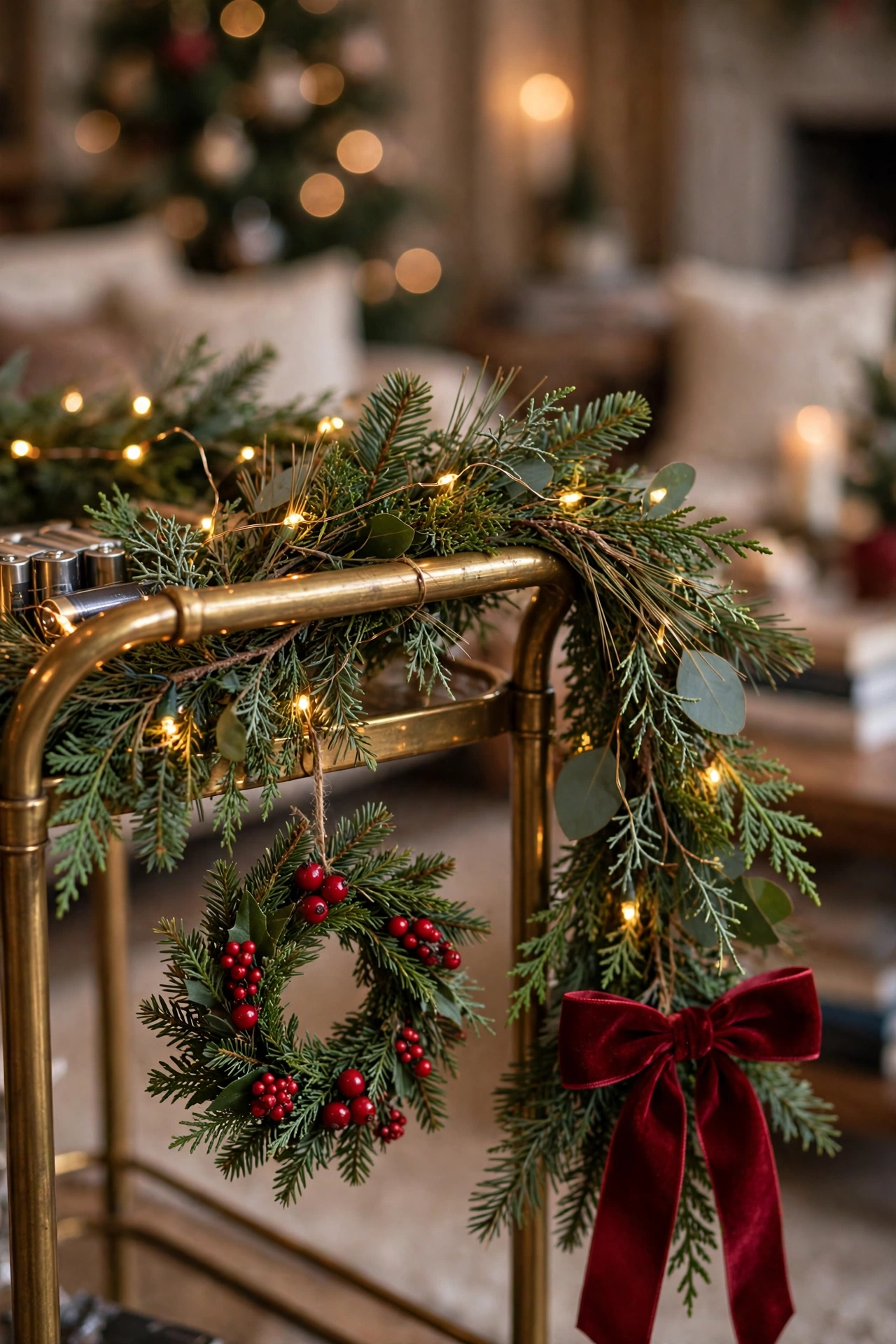
The Christmas layer goes on last, and it should take ten minutes, because everything underneath it is already finished. The Christmas layer is three things only: a short garland, a string of lights, and a mini wreath. That is the whole list. A cart with those three, applied with restraint, reads as Christmas from across the room. A cart with a fourth, a fifth and a sixth Christmas item reads as a cart that has been decorated by a committee, and the cart underneath disappears.
The garland goes on the handle first, because the handle is the longest clean line on the cart and the garland follows it naturally. A three foot piece of faux evergreen garland, thin wire core, not a thick pre lit garland, wraps around the handle in a loose spiral, about one turn every six inches, and it is tied at both ends with a short piece of twine or a twist tie, not taped, because tape leaves residue on brass. The garland should hang a little, not hug the handle tight, so it looks like it was draped, not installed. If the garland is too long, cut it, do not double it back, because a doubled garland looks twice as thick as it should and it hides the handle completely. A little red velvet ribbon, tied in a bow at one end of the garland, is the only extra, and it should be one bow, not three. The garland also goes along the back edge of the top shelf if the cart is against a wall and the back edge is visible, but only if the shelf is deep enough that the garland does not push the bottles forward. If the garland pushes the bottles, it does not belong on the shelf, and the handle is enough.
The lights go on second, and they go behind the bottles, not in front of them. One string of 20 to 30 warm white battery lights, tucked along the back rail of the top shelf, behind the bottles, so the glass catches the light and the bottles glow from behind. The battery pack hides behind a bottle or under the tray, and the timer, if the string has one, is set for six hours, so the lights come on at dusk and go off before bed without anyone touching them. The lights should never be wound around the garland on the handle, because that is two Christmas items in one place, and the handle will look lit up like a tree. The lights belong on the shelf, the garland belongs on the handle, and each one gets its own place. If the cart has a mirror back, the lights go in front of the mirror, not behind it, so the mirror doubles them. If the cart is black metal, add ten more lights, because black absorbs light and the cart will look dark otherwise.
The mini wreath goes on third, and it goes on the side of the cart, not on the front, because the front of the cart is where people stand to pour. A small wreath, 6 to 8 inches across, hung from the handle end or from the side rail with a short length of ribbon, at the height of the middle shelf, is the piece that makes the cart read as Christmas from the side, which is the angle most people see when the cart is parked in a corner. One wreath, not two, and it should be the same green as the garland, so the two pieces match. A wreath with a few red berries and no bow is the calmest choice. A wreath with a velvet bow is the dressiest choice. Either works, and the choice should match the ribbon on the garland, so the cart has one ribbon, repeated once, not two different ribbons fighting each other.
What does not belong in the Christmas layer is everything else people add when they get excited. Tinsel on a bar cart sheds into drinks. Ornaments on a bar cart roll off and break. A second garland on the bottom shelf makes the cart look heavy. A tree on every shelf makes the cart look like a shop. A Santa figurine on the top shelf blocks the glasses. The discipline is the same as the formula in Section 1: one hero, one light, one green, and the Christmas layer is the green and the light, not a second hero. If you want more Christmas in the room, put it on the mantel, the tree, or the dining table, where there is room for it. The Christmas Fireplace Decor Ideas guide on this site shows how a mantel carries a whole Christmas look, and the cart does not need to compete with it. The cart’s job is to be the small festive corner that serves drinks, and it does that job best when the Christmas layer is light enough that the cart still works.
Take the Christmas layer off in one move in January. Untie the garland, coil the lights, take down the wreath, and put all three in one labeled box, garland, lights, wreath, bar cart, so next December takes ten minutes again. A Christmas layer that takes ten minutes to put on and ten minutes to take off is a Christmas layer that will actually happen every year, and that is worth more than a complicated display that happens once and never again.
Three Color Stories You Can Copy in One Shopping Trip
A color story is a decision you make once, before you buy anything, and it saves you from buying the wrong things. These three stories cover almost every house, and each one can be built from pieces you probably already own, plus one or two small purchases. Pick one, commit to it, and do not mix stories on the same cart, because a cart with red napkins, emerald glasses and a blue wreath is a cart with three stories, and three stories is no story at all.
The first story is classic red and green, and it is the easiest to build, because it uses the colors most people already own. Red napkins, green garland, clear glass, brass cart, a bowl of cranberries, a few clementines, and one red velvet ribbon. The bottles stay neutral, clear glass and amber spirits, so the color comes from the napkins, the ribbon and the fruit, not from the bottles. The hero is a crystal decanter, or a bottle with a red label. The light is warm white, and the green is the garland plus a rosemary sprig. This story suits a traditional house, a house with a red and green tree, and a house where the dining room already has red in it, because the cart will match the room without any new purchase larger than a packet of napkins. It is also the story that photographs best in a room with warm wood, because red, green, brass and wood are the four colors of a classic Christmas, and they have worked together for a hundred years.
The second story is emerald and gold, and it is the dressiest of the three. Emerald glassware, a gold or brass cart, crystal decanters, a garland with a little gold ribbon, and one small gold ornament tied to the handle with thread, not hung where it can fall into a drink. The napkins are cream, not red, because cream lets the emerald and gold do the work, and the garnish is a slice of lime or a sprig of rosemary, not cranberries, because red would break the palette. The hero is a bottle with a dark green or gold label, or a small gold tree. This story suits a house with a modern tree, a house with brass fixtures, and a house where the dining room is already green and gold, because the cart will look like it was planned with the room. It is also the story that looks most expensive for the least money, because emerald glass and gold ribbon are cheap, and they read as luxury when they are the only two colors on the cart. The Christmas Dining Room Decor Ideas guide on this site shows how a dining room carries a color story across a whole table, and the cart should repeat the dining room’s story, not start a new one.
The third story is winter white and wood, and it is the calmest of the three. Cream napkins, a wooden cart or a brass cart with a lot of wood showing, clear glass, a white ceramic tree or a white bottle brush forest on the top shelf, and a garland with no ribbon at all, just green and warm light. The garnish is a bowl of white sugar cranberries, which are cranberries rolled in sugar until they look frosted, or a few white flowers in a small vase, if you can get them. The hero is a clear decanter, or a bottle with a white label. This story suits a small room, a Scandinavian house, a house with a white tree, and a house where the rest of the Christmas decor is already busy, because the cart becomes the calm corner in a busy room. It is also the story that works best in daylight, because white and wood look good in a bright room, while red and gold need evening light to glow. If your cart lives in a bright kitchen or a sunroom, this is the story to choose.
Whichever story you pick, buy the napkins first, because napkins are the cheapest way to commit to a story and the easiest to change. A packet of red napkins costs less than a coffee, and if you hate the red story after one evening, you can swap to cream napkins the next day and the whole cart changes with them. The ribbon is the second cheapest commitment, and it should match the napkins. The garland is the third, and it should be the same green in every story, because green is the constant and the napkins and ribbon are the variables. And once the story is chosen, write it down on a card and tape it inside the cupboard where the cart supplies live, so next December you do not have to choose again. A color story that survives from one year to the next is a color story that gets better every year, because you add one piece a year instead of starting over every December.
Small Carts, No Carts and the Coffee Bar Twin
Not every house has a standard bar cart, and that is fine, because the rules in this guide scale down to any size, and they work on any surface that holds drinks. A small cart, under 24 inches wide, needs the small cart version of the formula: one hero, one light, one green, and nothing else on the top shelf except the glasses. The middle shelf holds the tools and the napkins only. The bottom shelf holds the backstock only, no books, no basket, no plant, because there is no room. A small cart with three bottles, four glasses, a decanter, a short garland and a string of lights is a complete Christmas bar cart, and it will serve a party of six without any trouble. The mistake with a small cart is trying to fit a standard cart’s worth of things on it, and the fix is to move the extra bottles to the kitchen counter and bring them to the cart when they are needed. A small cart that is calm beats a small cart that is crowded, every time.
A cart with no wheels, a sideboard, a console table, or a kitchen counter, uses the same rules, and it is often easier to style, because it does not move. The top of a sideboard is a top shelf, the cupboard below is a bottom shelf, and the formula is the same: one hero, one light, one green, one tray, one row of bottles, one landing spot for a glass. The only difference is that a sideboard does not need the weight rule from Section 5, because it cannot tip, and it can hold a heavier display, a full decanter set, a large mirror behind it, a long garland along the back edge. A console table in a hallway makes a good Christmas drinks station for a party, because guests pass it on the way in, and it keeps the drinks out of the kitchen. The Christmas Coffee Table Decor Ideas guide on this site shows how a low surface carries a tray vignette, and a sideboard drinks station works the same way: one tray, one hero, one light, and a clear path to it.
No cart at all is not a problem either. A tray on a kitchen counter, a tray on a dining room sideboard, or a tray on a coffee table is a bar cart without wheels, and it is the best option for a small flat or a house where a cart would block the walkway. The tray holds the decanter, two glasses, a small bottle and a garnish bowl, and it lives on the counter until the party starts, then it moves to the table where the guests are. A tray bar is the cheapest Christmas bar cart there is, because the tray is the only purchase, and it is also the most flexible, because it can be a coffee bar in the morning and a drinks bar in the evening. The rule for a tray bar is the same as the rule for a cart: one hero, one light, one green, and a landing spot for a glass. The light is a battery candle on the tray, the green is a rosemary sprig in a glass, and the hero is the decanter. That is a complete Christmas bar cart, and it fits on a counter that is two feet wide.
The coffee bar twin is the last option, and it is the one for a house that does not drink alcohol, or for a morning party, or for a house with children. A coffee bar uses the same cart, the same formula and the same Christmas layer, with coffee instead of spirits. The top shelf holds the mugs, the coffee pot or the French press, and a small jar of cinnamon sticks. The middle shelf holds the syrups, the sugar, the napkins and the spoons. The bottom shelf holds the extra mugs, the coffee beans and a small plant. The garland goes on the handle, the lights go behind the mugs, the mini wreath goes on the side, and the hero is a beautiful mug or a glass coffee pot. A coffee bar cart is a Christmas bar cart, and it serves the same purpose: it makes the house feel ready for guests, it gives people a reason to gather in one corner, and it looks festive without a single bottle on it. If you have both a drinks cart and a coffee cart, style them the same way, same garland, same ribbon, same light, so they read as a pair, not as two different ideas.
Whichever version you build, standard cart, small cart, sideboard, tray or coffee bar, the test is the same. Stand at the doorway, look at the cart, and ask three questions. Can I see the hero? Can I see the light? Can I see the green? If the answer to all three is yes, the cart is finished, and you should stop. If the answer to any one is no, fix that one thing and stop. A Christmas bar cart is finished when it works, not when it is full, and the best compliment a cart can get is not that it looks beautiful, which it should, but that someone used it, which is the whole point.
Conclusion
A Christmas bar cart is the smallest party you can throw and the easiest decoration you can finish. It does not need a new cart, matching glassware, a full bar, or a big budget. It needs one hero, one warm light, one touch of green, and the discipline to leave a third of every shelf empty. Style it shelf by shelf, top shelf for the glasses and the hero bottle, middle shelf for the tools and the napkins, bottom shelf for the backstock and the quiet layer, then add the Christmas layer last, a short garland on the handle, a string of lights behind the bottles, a mini wreath on the side, and stop. Pick one color story, classic red and green, emerald and gold, or winter white and wood, and let the napkins and the ribbon carry it. Roll the cart to where the guests are, lock the wheels, pour the first drink, and leave a landing spot for the glass.
The cart will not be the biggest decoration in the house, and it should not be. The tree, the mantel and the dining table carry the season, and the cart carries the welcome. When the party is over, wipe the shelves, coil the lights, untie the garland, and put the Christmas layer in one labeled box for next year. The cart goes back to being a cart, the house goes back to being a house, and the whole project will have taken one afternoon and cost less than a bottle of the good stuff. That is the measure of a good Christmas decoration: it is beautiful while it is up, useful while it is used, and easy to put away when the season ends. Build it once, use it all December, and next year it will take ten minutes, because you will already know the formula, and the formula is the whole guide.