Christmas Gift Wrapping Ideas That Look Boutique Made
The gift under the tree is opened in four seconds. The wrapping is looked at for longer. People pick the box up, turn it over, run a thumb along the ribbon, read the tag twice, and sometimes photograph it before they even touch the tape. That is the truth most wrapping guides skip. The paper is not the packaging. It is the first half of the gift, and it sets the feeling of everything that follows.
A beautifully wrapped present also does something practical. It buys you time. A modest gift in gorgeous paper feels generous before it is opened, and a generous gift in torn, taped, sagging paper feels smaller than it is. Nobody means to judge a gift by its wrapping. Everybody does, because the wrapping is the only part of the gift anyone can see. Spend twenty minutes on the outside. The inside gets a better reception for free.
The good news is that boutique looking wrapping does not need boutique money or professional skill. The prettiest parcels this year are made from the cheapest materials in the craft aisle: brown kraft paper, twine, a roll of velvet ribbon, dried orange slices you make in your own oven, and greenery snipped from the tree you already own. One roll of kraft paper costs less than a single roll of fancy printed paper, and it wraps every gift under your tree. One spool of velvet ribbon transforms ten presents. The expensive looking part is not the material. It is the fold, the crease, the knot, and the one small detail on top.
This guide covers the whole job. You will learn the crisp wrap method that makes any box look store wrapped, with the measuring rule that stops bulky ends forever. You will get brown paper christmas wrapping ideas that are the most saved look on Pinterest right now, including the dried orange and twine classic and five variations that cost almost nothing. You will get elegant looks with cream paper, velvet ribbon and wax seals, natural and reusable wraps including fabric furoshiki, kids wrapping ideas that turn the paper into part of the fun, gift tags that double as keepsakes, and the fixes for odd shapes, bottles and last minute emergencies. Most ideas here cost under five dollars per gift, most take less than ten minutes, and every one of them works with supplies you can buy in one trip, or find already in your house.
Why the Wrapping Is Half the Gift
People remember how a gift made them feel in the moment they received it, and the wrapping creates that moment before the box is even open. A present handed over in a plastic bag feels like an errand. The same present handed over in crisp paper with a ribbon and a handwritten tag feels like an occasion. The object inside has not changed. The experience has. That is why shops spend so much on their wrapping, and why the most loved gifts in most families are the ones that looked beautiful sitting under the tree for a week before Christmas morning.
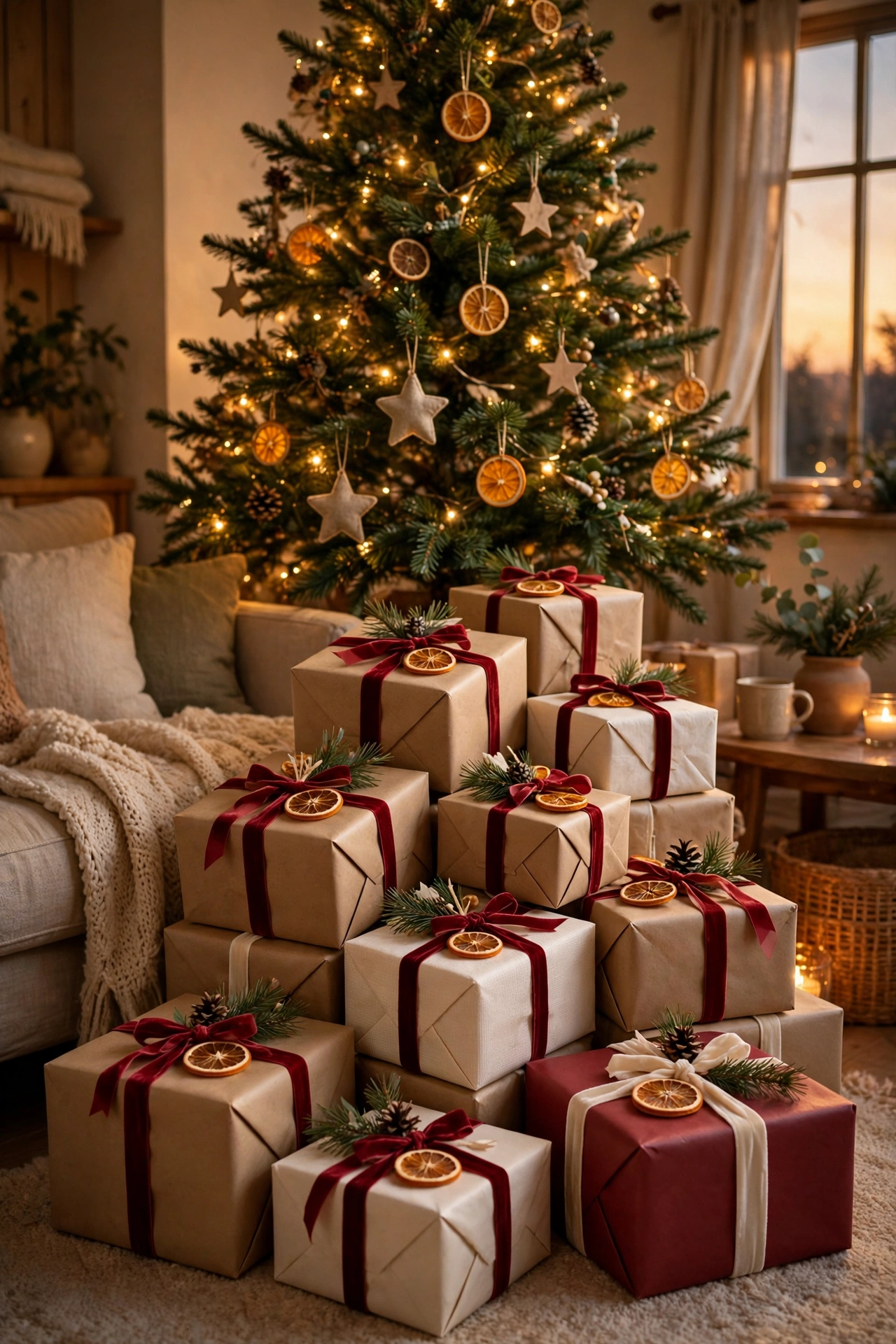
The tree itself is part of the reason. Wrapped presents are Christmas decoration for two or three weeks before they are opened. They sit under the tree, on the sideboard, in a basket by the door, and they are part of the room. A pile of coordinated parcels in kraft, cream and deep red looks like a display. A pile of clashing, torn, half taped parcels looks like clutter, even if the gifts inside are wonderful. Matching your wrapping to your room is one of the cheapest decorating moves you can make, because the parcels are already there. If your tree is dressed in warm neutrals, wrap in kraft and cream. If your room is traditional red and green, wrap in red paper with green ribbon. The gifts become part of the decor instead of fighting with it.
There is also a quiet kindness in good wrapping. It tells the person that you thought about them before the day itself. A gift wrapped in a hurry says the present was bought in a hurry, even when it was not. A gift wrapped with care says the opposite. The ribbon, the tag, the little sprig tucked under the twine, all of it says you spent time on this person, not just money. That message lands even harder for the people who are hardest to buy for, because the wrapping shows effort when the perfect gift is impossible to find.
None of this means wrapping has to be elaborate. The most admired parcels are usually the simplest ones. One colour of paper, one ribbon, one small natural detail, and clean sharp folds. The rest of this guide is built on that idea. Fancy materials help, but they are never the point. The point is a neat box, a straight ribbon, and one thoughtful detail that shows a person, not a machine, wrapped this gift.
The Crisp Wrap Method, Measure First and Tape Last
Every beautiful parcel starts with the same five minutes of boring work, and skipping it is why most wrapping looks homemade in the bad way. The method is simple, and once you learn it you will never wrap a gift any other way.
Start by measuring before you cut. Place the box in the middle of the paper and pull the paper up on both sides. You need about five centimetres of overlap on the long side, and just over half the height of the box on each short end. That is the whole rule. Too much paper is the most common mistake, and it is what makes the ends bulky and lumpy. If you have more than half the box height at the ends, trim it. A neat parcel is mostly a parcel with the right amount of paper.
Fold the long sides first. Bring one side up and over the box, then bring the other side over it, and tape the seam down the middle of the box, not at the edge. Before you tape, run your thumbnail or the flat of a pair of scissors along the fold to crease it sharply. Sharp creases are the entire difference between a parcel that looks store wrapped and one that looks like a parcel wrapped in a moving car. Crease every edge, top and bottom, as you go.
Now the ends. This is where most people give up and make a mess. Push the two side flaps of the end inward, like you are closing an envelope, and crease them flat. Then fold the top flap down and the bottom flap up, and tape. The secret is to fold the side flaps in first and make them tight against the box, so there is no loose paper to bunch up. If the end still looks puffy, you had too much paper. Unwrap it, trim a centimetre off the end, and try again. It takes thirty seconds and it is worth it.
Tape matters more than people think. Use clear tape, and use small pieces, hidden on the underside and the ends. Double sided tape on the long seam makes the paper look completely clean from the front, and it costs almost nothing. Never tape across the front of the parcel where it shows. If you can see the tape, the tape is in the wrong place.
One last rule for this section, and it is the one that saves the most time on Christmas Eve. Wrap in batches. Cut all the paper for one size of box at once, wrap all the boxes of that size, then move on to the ribbon and tags for all of them together. Assembly line wrapping is twice as fast as wrapping one gift start to finish, and the parcels come out looking like a set, which is exactly the boutique effect you want under the tree.
Brown Paper Christmas Wrapping, the Most Saved Look on Pinterest
If there is one wrapping style to learn this year, it is brown paper christmas wrapping. Brown kraft paper is the most saved gift wrapping look on Pinterest right now, and the reason is simple: one cheap roll becomes every style, from rustic to elegant, and the paper itself never clashes with anything. A roll costs a few dollars, it wraps every gift under the tree, and it looks expensive because it looks intentional. Fancy printed paper tries to do the decorating for you. Kraft paper lets you do it yourself, with one ribbon and one small detail.
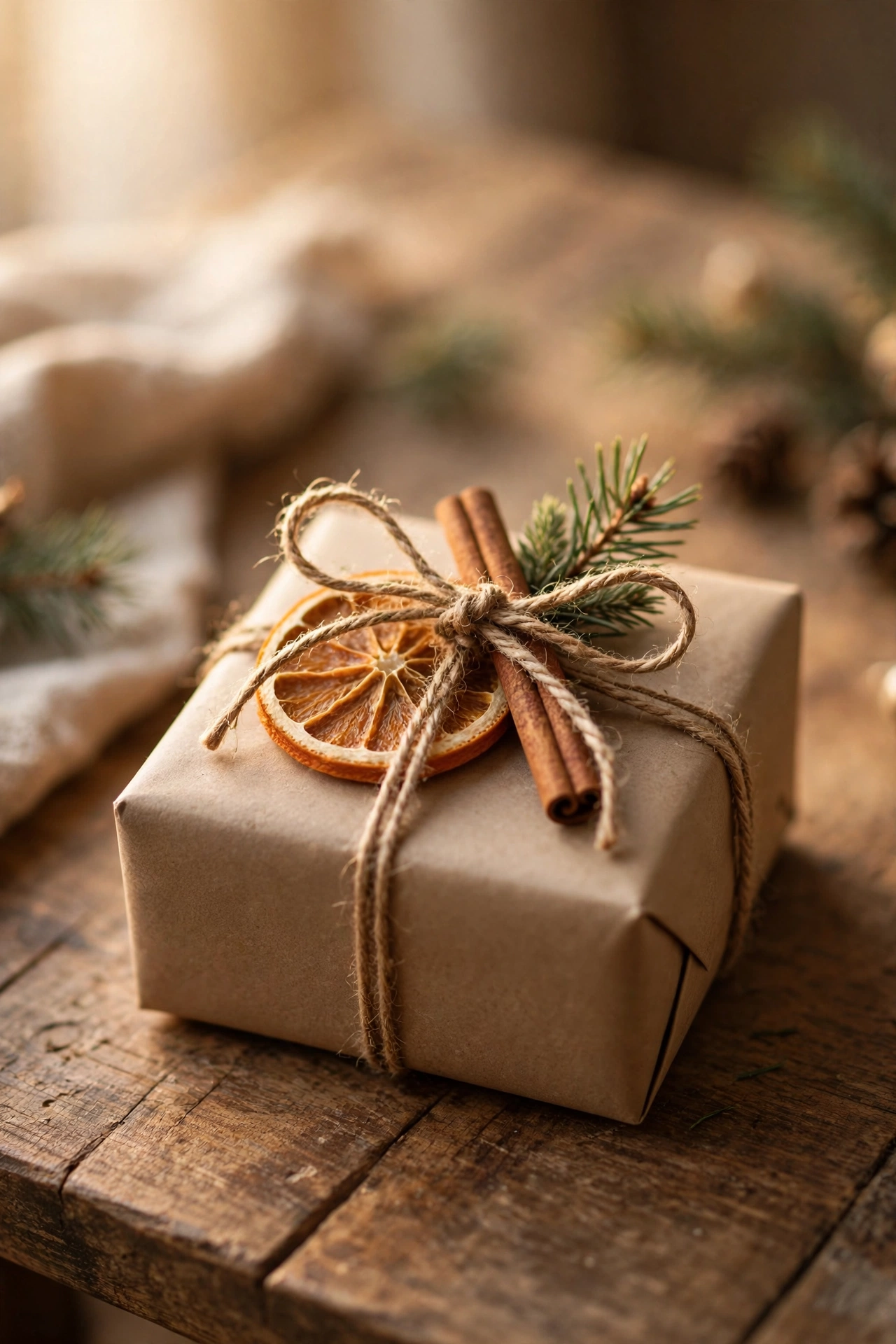
The classic is the one to learn first. Wrap the box in kraft paper with crisp folds, tie it with natural jute twine wrapped twice around, and tuck a dried orange slice and a cinnamon stick under the knot. Add a small sprig of pine or rosemary if you have it. That is the whole look, and it smells like Christmas and looks like a parcel from a Scandinavian market. It takes under two minutes once the oranges are dried, and the oranges cost almost nothing to make yourself. Slice oranges thin, lay them on a baking tray, and dry them low and slow in the oven until they are firm and translucent. A batch made in November will last through the whole wrapping season.
The crisscross is the same idea with more twine. Run the twine around the package in both directions, like a parcel from an old fashioned general store, and tuck a cluster of two smaller orange slices where the twine crosses, with greenery fanning out behind them. This version looks best on larger boxes, where the crossed twine has room to breathe.
Fresh greenery is the cheapest decoration in this whole guide, because it is free. Clip a few sprigs from your own tree, your wreath, or a neighbour’s hedge, and slide them under the twine. Pine, cedar and eucalyptus all work, and rosemary is wonderful because it smells good and stays green for days. One sprig per parcel is enough. Three sprigs start to look like a bouquet that will fall off.
Red baker’s twine is the nostalgic version. Wrap it around the gift several times in different directions, finish with a simple white tag, and the parcel looks like something from a Christmas card. Wide tartan or buffalo check ribbon over brown paper is the farmhouse version, and it is the fastest way to make a plain box look cosy. A paper doily wrapped around the middle like a lace band, then tied with twine, is the delicate version, and it works beautifully on gifts for grandmothers and godmothers.
Hand stamping is the version that turns the paper itself into the decoration. Roll out the kraft paper, stamp snowflakes or stars in white or gold ink, and let it dry before you wrap. It takes ten minutes to stamp enough paper for a dozen gifts, and every parcel looks like it came from a shop that sells nothing but wrapping paper. Kids can do the stamping too, which brings us to a later section, but even adults should try it once, because it is the easiest way to make a whole tree full of parcels look like they belong together.
The one thing to avoid with kraft paper is glitter. Glitter paper, foil paper and plastic coated paper usually cannot be recycled, and the whole point of kraft paper is that it is simple and honest. Keep it clean, keep it natural, and let one good detail do the work.
Elegant Wrapping, Cream Paper, Velvet Ribbon and Wax Seals
Brown paper is warm and rustic. Cream paper is the elegant half of the same idea, and it is the right choice for gifts that need to feel formal: a gift for a boss, a wedding present at Christmas, a gift for someone who loves beautiful things. The rules are the same, crisp folds and one strong detail, but the materials change.
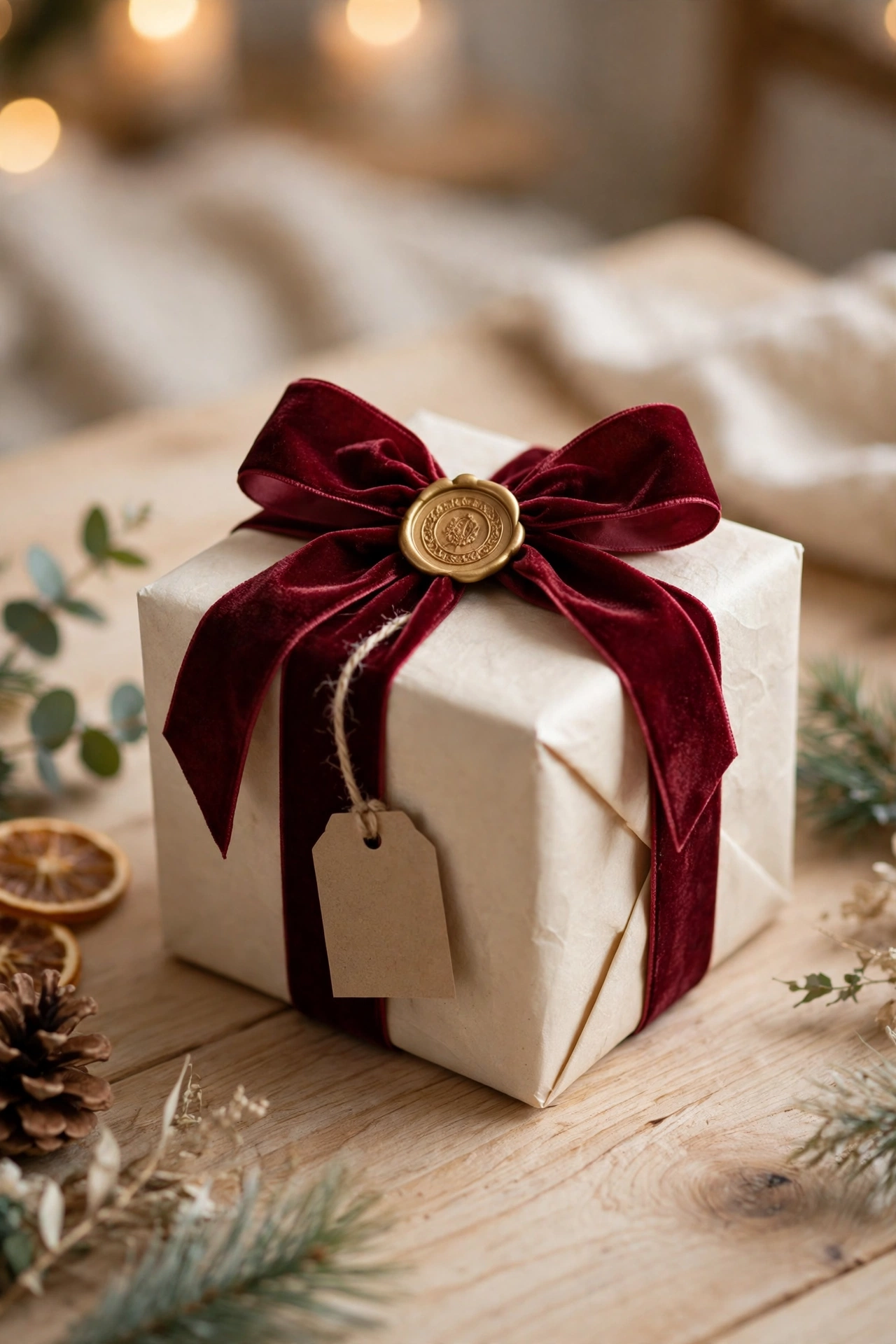
Start with cream or white paper and a wide velvet ribbon in navy, emerald or burgundy. Velvet is the fastest way to make any gift look luxurious, because the texture does the work that a pattern would do. One wide ribbon, tied in a simple bow, is enough. Do not add a second ribbon and a sprig and a charm and a tag all at once. Elegant wrapping is wrapping that stops early. The single most common elegant wrapping mistake is adding one more thing. Resist it.
Layering two ribbons is the one exception, and it is the trick that makes a parcel look like it came from a boutique. Lay a wide ribbon flat around the box first, then lay a narrow ribbon in a contrasting colour or texture on top of it, and tie them together in one bow. A wide cream satin ribbon with a narrow gold ribbon on top, or a wide burgundy velvet ribbon with a thin gold cord, looks far more expensive than either ribbon on its own, and it takes no extra skill. The key is that the two ribbons are tied as one, not separately.
A wax seal is the finishing touch that makes people gasp, and it is easier than it looks. A wax seal kit costs about ten dollars and lasts for years. Melt the wax, pour a small puddle where the ribbon crosses, press the seal in, and hold it still for ten seconds. Put the seal on the tag rather than on the paper if you are nervous, because a tag is easier to redo. Gold wax on cream paper, deep red wax on kraft paper, and green wax on white paper are the combinations that always work.
All white with a gold accent is the minimalist elegant look. White paper, a thin gold ribbon, one small gold star or one sprig of dried greenery, and a plain white tag with the name written in gold pen. Nothing else. This is the wrapping that photographs best, and it is the wrapping that suits a modern room with a white tree or a flocked tree. If your tree is white or heavily flocked, white parcels disappear into it beautifully, and the gold ribbon is what makes them visible.
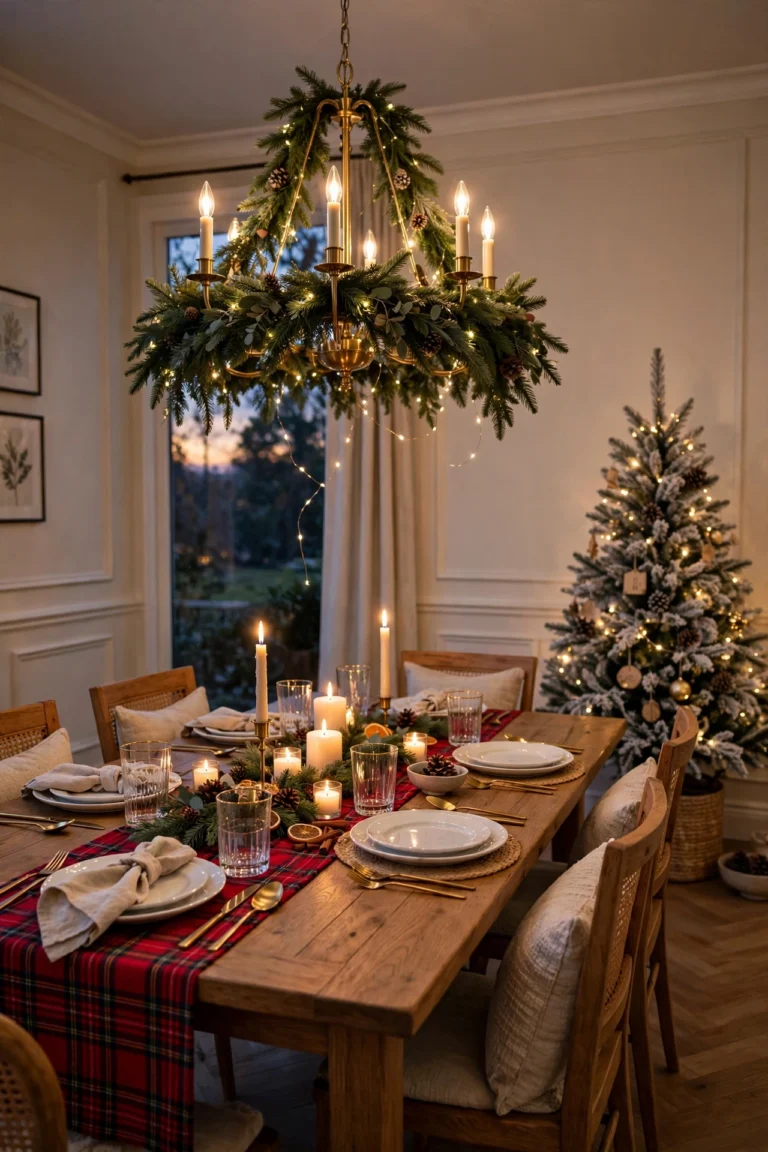
For a truly formal gift, match the wrapping to the occasion the way you would match a table setting. A bottle of something good, a piece of jewellery, a gift for a client, all of these deserve the cream paper, the velvet ribbon and the wax seal, because the wrapping is telling the person that the gift inside was chosen with care. And when the wrapping matches the candlelight and the centrepiece on the dining table, the whole evening feels like one thoughtful plan, which is exactly what a good Christmas should feel like. If you want that coordinated glow, our guide to Christmas candle decor ideas shows how candlelight and a simple centrepiece make a whole room feel finished, and the same thinking applies to the parcels under the tree.
Natural and Reusable Wrapping, Fabric, Newspaper and Greenery
Not every gift needs new paper, and some of the most beautiful parcels this year use no paper at all. Reusable and natural wrapping is the fastest growing style in Christmas wrapping, and it is also the most forgiving, because the materials are soft and textured and they hide imperfect folds.
Furoshiki is the Japanese art of wrapping a gift in fabric, and it is the most elegant reusable option there is. Take a square of fabric about three times the size of the gift, a scarf, a tea towel, a linen napkin, a bandana or a piece of printed cotton. Place the gift in the centre, bring two opposite corners together and tie them, then repeat with the remaining corners until the package is covered. The result is softer and more sculptural than paper could ever be, and the fabric is a second gift. A red and white ticking stripe looks crisp and festive, a linen napkin looks calm and expensive, and a silk scarf turns a small gift into something unforgettable. The fabric can be used again next year, which is the whole point.
Old newspaper and old maps are the vintage option, and they look far better than they sound. Wrap a gift in a clean page of newspaper, tie it with twine, and add a sprig of greenery and a plain tag. It looks like a parcel from another century, and it costs nothing. Old maps are even better, because the colours are beautiful and every parcel looks different. Use pages without heavy ink photographs, and avoid glossy pages, which do not fold cleanly. This is also a good way to wrap books, because a book wrapped in a map looks like it belongs in a library.
Repurposed boxes, jars and tins are the zero waste option. A clean biscuit tin, a jam jar, a sturdy shoe box covered in kraft paper, all of these are wrapping. Put the gift inside, tie a ribbon around the tin or the jar, add a tag, and you are done. A jar of homemade biscuits in a jam jar with a ribbon is a gift and a wrapping in one object. A small gift in a tin looks like it came from a shop, and the tin gets used in a kitchen drawer for years.
The scrunch test is the quick way to check whether your paper can be recycled. Scrunch a piece into a ball. If it stays scrunched, it can usually be recycled. If it springs back, it probably has a plastic coating and it cannot. Plain kraft paper, plain cream paper, newspaper and fabric all pass the test. Paper with glitter, foil or heavy lamination does not. If you care about the planet, and most people wrapping with natural materials do, keep the glitter off the parcels and let the greenery do the sparkling.
A final note for this section. Natural wrapping suits a natural tree. If your tree is dressed with dried oranges, pinecones and plain greenery, kraft and fabric parcels under it will look like they grew there. Our guide to Christmas tree decor ideas covers the natural tree look in detail, and the wrapping under the tree should match the tree above it. The tree and the parcels are one display, not two.
Kids Gift Wrapping, Let Them Help and Let It Show
Kids wrapping is the one style where mess is a feature, not a flaw. A parcel wrapped by a child, with a hand drawn snowflake and a crooked ribbon, is more charming than any boutique parcel, and grandparents will keep the paper. The trick is to give kids a style where their work looks good, instead of asking them to copy an adult style badly.
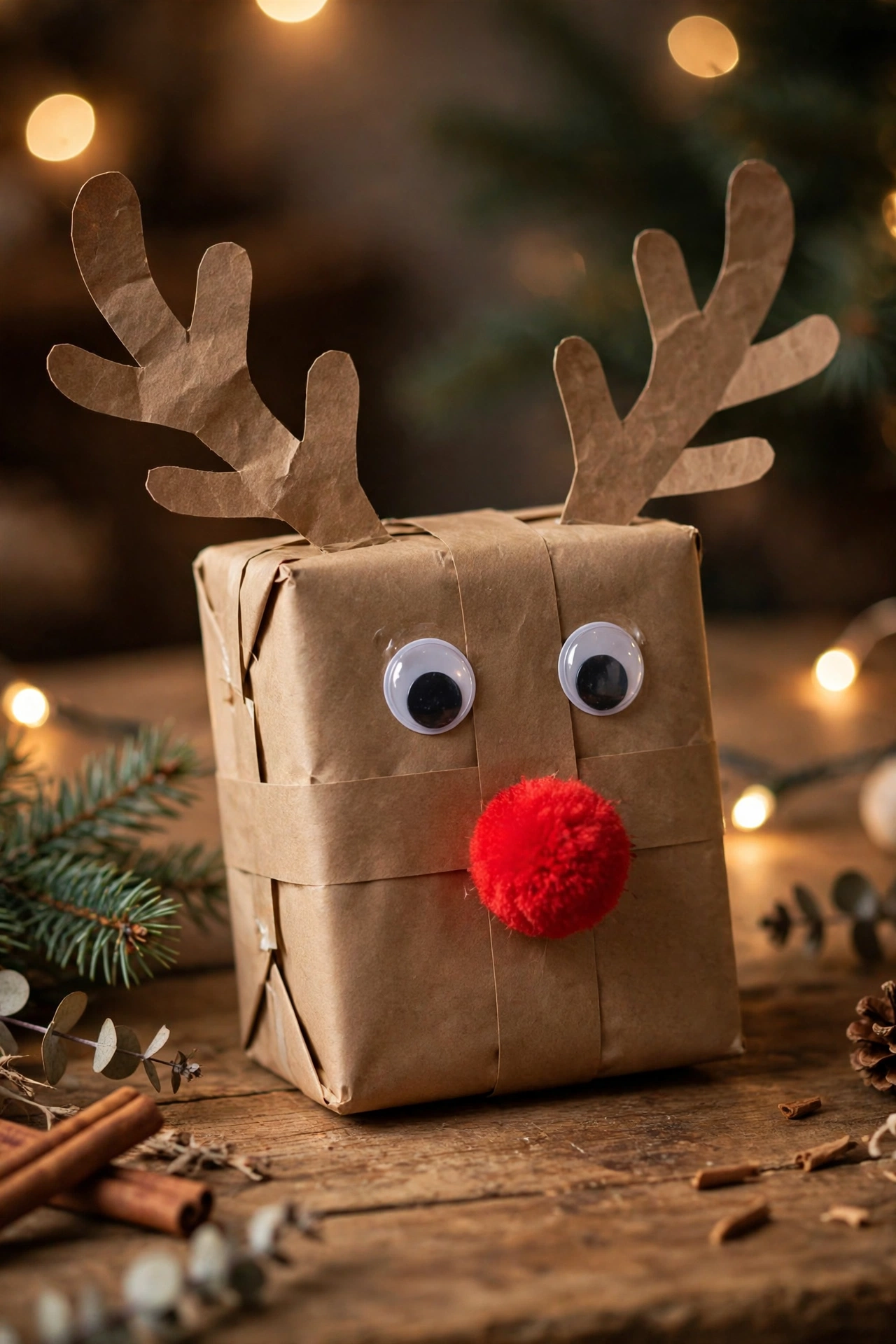
Reindeer faces are the easiest kids wrap and the most loved. Wrap the box in brown paper, cut antlers, eyes and a nose from construction paper, glue the pieces on, and draw a mouth. A red pom pom makes the perfect Rudolph nose, and googly eyes make the whole face come alive. One box takes five minutes, a child of five can do it with help, and a child of eight can do a whole pile of them alone. The same idea works as a snowman face, with a carrot nose cut from orange paper, or a Santa face, with a cotton wool beard glued along the bottom edge.
Hand painted paper is the second kids classic. Roll out plain brown kraft paper on the kitchen table, give the kids pots of poster paint, and let them make dots, stripes, stars and handprints. The paper dries in minutes, and every parcel wrapped in it is unique. This is also the cheapest way to wrap a whole tree full of gifts, because one roll of kraft paper and three pots of paint cover every present. Put newspaper under the painting area and old clothes on the painters, because this style does make a mess, and the mess is part of the fun.
Paper bag wrapping is the fast option for awkward gifts. A plain brown paper bag, decorated with hand drawn stars or rubber stamps, holds a gift that would be hard to wrap in paper. Fold the top over twice, punch two holes, thread ribbon through, and tie a bow. Kids can decorate the bag before the gift goes in, which means no waiting around while the paint dries on a finished parcel.
For teenagers, the craft upgrades: stamped kraft paper with a snowflake stamp, a pleated wrap where the paper is folded in accordion pleats across the top, or a diagonal wrap where the paper is turned at an angle so the seam runs across a corner. These are real techniques, and a teenager who learns them will wrap better than most adults. The pleated wrap in particular looks extraordinary and takes only a few extra folds. Fold the paper back and forth in one centimetre pleats across the top of the box, tape the pleats flat, and finish with a ribbon. It looks like a fan, and it turns a plain box into a display piece.
One rule for kids wrapping: let the child sign the tag in their own handwriting, even if it is wobbly. A wobbly name on a tag is the most personal thing on the whole parcel, and it is the part the recipient will remember. Print the name neatly underneath if you need to, but keep the child’s writing on the tag.
Gift Tags That Double as Decorations
A gift tag is a small rectangle of card, and most people treat it as an afterthought. That is a waste, because the tag is the one part of the parcel the recipient touches first, reads first, and often keeps. A good tag turns a parcel into a keepsake, and it costs pennies.
Start with the material. Plain brown luggage tags, white card tags, and tags cut from old Christmas cards all work. A tag cut from last year’s Christmas card is free, it is already beautiful, and it is the most sustainable option in this guide. Cut a rectangle, punch a hole, thread twine through it, and write the name in your best handwriting. If your handwriting is not your best feature, print the name in a simple font, cut it out, and glue it to the tag. The tag still looks handmade, because it is.
Personalise each tag with an initial. Write the recipient’s initial large on the tag, or cut the initial from card and glue it on, or stamp it. A parcel with a big gold initial on the tag looks like it came from a shop that charges for personalisation, and it also solves the problem of a tree full of similar parcels. When every parcel is kraft paper and twine, the tags are how you tell them apart.
Turn the tag into a tiny decoration. Glue a small dried orange slice to it, tie a cinnamon stick behind it, attach a tiny pinecone, or glue a small felt star to the corner. A tag with a miniature ornament tied to it is a tag and a tree decoration in one object, and the recipient can hang it on their own tree after the gift is opened. Metal cookie cutters make excellent tag shapes too. Trace around a star or a tree shaped cutter, cut the card out, and you have a tag shaped like Christmas.
Handmade clay tags are the keepsake version. Roll out air dry clay, cut a tag shape, stamp a name or a star into it, let it dry, and thread ribbon through the hole. A clay tag lasts for years, and many families keep them and reuse them every Christmas, adding one new tag per person per year. It is a small tradition that costs almost nothing and becomes more valuable every year it continues.
The practical rules are short. Write the name clearly, on the front of the tag, in ink that will not smudge. Do not write the name on the back of the tag where nobody can see it under the tree. If there are two people with the same name in the family, add a surname initial. And always attach the tag to the ribbon, not to the paper, so it can be removed without tearing the wrapping. A tag tied into the bow is a decoration. A tag taped to the paper is an afterthought.
Odd Shapes, Bottles, Bags and Last Minute Fixes
Sooner or later every wrapper meets the gift that will not sit still: a bottle, a soft toy, a round tin, a gift with no box at all. These are the parcels that end up in a plastic bag on Christmas Eve, and they do not have to. Every odd shape has a wrapping method, and most of them are easier than wrapping a box.
Bottles are the easiest odd shape. Wrap the bottle like a sweet in a cracker: place it in the middle of a rectangle of paper, roll the paper around it, twist the ends, and tie each end with ribbon. Or stand the bottle up, wrap paper around it like a cone, and tie the top with a ribbon and a sprig. A bottle wrapped in kraft paper with twine and a dried orange slice looks like a gift from a market stall, and it takes two minutes. Never lay a bottle flat and try to wrap it like a box. It will fight you, and it will win.
Soft gifts, like a scarf or a jumper, need a box first, and the box does not have to be bought. Any clean, sturdy box will do, a shoe box, a cereal box cut down, a delivery box with the labels removed. Wrap the box, not the soft gift. If you really have no box, use a fabric wrap or a gift bag. A scarf wrapped in furoshiki fabric looks better than a scarf stuffed into a paper bag, and the fabric becomes part of the gift.
Gift bags made from wrapping paper are the method that saves Christmas Eve. Wrap paper around a book or a box to use as a mould, tape the seam, fold the bottom like a box end, and slide the mould out. You now have a gift bag. Fold the top over, punch two holes, thread ribbon through, and you have a bag that matches the rest of your wrapping exactly. It takes three minutes, and it works for any gift that fits in the bag. Tissue paper in the top, pulled up and fanned out, makes the bag look full and finished. Flat, crumpled tissue makes even a nice bag look rushed, so take ten seconds to fan it properly.
Round gifts and tins get the gathered wrap. Place the gift in the middle of a large square of paper or fabric, gather the corners up above it, and tie them with ribbon. It looks like a sack of presents, which is exactly right for Christmas, and it works for anything round, soft or lumpy. A gathered wrap in cream paper with a velvet ribbon looks elegant. A gathered wrap in kraft paper with twine looks rustic. The same method, two different moods.
Last minute fixes are for Christmas Eve, when the paper has run out and the shops are shut. A paper doily wrapped around the middle of a plain parcel like a white band turns a boring wrap into a snowy one. A cluster of five small bows in one corner looks like a bouquet and hides a torn corner underneath. A pom pom glued over a hole hides the hole and adds a decoration. A handwritten note tucked under the ribbon turns a plain parcel into a personal one. And if you have truly run out of paper, wrap the gift in a tea towel, a scarf, or a pillowcase, and tie it with ribbon. It will look intentional, because fabric wrapping is a real style, and nobody needs to know it was a last resort. Our guide to Christmas centerpiece ideas uses the same thinking, one simple tray and a few good pieces, and wrapping works the same way. One good idea, done well, beats five rushed ones.
Conclusion
Good wrapping is not about money, and it is not about talent. It is about a sharp crease, the right amount of paper, one good ribbon, and one small detail that shows a person wrapped this gift. Brown kraft paper and twine will carry you through most of the tree. Cream paper and velvet ribbon will carry you through the formal gifts. Fabric, newspaper and greenery will carry you through the gifts that deserve something softer. Kids wrapping will carry you through the parcels that matter most to the people who receive them. And the tags, the odd shapes and the last minute fixes will carry you through Christmas Eve itself.
Start tonight, with one gift, and the method from section two. Measure the paper, crease the folds, tape where nobody can see it, tie the ribbon, and tuck one small thing under the knot. Put the finished parcel under the tree and step back. It will look like it came from a shop, and it will have cost you pennies and ten minutes. Then wrap the next one the same way, and the next, and by the time the tree is full, the parcels will be part of the decoration, and the room will look finished in a way it never did when the gifts were hidden in bags.
The gift inside will still be opened in four seconds. But the wrapping will be remembered, photographed, and talked about, long after the paper is in the recycling. That is the whole secret. Wrap the gift like it matters, because to the person receiving it, it does.