Christmas Stocking Ideas
A Christmas stocking is the first thing opened on Christmas morning, before the tree, before breakfast, before the big presents. It hangs on the mantel all December, quietly becoming part of the room. Then it does its real job in about ten minutes on the twenty fifth. That is a lot of work for one small sock shaped bag, and it is why stockings deserve more thought than they usually get. Most stockings fail in one of two ways. They are bought as a matching set that looks neat on the mantel but means nothing to anyone, or they are stuffed so full that the mantel hook bends and the whole row slides onto the floor. A good stocking is personal first and decorative second. It belongs to one person, it carries their name or their colour. It holds the weight it is asked to hold. This guide covers the whole job: choosing a style that fits your home, matching stockings loosely instead of identically, hanging them so they stay put with or without a fireplace, filling them with things people actually love, and keeping the budget honest. Pick one idea, hang the stockings this weekend, and the mantel is done.
Choose a Style That Fits Your Home, Not the Shop Display
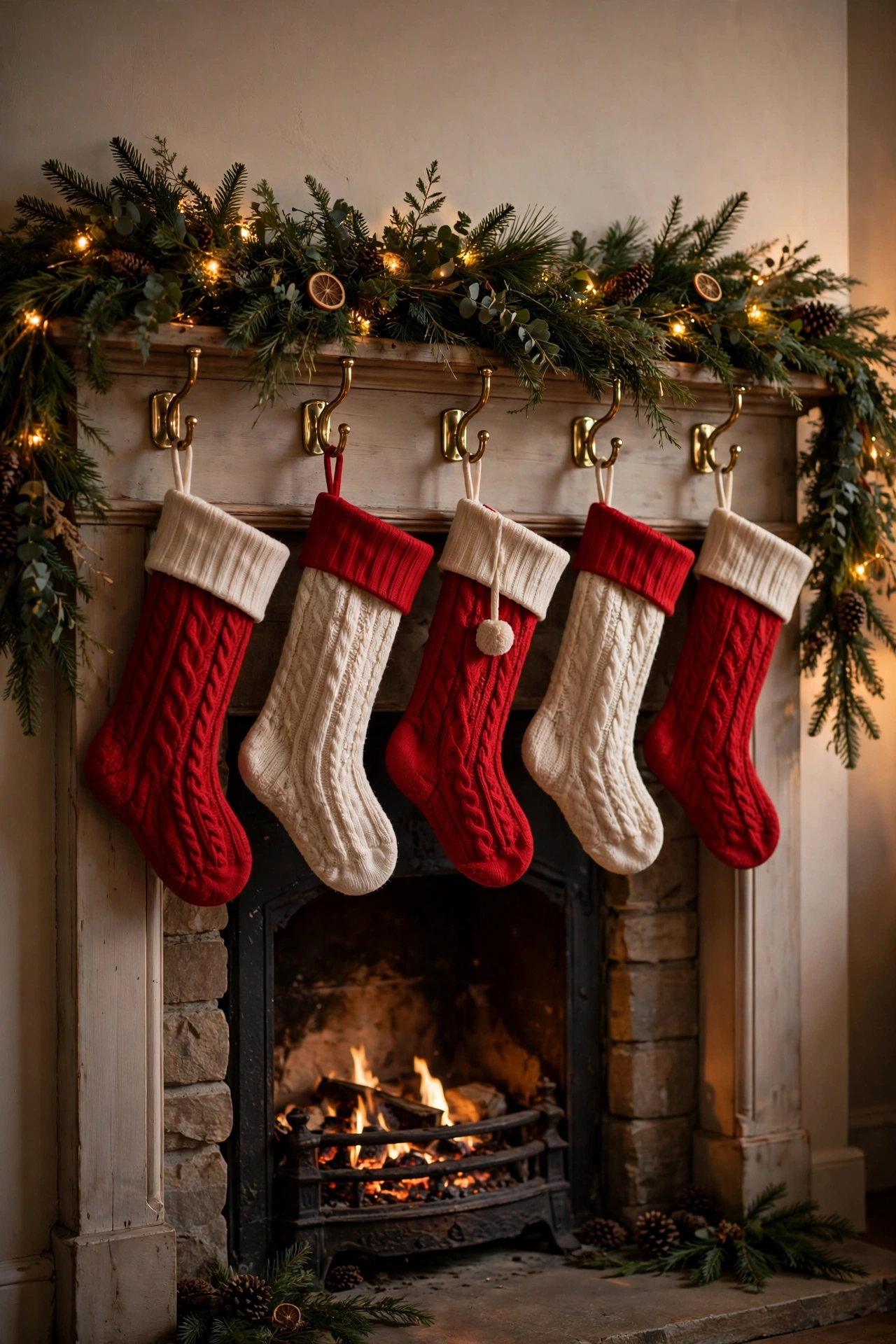
Start with the room, not the stocking. A stocking that matches the rest of your December decor looks like it belongs there. A stocking that fights the room looks like a shop display that wandered in by mistake. Classic red and white knit stockings suit a traditional home. The cable knit texture, the deep red cuff, the cream body, all of it reads warm and familiar against a green garland and a real fire. Velvet stockings in deep green, burgundy, or navy suit a calmer, more elegant room. They catch the light softly, they look expensive even when they are not, and they pair well with brass and gold. Linen and cotton stockings suit a modern or Scandinavian home. Cream, natural, and soft grey, with a simple embroidered name or a single stitched motif, they keep the mantel quiet instead of busy. Plaid and buffalo check suit a farmhouse room, especially with wood, pine, and a chunky knit throw nearby. Faux fur cuffs are the cosy shortcut: a plain stocking body with a thick faux fur cuff looks finished with almost no effort. Size matters more than style. Most stockings are about eighteen to twenty inches long, which is a good size for filling. A stocking much smaller than that is decoration only, and it will frustrate a child who expects it to hold something. A stocking much larger than that is hard to hang, because a full stocking is heavy, and a twenty four inch stocking filled with treats can pull a weak hook straight off the mantel. Buy for the person, not the set. An adult suits an understated knit, velvet, or needlepoint stocking. A child suits a character face, a bright colour, or a themed design. A pet gets a separate small stocking, and the treats inside stay separate from the family stockings, because small decorations and pet food do not belong in the same bag. A coordinated family set, where each stocking is the same style in a different colour, or the same colour in a different pattern, looks collected and warm rather than uniform.
Match Loosely, One Detail That Ties the Row Together
Identical stockings in the same colour and design look neat, but they also feel like something you would see in a hotel. A row of stockings that are clearly related but not identical looks like a family lives here, and that is the whole point. Pick one detail to repeat, and let everything else vary. One consistent cuff, one consistent colour, or one consistent placement detail can connect a group of very different stockings. A row of stockings in different fabrics, all with the same deep red cuff, reads as a set. A row in different patterns, all in the same cream and green palette, reads as a set. A row where every stocking has a name stitched in the same thread colour reads as a set, even if the bodies are completely different. Some colour palettes always work well: classic red, white, and green, which is timeless and instantly festive. Cream, gold, and neutral, which is soft and elegant and suits a modern room. Plaid and buffalo check, which is cosy and rustic. Jewel tones like deep green, burgundy, and navy, which feel rich and calm in a room with brass or dark wood. Choose the palette from the rest of your decor, not from the stocking aisle. If the tree is red and gold, the stockings should echo red and gold. If the room is cream and green, the stockings should follow that look. Personalise each one. A name, an initial, or a colour that belongs to one person turns a decoration into a tradition. Embroidered names last for years and survive the wash. Iron on letters are faster and cheaper. They work well on a plain cotton stocking. A small wooden tag tied to the hanging loop, with a name written in pen, is the simplest version of all, and it costs almost nothing. Children remember which stocking was theirs, and the name is how they know. For a growing family, leave room. A new baby means a new stocking. A stocking bought this year should still fit the row next year. Keep the same cuff colour or the same palette in mind when you add one, and the row will grow without looking patched together.
Hang Them So They Stay Put, the Weight Rule
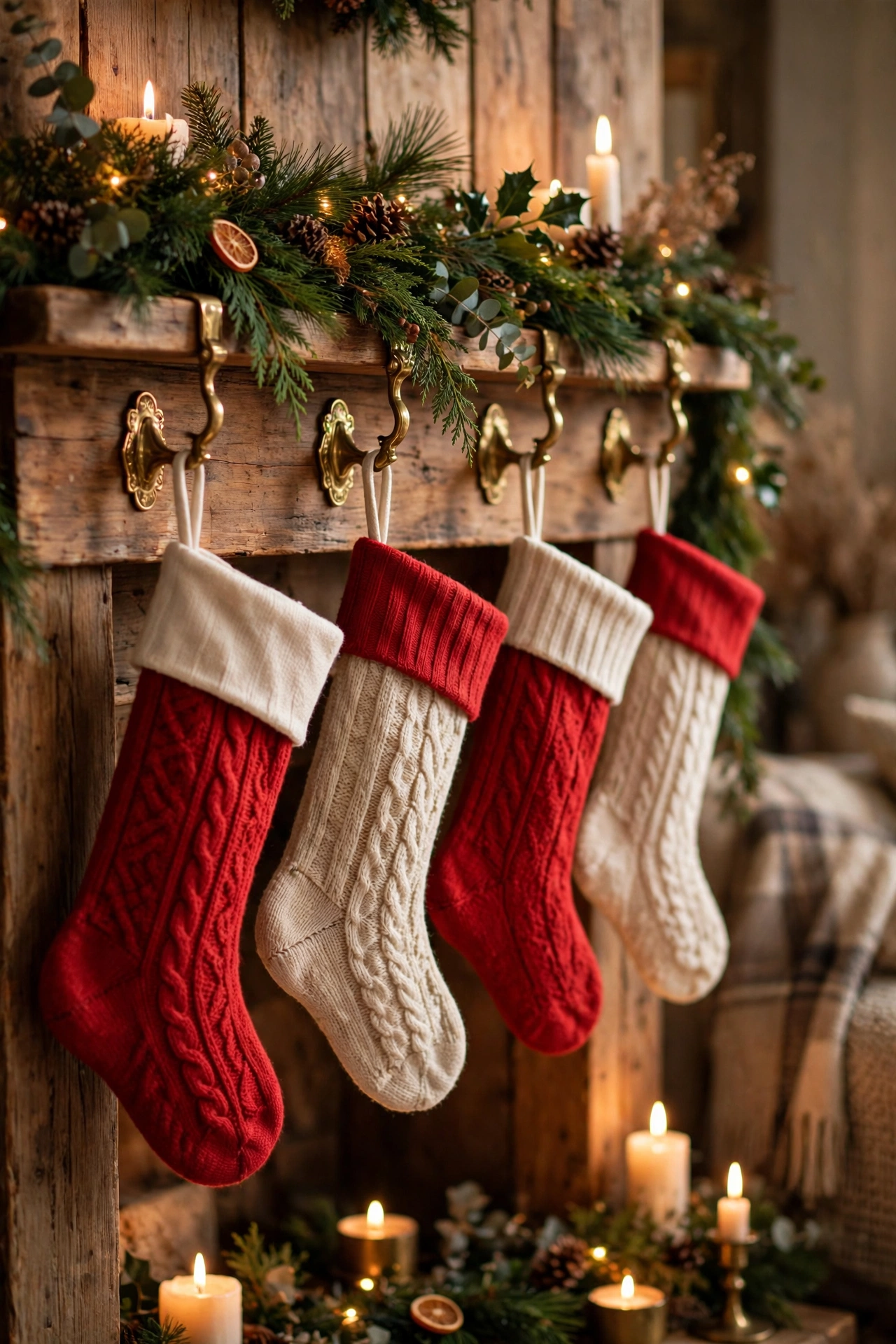
A stocking is light when it is empty and heavy when it is full. That is the detail most hanging plans forget, and it is why stockings end up on the floor on Christmas morning. Plan for the full weight, not the empty one. The classic spot is the fireplace mantel, and the classic tool is the mantel stocking holder. A heavy holder rests on top of the mantel and hangs over the front, so there are no nails, no drilling, and no marks on the wood. Choose a holder that weighs at least as much as a full stocking, because a light holder will tip forward when the stocking is loaded. Place the holders evenly, with enough space between them so that the stockings do not overlap, and keep the row level so the eye reads it as one line. Our fireplace guide covers the mantel setup in full, so read Christmas Fireplace Decor Ideas before you dress the whole mantel at once. Never hang a stocking from a nail in drywall, a command hook rated for a picture frame, or a hook that was meant for a wreath. A full stocking can weigh a kilogram or more, and a hook that holds a wreath will not hold it. Use a proper mantel holder, a sturdy screw hook driven into a stud, or a freestanding stocking stand that sits on the floor and carries the weight itself. If there is no fireplace, the stocking tradition still works. A staircase banister is one of the best alternatives: hang stockings from the newel posts or along the rail with ribbon or sturdy hooks, spaced evenly, with a garland or fairy lights running along the same line so the stockings read as part of the room. Our staircase guide covers banister displays in detail, so read Christmas Staircase Decor Ideas if the stairs are your display. A bedroom door, a wall mounted branch, a row of adhesive hooks on a solid wall, or a dedicated stocking holder stand all work too. Hang them at a height children can reach, so the morning reveal is theirs to perform, and keep them away from radiators and real flames. One more rule: hang the stockings before you fill them, and test the weight. Put a book or a bag of sugar in each one, leave it overnight, and check in the morning. If anything has slipped, moved, or tipped, fix the hook now, not on Christmas Eve.
Style the Mantel Around Them, Greenery First
Stockings look best when the mantel is styled around them, not when they are pinned onto a bare shelf. Greenery is the natural partner, because it frames the stockings and adds fullness without competing with them. Drape a pre lit garland across the mantel first, and position it so the stockings hang just in front of it, with the cuffs visible against the greenery. The garland gives the row a lush backdrop and a warm glow, and it hides the hooks and holders behind it. Add a few pinecones, a small cluster of red berries, and one or two battery candles at the ends of the mantel, and the display is finished. Keep the centre of the mantel clear of tall objects, because the stockings need the space, and a tall clock or vase behind a stocking looks cluttered. If your mantel is narrow, keep it simpler. One garland, one row of stockings, and nothing else. A narrow mantel with three stockings and a garland looks calm and intentional. A narrow mantel with stockings, candles, a clock, a village, and a vase looks like a shelf that gave up. Our mantel guide has the full styling plan, including what to put where, so read Christmas Mantel Decor Ideas if the mantel is your main display. For a mantel without a fireplace, the same rules apply on a shelf or a console. A long low shelf with a garland, a row of stockings, and warm light reads exactly like a mantel, and nobody misses the fire. The trick is the same: greenery behind, stockings in front, cuffs visible, nothing tall in the middle. Keep the stockings visible from across the room. They are the most personal thing on the mantel, and they should be the first thing the eye finds. If the garland is too thick, or the candles are too tall, the stockings disappear, and the display loses its meaning. Step back to the far side of the room and look. If you cannot read the names or the colours from there, thin the greenery and lower the candles.
DIY Christmas Stocking Ideas, Make One That Means Something
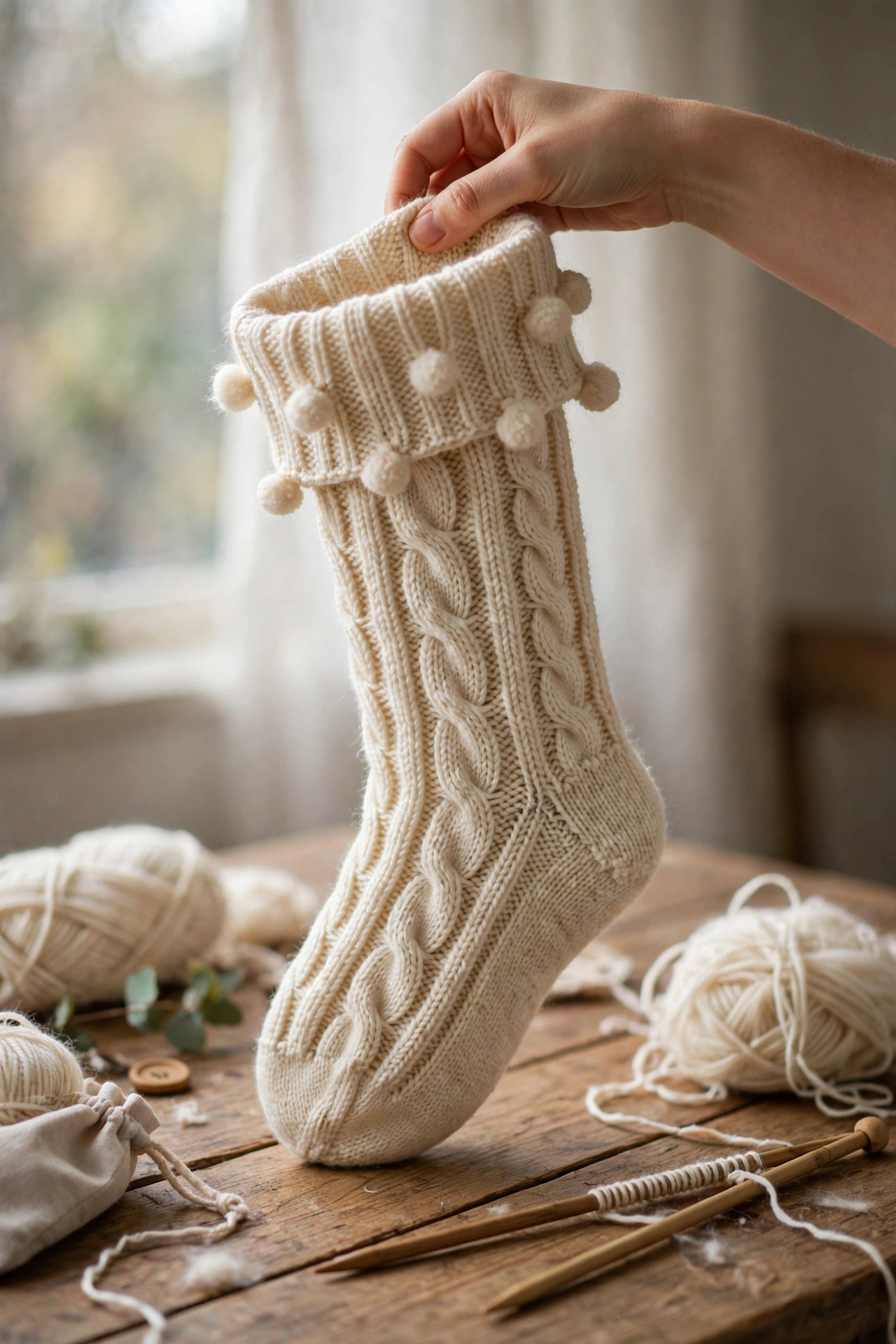
A handmade stocking is the one decoration nobody throws away. It does not have to be perfect. A slightly wobbly seam, a hand stitched name, a cuff made from an old jumper, all of it is the point. These are the DIY stocking ideas that actually get finished, not the ones that sit half sewn in a drawer until January. The easiest DIY stocking starts with a purchased blank. Buy a plain cotton or felt stocking in the colour you want, then add the personality: a folded faux fur cuff sewn or glued on, a large initial cut from felt and stitched on the body, a row of pom poms along the cuff, or a stitched name in a contrasting thread. A blank plus one strong detail beats a complicated pattern every time, and it takes an evening, not a weekend. A knit stocking is the classic handmade project, and it is simpler than it looks. A chunky knit in cream or red, worked in a simple stocking stitch, with a wide folded cuff, is a weekend project for a confident beginner. Add small pom poms hanging from the cuff, or a simple cable pattern down the front if you are feeling brave. The knit texture is forgiving: a small mistake disappears into the stitches, and the stocking looks handmade in the best way. A sewn stocking from fabric you already own is the most personal version of all. An old plaid shirt, a piece of velvet from a curtain, a linen tea towel, any of these can become a stocking body. Cut two stocking shapes, sew them together with the right sides facing in, turn it out, add a cuff and a hanging loop, and you are done. Line it with a plain cotton, because a lining stops small fillers from snagging on seams and makes the stocking last for years. For children, let them decorate their own. Give each child a plain stocking, a set of fabric pens, iron on shapes, felt pieces, and fabric glue, and let them design it. A stocking a child decorated themselves is the one they will ask for every year, and the slightly crooked snowman on the front is exactly what makes it precious. Keep the decorations flat and firmly attached, because anything that dangles will be pulled off by Boxing Day. One practical note for every DIY stocking: make the hanging loop strong. A loop of ribbon folded double and stitched through both layers of the stocking will hold a full stocking. A single thin loop will not. Test it with a bag of sugar before you trust it on the mantel.
Fillers People Actually Love, Small and Thoughtful
A great stocking is not about how much you stuff in it. It is about thoughtful, useful, or delightful things, and the best fillers are the ones that would be welcome on their own. The rule is simple: one treat, one useful thing, one small delight, and one thing that made you think of them. For adults, start with the useful: a good lip balm, a hand cream, a small notebook, a quality pen, a pair of warm socks, a tea bag they actually like, a small candle. Add one treat: good chocolate, a bag of their favourite sweets, a small jar of jam, a miniature bottle of something they enjoy. Add one small delight: a tiny ornament, a photo, a handwritten note, a lottery ticket, a seed packet for spring. The note matters more than anything else in the stocking, and it costs nothing. For children, mix play and treats. Crayons, stickers, a small puzzle, a bouncy ball, a tiny torch, a favourite sweet, a small soft toy for a toddler. Keep the pieces big enough to be safe for the age, and avoid anything small enough to swallow for babies and toddlers. A stocking for a child should be opened slowly, one thing at a time, and the filling should last the morning, not be finished in thirty seconds. For teenagers, think consumable and personal: a phone charger cable, a gift card for a coffee shop, a bath bomb, a small snack they love, a lip balm, a pair of fun socks. Teenagers are the hardest stockings to fill, and the trick is to stop buying toys and start buying small luxuries they would not buy for themselves. For a pet, keep it separate and safe. A few animal appropriate treats, a small toy, and nothing with small parts that can be chewed off and swallowed. Never put human chocolate or human food in a pet stocking. Pack it like a pro. Heavy things go in the toe, so the stocking hangs straight. Soft things go around them, to stop rattling. The best thing goes in last, at the top, so it is the first thing found. Wrap the smallest items in tissue paper, because unwrapping is half the fun, and a stocking full of loose small things is a mess by the second item. And leave a little space at the top: a stocking stuffed to bursting looks stressed, not generous.

Stockings Without a Fireplace, Stairs, Doors, and Walls
Not every home has a fireplace, and not every fireplace has a mantel. The stocking tradition does not need either one. It needs a hook, a rail, or a stand, and a place where the family gathers. The staircase is the best fireplace substitute. Hang stockings from the banister with ribbon tied to the newel posts, or from sturdy hooks clipped to the rail, spaced evenly down the stairs. Run a garland along the same rail, with fairy lights woven through it, so the stockings read as part of the staircase decoration. Keep the walkway clear, and keep the stockings on the side of the stairs that guests see, not the side they hold onto. A bedroom door works for a small family. Hang one stocking on each bedroom door, at a height the child can reach, and the morning reveal happens right where they wake up. A wall mounted branch, a piece of driftwood or a sturdy branch screwed to the wall, makes a beautiful rustic display: hang the stockings from the branch with ribbon at different heights, and add a few small ornaments between them. A freestanding stocking stand is the simplest answer of all. A metal stand with hooks, placed in the living room or the hallway, holds the stockings at the right height and carries the full weight safely. It packs away flat in January, and it works in a rented home where you cannot put a single nail in the wall. For a rented home, use adhesive hooks rated for the full weight of a loaded stocking, on a solid wall or a door, and test them the night before with a bag of sugar. Or use a tension rod across a wide doorway or an alcove, and hang the stockings from it with ribbon. The rod carries the weight, the wall stays undamaged, and the display looks intentional. Wherever you hang them, keep them together. A row of stockings in one place is a display. A stocking on every door in the house is a scavenger hunt. One place, one row, one moment on Christmas morning.
The Budget and the Mistakes, What Stockings Really Cost
Stockings are one of the cheapest Christmas decorations to do well, and one of the easiest to overspend on. The honest numbers help. A plain cotton or felt stocking costs about five to ten dollars. A knit stocking costs about fifteen to twenty five dollars. A personalised velvet stocking costs about thirty to fifty dollars, and a personalised family set of four commonly costs about one hundred and fifteen to one hundred and eighty five dollars. A DIY stocking made from fabric you already own costs almost nothing except thread and time. A mantel stocking holder costs about ten to twenty dollars each, and a freestanding stand costs about twenty to thirty dollars. Filling a stocking well costs about ten to twenty dollars per person, and a themed stocking, like a cosy night in with tea, a candle, and fuzzy socks, or a movie night with popcorn and a small gift card, costs about fifteen dollars and feels far more thoughtful than a random pile of small things. The mistakes to avoid are simple. Do not buy a matching set and call it done, because nobody will know which stocking is theirs. Do not hang a stocking from a weak hook, because a full stocking is heavy and it will fall. Do not fill a stocking with things nobody wants, because a stocking full of filler is worse than a stocking half empty. Do not put a scented candle beside a stocking, or a real flame anywhere near dry fabric. Do not hang stockings where a child cannot reach them, because the morning reveal belongs to them. And do not wait until Christmas Eve to hang them, because a stocking hung in a rush is a stocking that falls down. Buy one good stocking per person, hang it properly, fill it thoughtfully, and it will last for years. The stocking your child opens this Christmas is the stocking they will ask for next year, and the year after that, and the year after that. That is the whole tradition, in one small bag.
Conclusion
A Christmas stocking is a small thing with a big job. It decorates the mantel all December. It carries the first gifts of Christmas morning. It becomes a tradition that outlasts almost everything else in the house. Choose a style that fits your home. Match the row loosely with one repeated detail. Hang each stocking on a hook that can hold its full weight. Style the mantel around it with greenery and warm light. Fill it with things that were chosen for one person. Start this weekend. Pick the stockings, hang them, test the weight, and fill them the week before Christmas. When the morning comes, the stockings will be exactly where they should be, full of exactly the right things, and the first ten minutes of Christmas will take care of themselves.