
Home Bar, Library, Organisation & Renovation Ideas
A home feels right when it works as hard as it looks good. You want a corner where friends can gather for a drink, a quiet spot where you can read for half an hour, cupboards that close without a fight, and rooms that feel fresh without a full rebuild. That is what this guide brings together in one place.
We have taken seven of our most read home posts and merged the best ideas from each of them. The repeats are gone. What is left is a practical plan for a home bar, a home library, better organisation, and smart renovation, plus the finishing touches that make a house feel like yours. You can read it from start to finish, or jump to the section you need today and come back for the rest later.
How to Use This Guide
Start with the room that bothers you most. If the kitchen worktop is always crowded, start with organisation. If evenings feel flat, start with the bar. If you never sit down with a book, start with the library. Small wins build confidence, and confidence makes the bigger jobs feel possible.
As you read, keep three questions in mind. Where does this idea fit in my home? What can I do this weekend with what I already have? And what is worth saving for? You do not need to do everything here. Pick two or three ideas, try them properly, and let the rest wait until you are ready.
Home Bar Ideas That Fit Real Homes
A home bar does not need a separate room, a big budget, or a collection of rare bottles. It needs a clear spot, a little storage, and a reason to use it. Some of the best home bars we have seen are no bigger than a trolley in the corner of a living room, yet they change how people use the space in the evening.

Start with a Bar Cart You Can Move
A folding bar cart is the easiest place to begin, and it is easy to see why it appears in so many home bar lists. It holds bottles, glasses, and tools on two or three shelves, it rolls out of the way when you need the floor space, and it works just as well indoors as it does on a patio. Choose a sturdy one with a rail around the top shelf, so nothing slides off when you move it.
Style the cart the way you would style a shelf. Put the bottles you reach for most on the top, glasses on the middle shelf, and heavier items low down. Add a small plant, a candle, or a framed print, and leave some empty space. A cart that is packed to the edges looks like storage. A cart with breathing room looks like a bar.
Build In, or Build Up, with Wood and Shelves
If you have a little more room, reclaimed wood gives a bar warmth that new timber often lacks. A simple wooden counter against a wall, with open shelves above it, can hold everything you need. Add a built in wine rack on the wall, or a narrow rack under a shelf, and keep the bottles where you can see them. A dark stain makes the bottles stand out, while a pale finish keeps a small room feeling light.
Floating shelves work well in the same way. Two or three shelves above a sideboard or a kitchen counter create a bar without taking any floor space at all. Keep the shelves shallow, about the depth of a bottle, and mix glasses with a few decorative pieces so the shelves do not look like a shop display. Good lighting matters here. A small wall light or a strip light under the top shelf makes the glasses catch the light in the evening, and it makes the whole corner feel intentional.
Give Old Furniture a Second Life
Some of the most charming home bars start life as something else. An old dresser, a sideboard, or a sturdy bookshelf can become a bar with a little cleaning, a fresh coat of paint, and a few hooks for tools. A vintage suitcase opens up into a talking point, with bottles stored inside and glasses tucked into the lid, and it folds away when the evening ends. A pallet bar, made from cleaned and sanded pallets, suits a garden or a garage, and it costs far less than a new unit.
A pegboard on the wall behind the bar keeps tools, bottle openers, and hanging glasses within reach, and it lets you change the layout whenever you like. The rule for all of these is the same. Keep the structure safe and steady, keep glass away from the edge, and keep a small tray for spills. Character is welcome. Wobble is not.
Take the Bar Outside, and Give It a Menu
An outdoor bar can be as simple as a small table, a few stools, and a cool box, dressed up with a tiki style umbrella, string lights, and tropical plants. Keep the drinks simple, keep a jug of water on the table, and bring the bottles inside at the end of the night. Indoors or out, a short signature menu makes hosting easier. Choose three drinks you can make well, write them on a small chalkboard, and keep the ingredients for those three close at hand. Guests choose faster, you spend less time searching for bottles, and the evening feels relaxed rather than rushed.
Mix and match your glassware if you do not own a full set. Different shapes and sizes look collected rather than careless, as long as the glasses are clean and the shelves are not overcrowded. Add a few natural touches, a sprig of mint, a slice of citrus, or a wooden board for snacks, and the bar will feel welcoming before anyone pours a drink. If your bar sits near the kitchen, borrow ideas from our Kitchen Decor Ideas guide, so the two spaces share colours and materials instead of competing with each other.
A Home Library You Will Actually Use
A home library is not about owning the most books. It is about having a place where reading feels easy. A comfortable chair, light you can read by, and books within arm’s reach will do more for your reading habit than a wall of shelves you never touch.

Find the Nook First, Then the Shelves
Look for the spots your home already gives you. A window seat with cushions and a blanket becomes a reading nook with almost no work. The space under the stairs fits low shelves and a small chair. A quiet corner of a bedroom or living room takes a tall bookcase and a floor lamp. Even a hallway can work, with shallow shelves that hold books spine out without blocking the way.
Built in shelves make a room feel finished, and they use the wall from floor to ceiling. If built ins are out of reach, tall freestanding shelves do the same job, especially with a small ladder for the top rows. Keep the shelves you use most at eye level. Put heavy books low down, where they are stable, and keep a few favourite objects on the top shelves, where they can be seen but do not get in the way.
Light, Comfort, and a Little Personality
Reading light should be warm and close. A floor lamp beside the chair, a small table lamp, or a wall light above the shelves will all work, as long as the light falls on the page and not in your eyes. Natural light helps in the daytime, so keep the chair near a window if you can, with a sheer curtain to soften the glare.
Comfort is personal, so choose seating you will sit in for an hour. A deep armchair with a cushion, a soft throw, and a small side table for a cup of tea will beat a stylish chair that nobody uses. Then add the details that make the library yours. A plant on the shelf, a framed print, a favourite colour on one wall, or books arranged by colour on a single shelf, all of these turn storage into a room with character.
Organise the books in a way that helps you find them. Sorting by genre works for most people, sorting by author works if you read a lot of one writer, and sorting by colour looks lovely on open shelves, even if it is harder to find a single title. Whichever system you choose, leave a little empty space on each shelf. A shelf that is completely full is hard to use, and it leaves no room for the next book you bring home.
Organisation That Makes Every Room Calmer
Organisation is not about having a perfect home. It is about knowing where things live, so you stop losing time to searching, tidying the same pile twice, and buying a second copy of something you already own. A calm home is usually an organised home, and the ideas below work in almost any size of house or flat.
Use the Space You Already Have
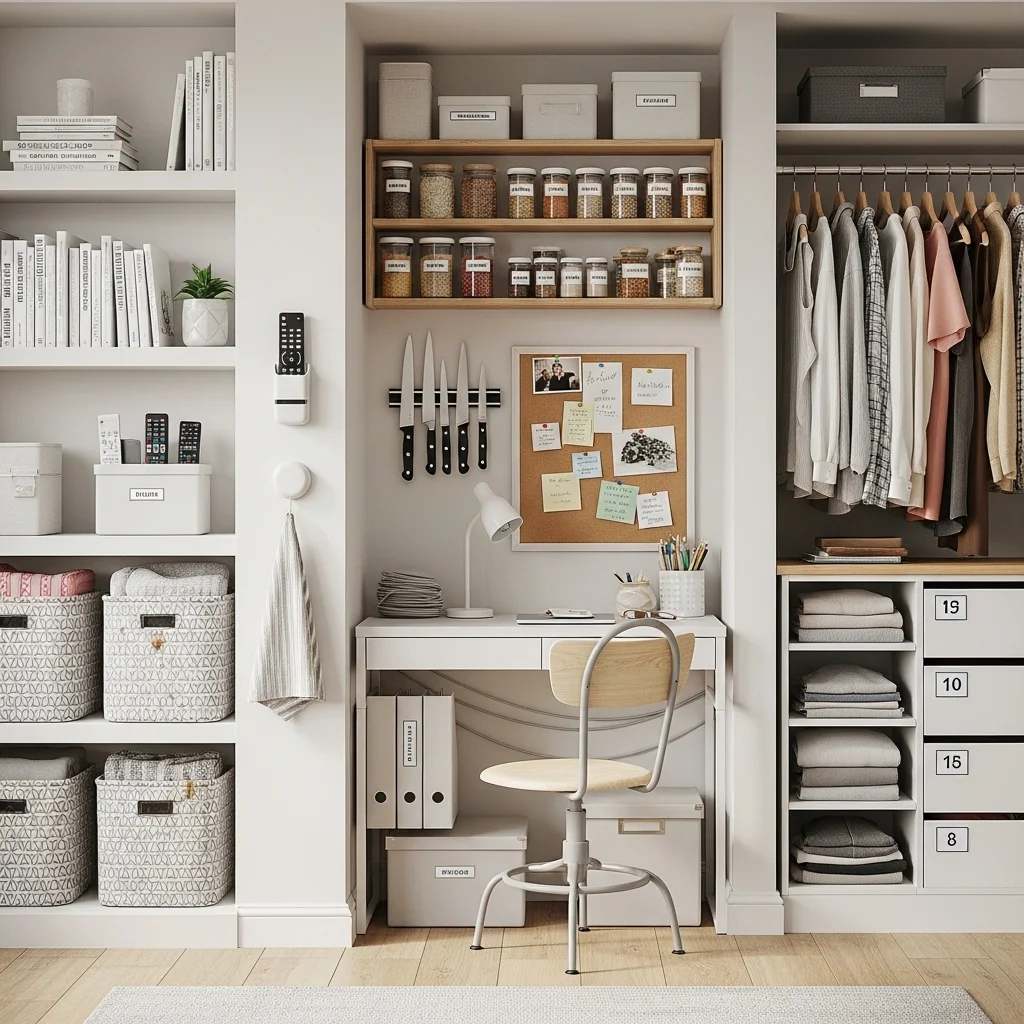
Start by looking up, down, and behind doors. Vertical storage is the easiest win in a small home. Tall shelves, hooks on the wall, and a pegboard in a kitchen or hallway use wall space that would otherwise sit empty. Under the bed, flat boxes hold out of season clothes, spare bedding, and shoes, and they keep the floor clear. Over the door hooks and racks add storage to a bedroom, a bathroom, or a cupboard without a single screw in a new place, in many cases.
In the kitchen, small gadgets earn their place only if they save time every week. A compact chopper, a good peeler, or a set of stackable containers can free up a surprising amount of worktop. The test is simple. If you have not used it in a month, move it to a higher shelf or pass it on. The same test works in every room.
Choose Furniture That Does Two Jobs
Multi functional furniture is worth its weight in a small home. An ottoman that opens for storage, a bed with drawers underneath, a coffee table with a shelf, or a bench by the door that holds shoes inside, each of these removes a pile from somewhere else in the room. When you buy a new piece, ask what it will store as well as how it will look. If the answer is nothing, make sure you love it enough to keep it anyway.
Closets work better when they are customised, even a little. A second rail for shorter clothes, a row of hooks for bags and belts, and a few matching boxes on the top shelf can double the useful space. Label the boxes, even if you think you will remember what is inside. Future you, in a hurry on a Monday morning, will be grateful.
Declutter First, Then Create Zones
It is tempting to buy storage before you declutter. Try the other order. Take one drawer, one shelf, or one cupboard, empty it completely, keep what you use, and let the rest go. Then put the keepers back in a way that makes sense. That one small win often gives you the energy for the next drawer.
Once a space is clear, give it a job. A charging zone by the door, a reading zone by the window, a work zone at a desk, and a play zone in a corner of the living room, each zone tells you where things belong. Light colours and a mirror help a small room feel larger, and they make an organised room feel brighter too. If you work from home, the same zoning idea helps there as well, and our Home Office Decor Ideas guide shows how to set up a workspace that stays tidy.
Renovation Ideas That Refresh Without Rebuilding
Renovation sounds big and expensive, and it can be, but the most satisfying projects are often the smallest ones. A fresh coat of paint, new handles on kitchen cupboards, or better lighting can change how a room feels for the cost of a weekend and a modest budget. The trick is to choose the change that gives you the most visible result for the effort involved.

Paint, Light, and the Small Details
Paint is the fastest renovation there is. A light, warm white makes a dark room feel larger. A bold colour on one wall adds depth without overwhelming the space. Paint the ceiling white, paint the skirting boards the same colour as the wall for a modern look, and take your time with the preparation. Clean walls, filled holes, and good tape make the difference between a paint job that looks professional and one that looks rushed.
Lighting comes next. Swap a single harsh ceiling light for layers, a ceiling light for general use, a lamp for reading, and a small light under a kitchen shelf or above a picture. Warm bulbs feel cosy in living rooms and bedrooms, while brighter bulbs suit kitchens and bathrooms. New handles, taps, and switch plates are small jobs with a big visual return, and they are a good first project if you are new to DIY.
Refresh the Kitchen, Bathroom, and Floors
You do not need a new kitchen to make a kitchen feel new. Repainting cupboard doors, adding open shelves for the things you use every day, and clearing the worktops can transform the room. In the bathroom, a new mirror, fresh grout, and a tidy vanity have the same effect. Keep the layout the same, and spend the money on the surfaces you touch and see every day.
Floors deserve the same thinking. A deep clean and a good rug can revive a tired floor, while sanding and resealing wooden boards brings back their colour. If you do replace flooring, choose one material that flows through the main living spaces. It makes a home feel larger and more connected, and it is easier to clean.
Open Up the Layout, and Know When to Call a Professional
Many homes feel small because of how the furniture sits, not because of their size. Pulling a sofa a few inches away from the wall, removing a bulky unit you never use, or opening a doorway to the garden can make a room feel larger without moving a single wall. If you do want to open up a space, start with the layout on paper, live with the idea for a week, and only then think about building work.
Deciding between DIY and a professional is part of every renovation. Paint, shelving, handles, and simple garden work suit most confident beginners. Plumbing, gas, structural changes, and anything involving electricity belong to a qualified professional, and that is not a failure, it is good sense. Get two or three quotes for larger jobs, check recent work, and agree the scope in writing before anyone starts. For more weekend project ideas, see our DIY and General Home Decor Ideas guide.
Oversized Decor and Name Plates: The Finishing Touches
Once the practical work is done, the finishing touches give a home its personality. Oversized decor and a personal name plate are two of the simplest ways to do that, and they work in almost any style of home.
Go Big, But Only Once or Twice
Oversized decor works because it gives the eye one clear focal point. A large piece of art above a sofa, a tall mirror that reflects light across a room, or a large plant in a corner can anchor a space in a way that many small objects cannot. A big rug defines a seating area, chunky furniture adds comfort, and a bold light fitting turns a plain ceiling into a feature.
The secret is restraint. Choose one oversized piece per room, and keep the rest of the room calm around it. A large mirror in a small room makes it feel bigger, while a large artwork in a large room stops the walls feeling empty. Measure before you buy, and leave enough space around the piece for it to breathe. A grand shelf, extra large cushions, a dramatic feature wall, or a sculptural object can all work, but they work best when they are not competing with each other. For ideas on styling a whole room around one bold piece, our Living Room Decor Ideas guide is a good next read.
Name Plates That Welcome People In
A name plate is the first detail a visitor sees, and the last detail many homeowners think about. It is worth a little care. Wooden plates suit traditional and rustic homes, metal plates suit modern homes, acrylic plates look clean and contemporary, and ceramic plates add colour and craft. LED backlit plates are easy to read at night, and engraved plates last well outdoors.
Choose a plate that fits the door and the wall around it. A small plate on a large door looks lost, while a very large plate can overwhelm a narrow entrance. Keep the lettering clear and readable from the path, include the family name or house name, and add a simple welcome message only if the design stays uncluttered. Fix it at eye level, where it can be seen without searching, and check the fixings once a year, so it stays straight and secure in all weathers.
A Simple Plan to Put It All Together
If you are not sure where to start, follow this order. It moves from the easiest wins to the bigger projects, and each step makes the next one easier.
- Weekend one: declutter one room, set up a bar cart or a reading nook, and hang a name plate.
- Weekend two: add vertical storage, a pegboard, or floating shelves where you need them most.
- Weekend three: paint one wall, change handles and lighting, and add one oversized piece to a room that feels empty.
- Next month: plan a larger renovation, get quotes, and save for the job that will make the biggest difference.
Write the plan down, set a realistic budget for each step, and keep a note of what worked. Homes improve in layers, and a layer done well is better than three layers rushed.
Frequently Asked Questions
How much space do I need for a home bar?
Very little. A bar cart needs about the same floor space as a small side table, and floating shelves need no floor space at all. Start small, use it for a month, and only add more storage if you find you need it.
What is the best way to organise books in a home library?
Sort by genre first, then by author within each genre. That is the easiest system to keep up, and it helps guests find a book too. Sorting by colour looks lovely, so save that for one shelf you want to show off.
Should I renovate myself or hire a professional?
Do the cosmetic work yourself, such as painting, shelving, and changing handles, and hire a professional for plumbing, gas, electrics, and structural work. If a job could damage your home or put anyone at risk, it belongs to a professional.
Can oversized decor work in a small home?
Yes, if you choose one piece and keep the rest of the room simple. A large mirror or a single large artwork can make a small room feel bigger, while a room full of small objects can make it feel cluttered.
Bringing It All Together
A home bar, a library, good organisation, and a thoughtful renovation are not four separate projects. They are four ways of asking the same question. How should this home work for the people who live in it? Answer that question room by room, start with the smallest change you can make this weekend, and build from there.
Your home does not need to look like a showroom. It needs to welcome you in the morning, help you relax in the evening, and make room for the life you actually live. Pick your favourite idea from this guide, try it properly, and enjoy the difference it makes. Then come back for the next one.