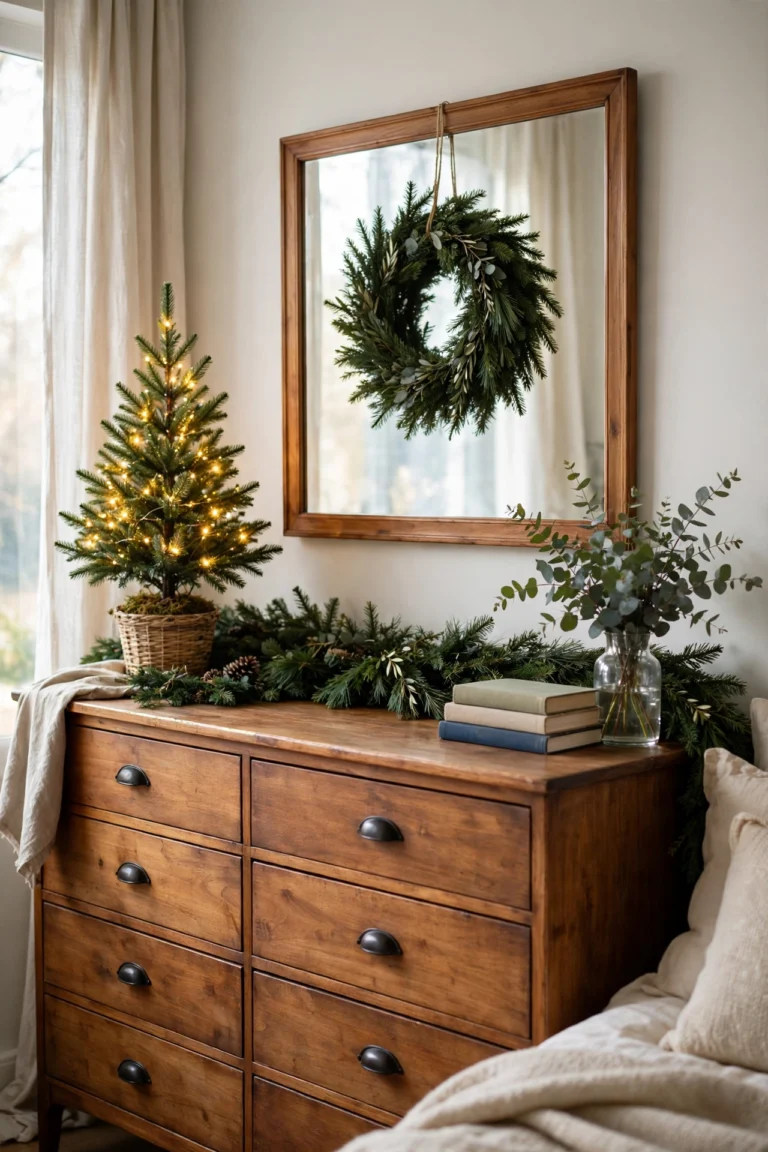
Christmas Mudroom Decor Ideas That Keep It Working
Introduction
A mudroom is the hardest working room in the house at Christmas, and it is also the room most people forget to decorate. It is where wet boots land, where coats pile up, where school bags drop, and where parcels wait to be opened. It is not a showroom. It is the place between outside and inside, and in December it works harder than any other room. That is exactly why it deserves a little care. A mudroom that looks warm and feels organised makes the whole house feel calmer, because the mess of coming and going stays in one place instead of spreading into the hallway and the living room.
The good news is that a mudroom does not need a full makeover to feel festive. Mini wreaths on the hooks, a garland along the top shelf, plaid cushions on the bench, a boot tray by the door, and one small tree in the corner can change the whole feeling of the space in a single afternoon. None of these pieces needs to be expensive, and none of them needs to stop the room from doing its job. In fact, the best Christmas mudroom decorations are the ones that help the room work better, because they give every coat, boot, hat and scarf a clear home.
Before you start, take everything out of the mudroom. Take the coats off the hooks, the boots out from under the bench, and the clutter off the shelf. Sweep the floor, wipe the bench and the shelf, and look at the bare space for a minute. Notice where the light falls, where the hooks sit, and where the wettest patch of floor is. That empty view tells you where the garland should go, where the tree will fit without blocking the door, and where the boot tray belongs. Work from that empty room, one layer at a time, and step back after each layer. If you are planning the whole entrance as well, start with these Christmas entryway decor ideas to set the mood at the front door, then look at these Christmas hallway decor ideas if your mudroom opens into a longer passage, and finish the story with these Christmas console table decor ideas so the entry, the passage and the mudroom feel like one home, not three separate displays.
1. The Mudroom Formula: Hooks High, Bench Low, Floor Clear
Every mudroom that works well follows the same quiet pattern, even when the rooms look completely different. Think of it in three levels: hooks high, bench low, floor clear. The hooks are the high level, where coats, hats and scarves hang within easy reach. The bench is the low level, where people sit to pull on boots and where a cushion or two can add warmth. The floor is the clear level, where boots, bags and the dog need space to move. Decorate the high level and the low level, and protect the clear level. That is the whole formula, and it will guide every choice that follows.
Start with the hooks. Count how many people use the mudroom every day, then give each person one hook, plus one spare hook left free. That spare hook is not wasted space. It is the hook for a guest coat, for a wet scarf that needs to dry, or for the coat someone grabs on the way out. If every hook is full, the room will overflow onto the bench and the floor within a week. If one hook stays free, the room can absorb a guest, a parcel run, or a muddy dog walk without falling apart. One hook per person, plus one spare, is the rule to keep until January.
The bench has one job: to be sat on. That sounds obvious, but it is the first thing a Christmas mudroom gets wrong. A bench covered in cushions, throws, baskets and ornaments is a display, not a seat, and a family will stop using it. Keep most of the seat free. Two cushions at the back, one folded throw at one end, and the rest of the seat empty is plenty. The empty seat is what makes the room feel welcoming, because it says, sit down, take your time, pull your boots on properly.
The floor is the clear level, and it is the level that keeps the room safe. A mudroom floor gets wet, muddy and slippery in December, and it needs to be easy to sweep and mop. Keep the middle of the floor completely clear, with no baskets, no gifts, and no low decoration sticking out into the walkway. Put the boot tray flat against the wall or under the bench, where boots can drip without anyone stepping in the puddle. Put baskets under the bench, not beside it, so they do not narrow the path. When you finish decorating, walk through the mudroom carrying a bag, as if you have just come in from the cold. If you have to turn sideways or step over something, move it.
2. Mini Wreaths on the Coat Hooks
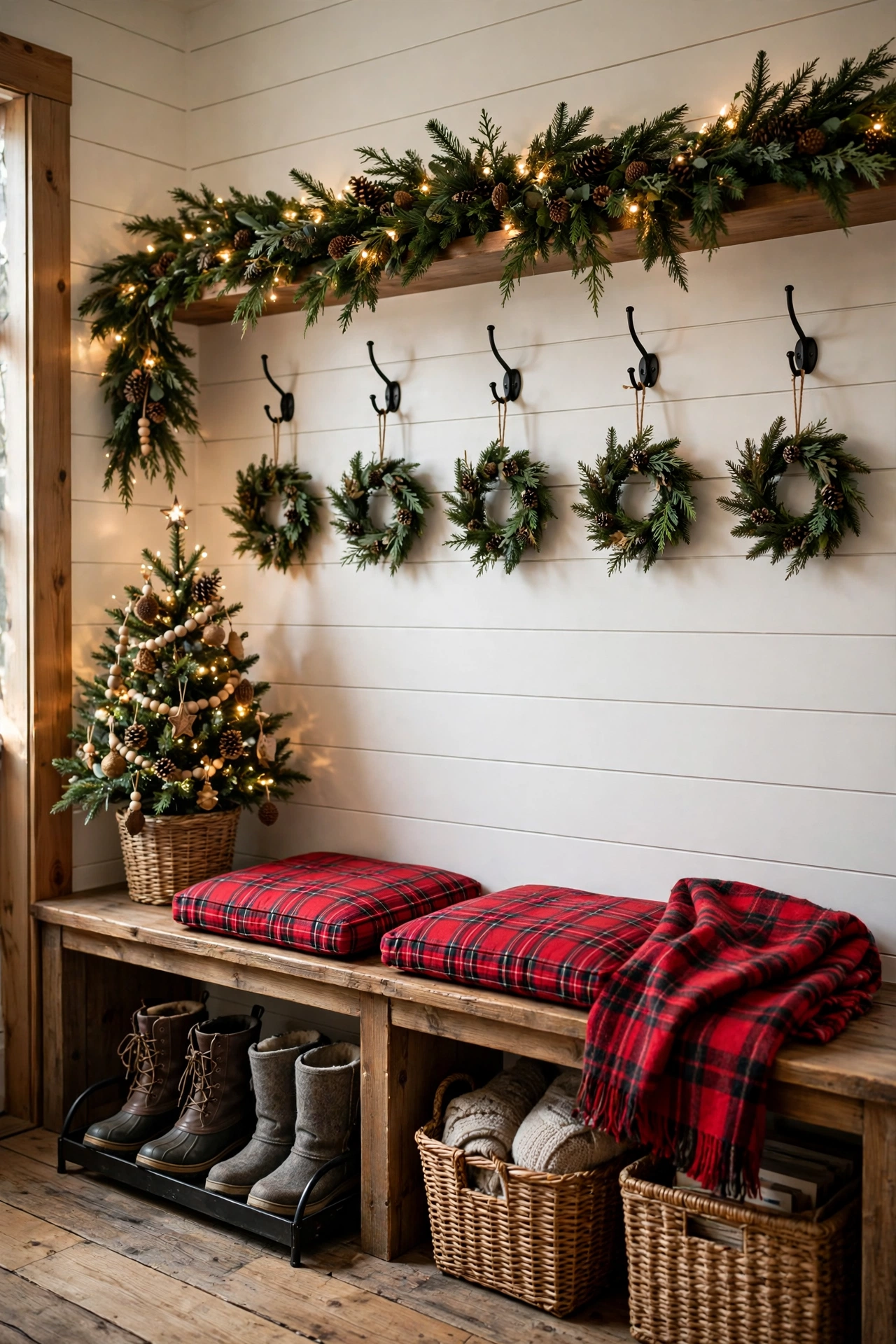
Mini wreaths are the single best decoration for a mudroom, because they use the hooks themselves as part of the display. A small wreath hung on a coat hook turns a plain row of hooks into a festive line, and it does it without taking up any shelf space, any bench space, or any floor space at all. That is why they work so well in small mudrooms and boot rooms, where every centimetre of surface counts. A row of mini wreaths, each one a little different, looks generous and handmade, and it costs far less than one large wreath.
Choose wreaths between 15 and 25 centimetres across. Smaller than that, and they can look lost on a full size hook. Larger than that, and they will cover the hook completely and make it hard to hang a coat. A wreath in that middle size sits neatly on the hook, frames it, and still leaves room for a coat to hang behind or beside it. If you buy artificial mini wreaths, look for full ones with a clear round shape and a good mix of pine tips. If you make your own, a simple grapevine ring with a few pine sprigs, a small bow and two or three tiny baubles is enough.
Hang each wreath from the hook with a loop of ribbon, not with a wire hook that can scratch the wall or snag a coat. A ribbon loop in deep red, forest green or cream will match the rest of your colours, and it lets you adjust the height easily. Hang the wreath so its centre sits just above the hook, with the bottom of the wreath level with the top of the coats when they hang. That way the wreath is visible above the coats, not hidden behind them. Step back and look from the doorway, because that is the view guests will see.
Vary the wreaths a little, but keep them in the same family. Use the same greenery and the same ribbon colour on every wreath, then change one small detail on each one. One wreath might have tiny red berries, the next a small wooden star, the next a cluster of pinecones, and the next a sprig of dried orange. Those small differences make the row feel handmade and personal, while the shared greenery and ribbon keep it calm and coordinated. If every wreath is identical, the row can look like a shop display. If every wreath is completely different, the row can look busy. Same base, one small change each, is the balance to aim for.

3. Garland Along the Top Shelf
The top shelf is the mudroom’s best decorating space, because it is high, out of the way, and visible the moment you walk in. A garland along the top shelf frames the whole room, just as a garland along a mantel frames a fireplace. It draws the eye up, it makes a low ceiling feel taller, and it adds greenery without taking up a single centimetre of bench or floor. If you only do one thing in your mudroom this Christmas, make it the garland on the top shelf.
Lay the garland along the front edge of the shelf, not pushed back against the wall. A garland at the front edge is visible from the doorway, and it lets a few branches spill over the edge in a soft, natural line. A garland pushed to the back will be hidden behind whatever sits on the shelf. Let the garland run the full length of the shelf, with a little spill over each end if the shelf allows it. That spill is important. A garland that stops exactly at the edge looks cut off. A garland that drops a few inches over each end looks generous and finished.
Once the garland is in place, dress it in layers. Start with lights if you use them, and choose warm white battery lights with a timer. Tuck the battery pack behind the garland at one end, where it is hidden but still easy to reach. Then add ribbon, weaving it through the greenery in loose loops rather than tight wraps. A wide plaid ribbon looks wonderful in a mudroom, because it echoes the plaid cushions on the bench below and ties the high level to the low level. Let the ends of the ribbon hang down a little at each end of the shelf for movement.
Safety matters here more than in most rooms, because a mudroom shelf sits above coats, scarves and hats, and above the heads of children reaching for their own things. Use battery operated flameless candles only, never a real flame near dry greenery. A garland is dry by nature, whether it is real or artificial, and a flame beside it is a risk you do not need. Flameless candles give you the same warm glow, they are safe to leave on a timer, and you can tuck them into the garland without worrying. If you love the look of a real candle, use it on a different surface, away from greenery, and never leave it unattended.
4. The Bench: Plaid Cushions, One Throw, Most of the Seat Free
The bench is where the mudroom becomes a room you sit in, not just a room you pass through. It is where children sit to pull on wellington boots, where you sit to lace up walking boots, and where a guest sits to take off wet shoes. A bench with a few soft, warm touches feels welcoming. A bench buried under cushions and throws feels like a storage shelf. The difference is not the number of cushions. It is the amount of seat left free.
Start with two cushions, no more. Place them upright against the back of the bench, one at each end or both together at one end, and leave the middle of the seat clear. Plaid is the natural choice for a mudroom, because it is warm, it hides marks, and it suits the season without looking like a costume. Choose a plaid in your two main colours, red and green, or red and cream, or green and cream, and keep the pattern simple. A large check reads calmly. A very small, busy check can look restless on a small bench. If you already have plain cushions, add a plaid cushion cover rather than buying new cushions. Covers are cheaper, they wash easily, and you can swap them in January without storing a bulky cushion.
Add one throw, folded neatly, not draped in a heap. Fold it in thirds lengthways, then in half, and lay it across one end of the bench, or drape it over the back at one end, with the folded edge showing. A folded throw looks intentional. A throw that has been tossed across the bench looks like someone left it there, and it will slide onto the floor within a day. Choose a throw in a soft wool or fleece, in a plain colour that matches your plaid, such as cream, deep red or forest green. A throw that is too long will trail on the floor and get muddy.
Keep the bench top clear of anything else. No trays, no ornaments, no books, no plant pots on the seat. Those things belong on the shelf, on the floor under the bench, or in another room. The seat is for sitting, and every object on it is one less place to sit. If you want a small decorative touch on the bench itself, put it on the shelf above, or hang it on the wall, not on the seat. A bench that is clear except for two cushions and one folded throw will be used every day, and it will still look festive in every photo.
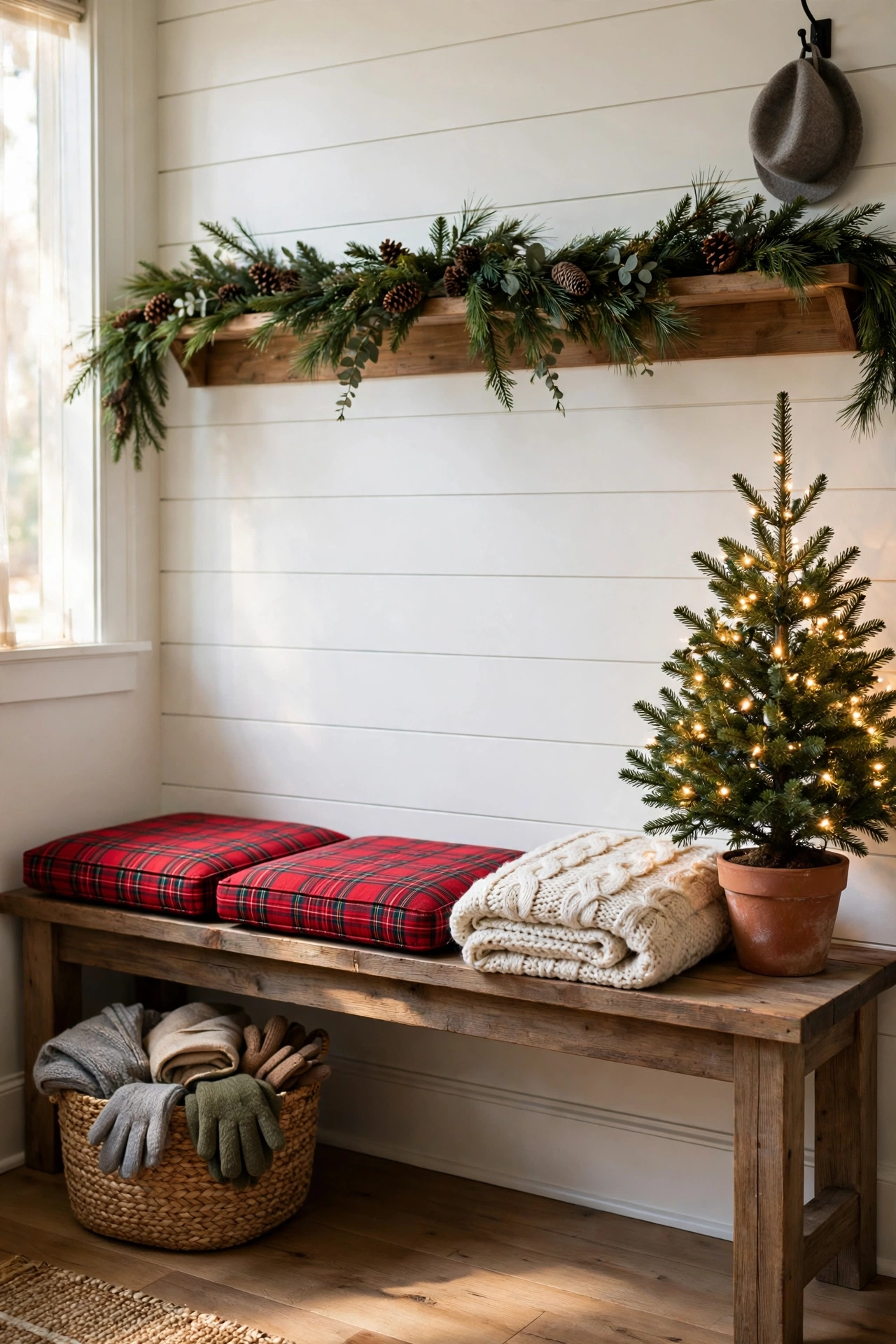
5. Boot Tray and Baskets Under the Bench
Under the bench is the mudroom’s hidden storage, and at Christmas it can also be part of the decoration. A boot tray and a row of baskets under the bench will keep wet boots, gloves, scarves and hats in one tidy place, and they will do it without taking up any floor space in the walkway. The trick is to keep it to one tray and one basket per person, and to keep everything pushed back under the bench, so the front edge of the tray and the baskets line up with the front legs of the bench, or sit just behind them. That line creates a neat rectangle from the bench to the floor, and it makes the whole room feel tidy even when the boots inside are muddy.
Start with the boot tray. Choose a tray with a raised edge, deep enough to hold water, and large enough for two or three pairs of boots. A metal tray, a rubber tray, or a tray lined with pebbles all work well, because they contain the water and mud instead of letting it spread across the floor. Place the tray flat on the floor, under one end of the bench or in front of the bench against the wall, where boots naturally land when people come in. Put the boots in the tray, not beside it, and teach the family once where the tray is. A tray that is used every day will save you mopping the whole floor every day.
Make the boot tray part of the display, not just a practical afterthought. A tray with a neat row of winter boots looks lived in and welcoming, especially in a family home. Add a small bunch of pine sprigs at one end of the tray, or a few pinecones beside the boots, to tie the tray to the garland above. Do not overdecorate the tray. It is a working tray, and it will get wet. One small natural touch is enough. A tray full of ornaments will be in the way when someone needs to put boots in it, and the ornaments will get wet and muddy within a day.
Baskets belong beside the tray, under the bench, one per person. Give each person a basket for gloves, scarves, hats and ear muffs, and label it if you have children who share a bench. A woven basket, a fabric basket, or a simple wooden crate all work, and they all look better than a pile of gloves on the bench. Choose baskets in the same material and the same size, so the row under the bench looks calm and even. If the baskets are different sizes and colours, the row will look like storage that happened by accident.
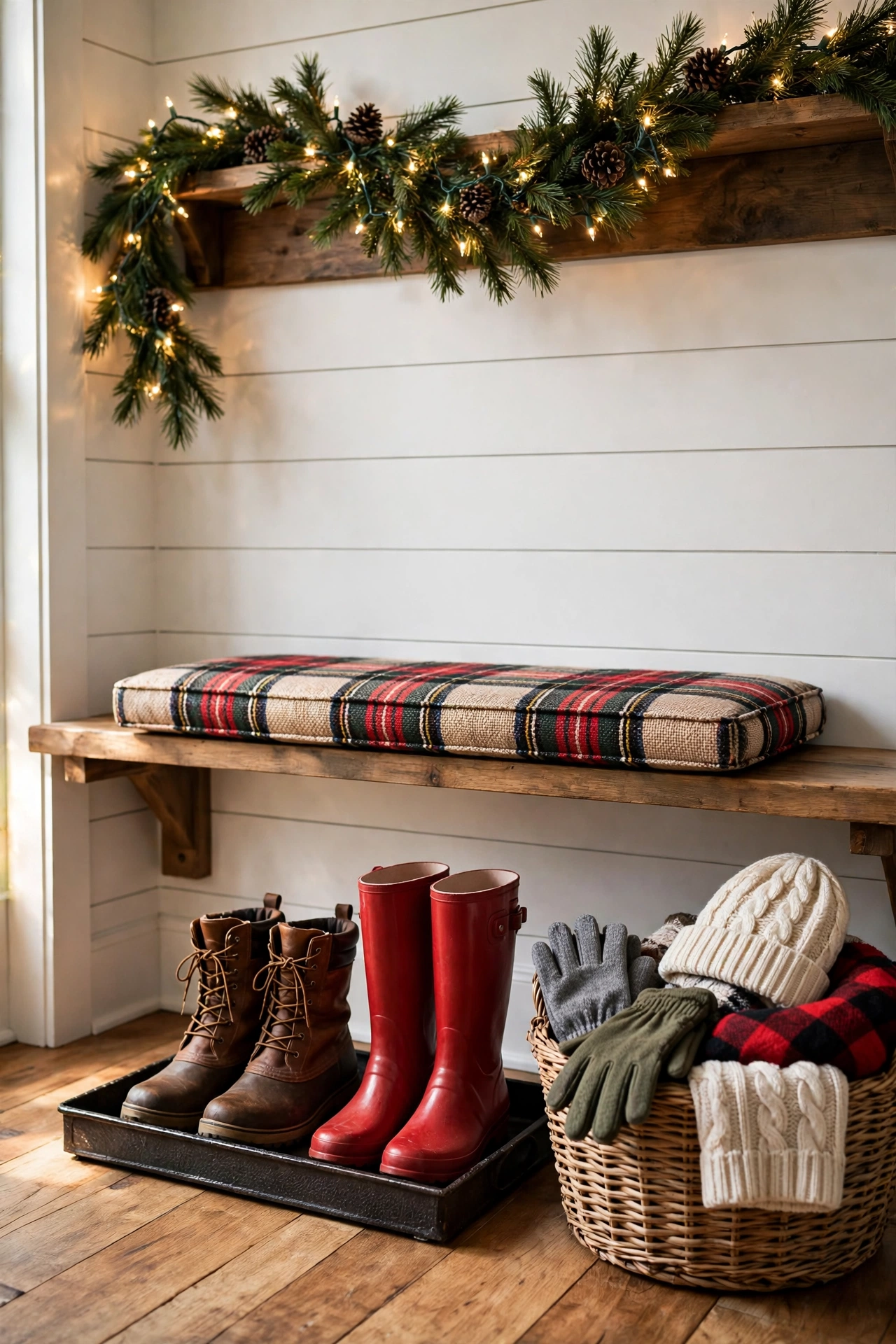
6. A Small Tree in the Corner
A small tree in the corner is the piece that makes a mudroom feel like Christmas, not just like a tidy entrance. It does not need to be large, and it should not be large, because a mudroom is a working room and a large tree will block the door, block the bench, and get knocked over by a bag. A small tree, between 60 and 90 centimetres tall, placed at the end of the bench or in the corner by the door, gives the room height, colour and a clear festive signal, without taking over the space.
Choose the corner carefully. The best place is usually at the end of the bench, against the wall, where the tree can sit on the floor or on a low stool and still be out of the walkway. The second best place is in the corner by the door, on the side where the door opens away from it, so the door does not hit the tree every time it opens. Stand in the doorway and look at the corner. If you can see the tree clearly from the door, and you can walk past it without brushing it with your coat, you have found the right spot. If you have to squeeze past it, or if it blocks the light switch, move it.
Keep the tree below eye level if you can, or just at eye level at most. A tree that is below eye level feels like a small, friendly decoration, part of the room rather than the centre of it. A tree that towers over the bench can make a small mudroom feel cramped, and it can block the garland on the shelf above. If your tree is a little too tall, put it in a shorter pot, or choose a smaller tree. Scale matters more in a mudroom than in a living room, because the room is small and every piece is close to eye level.
Decorate the tree simply. A string of tiny warm battery lights, a handful of small baubles in one or two colours, and a simple topper, such as a small star, a bow, or a pinecone, are enough. Do not try to fit full size ornaments on a small tree. They will overwhelm it and hide its shape. Small wooden stars, tiny baubles, dried orange slices and small pinecones suit a small tree because they are light and they leave the green visible. Use battery lights with a timer, and tuck the battery pack behind the pot, where it is hidden but easy to reach.
7. Small Mudrooms and Boot Rooms
A small mudroom is not a problem to solve. It is a room with a clear limit, and that limit makes the choices easier. You cannot fit a wide bench, a large tree, a full garland and a row of baskets in a small space, so you choose the pieces that matter most, and you decorate up, not out. Decorate up means use the wall, the hooks, the shelf and the top of the door, and leave the floor and the seat as clear as you can. A small mudroom that is decorated up will feel festive and spacious. A small mudroom that is decorated out, with things sticking into the walkway, will feel crowded, no matter how pretty those things are.
A boot room is a mudroom with a slightly different job. It is often a separate small room by the back door, sometimes with a sink, sometimes with a washing machine, and it is where muddy boots, dog towels and outdoor kit live. Decorate a boot room the same way, but lean into its practical side. A garland along the top shelf, mini wreaths on the hooks, and a boot tray by the door will make it feel festive without getting in the way of the sink or the washing machine. Keep decoration away from water, away from the washing machine door, and away from anything that gets hot.
A laundry room that doubles as a mudroom needs the same approach, with one extra rule: keep decoration away from the machines. Do not hang a wreath on the washing machine door, do not lay a garland across the top of the dryer, and do not put a basket on top of a machine that vibrates. Use the wall above the machines for a shelf, put the garland on that shelf, hang mini wreaths on the coat hooks by the door, and keep the floor clear for laundry baskets. A small tree can sit in the corner by the door, away from the machines, and a plaid cushion on a small stool can give you somewhere to sit while you wait for a wash to finish.
In a small mudroom, choose one focal point and let the rest stay simple. That focal point might be a row of mini wreaths on the hooks, or a garland on the shelf, or a small tree in the corner. Pick one, do it well, and keep everything else plain. A small room with one strong focal point looks intentional. A small room with five focal points looks crowded. If you love wreaths, make the wreaths the star, and keep the bench cushions plain, the baskets plain, and the tree small. If you love the garland, make the garland full and rich, and keep the wreaths small and simple.
8. Keeping It Working All December
A Christmas mudroom that looks beautiful on the day you decorate it and falls apart by the second week is not a success. A mudroom that still looks good on Christmas Eve, and still works on the morning after, is the real goal. That takes a little maintenance, but not much. It takes one hour at the start, a few minutes each week, and a clear idea of what to tidy, what to leave alone, and what to take down after Christmas.
Start with the one hour plan. Give yourself one hour, not a whole day, to decorate the mudroom. Spend the first fifteen minutes clearing the room completely and cleaning it. Spend the next fifteen minutes hanging the garland and the mini wreaths, because those are the high pieces and they set the shape of the room. Spend the next fifteen minutes on the bench, the cushions, the throw, and the baskets under it. Spend the last fifteen minutes on the boot tray and the small tree, then step back, take a photo, and look at the small image. If the photo shows a clear floor, a free seat, and a calm row of hooks, you are done.
Tidy weekly, not daily. A mudroom will get messy every day in December, and trying to keep it perfect every day will wear you out. Instead, pick one day a week, perhaps Sunday evening or Monday morning, and spend ten minutes on it. Empty the boot tray and wipe it dry. Shake out the baskets and put back only what belongs there. Straighten the cushions and refold the throw. Tighten any ribbon that has slipped, replace any lights that have gone out, and sweep up any needles from the tree and the garland. Wash the cushion covers if they are muddy, and swap in the spare cover from the basket. Ten minutes a week will keep the room looking fresh all month.
Know what to leave up after Christmas, and what to take down. The garland, the mini wreaths, the plaid cushions and the small tree are Christmas pieces, and they should come down in early January, when the season ends. Take them down in the same order you put them up, in reverse: tree first, then cushions and throw, then garland and wreaths, then boot tray wash and basket tidy. Store the wreaths flat, store the garland in a long box, wash the cushion covers and fold them away, and keep the baubles and lights in a labelled box for next year. Leave the boot tray and the baskets in place, because they are useful all year, not just at Christmas. A mudroom that returns to normal easily is a mudroom you will want to decorate again next year.
Conclusion
A Christmas mudroom does not need to be large, expensive, or perfect. It needs to be warm, organised, and easy to use. Start with the formula, hooks high, bench low, floor clear, and give each person one hook plus one spare. Hang mini wreaths on the coat hooks, so the hooks themselves become part of the display. Lay a garland along the top shelf, and let it spill a little at the ends. Dress the bench with two plaid cushions and one folded throw, and keep most of the seat free to sit on. Put a boot tray and one basket per person under the bench, and keep them pushed back so the floor stays clear. Add a small tree in the corner, below eye level, with battery lights and simple decorations. Adapt everything for a small mudroom or a boot room by decorating up, not out, and by choosing one focal point and keeping the rest simple. Keep the room working all December with one hour at the start and ten minutes a week, and take the Christmas pieces down in early January, leaving the boot tray and baskets in place for the rest of the year.
Frequently Asked Questions
How do I decorate a mudroom for Christmas without blocking the hooks?
Hang mini wreaths on the hooks with a ribbon loop, so each wreath frames its hook and still leaves room for a coat behind it. Keep the wreaths between 15 and 25 centimetres across, hang them a little high so they show above the coats, and leave one spare hook free of a wreath for a wet coat or a guest. Put the garland on the top shelf, not on the hooks, so the hooks stay free to use.
What is the best garland for a mudroom top shelf?
Choose a garland that fits the length of your shelf, with a little spill over each end, and dress it with warm white battery lights, a wide plaid ribbon, and small clusters of pinecones, berries and dried orange slices. Lay it along the front edge of the shelf so it is visible from the doorway, and keep useful things in baskets behind it. Use battery lights with a timer, and use flameless candles only, never a real flame near dry greenery.
How many cushions should I put on a mudroom bench?
Use two cushions, placed upright against the back of the bench, and one folded throw at one end, and leave most of the seat free to sit on. Plaid covers in your main colours will look warm and hide marks, and washable covers are worth choosing, because mudroom cushions get sat on, dropped and covered in mud. Keep a spare cover in a basket under the bench so you can swap a muddy one in a minute.
How do I keep wet boots from making a mess in my Christmas mudroom?
Use a boot tray with a raised edge, large enough for two or three pairs, placed flat on the floor under one end of the bench or against the wall. Put the boots in the tray every time, empty and wipe the tray once a week, and keep a small towel by the door for wiping paws and boots. A tidy row of boots in a tray looks welcoming, and it stops mud and water from spreading across the floor.
Can I put a Christmas tree in a small mudroom?
Yes, if you choose a small tree, between 60 and 90 centimetres tall, and place it at the end of the bench or in the corner by the door, where it will not block the walkway or the door. Keep it below eye level, decorate it simply with battery lights and small baubles, and hide the pot in a basket or a planter. Check it once a week, tighten any baubles that have slipped, and sweep up any needles.
What should I do with my mudroom decorations after Christmas?
Take the Christmas pieces down in early January, in reverse order: tree first, then cushions and throw, then garland and wreaths. Wash the cushion covers, store the wreaths flat with tissue paper between them, and keep the baubles and lights in a labelled box for next year. Leave the boot tray and the baskets in place, because they are useful all year, and give the bench and the shelf a good clean before the room returns to normal.
Budget Table
| Item | Approximate cost |
|---|---|
| Mini wreaths, set of 4 | 16 to 28 dollars |
| Artificial garland, 180 cm | 15 to 25 dollars |
| Plaid cushion covers, set of 2 | 12 to 22 dollars |
| Soft throw in plain colour | 14 to 24 dollars |
| Boot tray with raised edge | 12 to 20 dollars |
| Woven baskets, set of 3 | 18 to 30 dollars |
| Small tree, 75 cm, with pot | 18 to 32 dollars |
| Warm white battery fairy lights | 6 to 12 dollars |
| Wide plaid ribbon, 3 metres | 5 to 9 dollars |
| Pinecones, berries and sprigs | 8 to 15 dollars |