
Christmas Nutcracker Decor Ideas for Every Room
A nutcracker is the one Christmas decoration that stands guard. It does not hang, it does not drape, it does not twinkle. It stands, straight backed and bright coated, at the end of a mantel or beside a front door, and it tells every guest who walks in that Christmas has arrived and this house is ready for it. That is why nutcrackers have guarded German mantels for more than two centuries, and why they are back at the front of Christmas decorating in 2026.
This year the nutcracker is not a small collectible for a shelf. It is one of the nine trending Christmas themes of the season, named in the 2026 trend guides alongside vintage and whimsy, and the guides agree on why: a nutcracker carries the whole story of Christmas in one figure, the ballet, the toy soldier, the Land of Sweets, the protection and good fortune of German folklore, and it does it in a shape a child recognises at once and a grown up still loves. The home guides published this November say searches for nutcracker collections are among the fastest growing Christmas searches of 2026, and the shops agree, from West Elm and World Market to Walmart, where a six foot paintable nutcracker released in September 2026 became the viral Christmas DIY of the year.
The system in this guide is simple enough to remember: one hero, one place, one story. A nutcracker works best when it has a job and a spot, guarding a mantel, welcoming guests at a door, anchoring a table, or standing in a group of three on a shelf. It works worst when it appears in every room at once, because ten nutcrackers scattered through a house stop being charming and start being wallpaper. Pick the spots, pick the sizes, and let each nutcracker do its job in one place.
You do not need a collection to start. You need one good figure, and this guide will show you how to choose it, where to stand it, how to group it, and how to keep it safe from heat, steam and small hands. We start with the one hero rule and the sizes that matter, then the mantel pair, the front door welcome, the tree, the dining table, the shelf and the windowsill, the ballet corner, and finally the budget buys and the storage rules, because a good nutcracker should last for decades. One nutcracker, one place, and a house that feels guarded and warm all December.
Start With One Hero, Not a Dozen
Every nutcracker collection that looks good started with one figure, and every collection that looks cluttered started with twelve bought in one afternoon. The first rule of nutcracker decorating is the one hero rule: buy one nutcracker you love, give it the best spot in the house, and live with it for a week before you buy a second. A single figure standing alone on a mantel or a hall table has more presence than a shelf crowded with figures nobody can see properly, and it teaches you what size and style you actually like before you spend more money.
Size is the first decision, and nutcrackers come in four useful sizes. The tabletop size, about 12 to 18 inches tall, is the most versatile size there is. It sits on a mantel, a shelf, a sideboard or a windowsill, it works in pairs and in groups, and it does not overwhelm a small room. If you buy only one nutcracker this year, buy this size, because it fits everywhere and it is the size that looks collected rather than bought in bulk. The medium size, about 18 to 24 inches, is a small statement piece, good for a hall table or the floor beside the tree, where it reads clearly from across the room without needing a partner.
The large size, about 3 to 4 feet tall, is a statement piece for the floor. It stands on its own in a hallway, on a hearth, beside the tree, or on a wide stair, and it needs little around it beyond a candle or some greenery at its feet. Two large nutcrackers flanking a front door are the classic welcome, and one large figure in a corner can anchor a whole room. The giant size, five to six feet tall, is the showpiece of 2026. The viral six foot Walmart nutcracker, released in September 2026 for $159, comes unfinished so you can paint it yourself, and it lights up and plays music. A giant nutcracker belongs on a porch or in a large entryway, never in a small room, where it will crowd everything else out.
Style is the second decision, and the honest answer is that there are two families and you should pick one. The traditional family is the soldier: red coat, tall black hat, gold braid, white trousers, the figure from the ballet and from a century of mantelpieces. The storybook family is everything else: the king with a crown, the drummer boy, the baker, the forester, the Sugar Plum Fairy, the Mouse King, and the pastel ballet figures in pink and gold. Traditional soldiers suit a classic red and green house. Storybook figures suit a whimsical, pastel or ballet themed house. Mix the two families and the display looks confused, because a red soldier and a pink fairy are telling two different stories. Pick one family, stay inside it, and the house will read as one plan.
Material matters more than most people expect, because a nutcracker is a display piece that gets handled, dusted and stored every year. Wood is the classic material, heavy, warm, and the one that ages best, and a wooden nutcracker bought this year can still be standing guard in twenty years. Resin is the practical choice for outdoor figures, because it survives rain and cold, and the weatherproof porch nutcrackers are almost always resin painted to look like wood. Painted metal and ceramic figures look beautiful on a shelf but chip easily, so keep them indoors and away from the edges of tables where they can be knocked off. Whatever the material, check the base before you buy: a nutcracker with a wide, flat, heavy base stands safely on a mantel, while a narrow base topples at the first bump from a pet or a child.
The one hero rule ends with a question, not a purchase. Stand your one nutcracker in its spot, step back to the doorway, and look at the room the way a guest will see it. If the figure draws your eye and the room feels more festive, the size and the style are right. If the figure disappears into the clutter, move it to a clearer spot before you buy a second one. One nutcracker in the right place is worth more than a dozen in the wrong ones, and the right place is always the one where the figure can be seen from the door, with nothing in front of it and nothing competing beside it.
The Mantel Guard Pair
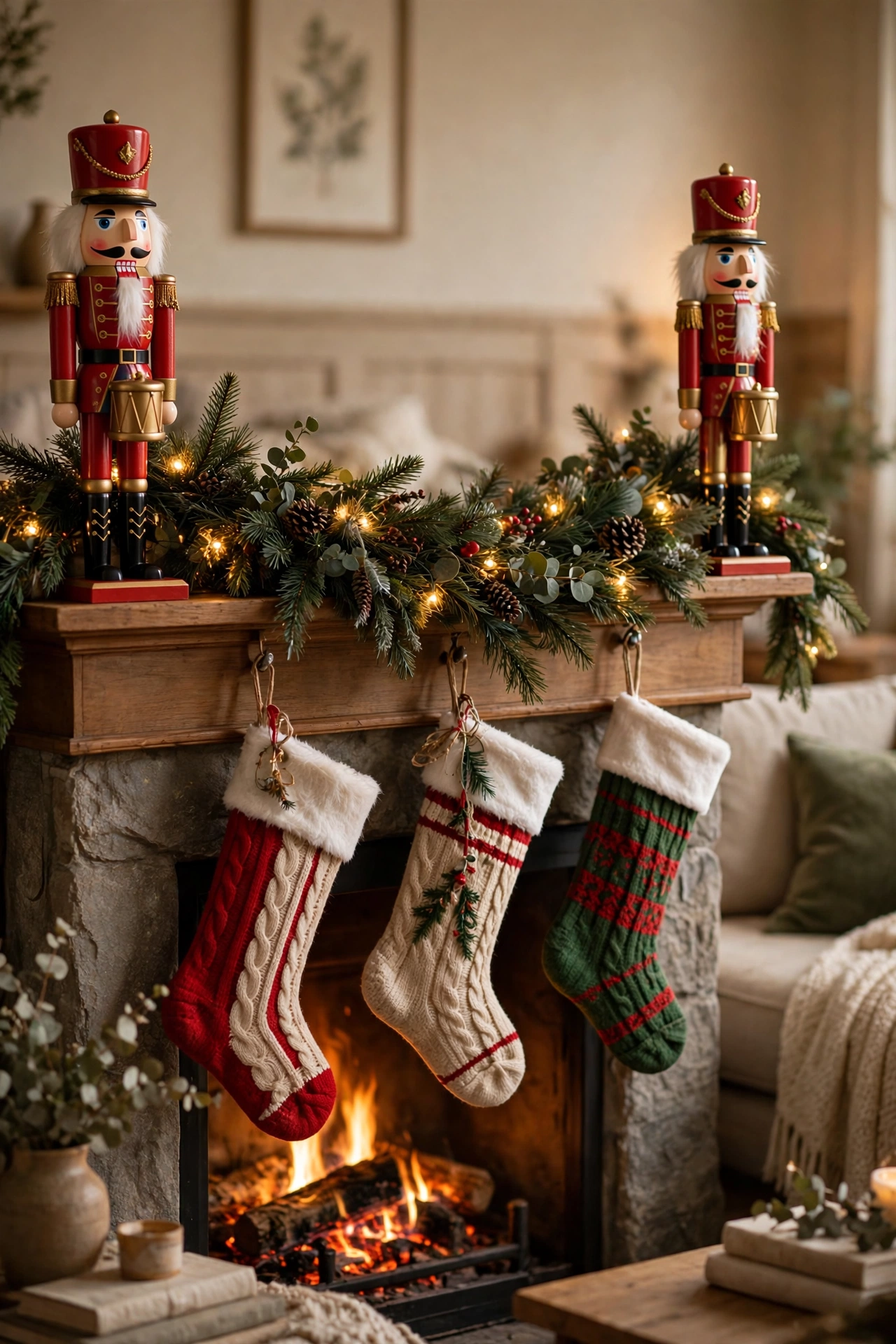
The mantel is the nutcracker’s natural home, and it has been for more than two centuries. The fireplace is the heart of the living room in December, every eye in the room lands on it, and two tall nutcrackers standing guard at each end of the mantel frame everything between them: the garland, the candles, the stockings, and the mirror or the artwork above. A mantel without a nutcracker is a mantel waiting for its guards, and a mantel with a nutcracker in the middle and nothing at the ends looks lopsided, because the figure pulls the eye to one side.
The classic arrangement is a pair, and the rules for a pair are simple. Choose two nutcrackers of the same height, either the same design or two different designs in the same family and the same palette, and stand one at each end of the mantel with the greenery and the candles between them. The center of the mantel stays clear for the mirror or the artwork, and the two figures frame it like sentries. The pair works because nutcrackers are upright, symmetrical figures, and symmetry suits them: a matching pair gives a room a formal, finished look that a single figure in the middle never quite achieves. The height to aim for is 12 to 18 inches on a standard mantel, tall enough to read from the sofa, short enough to leave the mirror visible above them.
Greenery is what turns two figures into a display. Drape a faux evergreen garland along the mantel, let it swag gently between the figures, and tuck the nutcrackers slightly in front of the garland so they stand proud of it rather than disappearing behind it. Add warm white fairy lights woven through the garland, and the light will catch the gold braid and the painted details in the evening. Add three pillar candles of different heights in the center, in glass holders so the flame is protected, and the mantel has three layers: figures at the ends, greenery and light in the middle, candles rising above it. Keep the candles at least a foot away from the nutcrackers, because a wooden figure and an open flame should never be neighbours.
Stockings hang below, and the mantel pair sets the palette for them. If the nutcrackers are traditional red soldiers, the stockings look best in deep red, forest green, or cream, with gold or brass holders that match the braid on the uniforms. If the nutcrackers are pastel ballet figures, the stockings look best in blush pink, pale gold, or cream. The mistake to avoid is a mantel where the nutcrackers say traditional and the stockings say something else entirely, because the eye will keep jumping between two stories. One palette, one family, and the mantel reads as a single picture.
The small details make the mantel feel finished rather than staged. A mirrored tray under the candles reflects the firelight and doubles the glow. A small cluster of pinecones and red berries at the feet of each nutcracker hides the base and grounds the figure, so it looks planted rather than placed. A ribbon in the same colour as the nutcracker coats, tied around the garland at intervals, repeats the palette without adding another object. And a felt pad under each base protects the mantel surface from scratches and stops the figure sliding when the garland is adjusted, which is a small job that saves a real repair.
If your home has no fireplace, the mantel rule still applies, because a mantel shelf, a console table, or a wide sideboard can play the same role. Stand the pair at the ends, drape the garland between them, and hang a wreath or a mirror above, and the sideboard becomes the focal point the room was missing. Our Christmas Mantel Decor Ideas guide covers mantels in detail, including the no fireplace version, and the pair arrangement in that guide works with exactly the same measurements: two figures, same height, greenery between, center clear. A nutcracker pair does not need a fire to guard a room. It needs a shelf, a little greenery, and two ends to stand on.
The Front Door Welcome: The Porch Pair
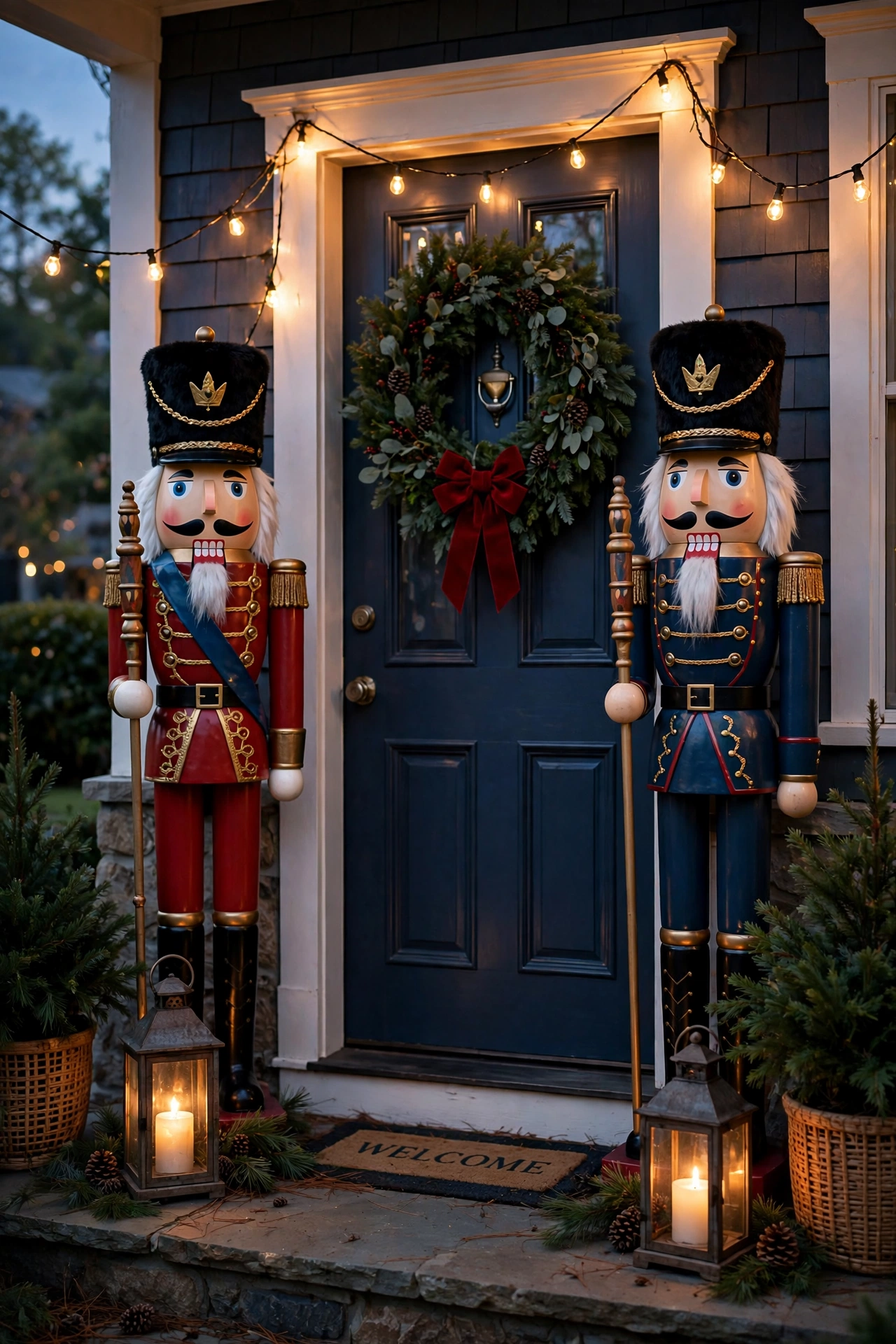
The front door is the second natural home of the nutcracker, and it is the one guests see first. Two tall nutcrackers flanking a front door turn an ordinary entrance into a welcome, and they do it before a guest has even knocked. The porch pair is the most photographed nutcracker display of 2026 for a simple reason: a soldier standing guard on each side of a door is a picture that needs no explanation, and it photographs beautifully in the evening when the lanterns are lit and the string lights are on.
Outdoor nutcrackers are a different purchase from indoor ones, and the first rule is to buy for the weather. A wooden nutcracker left outside in rain will swell, crack, and lose its paint in one season, so outdoor figures should be resin, marine grade resin if you can find it, painted with UV stable acrylics that hold their colour in winter sun. Check the label before you buy: if it does not say outdoor or weather resistant, it is an indoor figure, and it will not survive December outside. The porch pair should also be heavy, or weighted at the base, because a tall figure on a windy porch topples easily, and a toppled nutcracker chips its paint and cracks its hat. Some porch nutcrackers come with stakes or sand compartments in the base; if yours do not, stand them inside a heavy planter or wedge a sandbag behind them, out of sight.
Size on a porch follows one rule: the figure should be about a third of the height of the door. A standard front door is about 80 inches tall, so a porch nutcracker of 24 to 36 inches looks right beside it, tall enough to be noticed from the street, short enough not to crowd the doorway. The giant five to six foot nutcrackers break this rule on purpose, because they are meant to be as tall as the door itself, and they work best as a single pair on a wide porch with room around them. On a small porch or a narrow stoop, a giant pair will block the walkway and crowd the door, and a single medium figure on one side, balanced by a lantern on the other, looks better than two giants fighting for space.
The porch display is built in layers, and the nutcrackers are only the first layer. Behind them, the door carries a wreath, evergreen with a red velvet bow, which repeats the palette of the soldiers’ coats. Between them and the door, potted evergreens in heavy pots add height and greenery, and they also anchor the display visually so the figures do not look like they are standing alone on bare concrete. At their feet, two lanterns with warm battery candles give the evening glow, and the light should be warm white, never cool white, because cool light makes red coats look pink and gold braid look grey. Wrapped gift boxes in the same palette, stacked beside the planters, add a third layer, and a doormat in a plain dark colour keeps the eye on the figures instead of on a pattern.
Safety on a porch is not optional, because a porch is a walkway and guests arrive in the dark. Keep the path clear: no figure, lantern, or planter should narrow the walkway below the width of a person carrying shopping bags. Keep cords off the walkway, and use battery candles in the lanterns rather than real flames near dry greenery. If the nutcrackers light up, run the cable along the wall and under the doormat, never across the steps. And bring the figures in before a storm if you can, or at least turn them to face the wall so driving rain does not hit the painted faces directly. Our Christmas Front Porch Decor Ideas guide covers the full porch plan, including the weatherproofing checklist, and the nutcracker pair slots into that plan as the tallest element, with the wreath, the garland, and the lanterns around it.
The porch pair is also the easiest nutcracker display to scale up or down. One year you start with two medium resin soldiers and a wreath. The next year you add the lanterns and the planters. The year after that you replace one soldier with a giant six foot figure and move the medium one to the hallway. The display grows with the collection, and because the pair is the unit, it never looks unfinished: two figures, one door, and a welcome that works from the street. That is the whole secret of the porch pair, and it is why the guides keep photographing it: symmetry, height, and warm light, and nothing else competing for attention.
The Tree: Mini Nutcrackers and the Tree Skirt
The Christmas tree is where the nutcracker shrinks, and that is exactly why it works. A full size nutcracker beside the tree is a guard. A mini nutcracker on the tree is a jewel, a small painted figure hanging among the ornaments, catching the light at eye level, and telling the ballet story in miniature. The 2026 guides all name the same idea: mini nutcracker ornaments, three to five inches tall, hung in a cluster on one section of the tree, or scattered evenly through the branches in the same palette as the rest of the ornaments.
The cluster is the better arrangement for most trees. Pick one section of the tree, about a third of the way up and facing the room, and hang five to seven mini nutcrackers there in a loose group, mixed with small gold and red baubles and a few pinecones. The cluster reads as a themed moment, a little ballet scene inside the tree, and it photographs beautifully because the eye has one place to land. Scattering the same figures evenly around the whole tree spreads them too thin, and each one disappears among the ornaments. A cluster says this tree has a story. A scatter says this tree has a few small figures lost in it.
Scale is the rule that makes or breaks the tree nutcracker. A mini figure of three to five inches suits a six to seven foot tree, because it is big enough to see from the sofa and small enough not to bend the branch. A figure larger than six inches is too heavy for a branch and will droop, pulling the branch down and hiding the ornaments below it. Hang the minis on the sturdier inner branches near the trunk rather than on the delicate tips, and use ornament hooks or short lengths of ribbon rather than the thin wire that comes in the box, because ribbon holds better and looks better. Keep the minis away from the top of the tree, where the topper belongs, and away from the bottom branches, where they will be hidden by presents.
The tree skirt is the second place the nutcracker belongs on a tree, and it is the one most people miss. Three miniature nutcrackers, three to five inches tall, nestled into the folds of a burlap or felt tree skirt, angled outward like sentinels, turn the base of the tree into a scene. They should be the same family and the same palette as the minis on the branches, so the tree reads as one story from top to bottom. A burlap skirt suits traditional red soldiers. A cream felt skirt suits pastel ballet figures. The figures sit on the floor, so they need a flat base and a spot where they will not be kicked when presents are put down, which means placing them at the back or the sides of the tree rather than at the front where the gifts go.
Colour is what ties the tree nutcrackers to the rest of the tree. If the tree is red and gold, the minis should be red coated soldiers with gold braid. If the tree is pink and gold, the minis should be pastel ballet figures. If the tree is a natural green and wood theme, the minis should be unpainted wooden figures. The mistake is a tree where the ornaments say one palette and the nutcrackers say another, because the figures will look like they wandered in from a different house. One palette, one family, from the topper to the skirt, and the tree will look planned rather than assembled.
The tree nutcracker also connects to the rest of the house, because the same figures can echo in other rooms. A mini nutcracker on the tree, a medium one on the mantel, and a large one by the front door, all in the same family, make the whole house feel like one home, and that repetition is the cheapest way to make Christmas decorating look professional. Our Christmas Tree Decor Ideas guide covers the tree itself in detail, including ornament depth and the lights first rule, and the nutcracker minis slot into that guide as the themed cluster, hung after the lights and before the last ornaments, so they sit at the right depth and catch the light. A tree with a nutcracker cluster is a tree with a story, and the story is the one every child in the house already knows.

The Dining Table: One Nutcracker, One Land of Sweets
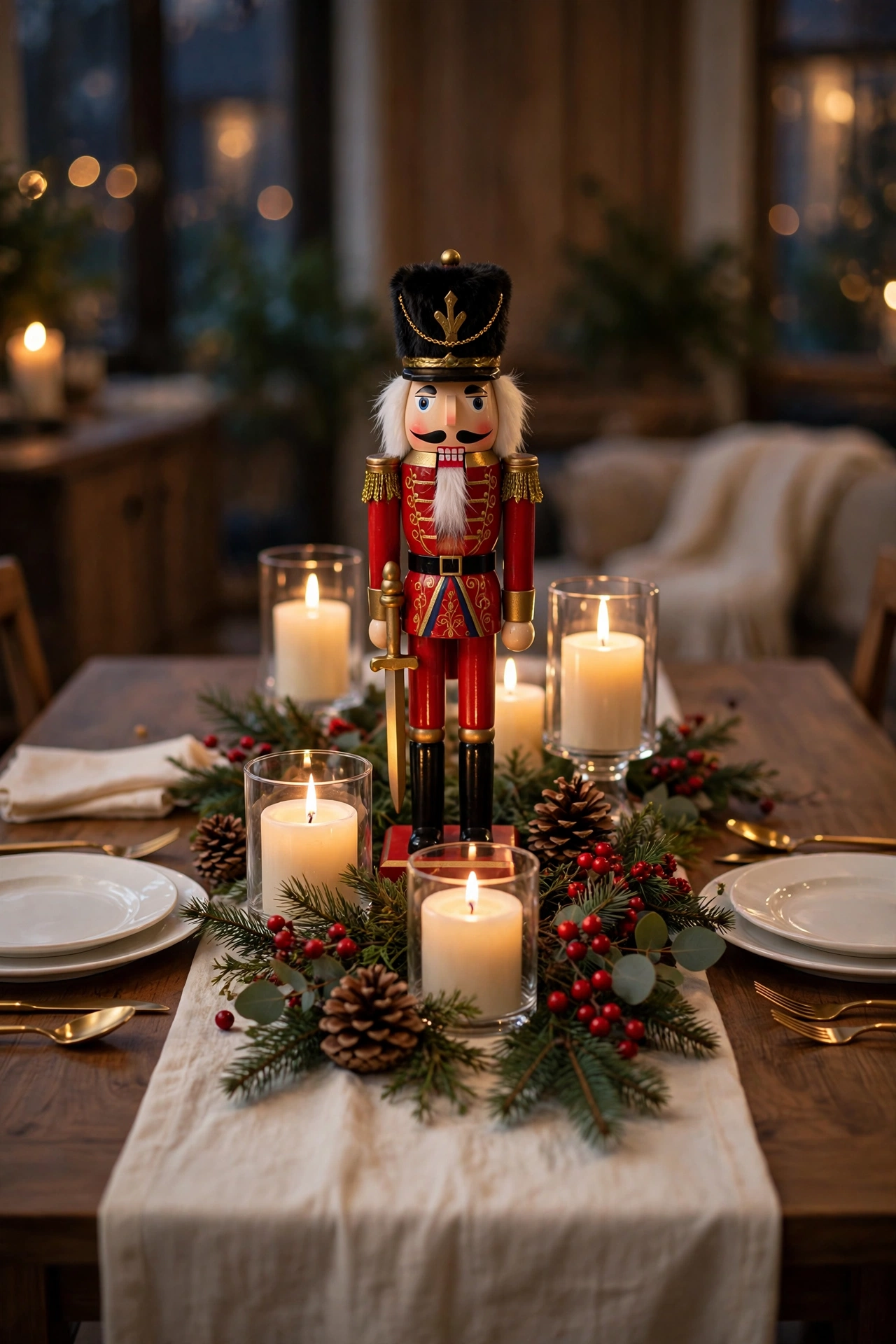
The dining table is where a nutcracker earns its keep as a centerpiece, and the rule here is one figure, not a row. A single tall nutcracker, about 14 to 18 inches, standing at the center of the table or at the head of a long table, anchors the whole setting, and everything else arranges itself around it: the candles, the greenery, the plates, and the glasses. A row of nutcrackers down the middle of a table blocks the view across it, crowds the serving dishes, and turns dinner into a game of peeking around soldiers. One figure, one anchor, and the table still works for eating.
The Land of Sweets is the theme that makes a table nutcracker feel like a story rather than a statue. The Nutcracker ballet ends in a kingdom of sweets, and the table can borrow that idea with very little effort: a linen runner in cream or deep red, a low evergreen garland running down the center, pillar candles in glass holders at different heights, pinecones, cinnamon sticks, and a scattering of red berries. The nutcracker stands at the center of that runner, or at the head of the table if the table is long, and the sweets themselves join the display: a bowl of sugared fruit, a plate of gingerbread men, a small bowl of candy canes, and a jug of spiced punch. The table looks like a feast before the food arrives, and the nutcracker is the host.
Height is the practical rule on a table, and it is the one that decides whether dinner works. The nutcracker should be tall enough to be seen, about 14 to 18 inches, and short enough that guests can see each other over it. Anything taller blocks conversation, and anything shorter disappears behind the candles. Keep the figure well away from open flames, at least a foot from any candle, and never place a nutcracker directly beside a candlestick, because a wooden figure and a flame are a bad combination. Battery candles in glass holders give the same glow with none of the risk, and they are the better choice on a table where people are reaching for dishes.
The place settings repeat the palette without repeating the figure. If the nutcracker is a traditional red soldier, the napkins are deep red or cream, tied with a thin gold ribbon, and the plates are white with gold cutlery. If the nutcracker is a pastel ballet figure, the napkins are blush pink, the ribbon is gold, and the glasses carry a sugared rim. A small nutcracker themed detail at each place setting, a mini figure as a place card holder, or a single candy cane tied to the napkin, extends the story to every guest without crowding the table. One detail per setting is enough. Two is clutter.
The table nutcracker is also the figure that moves most easily after dinner. When the plates are cleared, lift the nutcracker and the runner together to the sideboard, and the table is clear for dessert and coffee. A centerpiece that lifts away in one move is the test of a good table display, and a single figure on a tray passes it easily, while a row of figures and candles does not. Set the nutcracker on a wooden tray with the candles and the greenery, and the whole centerpiece moves in one hand. That tray is also the secret to the small table version of this display: one tray, one figure, two candles, and a table for four that still seats four.
After Christmas dinner, the table nutcracker can move to the sideboard or the hall table and guard the room for the rest of the season, which is the practical advantage of a single figure: it has no fixed home, so it can go wherever the house needs a little ceremony. A nutcracker that has hosted dinner has earned its place by the door, and it will stand there happily until the decorations come down.
The Shelf, the Windowsill, and the Odd Number Rule
The shelf and the windowsill are where a nutcracker collection lives, and the rule that governs them is the odd number rule: three or five, never four or six, and mixed heights so the eye moves across the group instead of stopping at a straight row. A row of identical figures in a straight line looks like a shop display. A group of three in different heights, one tall in the middle and two shorter flanking it, looks collected, and that is the difference between a display and a lineup.
The shelf display starts with clearing the shelf. A nutcracker group needs a clear surface, because a figure standing in front of books, boxes, and clutter disappears into the background. Clear one open shelf, or one end of a sideboard, and give the group a plain backdrop: a wall, a mirror, or a piece of fabric hung behind it. Add greenery first, a short garland or a few sprigs of faux pine laid along the back of the shelf, then the figures in front of it, so the green frames them and the light catches them. A string of warm fairy lights behind the figures, tucked into the greenery, gives the group its evening glow, and the light should be behind the figures, not in front of them, so the figures are lit from behind and their painted details catch the light.
Mixed heights are what make the group work. A tall figure of about 18 inches in the middle, flanked by two figures of about 12 inches, creates a triangle, and the eye follows the triangle up and down instead of sliding across a flat line. Mixed finishes help too: a natural wooden nutcracker beside a painted red one reads as a collection built over years, while three identical painted figures read as a single purchase. One tall wooden figure, one painted soldier, and one small king or drummer boy, all in the same palette, look like a family. Three identical soldiers look like a set.
The windowsill is the shelf with daylight, and it has its own rules. A cheerful trio of nutcrackers lined along a windowsill brings instant personality to a room, because the figures are visible from both inside and outside the house, and the natural light shows their colours honestly. The sill display should be low, figures of 12 inches or less, so they do not block the light, and the group should be small, three figures at most, so the window still feels like a window. Keep the figures away from radiators below the sill, because heat dries wood and cracks paint, and keep them out of direct sun for long hours, because velvet hats and painted faces fade. A sill display is a display for the daytime, and it looks best in the morning light, when the sun catches the gold braid.
The kitchen is the room where the shelf rule matters most, because a kitchen counter is a working surface and a nutcracker on it must not get in the way of cooking. The best spots are a shelf, a windowsill, or the end of a counter where the figure can be seen but never blocks the chopping board. Keep nutcrackers at least a few feet from the stove and the sink, and never place one above a kettle or a steaming pot, because steam and heat damage paint and wood faster than anything else in the house. A food themed figure, a baker or a chef nutcracker, suits a kitchen shelf, and a small group of three on the shelf above the coffee station turns a plain corner into a Christmas corner without losing a single inch of counter.
Rotation is the last part of the shelf rule, and it is the one that keeps a collection feeling new. If you own a dozen nutcrackers, do not display all twelve. Display five this year and five different ones next year, and the collection feels new without spending anything. The figures that stay in the box are not wasted. They are next year’s display, and they will look fresh because nobody has seen them for a year. A collection that rotates is a collection that lasts, and a shelf that changes is a shelf that guests notice, because it is never quite the same twice.
The Ballet Corner: Sugar Plum Pinks, Swans, and Gold
The Nutcracker is a ballet before it is a decoration, and the ballet corner is the display that leans into the story instead of the soldier. The 2026 trend guides describe this version clearly: a Nutcracker Christmas that leans soft and ballet inspired, with sugar plum pinks, swans, and gold, rather than rows of soldiers. It is the prettiest version of the theme, the one that suits a bedroom, a little girl’s room, or a living room that already runs pink and gold, and it is the version that photographs best on Pinterest, where pastel trees and ballet details are leading the saves this November.
The palette is the whole idea, and it has three colours: sugar plum pink, soft gold, and cream. Pink carries the romance, gold carries the celebration, and cream keeps the two from turning sugary. A pink that is too bright reads as a toy shop. A pink that is soft, blush or dusty rose, reads as a ballet. The figures to choose are the storybook family: the Sugar Plum Fairy with her crown, the Mouse King, Clara in her party dress, and the swan, which is the symbol of the ballet’s second act and the figure that makes the display unmistakably Nutcracker rather than generically pink. A swan tree topper, a felt Sugar Plum Fairy stocking, and a set of felt nutcracker ornaments are the pieces the 2026 guides keep naming, and they are worth seeking out because they are the details that make the theme read as a story.
The ballet corner needs one clear spot, and the best spot is a side table or a small console in the room where the tree stands. Set a small tree, about two to three feet tall, on the table, dress it in pink and gold ornaments with a swan topper, and stand two ballet figures beside it, a Sugar Plum Fairy on one side and a nutcracker prince on the other. Add a string of warm fairy lights, a small stack of books about the ballet, and a pink throw draped over the chair beside the table, and the corner becomes a scene. The corner works because it is small and complete: one table, one tree, two figures, and nothing else competing for attention.
The kids’ corner is the ballet corner’s younger sibling, and it is the version that children actually play with. A low table or a toy shelf, a few sturdy nutcracker figures that can survive being picked up, a puppet theatre kit or a set of character crackers, and a stack of picture books about the ballet turn a corner of a child’s room into a stage. The figures for a kids’ corner should be resin or sturdy wood, never ceramic, because they will be handled, and they should be large enough not to be a choking hazard for small children. The rule for a kids’ display is that it is a display to touch, not a display to look at, and that means choosing figures you are willing to see played with.
The party table borrows the ballet corner for one evening. A Nutcracker themed Christmas party table uses the same palette, pink and gold, with a Land of Sweets dessert table, sugar plum treats, spiced plum tarts, sugared fruit, and a pink punch, and the figures become the table decorations: a Sugar Plum Fairy at the center, small nutcrackers as place markers, and character crackers at each setting. The Meri Meri ballet collection, with its advent calendar, garland, character crackers, plates, and cups, is made for exactly this table, and the guides name it as the party collection of the season. A ballet party is a party with a story, and the story is the reason guests remember it.
The ballet corner is also the version of the theme that ages best, because it is not tied to a single Christmas. A pink and gold display can stay up through January as a winter display, long after the red soldiers have gone back into their boxes, and the swan and the fairy still look right in the soft light of a winter afternoon. That is the practical advantage of the pastel version: it outlasts Christmas, and it does it without looking like a decoration that overstayed its welcome.
Budget Buys and Safe Storage
A nutcracker collection does not need a big budget, and the cheapest figures are often the ones with the most character. Thrift stores, charity shops, and end of season sales are the best places to find nutcrackers cheaply, because a wooden soldier bought secondhand for a few dollars has the same presence on a mantel as one bought new for fifty. The trick is to buy for condition, not for price: check that the jaw still moves, that the hat is firmly attached, that the paint is not chipped on the face, and that the base is flat and stable. A chipped figure can be repainted, but a figure with a broken jaw or a wobbling base is a repair, not a bargain.
The paint your own nutcracker is the budget buy of 2026, and it is also the most personal. The six foot Walmart nutcracker, released in September 2026 for $159, comes unfinished in white, so you can paint it to match your house exactly, and it lights up and plays music when it is done. Painting one takes a weekend, a primer, acrylic paints, brushes, and a sealer, and the guides that cover it agree on the same tips: prime first, paint in thin coats, let each coat dry, and seal at the end so the paint survives a winter outside. The same idea works at tabletop size, where an unfinished wooden nutcracker costs a few dollars and a set of acrylic paints turns it into a figure that matches your palette exactly. A painted nutcracker is a nutcracker that belongs to your house and no other, and that is worth more than a perfect shop bought one.
The budget rule for a collection is to buy one good figure a year rather than twelve cheap ones in one afternoon. A collection built one figure at a time, over five or six Christmases, has a story: this one came from a thrift shop, this one was painted with the children, this one was a gift, this one was the splurge. A collection bought in one box has no story, and it shows, because every figure looks the same age and the same style. One figure a year, chosen carefully, is the slowest way to build a collection and the best way, because the collection grows with the house and the family, and each figure means something.
Storage is the part of nutcracker decorating that nobody photographs and everybody regrets skipping. A nutcracker stored badly comes out of the box in January with a chipped hat, a cracked jaw, or a faded coat, and a figure that stood guard all December deserves better. Wrap each figure in acid free tissue paper, not newspaper, because newsprint transfers ink to paint, and stand the figures upright in a box with dividers, one figure per compartment, so they cannot knock against each other. Stuff the gaps with tissue paper so nothing moves when the box is carried. Keep the box in a cool, dry place, never in a damp garage or a hot attic, because wood cracks in dry heat and paint peels in damp. Label the box with the year and the figures inside, so next December you can find the pair you want without opening every box in the store room.
Heat and steam are the two enemies to remember all year, not just in storage. Anchor displays at least three feet from direct heat, from fireplaces and radiators, and keep the humidity in the room between 40 and 55 percent if you can, because wood dries out and cracks when the air is too dry, and paint lifts when it is too damp. Never place a nutcracker directly on polished wood or marble without a felt pad underneath, because paint and dye can transfer to the surface and leave a mark that does not come off. A cork pad or an acid free felt disc under each base costs almost nothing and saves a real repair.
The last budget tip is the simplest: a nutcracker is a decoration that appreciates. A good wooden figure, kept safe, dusted gently with a soft brush, and stored properly, will stand guard for decades, and it will be the decoration your children remember and ask for when they have homes of their own. Buy it once, buy it well, store it kindly, and the nutcracker that guards your mantel this Christmas will guard theirs in twenty years. That is the real value of a nutcracker, and it is why the cheapest figure in the shop is never the best buy. The best buy is the one you will still love in a decade.
A nutcracker is the simplest Christmas decoration to get right, because it asks for so little: one figure, one place, and a little room to stand. It does not need a big budget, a big house, or a big collection. It needs a mantel with two guards, a front door with a welcome, a tree with a small cluster, a table with one anchor, a shelf with three figures in odd numbers, and a corner where the ballet can tell its story. That is the whole system, and it fits in one afternoon.
Start this year with one hero. Stand it where the room needs it most, step back to the doorway, and look at it the way a guest will. If the room feels warmer, the size and the style are right, and you can add a second figure next year, and a third the year after, until the house has a collection with a story. If the figure disappears, move it before you buy another, because one nutcracker in the right place is worth more than a dozen in the wrong ones.
The nutcracker has stood guard over Christmas for more than two centuries, from German mantels to ballet stages to the viral six foot figures of 2026, and it has survived because it is more than a decoration. It is a symbol of protection and good fortune, a toy soldier that became a story, and a figure that a child recognises at once and a grown up still loves. Put one on your mantel this Christmas, and let it stand guard over your house. It will do its job, and it will do it beautifully, all December long.