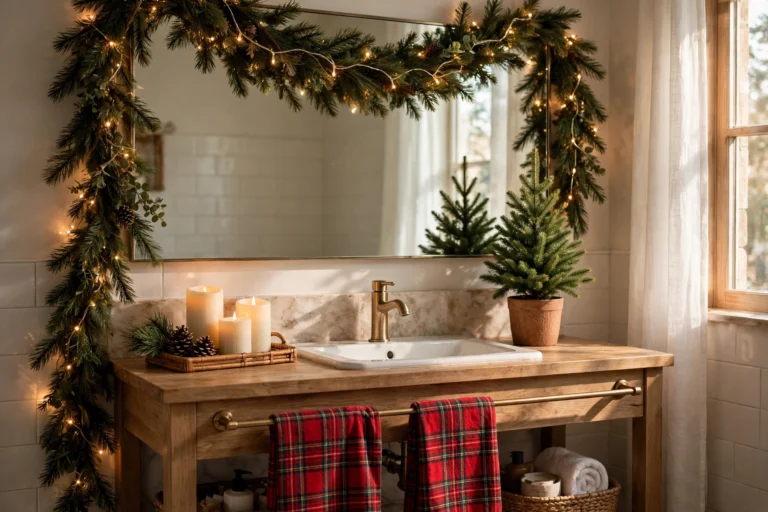

Christmas Guest Room Decor Ideas for Happy Guests
Your guests will not remember the matching cushions. They will remember whether they slept warm, whether they could find a glass of water at midnight without waking the house, and whether the room felt like it was waiting for them or like it was a storage room with a bed pushed into it. A guest room at Christmas is not a showroom. It is a small act of care, and the decorating should serve that care first and the photographs second.
The good news is that a welcoming guest room costs almost nothing and takes about an hour once you know what matters. The bed does most of the work. The nightstand does the next most. Warm light, one small tree, a place for a suitcase and a basket of spare blankets do the rest. Everything else is optional. Most of the things people buy for a guest room are optional, which is why many guest rooms become crowded with decorations and lack items that guests actually use.
This guide shows how to set up a Christmas guest room in the order your guests will experience it. First, reset the room the way a guest needs it. Next, layer the bed like a small hotel. Then add a nightstand tray, a touch that makes guests feel welcome. Then add warm light, because a guest room is used mostly in the dark. Then add a tree and greenery kept small and out of the way. Then add storage so a suitcase has a place that’s not the floor. Then add the small room and the sofa bed version for homes without a spare bedroom. Finally, add scent, quiet and the morning after, the details that turn one good night into a stay people ask to repeat.
A spare room, a mattress topper, fresh sheets, one tray and one string of battery lights will carry the whole look, and your guests will sleep better for it.
Start With the Guest, Not the Decor
Before you buy or hang a single decoration, walk into the guest room the way a guest would. Hold a suitcase in one hand. Have tired eyes after a long drive. That walk shows you everything the room needs. It tells you honestly, because a guest does not see your decorating plans. A guest sees if the bed is made, if there is a place to put a bag, if the room smells fresh, and if the light switch is easy to find in the dark. Start there. The decorating becomes easy, because you are adding Christmas to a room that already works instead of using Christmas to hide a room that does not.
First, clear the room completely. Guest rooms collect the things no other room wants. These are the ironing board, the box of old cables, the chair with the dry cleaning on it, the stack of books waiting for a shelf. Move all of it out, even if it only moves to another room for the week. A guest who opens a wardrobe and finds it full of your winter coats has nowhere to hang their own. A guest who finds a chair covered in your things has nowhere to sit. The room should look like it belongs to the person sleeping in it, even for one night. Vacuum, dust the surfaces, open the window for an hour if the weather allows, and put fresh air in the room before you put anything festive into it. A clean room with one sprig of greenery feels more welcoming than a dusty room full of ornaments, every single time.
Second, fix the things a guest will touch in the first ten minutes. The bed should be made with fresh sheets, not the sheets that have been on the bed since last Christmas. The pillows should be plumped, with one firm and one soft option if you can manage it, because guests sleep differently and a choice costs you nothing. The lamp should work, with a bulb that’s warm white, not the cold white bulb left over from the office. The door should close properly and lock or latch from the inside, because privacy is the first comfort. Put a small bin by the bed, an empty drawer or a clear shelf, and a phone charger that fits the common plug types your guests use, or at least a free socket by the bed that is not hidden behind the headboard. These are not decorations. They are the reason a guest relaxes instead of quietly coping.
Third, give the room a quick sleep test yourself. Lie on the bed for two minutes. Is the mattress too hard, too soft, or fine with a topper? A soft mattress topper costs far less than a new mattress, and it can rescue a spare bed that has gone lumpy, which is exactly what a guest notices at 2 in the morning. Is there a draft from the window? A rolled towel at the sill or a lined curtain fixes it for the price of nothing. Can you reach the lamp from the bed without getting up? If not, move it. Is the room too hot or too cold? A spare blanket in a basket beside the bed solves both, because the guest can add or remove a layer without asking. Do this test in the evening, with the lights as your guest will use them, and you will find the three small fixes that matter more than any decoration you could buy.
Only after the room works should you start decorating it, and when you do, keep the rule that has guided every room in this series: the decoration must not get in the way of the room doing its job. A wreath on the wall is fine. A pile of pinecones on the bedside table is not, because the table is where a guest puts a glass of water, a book and a phone. A garland over the headboard is fine. A garland across the doorway is not, because a guest carrying a suitcase will catch it every time. Decorate the walls, the top of the dresser, the window and the corner. Leave the bed, the nightstand, the floor and the wardrobe clear. Your guests will feel the difference even if they never notice why.
Layer the Bed Like a Boutique Hotel
The bed is the attraction in the guest room, and it should get most of your focus and most of your money, because it is the one thing your guests will spend eight hours on. A bed that looks soft and full shows a guest they were looked forward to, and a bed that feels cozy and can be adjusted lets them sleep how they want. The order of the layers is more important than buying more things, and the good news is that you probably already have most of what you need.
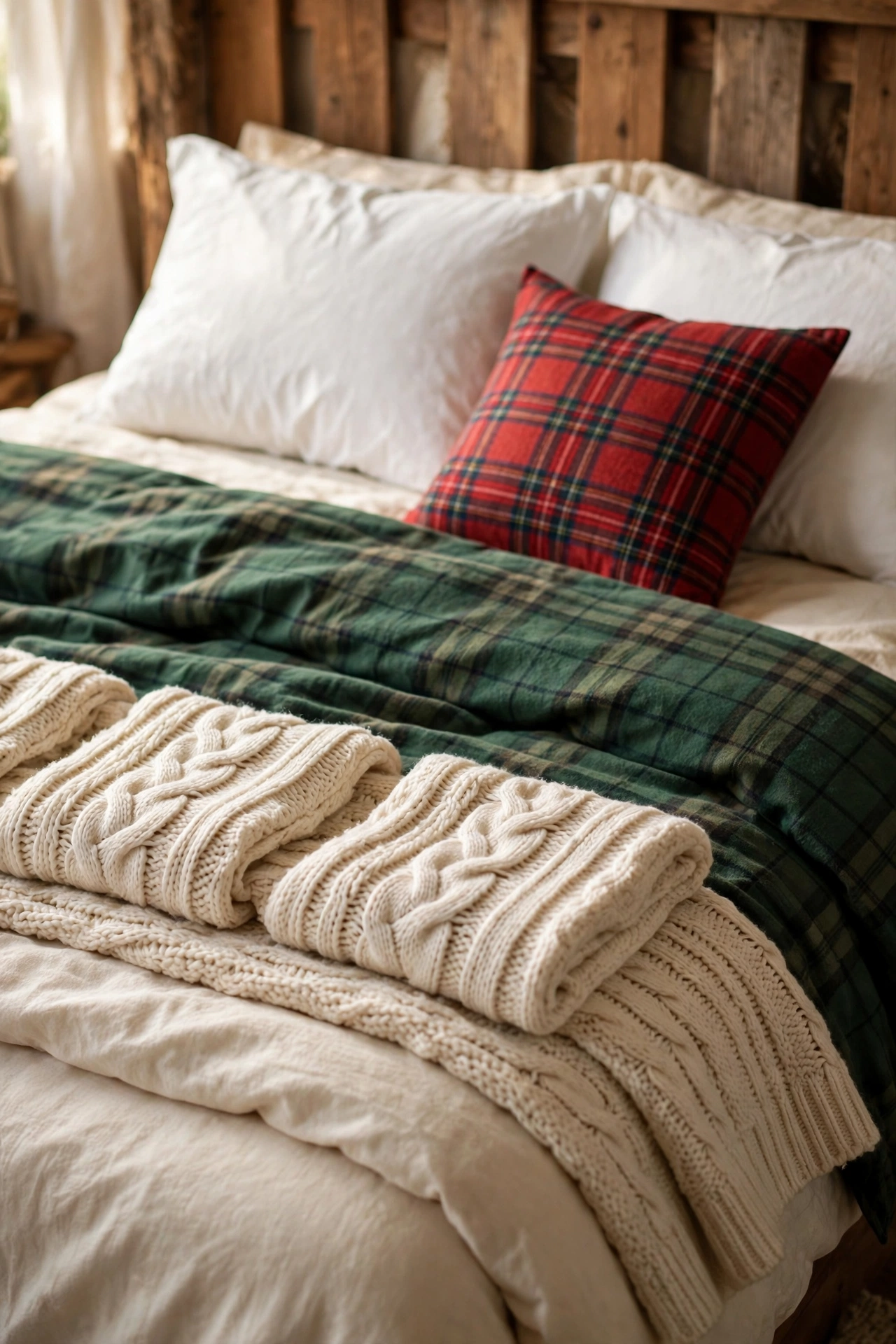
Start with clean sheets in a color that feels fresh. White is the hotel choice for a reason: it always feels clean, it lets your Christmas colors stand out. It works for every guest. Cream is the choice, and it looks good in a room with warm wood or warm light. If you want a holiday feel in the sheets themselves, flannel is the one to pick, in forest green, burgundy or a soft charcoal plaid, because flannel is warm the moment you touch it, which matters on cold December nights when a guest gets into a bed that has been sitting in a cool room. The Cozy Christmas Bedroom Ideas guide on this site shows the same layering order for your own bed, and the guest bed uses it exactly, because the order is what makes the layers work, not whose bed it is.
The order is: fitted sheet, flat sheet, duvet, throw, then one cushion. Put the fitted sheet on tight, with no wrinkles in the corners. Tuck the flat sheet in at the foot so it stays in place. Add the duvet. Choose one a little larger than the bed if you can, a king duvet on a queen bed, for example, because the extra fabric looks generous and it stops cold air from coming in on the sides. Fold a chunky knit throw across the lower third of the bed, in thirds, so it looks like a planned layer and not something just put on top. Finish with the pillows: two sleeping pillows flat against the headboard, two standard pillows in white covers in front of them, and one decorative cushion in a Christmas design or a rich velvet. Guests will move the cushion aside at night. That is okay. The layered look is for when they first arrive, and comfort is for when they sleep.
Keep the palette to two or three colours so the room stays restful instead of busy. Red, cream and green are the safest Christmas palette for a guest room, because they feel festive without overwhelming the space. White bedding with red and green accents suits almost any guest, and it photographs beautifully, which matters if you want the room to look as good in a photo as it feels in person. If your taste runs quieter, try cream bedding with forest green and brass, or soft grey with burgundy and warm wood. The palette should match the rest of your home loosely, not exactly, because a guest room that looks like it belongs to the house feels intentional, while a guest room in a completely different style feels like a themed hotel room, and not in a good way.
Wash everything a day or two before your guests arrive so the bed smells clean and not like storage. A mattress topper goes on before the sheets, and a mattress protector goes under the topper, because a spare mattress is often older than the one you sleep on and a topper hides a multitude of sins. If the mattress is truly past saving, say so honestly to yourself and budget for a replacement before next Christmas, because no amount of layering fixes a mattress that sags in the middle. For this year, a thick topper, fresh sheets and good pillows will carry you through. Your guests will not know the difference.
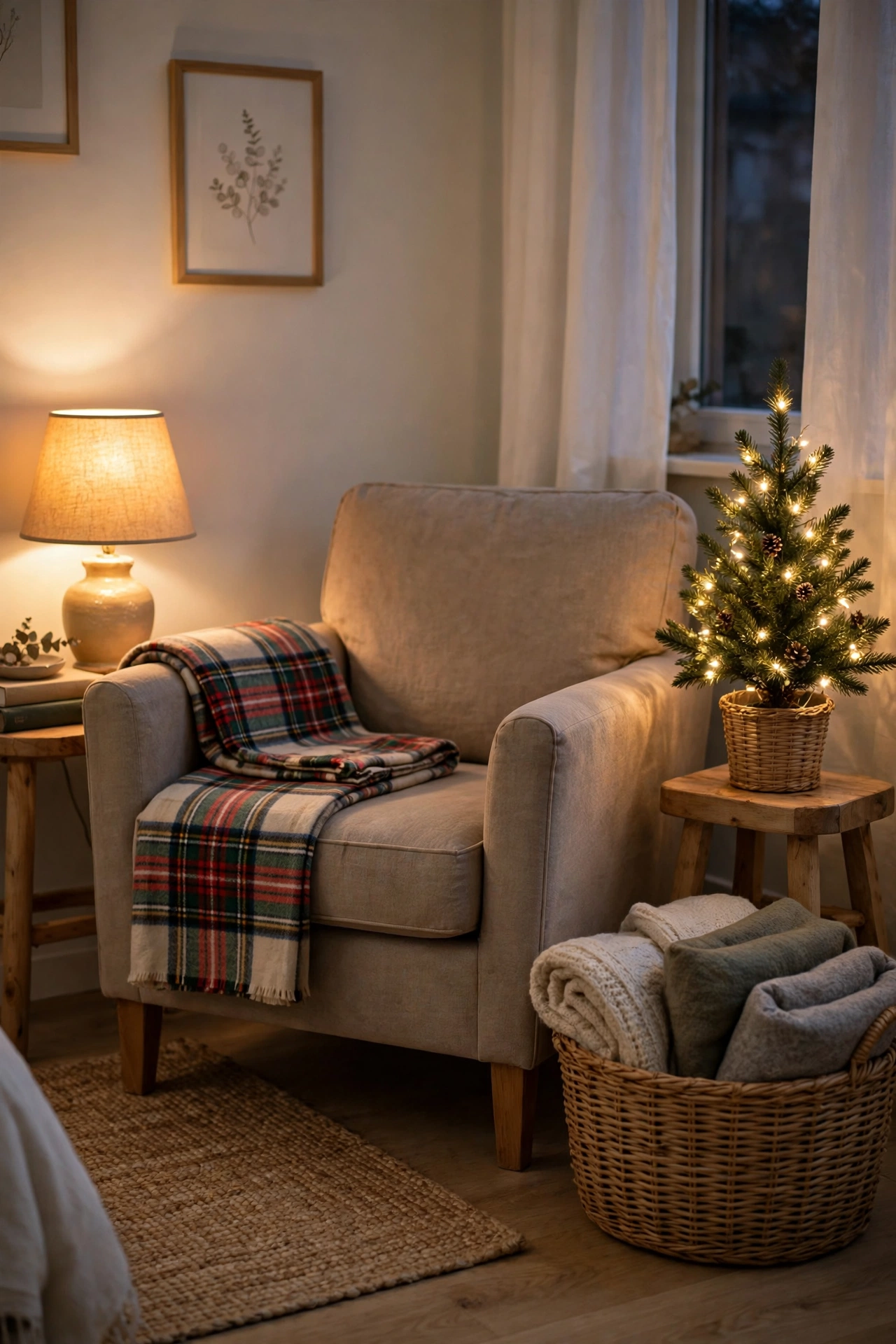
Finally, leave the choice with the guest. Fold one spare blanket at the foot of the bed, or set a basket of two folded blankets beside it, one chunky knit and one lighter plaid, so a guest who runs cold and a guest who runs warm can both adjust without asking you for anything. A fleece throw costs around 15 dollars and folds neatly into a basket, and a plaid throw from a home store costs around 25 dollars and instantly says Christmas without turning the room into a theme park. The basket is the whole trick: it says, take what you need, help yourself, this room is yours for the night. That message is worth more than any decoration.
The Nightstand Welcome Tray
If the bed is the centerpiece, the nightstand is the handshake. It is the first surface a guest touches after putting their bag down. A small tray on it tells them they were expected, in a way no amount of wall decor can. A welcome tray costs almost nothing. It takes five minutes to set. It is the detail guests mention when they go home, because it is personal in a way a wreath never is.
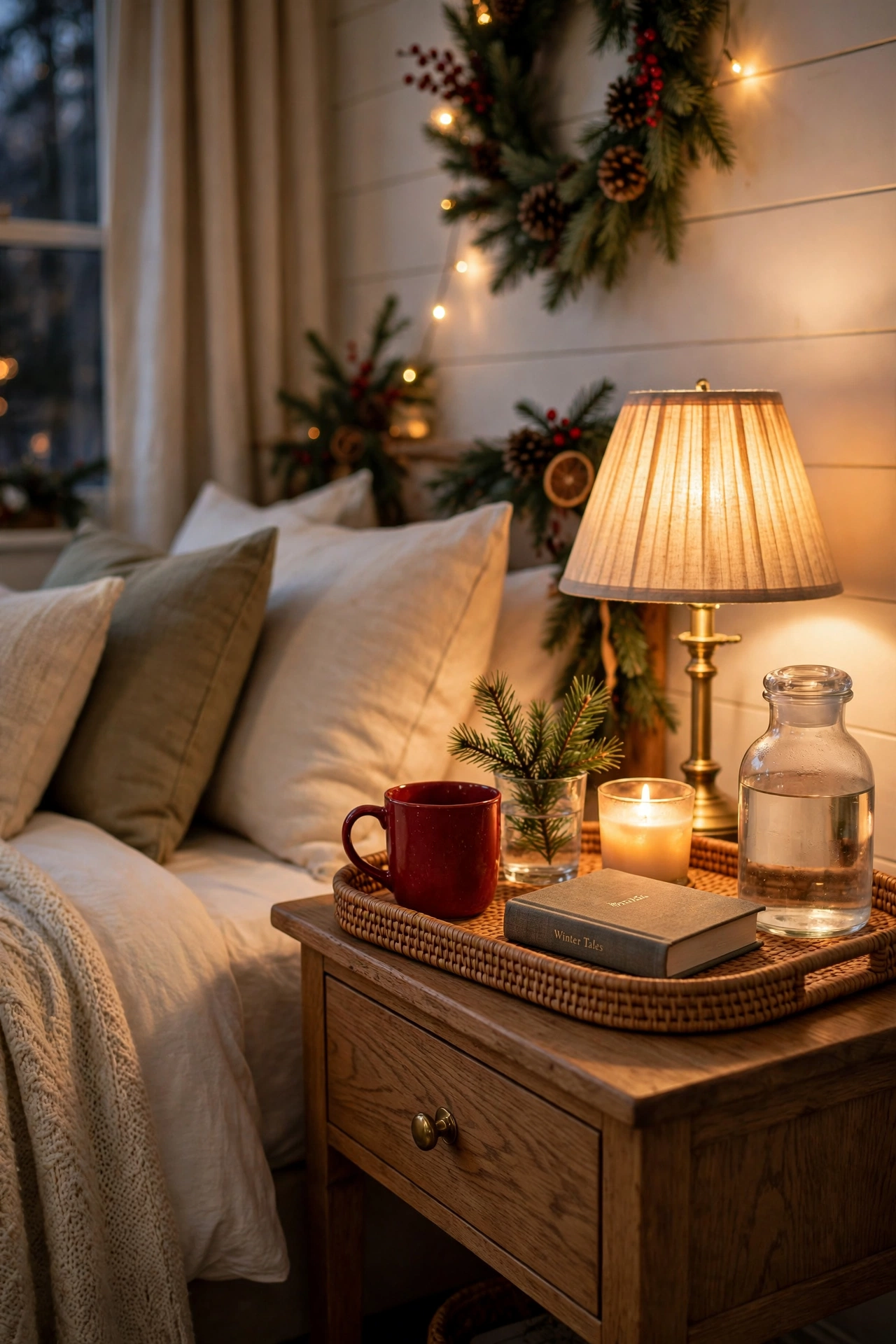
Start with a tray, any tray you own: a wooden board, a small silver platter, a thrifted tray, even a large dinner plate. The tray matters because it keeps the small things together. It protects the nightstand from rings and drips. It makes the whole arrangement look deliberate instead of scattered. On the tray, set five things and no more. A mug, for hot chocolate or tea, because the Christmas Hot Cocoa Bar Ideas guide on this site proves that a warm drink is the fastest welcome there is. A guest who wakes early can make a cup without waking the house. A small carafe or bottle of water with a glass, because a guest who wakes thirsty at night should not have to find the kitchen in the dark. A pine sprig in a tiny glass or a small bud vase, because it brings scent and life to the tray for the price of a walk to the garden. A battery candle, for soft evening light that is safe to leave on. And a short book or a magazine, because a guest who cannot sleep needs something to read that is not their phone.
A welcome basket is the bigger version of the same idea, and it suits a longer stay, a guest who has not been seen in years, or a parent or in-law staying for the week. A small basket or a cloth bag placed by the bed or on the dresser can hold a few thoughtful items, such as a pair of warm socks, a small bar of chocolate, a sachet of cocoa or tea, a tiny bottle of hand cream, and a handwritten note that says welcome and provides the WiFi password. A welcome basket that costs around 15 dollars total can make a guest feel as if they have checked into a small hotel, and the note is the part that costs nothing and matters most. Write the WiFi password on a card, not on a scrap of paper, and add one line about breakfast time, so your guest does not have to guess when to appear in the morning. Guests hate guessing. A note removes the guessing. That is a kindness.
Keep the rest of the nightstand clear. One lamp, one tray, and nothing else. The phone, the book, the glass of water and the glasses case all need space, and a nightstand crowded with decorations pushes those items onto the floor. If the nightstand is small, put the tray on the dresser instead. Keep only the water and the lamp beside the bed. The rule is simple: a guest should be able to reach the water, the light and the phone charger without moving a decoration. If the guest cannot, remove a decoration, not the water.
Finally, check the light. The bedside lamp is the most used light in the guest room, and it should be warm, low and easy to switch off from the bed. A lamp with a fabric shade gives a softer glow than a bare bulb, and a bulb around 2700K, warm white, makes the whole room feel like evening, which is exactly the feeling a guest wants after a long day. If the lamp is too bright, a lower wattage bulb fixes it for a few dollars. If there is no lamp, a battery candle on the tray and a string of fairy lights on the headboard will carry the evening, which brings us to the next section.
Warm Light at Bed Height
A guest room is used mostly in the dark, in the evening and in the early morning, so light matters more here than in any other room in the house. The right light makes a small room feel warm and a plain room feel considered. The wrong light, one cold ceiling bulb, makes the same room feel like a waiting room. You do not need new lamps. You need warm light at bed height, in two or three small sources, and you need to keep the ceiling light off.
The bedside lamp is the first source, and it should be the one your guest uses most. Put it on the side of the bed where a right handed guest will reach it naturally, or put a lamp on both sides if you have two. The shade should be fabric or frosted glass, never bare, and the bulb should be warm white, around 2700K, at a low wattage, because a guest reading in bed wants a pool of warm light, not a spotlight. If the lamp has a dimmer, even better. Test it yourself: sit on the bed in the evening, switch the lamp on, and see whether you can read comfortably without squinting. If the light glares, move the lamp back a few inches. Swap the bulb. A ten dollar bulb change can transform a guest room more than a fifty dollar decoration.
The second source is a short strand of warm white fairy lights, and the best place for it is along the headboard. Run the strand along the top edge of the headboard, letting it dip gently between the posts. Use battery lights with a timer so they switch themselves off after six hours. Fairy lights give a guest room its Christmas feeling for almost no effort and no floor space, and they cost a few dollars. Keep the strand short, one strand, not three, and keep it warm white only, never cool white and never multicolour, because the goal is a warm glow, not a fairground. If there is no headboard, run the lights along the curtain rail or around a mirror instead. The effect is the same: a low, warm line of light at eye level when you are sitting on the bed.
The third source is candlelight, and the rule here is safety first. Real candles look beautiful and smell wonderful, but a guest room is the wrong place for an open flame, because a guest may fall asleep with it burning, or knock it over reaching for water in the dark. Use battery candles instead, one on the nightstand tray and one on the dresser, with a flickering setting if yours has one. Battery candles give the same warm glow, they are safe to leave on, and a guest can carry one to the bathroom at night like a small lantern. If you do use a real candle, put it on the dresser, in a deep glass holder, away from the bed and the curtains, and blow it out yourself before bed. Never leave a real candle burning in a room where someone is sleeping.
One more light check before your guests arrive: walk the route from the guest room to the bathroom in the dark, with only the night light or the battery candle to guide you. Is there a small light in the hallway, or a plug in night light you can leave on? A guest who has to feel along a dark hallway at 3 in the morning will not enjoy the stay, however pretty the room is. A two dollar plug in night light in the hallway, and one in the guest bathroom, solves it completely. The Christmas Bathroom Decor Ideas guide on this site shows how warm light and a tidy tray make a small bathroom feel welcoming, and the hallway light is the same idea: small, warm, and exactly where a guest needs it.
A Mini Tree and Greenery That Stay Out of the Way
Every Christmas guest room needs one piece of greenery that says Christmas the moment the door opens, and one is enough. A guest room is a small room, and a small room punishes excess faster than a living room does. The goal is a tree or a wreath that a guest can enjoy from the bed, and that never blocks a walkway, a drawer, or the light from the window.
A mini tree is the classic choice, and the best place for it is the corner that usually sits empty, the one by the dresser or the one opposite the bed. A tabletop tree on the dresser works just as well, and it is the safer choice in a very small room, because it takes no floor space at all. Choose a tree between one and three feet tall, pre lit with warm white lights if you can, and decorate it simply: a few small ornaments, a thin ribbon, and nothing else. A mini tree with ten ornaments looks intentional. A mini tree with fifty looks like the main tree lost a fight. Put the tree where it can be seen from the bed, because a guest falling asleep to a small glowing tree is the whole point, and keep it away from the curtains and the bedding, because even a small tree with lights should never touch fabric.
If a tree feels like too much, a wreath over the bed does the same job with no floor space at all. A simple evergreen wreath, real or faux, hung on the wall above the headboard, frames the bed and gives the room its Christmas anchor. Add a thin velvet ribbon at the top and a few small pinecones, and stop there. A wreath over the bed is also the easiest decoration to store, because it hangs on a nail and comes down in January in one move. If there is no headboard to frame, hang the wreath on the inside of the bedroom door, or on the wall opposite the bed, where a guest sees it when they wake up. The rule is one wreath, in one place, at eye level when you are standing, not above a door where nobody looks.
Fresh greenery is the third option, and it is the cheapest and the most scented. A few stems of pine, cedar or eucalyptus in a plain glass vase on the dresser bring scent and life into the room without a single ornament. A short garland along the top of the dresser, or along the window sill, does the same job on a longer surface. Fresh greenery lasts about two weeks in a cool room if you change the water, so cut it the day before your guests arrive, not a week early. If you do not have a garden, a grocery store bunch of eucalyptus costs a few dollars. Looks far more expensive than it is. A small bowl of pinecones with a drop of cedar oil on the dresser is the zero effort version, and it scents the room gently every time someone walks past.
Whatever you choose, keep the count low: one tree or one wreath or one vase of greenery, plus one garland at most. A guest room with a tree, a wreath, a garland, a vase, a bowl of pinecones and a stack of wrapped boxes on the dresser is not festive, it is crowded, and a crowded room makes a guest feel like they are sleeping in a shop display. Leave the dresser top mostly clear, with the greenery at one end and space for a guest to put their own things at the other. The decoration should frame the room, not fill it.
Storage Guests Can Actually Use
A guest with no place to put their stuff is a guest who lives out of a suitcase on the floor for three days, stepping around it every time they get up. Storage is the least photogenic part of a guest room and the most appreciated, and it costs nothing, because it is mostly about emptying space you already have rather than buying new furniture.
Start with the wardrobe or the closet. Take one rail and one shelf completely empty. Put five or six empty hangers on the rail, mixing shirt hangers and one or two trouser hangers. Five hangers is the right number: enough for a few days of clothes, few enough that the rail still looks empty and inviting. If there is no wardrobe, a simple standing clothes rail in the corner works as well, and a row of wall hooks by the door works for coats and scarves. Leave the hangers visible, not hidden in a drawer, because a guest who sees empty hangers knows right away that the space is theirs. A guest who opens a wardrobe full of your coats will not ask you to move them. They will just live out of the suitcase.
Next, clear one drawer in the dresser, or clear the whole top of the dresser, so a guest has somewhere for the small things: a watch, a phone, a book, a pair of glasses, the contents of a pocket. A guest room with no clear surface forces everything onto the bed or the floor, and both are miserable. If the dresser drawers are full, move one drawer of things into another room for the week. It is a small inconvenience for you and a real comfort for your guest. Put a small tray or a dish on the dresser top for jewellery and keys, because a guest who has a place for their keys will not lose them, and a guest who loses their keys on Christmas morning will remember the trip for the wrong reason.
Then give the suitcase a home that’s not the floor. A luggage rack is the hotel answer, and a folding one costs around 25 dollars and stores flat under the bed for the rest of the year. If you do not own one, a sturdy bench at the foot of the bed works, or a cleared chair, or even a low stool. The point is that the suitcase should be at waist height, open, and easy to reach, not on the floor where a guest has to kneel to find a jumper. If the room is too small for a rack, slide the suitcase under the bed once it is unpacked. Put a folded towel on the bed for the clothes that are in use. The suitcase on the floor is the single biggest sign that a guest room was not really prepared, and it is the easiest to fix.
Finally, think about the bathroom your guest will use. Fresh towels, folded and visible, two per guest, one bath towel and one hand towel, with a small basket or a shelf to put them on. A spare toothbrush still sealed in its packet, a small bottle of shampoo, and a clean flannel cost a few dollars and save a guest who forgot theirs. The Christmas Bathroom Decor Ideas guide on this site covers the bathroom itself, but the guest room side of the job is simpler: make sure your guest knows which bathroom is theirs, and make sure it has what they need before they have to ask. A guest should never have to ask for a towel. That is the rule.
The Small Spare Room and the Sofa Bed Version
Not every home has a spare bedroom, and a guest room does not need one. A small spare room, a box room, a study with a bed in it, or a sofa bed in the living room can all be a proper Christmas guest room, as long as the same rules apply: a comfortable bed, a clear surface, warm light, and a door or a curtain that offers privacy. Small is not a problem. Small is a size to respect, and a small room done well feels cosier than a big room done carelessly.
For a small spare room, decorate up, not out. A wreath on the wall, a garland along the curtain rail, a mini tree on the dresser, and one floor accent, a basket of blankets or a small stool, and that’s it. One grouping, a clear walkway, and a bed that can be walked around on at least two sides. If the bed has to be against the wall, put the pillows at the end that’s away from the wall, so the guest can sit up without hitting their head, and put the lamp on the side that is open. A small room needs a small tree, not a three foot one, and it needs the nightstand tray more than a big room does, because there is nowhere else to put a glass of water. The formula for a small room is: bed, tray, light, one piece of greenery, basket of blankets. Five things, and the room is done.
The sofa bed version needs a little more thought, because the room is also a living room, and the guest is sleeping where everyone watches television. The first job is privacy. A folding screen, a curtain on a tension rod across an alcove, or a tall bookshelf turned sideways can give a sleeping guest a sense of their own space. It does not need to be a wall. It needs to be a visual boundary that says, this corner is yours tonight. The second job is the bed itself. Make the sofa bed up properly, with real sheets, not the thin set that came with the sofa, and a mattress topper if the sofa bed mattress is thin, because a sofa bed mattress is usually the thinnest mattress in the house and a topper is the difference between a good night and a bad back. Put the same layered bedding on it, white sheets, a duvet, a folded throw, one cushion, and the same nightstand tray on a small stool or a side table beside it.
The third job is the morning after. A sofa bed guest needs to know where the bedding goes in the morning. They need a place to put their clothes while the sofa is a sofa again. A basket by the sofa holds the folded bedding, a hook on the wall holds the overnight bag, and a note that says, leave the bedding in the basket, I will sort it, removes the awkwardness completely. Guests worry about being a burden, and a note that tells them exactly what to do is a gift. If the living room has the main Christmas tree, the sofa bed guest already has the best decoration in the house, and you do not need to add anything else. One small tray, one lamp, and the tree across the room is the whole setup.
A guest staying in a room that’s also an office needs the same care. Clear the desk, or cover it with a cloth, so the guest does not sleep facing your work. Move the work laptop and the papers out of sight, put the welcome tray where the keyboard was, and hang the wreath where the whiteboard was. The room should feel like a bedroom for the week, not like an office with a bed in it. That single change, hiding the work, is what turns a spare room into a guest room.
Scent, Sound and the Morning After
The last details are the ones no photograph can show, and they are the ones your guests will remember longest. Scent, sound and the morning after are the difference between a room that looks welcoming and a stay that feels welcoming, and all three cost almost nothing.
Scent first, and the rule is gentle, not loud. Choose one gentle scent for the guest room, and only one: a pine or cedar reed diffuser on the dresser, a small bowl of pinecones with a drop of cedar oil, or a linen spray on the pillows before your guests arrive. One scent, in one place, at a strength you can only just notice when you walk in. Never use a plug in air freshener at full strength, never burn a strongly scented candle in a small room, and never mix two scents, because a guest with a sensitive nose or an allergy will spend the night with a headache instead of sleeping. If you are not sure, choose no scent at all, and let the fresh greenery do the work. A few pine stems in a vase scent a room more gently than any product, and they cannot trigger an allergy the way a synthetic fragrance can.
Sound second, and the job is to make the room quiet, not to fill it with music. A guest room near a busy road, a boiler, or a television needs help. Heavy curtains help more than anything, because they muffle sound and block light at the same time. A lined curtain, even a cheap one, is worth buying for a guest room that faces a street. A small fan, running on low, gives a steady background hum that masks household noise and helps a guest who is used to sleeping with one. A pair of soft earplugs on the nightstand tray, still sealed, is a thoughtful touch for a light sleeper, and it costs pennies. Ask yourself whether you would sleep well in this room, with the heating clicking, the pipes ticking, and the early morning light coming through a thin curtain, and fix the two things that would bother you. Your guest will have the same two complaints.
The morning after is the third detail, and it is the one that decides whether your guests ask to come back. Leave a note on the tray that says what time breakfast is, and whether they should just come down when they are ready. Put a small jug of water and a clean glass in the room for the morning, and make sure the bathroom has fresh towels waiting. If your guests are early risers, a small cafetiere or a kettle in the room, with mugs and tea bags, lets them make a cup without waiting for the house to wake up. If they are late risers, keep the house quiet until they appear, and do not vacuum outside their door at 8 in the morning. The best hosts are the ones who make the morning easy, because the morning is when a guest decides whether the stay was restful or just polite.
Finally, plan the goodbye the way you planned the welcome. Fresh towels for the last morning, a bag for the damp towels, and a clear place to leave the bedding, so your guest does not have to guess. A small gift to take home, a jar of homemade jam, a bag of the cocoa mix from your cocoa bar, or a pine sprig tied with ribbon, costs almost nothing and sends your guest home with something to remember. The Christmas Hot Cocoa Bar Ideas guide on this site has the cocoa mix recipe, and a small bag of it is the easiest goodbye gift there is. Your guest will make cocoa at home, think of your house, and ask to come back next Christmas. That is the whole point of a guest room, and it is why the details matter more than the decorations.
Conclusion
A Christmas guest room is not a decorating project. It is an hour of care, spent in the right order, on the things a guest actually touches. Clear the room first, so it belongs to the person sleeping in it. Layer the bed like a small hotel, with fresh sheets, a duvet that is a little too big, a throw folded in thirds, and a basket of spare blankets beside it. Set the nightstand tray with a mug, water, a pine sprig, a battery candle and a book. Write the WiFi password on a card. Put warm light at bed height, one lamp and one short strand of fairy lights, and leave the ceiling light off. Add one piece of greenery, a mini tree or a wreath or a vase of pine, and stop there. Empty a rail, hang five hangers, clear a drawer, and give the suitcase a home off the floor. Scent the room gently, quieten it with curtains, and make the morning easy with a note about breakfast.
Do it in that order, in one hour, the day before your guests arrive, and the room will be ready. Your guests will sleep warm, find water in the dark, and wake up to a small tree glowing in the corner. They will tell you the room felt like a hotel, which is the highest praise a spare room can earn. The decorations are the smallest part of the job. The welcome is the job, and the welcome is free.