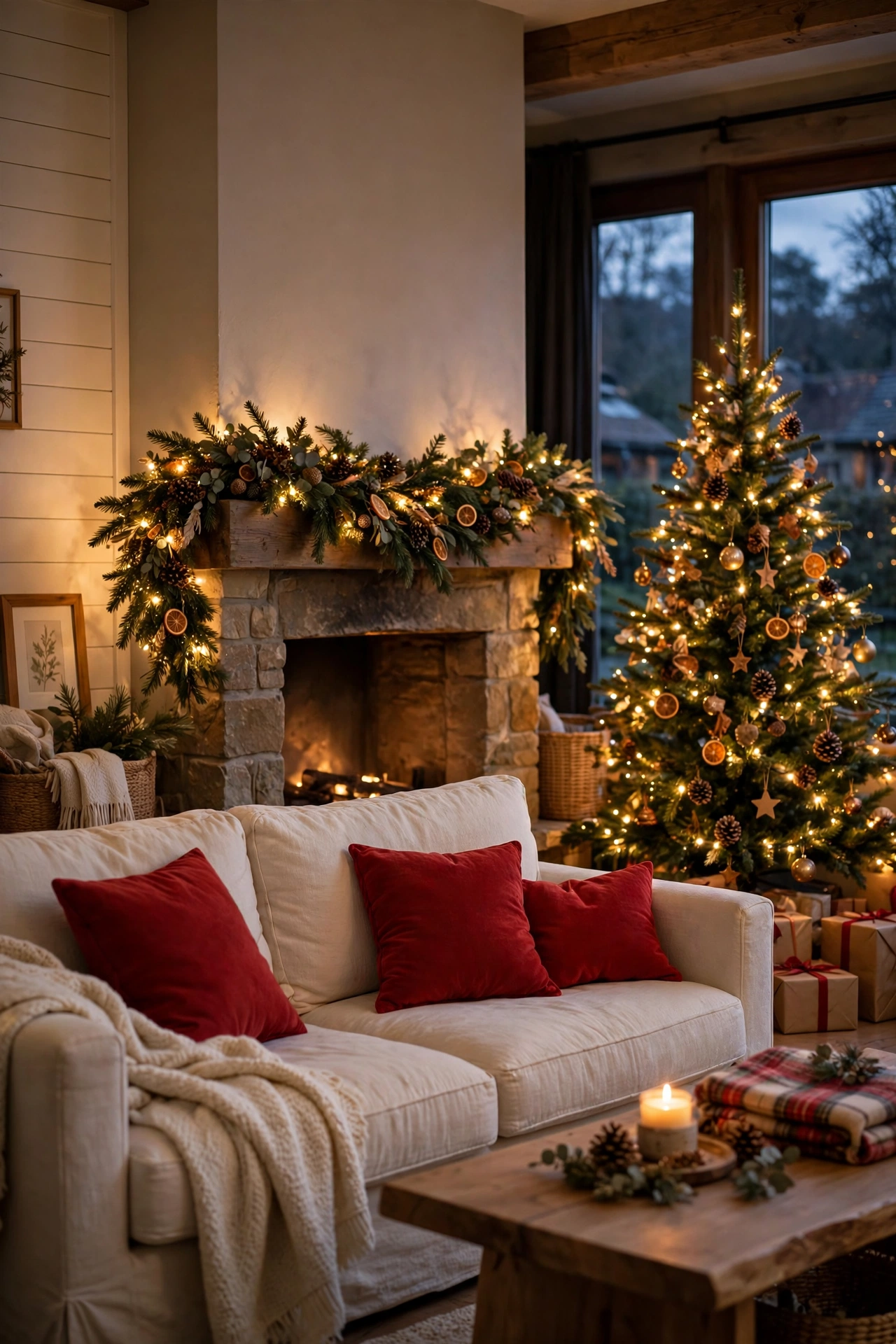
Christmas Lights Decor Ideas That Make Every Room Glow
Ask anyone what makes a home feel like Christmas and they will probably mention the tree, the smell of pine, or the presents under the tree. But ask them what makes a home feel warm on a dark December evening, and the answer is almost always the lights. A room with no lights on a winter evening feels unfinished, no matter how many ornaments the room holds. A room with one strand of warm fairy lights feels festive before a single bauble goes up.
Lights do more work than any other decoration in the house. Lights cost the least, lights take up no floor space, lights hide a multitude of sins in an old room, and lights flatter every other decoration you own. A plain garland looks expensive with lights woven through it. A tired corner looks intentional with a glowing jar on a shelf. A small tree looks generous when the lights are tucked deep into its branches. No other single purchase changes a room so much for so little money.
Yet most homes use lights badly. The classic mistakes are everywhere. Cool white strands make a living room look like an office. One blazing set of lights and nothing else leaves a room with a single hot spot and four dark corners. Fairy lights pinned flat show the wire and not the glow. The annual tangle of last year’s lights pulled out of a box in a knot is another familiar one. None of these need money to fix. They need a plan, and that plan is what this guide gives you.
In this guide I will show you the warm white rule that decides whether your lights look cozy or clinical. You will learn how to use fairy lights in every room without an outlet in sight. You will see how curtain lights turn a plain window into the best seat in the house, and how jars and lanterns give you light you can carry anywhere. You will learn how to light a tree so it glows from inside rather than sparkling only on the surface, and how to mix real candles and flameless candles safely. You will also learn how to plan lights room by room so the whole house glows evenly instead of one corner doing all the work. Most ideas here cost under twenty dollars, most take less than an hour, and every one of them works in a rented home too.
The Warm White Rule, Why Colour Temperature Decides Everything
Every Christmas lights decision starts with one choice, and it is not the shape or the length or the price. It is the colour temperature. Getting it wrong is the most common reason a decorated room feels cold instead of cozy. Warm white light sits around 2700 Kelvin, the colour of candlelight and old fashioned bulbs. Cool white sits around 4000 Kelvin and above, the colour of office ceilings and hospital corridors. Both are sold as Christmas lights. Both look identical in the packet, and they could not feel more different on a wall.
Warm white is the right choice for almost every room in the house. It flatters skin, it flatters wood, it makes red look rich and green look deep, and it makes a room feel smaller and closer in the way a winter evening should feel. Cool white is honest light, and that is the problem. It shows every scuff on the wall, every dusty shelf, and every wrinkle in the curtain. It makes the room feel like a place you work in rather than a place you rest in. If your lights have ever made your living room feel like a shop display, the colour temperature was almost certainly the cause.
Check the box before you buy, because the labelling is confusing. Shops sell warm white, soft white, warm, extra warm, and vintage glow. Most of those mean the same thing, somewhere near 2700 Kelvin. They also sell cool white, daylight, bright white and ice white. Those all mean the same thing too, somewhere near 4000 Kelvin or higher. The number in Kelvin is the only reliable guide, and it is usually printed in small type on the back of the packet. If the packet does not give a number, hold the strand up to something red. Warm white makes red look deep and soft, cool white makes red look pink and flat.
Multicolour lights are a separate question, and the honest answer is that they work in exactly one place at a time. A multicolour tree in a room that is otherwise warm white looks joyful and deliberate. Multicolour lights on the tree, the mantel, the window, the banister and the shelf all at once look like a fairground, and the eye has nowhere to rest. If you love colour, give it one home, usually the tree, and keep everything else warm white. The contrast makes the colour look richer, not duller, because it has a calm background to shine against.
One more rule before you spend anything. Buy lights you can dim, or at least lights with a timer and several modes. A strand at full brightness in daylight looks harsh, and the same strand at half brightness in the evening looks like candlelight. Battery strands with a remote cost only a few dollars more than the basic ones. The remote is the difference between lights you actually use every evening and lights you switch on once and then ignore because they are too bright to live with. Dimming is not a luxury feature. It is the feature that makes the lights livable.
Fairy Lights Everywhere, the One Strand That Does the Most Work
If you buy only one kind of Christmas light this year, buy warm white fairy lights on copper wire. They are the most versatile decoration in the whole season. The reason is simple. The wire is thin, the bulbs are tiny, and the strand bends around anything. A fairy light strand does not need a hook, a nail or a surface. It needs a place to sit, and almost every surface in your home qualifies.
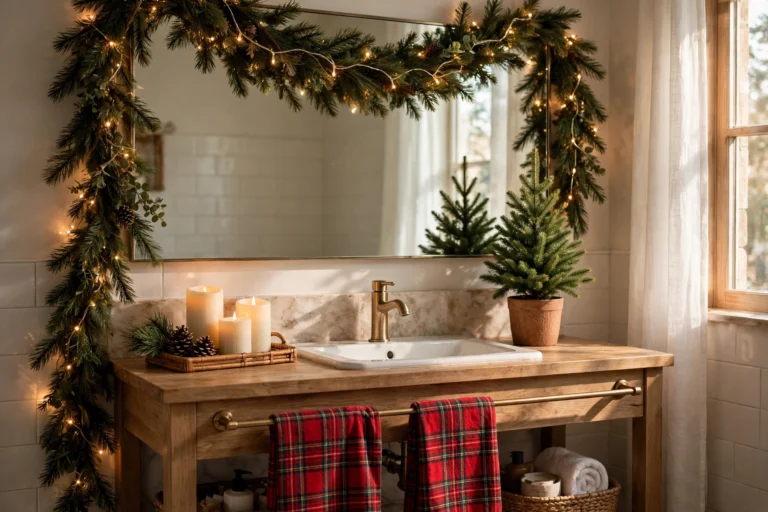
Start with the rule that makes fairy lights look expensive. Tuck the strand behind things, never pin it flat on top of them. A strand laid on top of a garland shows its wire and looks like a cable. A strand woven through the back of the same garland shows only its glow, and the garland looks as if it is lit from inside. The same rule works on a shelf, where the strand runs behind the books and the ornaments, on a mantel, where it hides behind the greenery, and on a mirror, where it runs along the back edge of the frame so the glass catches the light without the wire showing. Hide the wire, show the light. That is the whole secret.
Battery powered strands are what make this possible in a rented home or a room with no free outlet. A battery pack the size of a matchbox hides behind a book, inside a jar, or behind a cushion. Most battery strands come with a timer that switches them on for six hours and off for eighteen, so they light themselves every evening without you touching them. USB strands are the middle option. They plug into a phone charger, a laptop, or a power bank, which means they can live on a shelf far from any wall socket. Mains strands are still the right choice for the tree and the window, where one long run matters. For everything else, battery and USB win.
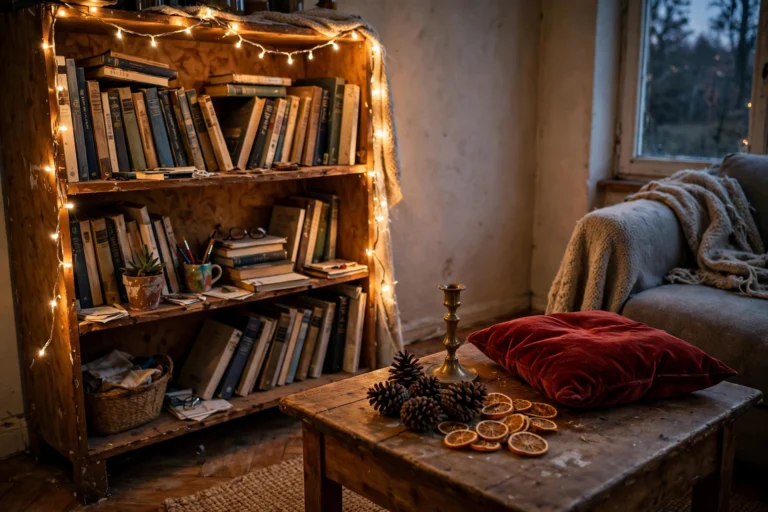
The places fairy lights work best are the places you already look at every evening. Along a bookshelf, weaving between the books and a few small ornaments, so the shelf glows like a shop window. Around a mirror, where the light doubles itself in the glass. Inside a glass jar or a vase, where ten minutes of coiling turns an empty jar into a lantern. Behind a sofa, where a strand taped to the back of the sofa throws a gentle wash of light up the wall. Around a headboard, where the light falls soft on the pillows and makes the bedroom feel like a small hotel. None of these need a ladder, a drill, or a second person. Each one takes about ten minutes.
Buy more fairy lights than you think you need, and buy them in the same colour temperature. The most common fairy light regret is buying one short strand, loving it, buying a second strand from a different shop, and discovering the two strands are different whites. Two warm white strands from different makers can still clash, one slightly yellow and one slightly pink. Buy your strands in one order, from one maker, in one colour temperature, and test them side by side on the floor before you hang a single one. A strand that looks wrong on the floor will look wrong on the wall, and it is much easier to return before it is tangled around a banister.
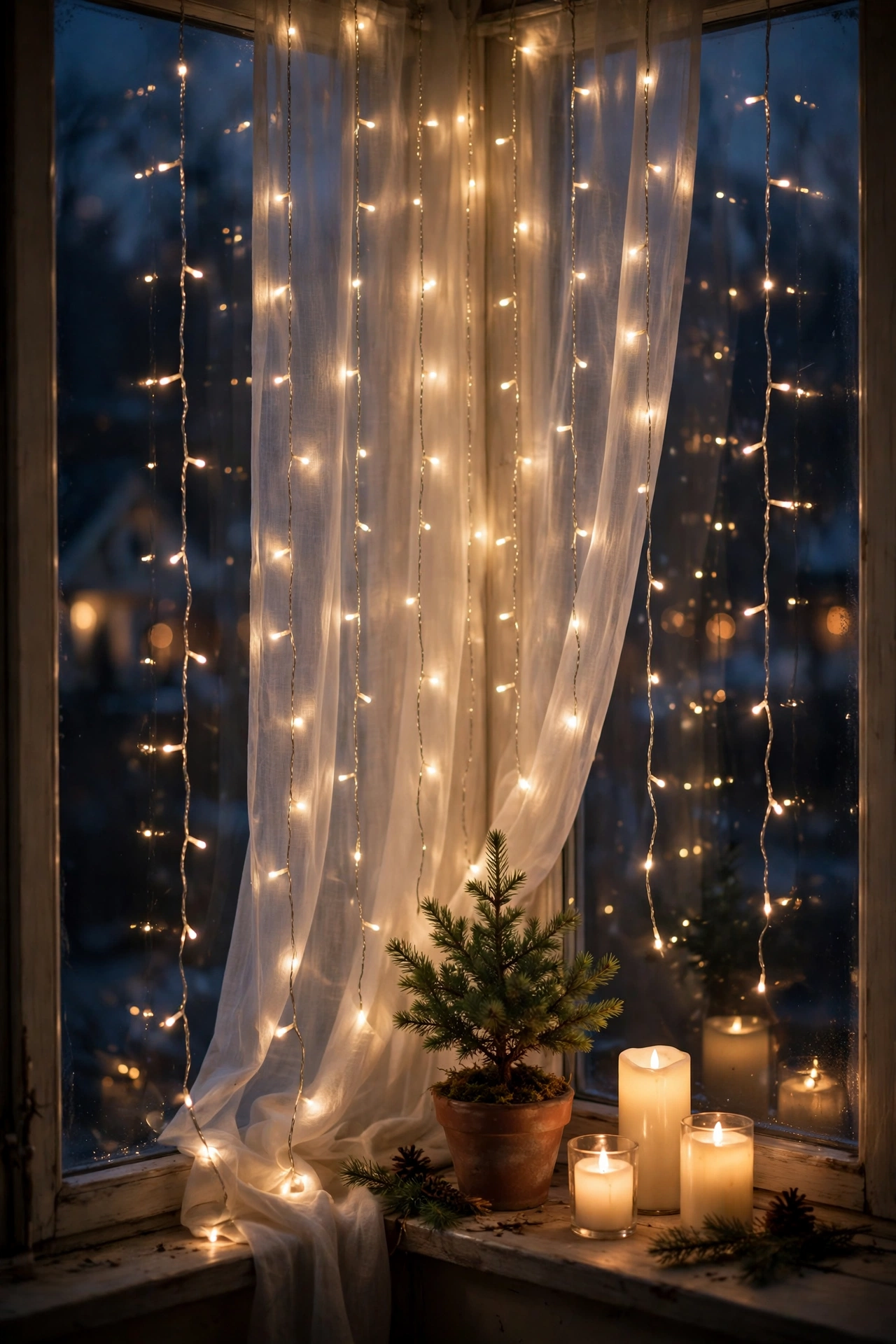
Curtain Lights, the Window That Glows Like a Snowfall
A plain window in December is a black rectangle after four in the afternoon, and a window dressed with curtain lights is the best seat in the house. Curtain lights are fairy lights hung in vertical drops from a single top wire, so they fall like a waterfall of light, and they solve the window problem completely. They give you a glowing backdrop that looks beautiful from inside the room and from the street outside. They take up no floor space, and they leave the windowsill free for candles and greenery.
Hanging curtain lights is simpler than it looks. The top wire hooks over a curtain rod, a tension rod, or two small removable hooks at the top corners of the window frame, and the drops fall by gravity, so there is almost nothing to arrange. Keep the drops inside the glass, not pressed against it, so the light has room to breathe, and let the bottom of the drops stop a few inches above the sill rather than pooling on it. If your window is wider than the curtain light panel, hang two panels side by side and overlap the top wires by a few inches so there is no dark stripe down the middle. The overlap is invisible once the lights are on.
Sheer curtains make curtain lights look twice as good, because the fabric diffuses the bulbs into a soft wash instead of sharp points of light. If you already have sheers, hang the lights behind them, between the curtain and the glass, and the whole window glows like a lantern. If you do not have sheers, a plain white bed sheet hung on the same rod does the same job for the season, and it costs nothing. The trick is the layering: light, then fabric, then room. The fabric is what turns a string of bulbs into a glow.
Curtain lights are not only for windows. Hung behind a sofa they make a glowing backdrop for the whole living room. Hung behind a bed they turn a plain bedroom wall into a feature. Hung in a hallway they light a dark passage without a single ceiling fitting. The same panel that costs fifteen dollars for a window does all three jobs, which is why it is the best value light in this whole guide. Just remember the rule from the first section: warm white, always, and a dimmer or a timer if you can find one, because a full brightness curtain panel is a lot of light in a small room.
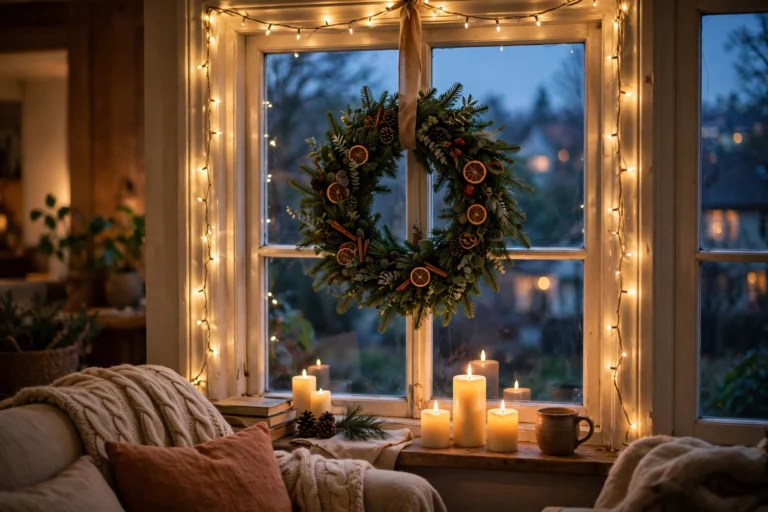
If you want the same window magic with a smaller budget, start with a single strand of fairy lights around the window frame itself. One strand, clipped or hooked around the frame with removable hooks, gives you the outline of the window in light, and it costs about five dollars. It is the simplest window idea in this guide, it takes ten minutes, and it works in every room. For more window ideas that pair with these lights, including wreaths, garlands and sill villages, see our Christmas Window Decor Ideas.
Jars, Lanterns and Bottles, Light You Can Carry Anywhere
Some lights belong to a room. Jars, lanterns and bottles belong to you, because you can pick them up and carry them wherever the evening takes you. A glowing jar on the coffee table during a film, the same jar on the dining table during dinner, the same jar on the bathroom shelf during a bath. One object, three rooms, no installation at all. That portability is why this is the section renters love most, because nothing here touches a wall.
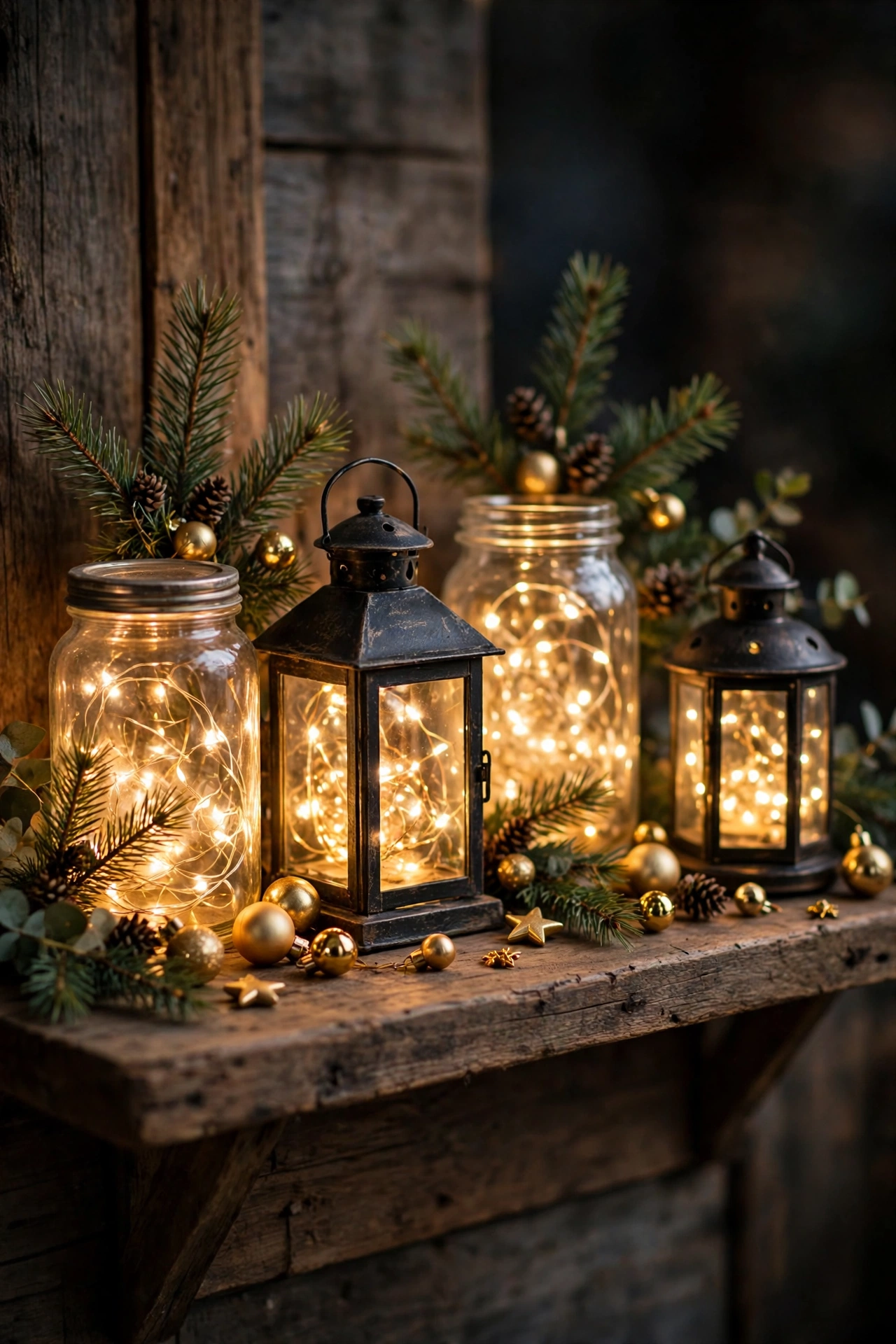
A fairy light jar is the easiest project in this guide. Take a clean glass jar, any size from a jam jar to a large storage jar, coil a battery fairy light strand inside it loosely, and tuck the battery pack behind the jar or under a small cloth. The glass does the work. It softens the bulbs, doubles the glow, and turns a tangle of wire into something that looks deliberate. Add a pine sprig, a few small gold ornaments, or a spoonful of fake snow at the bottom, and the jar looks like a shop bought decoration. Make three jars in different sizes and group them together on a shelf, a mantel, or a windowsill, and the group looks like a set you paid good money for.
Lanterns are the grown up version of the same idea, and they are worth the small investment because they last for years. A metal and glass lantern with a battery pillar candle inside gives you the flicker of a real flame with none of the risk, and a lantern filled with fairy lights instead gives you a much brighter glow for a hallway or a porch. Buy lanterns in odd numbers, one large and two small, or three different heights, because odd groups always look more natural than pairs. Put them on the floor by the fireplace, on the steps by the front door, or in the middle of the dining table, and they anchor the whole arrangement around them.
Empty glass bottles are the free version. A wine bottle with a string of fairy lights pushed inside it, the battery pack hidden in the neck, makes a beautiful piece of light for a shelf or a side table, and a row of three bottles in different heights makes a mantel display that costs nothing at all. Clean the bottles properly, let them dry completely, and choose bottles with interesting shapes, because the shape is what the light shows off. Green glass gives a soft forest glow, clear glass gives a bright sparkle, and amber glass gives the warmest light of all.
Safety matters here more than anywhere else, because these are the lights that sit closest to fabric, paper and greenery. Use LED fairy lights only, never old incandescent strands, because LEDs stay cool to the touch even after hours. Keep real candles out of jars and bottles entirely, and use flameless candles in lanterns instead. Check the battery pack for heat after the first hour, and if it is warm, change the batteries or the strand. A glowing jar should feel like a warm mug, never like a hot plate.
The Tree, Done Properly, Depth Not Just a Spiral
The tree is where most people spend the most on lights and get the least back, because the standard way of lighting a tree is wrong. Wrapping a strand around the outside of the tree in a spiral lights the surface and leaves the middle dark, so the tree sparkles on the outside and looks hollow from across the room. The fix is simple, and it is the difference between a tree that looks lit and a tree that looks alive.
Light the tree in layers, from the inside out. Start at the trunk, with a strand woven deep into the branches near the centre of the tree, and work outward in vertical sections rather than horizontal spirals. The inner strand is what gives the tree its depth. It lights the ornaments from behind, it fills the dark gaps between the branches, and it makes the tree glow from within instead of glittering only on the surface. Then add a second strand on the outer branches for sparkle, and finally a few fairy lights tucked into the very tips for the starlight effect. Three strands sounds like a lot, but a small tree needs only two, and a large tree rewards the third.
Count the lights before you buy, because the shops always understate it. A good rule is one hundred lights per foot of tree height, so a six foot tree needs about six hundred lights, and a seven foot tree needs about seven hundred. That sounds like a lot, and it is, but a tree with too few lights looks sparse no matter how good the ornaments are, while a tree with plenty of lights looks generous even with simple ornaments. If your tree looks thin, the answer is almost always more lights, not more baubles. Buy the lights in the same colour temperature as the rest of the room, and buy them all at once, for the same reason as the fairy lights: mismatched whites show up most on a tree.
Test the lights before they go on the tree, and test them on the floor, not on the branches. Lay each strand out, plug it in, and check every section for a dead bulb or a dark patch. A strand with a dead section is much easier to return or repair on the floor than it is to untangle from a tree. Then put the lights on before the ornaments, always, because ornaments hide the wire and the wire hides the lights. Lights first, garland second, ornaments last. That order never changes, and every year you follow it the tree gets easier.
If you want the full tree plan, including ornament depth, colour schemes and small tree ideas, our Christmas Tree Decor Ideas covers it in detail. The lights in this section are the foundation that guide builds on, and a tree lit well needs far fewer ornaments to look finished.
Candles and Candlelight, Real Flame, Fake Flame, and the Safe Middle
No light in the house moves like a real flame, and that is why candles still matter in a home full of LEDs. A real candle flickers, it breathes, it throws moving shadows on the wall, and no LED has quite matched it yet. But a real candle also burns, and in a house full of dry greenery, paper stars and fabric, that matters more than the flicker. The answer is not to choose one or the other. It is to use each where it is safest and most effective.
Real candles belong in exactly three places. On the dining table, inside a hurricane glass or a tall holder, where they are watched all evening and blown out when dinner ends. On a stone or metal tray, where a drip or a tip cannot reach wood or fabric. In the bathroom, where the surfaces are tile and stone and there is nothing flammable nearby. Everywhere else, use flameless. That rule sounds strict, and it is meant to be, because the most common Christmas fire starts with a candle left burning on a mantel or a shelf while the room is empty. A candle on a mantel surrounded by dry pine is not cozy. It is a risk you can see coming.
Flameless candles have improved enormously, and the good ones are now hard to tell from real candles at arm length. Buy the ones with a flickering LED and a slightly irregular wax edge, not the smooth plastic ones that look like a torch. Put them inside lanterns, inside jars, on the mantel, on the windowsill, and on the bedside table, and use the remote or the timer so they light themselves at dusk. A flameless candle in a lantern on a shelf is the safest light in the house, and it is also one of the prettiest, because the glass of the lantern doubles the flicker.
Mixing real and fake candles in the same room is fine, and it is actually the best approach, because the real candles give you the movement and the flameless ones give you the volume. Put two real candles on the dining table where you can watch them, and put flameless candles everywhere else, on the mantel, the shelf, the sideboard and the windowsill. The room will look as if it is full of candlelight, and only the dining table will need watching. For the dining room itself, including the table, the sideboard and the chairs that the candles will light, see our Christmas Dining Room Decor Ideas.
One safety habit covers all of it. A candle, real or flameless, never sits directly on wood, paper, or fabric, and never sits under a shelf or a hanging decoration. A small plate, a tile, or a tray under every candle costs nothing and removes the most common accident. A real candle is never left burning in an empty room, not even for five minutes, because five minutes is all a dry garland needs. Blow it out when you leave the room. Light it again when you come back. The ritual is part of the season.
Room by Room, Living Room, Bedroom, Kitchen and Hallway
A house glows when every room has a little light, not when one room has all of it. The room by room plan is the part of this guide that makes the biggest difference for the least money, because it spreads the lights you already own across the whole house instead of piling them all in the living room. Walk through the house with this plan in one hand and a basket of battery fairy lights in the other, and most rooms take ten minutes each.
The living room gets the most light, because it is where the evenings happen. One hero: the tree or the mantel, lit properly. One supporting glow: fairy lights on the shelf or the mirror. One portable glow: a jar or a lantern on the coffee table. That is three light sources, and it is enough, because the living room also has the television, the lamps, and the fire or the radiator glow. More than three light sources in a living room starts to feel like a display, and the room stops feeling like a place to sit.
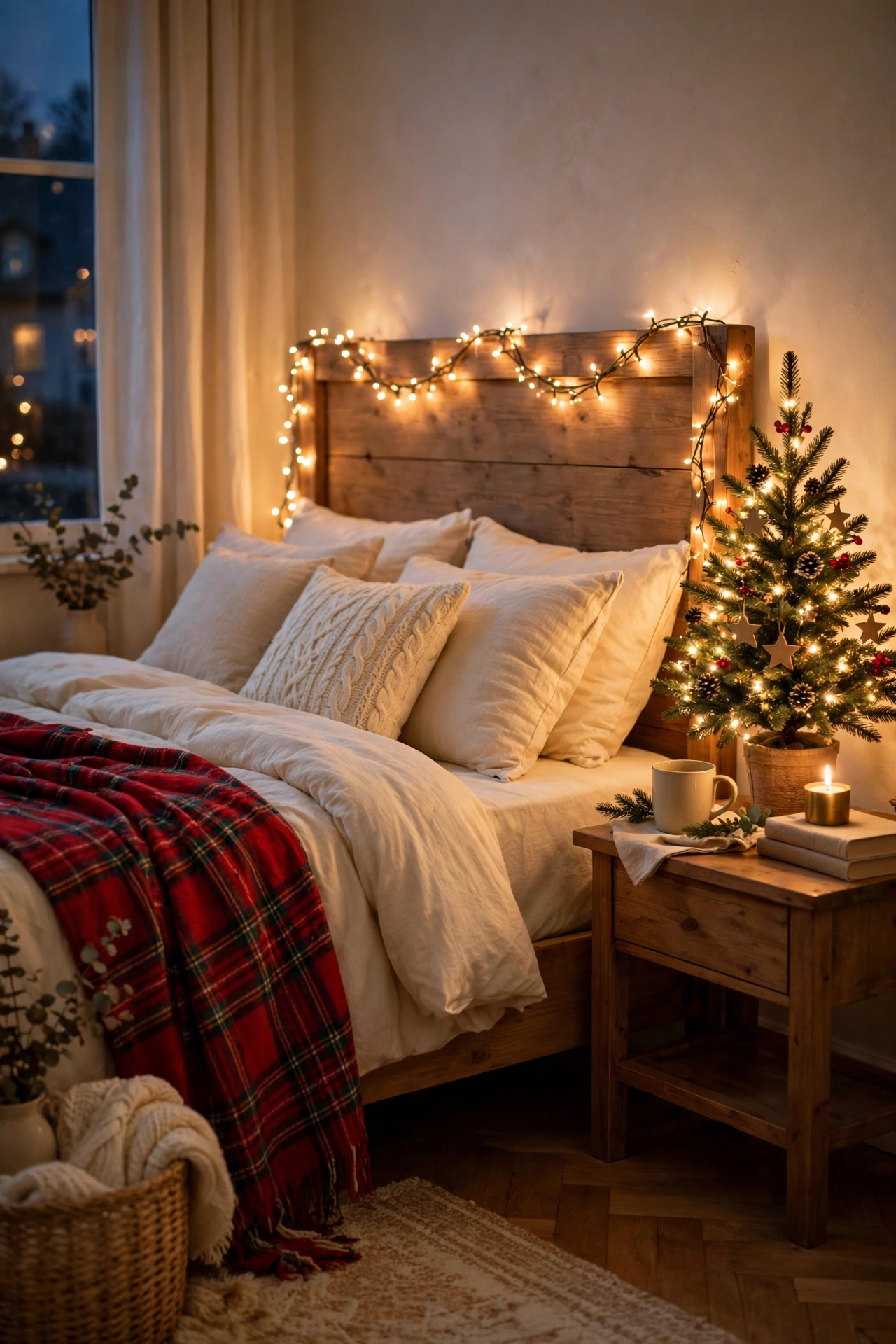
The bedroom gets the softest light, because it is where you wind down. Fairy lights around the headboard, one flameless candle on the nightstand, and nothing else. No curtain lights in the bedroom, no bright strands, no multicolour. The bedroom should feel like a hotel room in December: warm, low, and quiet. A single strand on the headboard does that, and it is the light people photograph most, because it makes the whole bed look like a scene from a film. Keep the lights on a timer so they switch themselves off after you fall asleep.
The kitchen gets practical light, because it is a working room all December. Fairy lights under the wall cabinets, where they light the worktop without taking any space. A jar of lights on top of a high cabinet, where it glows above the eyeline and never gets in the way of cooking. One small tree or one lantern on the windowsill, and nothing on the worktops, because a kitchen worktop in December needs every inch for cooking. Kitchen lights should be battery powered where possible, so there are no cables near the sink, and they should be warm white, because cool white in a kitchen at night looks like a laboratory.
The hallway and the stairs get the guiding light, because they are the rooms you walk through in the dark. A strand of fairy lights along the banister, a lantern on the bottom step, and a small light on the console table if you have one. Hallway lights are about safety as much as beauty: they show you the steps, they show you the door, and they make coming home in the dark feel like arriving somewhere warm. A timer is essential here, because the hallway lights are the ones you most want on when you come home and off when you go to bed.
Safety, Timers and the January Take Down
Christmas lights are safe when they are respected and dangerous when they are not. The difference is a handful of habits that take almost no time. The first habit is inspection. Before any strand goes up, unroll it completely and look at it. Check the wire for nicks, cracks, or bare spots. Check the plug for damage. Check the bulbs for cracks, and throw away any strand that has been repaired with tape or that smells of burning when you plug it in. A strand costs a few dollars. A repair costs a house. Throw it away.
The second habit is the timer. Every mains strand should run on a timer, either a plug in timer or a built in one, set to switch on at dusk and off at bedtime. Lights left on all night waste electricity, wear out faster, and, in the case of old incandescent strands, run hot for hours while nobody is watching. Battery strands with built in timers are even easier: six hours on, eighteen hours off, every day, without you touching them. A timer is the cheapest safety device in the house, and it also makes the lights feel magical, because they are always on when you come home and always off when you wake up.
The third habit is about outlets. One strand per outlet, never three strands chained through one plug, and never a mains strand running under a rug, behind a curtain, or through a doorway where it will be stepped on. If you need more light in a room, use a battery strand instead of an extension lead. Extension leads across a floor in December, when the room is dark and people are carrying drinks and plates, are an accident waiting for a moment. Keep cables against walls, keep plugs visible, and keep the total load well under what the socket can handle.
The take down in January matters as much as the put up in December, because the lights you store badly are the lights that fail next year. Wind each strand around your elbow or around a piece of cardboard, loosely, so the wire is not kinked, and store each strand in its own bag with a label saying where it lived: tree, mantel, window, shelf. A labelled bag takes ten seconds to write and saves half an hour of untangling next December. Test every strand before you store it, so you know which ones need replacing, and throw away the ones that failed rather than storing a problem for next year. Good storage is the reason the same lights can last five Christmases instead of one.
Conclusion
Christmas lights are the cheapest, fastest, and most forgiving decoration in the house, and they are also the one that most people get wrong for the most avoidable reasons. A wrong colour temperature, a strand pinned flat so the wire shows, one bright corner and four dark ones, a real candle in the wrong place: none of these need money to fix, and all of them are fixed by the plan in this guide.
Start with the warm white rule, because it decides everything else. Then pick one job at a time: fairy lights woven behind things rather than laid on top of them, curtain lights on the window that needs them most, a jar or a lantern you can carry from room to room, a tree lit from the inside out, candles where they are safe and flameless where they are not, and a little light in every room instead of all of it in one. Buy the strands in one order, test them on the floor, put them on a timer, and store them labelled in January.
Do that, and your house will do what Christmas lights are meant to do: make a dark evening feel warm, make an ordinary room feel like a place worth coming home to, and make the whole season glow a little longer every night. The tree gets the photographs, but the lights are what you will actually remember.