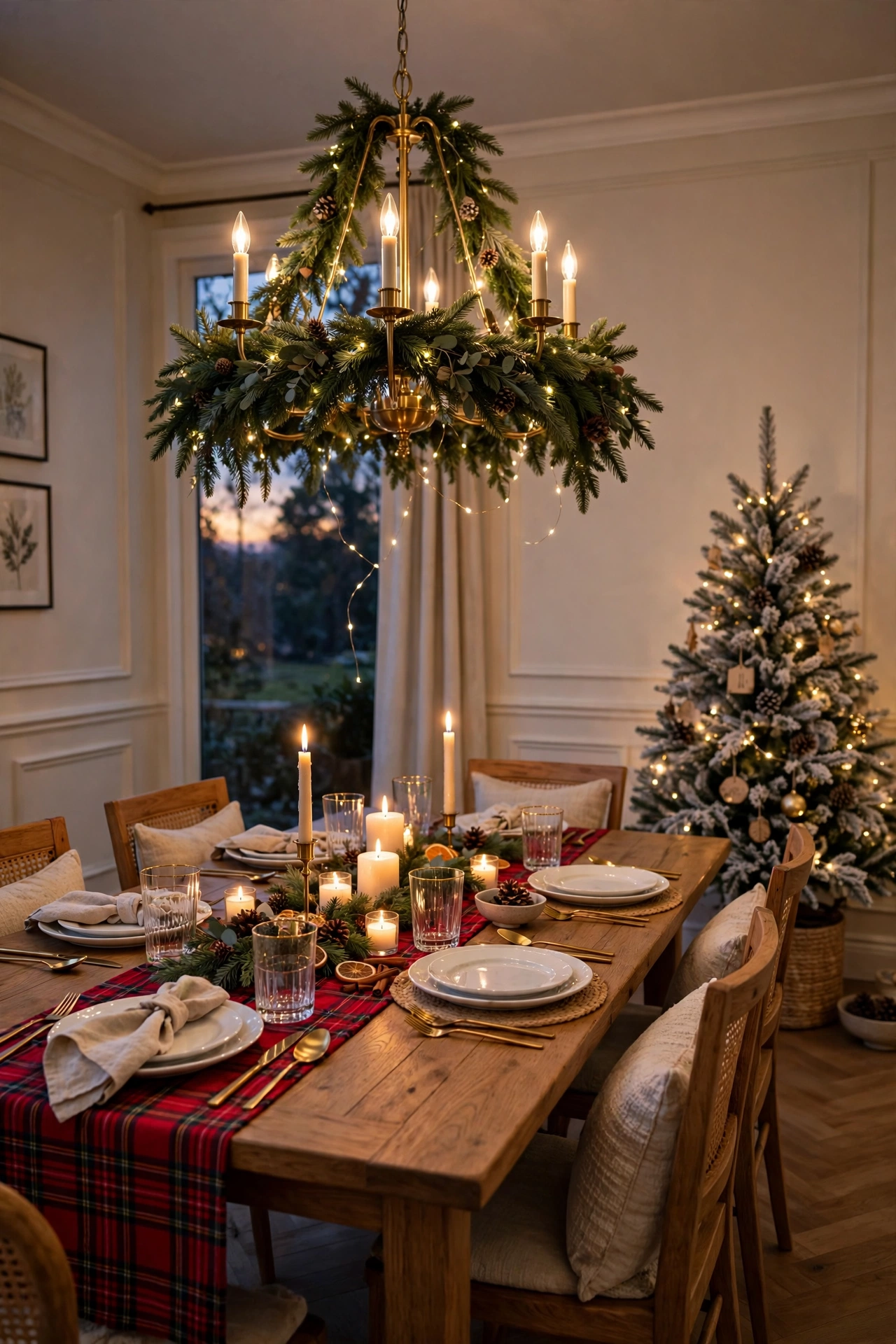
Christmas Dining Room Decor Ideas That Feel Festive, Not Formal
The dining room is where Christmas really comes alive. The tree might go in the living room, the photos might gather there too, and people might relax there with a drink. The dining room is where everyone sits together. That is where the food arrives. That is where the candles go on and the lights come on. That is where the night goes on and on, even after the last plate is gone. It should feel special. It should feel like the heart of the holiday. Too often it does not. Most people treat the dining room like an afterthought. They put a tablecloth on the table, throw a centrepiece down, and the rest of the room stays unchanged. It still looks like November. It feels empty. A few chairs sit unoccupied. The walls are bare. The sideboard is full of junk. The light is too bright or too dark. The room never gets its chance. This guide fixes that. First the room. Then the table. You will learn the one rule that keeps a dining room from looking messy. You will learn how to set a tablescape and still fit everyone. You will learn how to dress the chairs, the sideboard and the walls without buying a new decoration. You will learn how to light the room so it glows, not shines. You will learn which colours work best at a dinner table. You will learn how to make a small dining room feel full of holiday spirit without losing a single seat. Most of the ideas use things you already have. Most rooms can be ready in one evening. Start with the room. Then let the table follow.
Dress the Room, Not Just the Table
The biggest mistake in Christmas dining room decor is treating the table as the room. A beautiful tablescape on a table in a bare room still looks unfinished. Guests do not look at the table. They look at the chairs they sit on. They look at the wall in front of them. They look at the sideboard behind them. They look at the light above them. Decorating the room means giving each of those surfaces one job. No surface should have more than one job.
Start with the one hero rule. Pick one hero piece for the room before you place anything else. The hero might be a garland on the chandelier. It might be a tree in the corner. It could be a centrepiece. It could be a wall of greenery above the sideboard. Everything else in the room supports that hero. If the hero is the chandelier garland, the table stays low and simple. If the hero is the centrepiece, the walls stay quiet. A room with one hero looks designed. A room with four heroes looks like a shop window after a storm.
Walk the room the way a guest will. Come in through the door. Sit in the chair furthest from the kitchen. Look around. The first thing you see from that chair is the wall you should decorate first, because that is the view your guests will live with for two hours. The wall behind the sideboard is usually that wall. It is also the easiest to dress. Use a wreath. Use a garland swag. Use a row of framed prints. Decorate the view, not the corners nobody looks at.
Clear before you decorate. A dining room accumulates clutter faster than any room in the house. School bags on chairs. Post on the sideboard. A laundry basket by the door. A stack of cookbooks on the table. None of it is festive. None of it needs to move. One basket in a cupboard holds the clutter for the whole season. The room instantly has space for the decorations. Every piece of decor you add after clearing reads twice as well, because it is not competing with a pile of ordinary life.
Set the mood with the room, not with a single object. Festive is a feeling made of several small things at once: warm light at face height, greenery at eye level, soft textiles under hands and elbows, and one scent. It may be pine. It may be cinnamon. It may just be the candles. No single decoration creates that feeling on its own. The room creates it when the light, the greenery and the textiles all agree. That is why this guide works through the room surface by surface, so nothing is left shouting while the rest of the room stays silent.
The Tablescape That Still Seats Everyone
I set the table at the centre of the room. The table is also a working surface, and a Christmas tablescape that forgets that will be taken apart five minutes into dinner. The rule is simple: everything on the table must be eaten from, drunk from, or lifted away in one move. If a decoration cannot survive a serving dish arriving, it belongs somewhere else in the room.
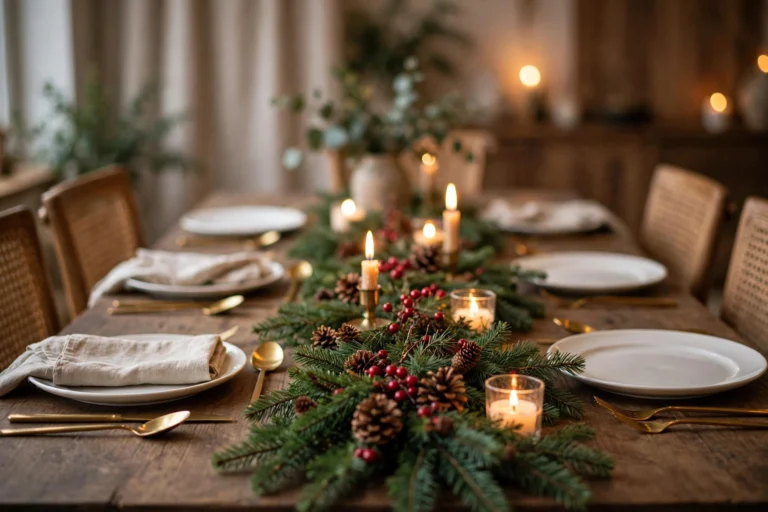
Start with the base layer. A tablecloth, a runner, or bare wood with placemats all work, but pick one and commit to it. A linen runner down the centre gives the table a spine to build on, and it protects the wood from hot dishes. A full cloth suits a formal dinner and hides a tired table. Bare wood with a runner looks relaxed and shows off a good table. Whatever you choose, keep the base flat and washable, because gravy will find it.
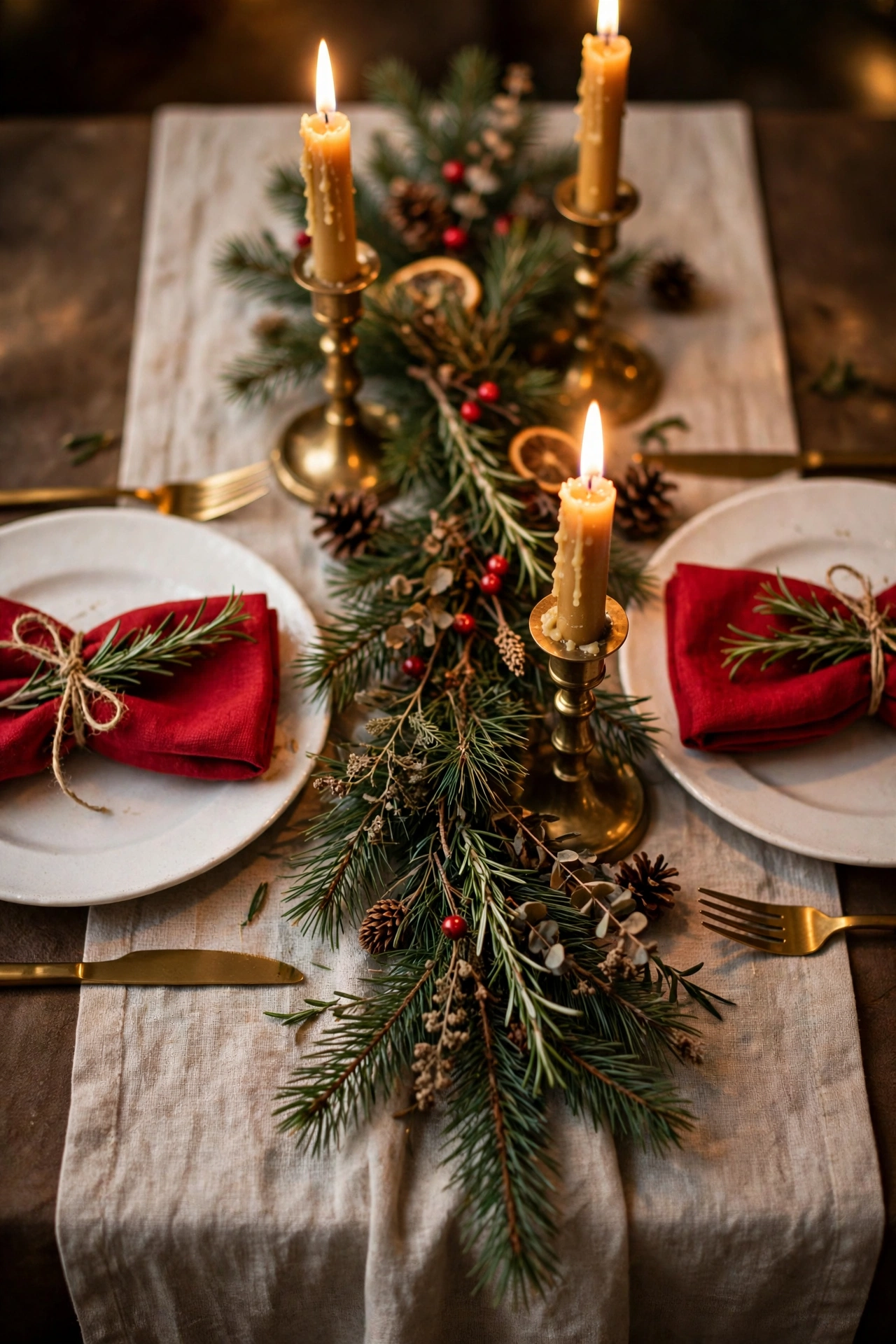
I build the centrepiece on the table low and liftable. A low garland runner, a row of potted evergreens, or a tray holding three candles and a few ornaments all sit below eye level, so guests can see each other across the table. That is the test: sit down and look across. If you cannot see the face opposite, the centrepiece is too tall. The full guide to low centrepieces that lift away in one move is in our Christmas Centerpiece Ideas, and the whole table formula, runner lengths, candle heights and place setting order, is in our Christmas Dining Table Decor Ideas. Both are worth reading before you buy anything, because they save you from the tall candelabra mistake almost everyone makes once.
Place settings come next. They are decoration on the table too. A folded napkin, a sprig of rosemary, a name card, a single ornament on each plate: these small touches cost almost nothing and make the table feel considered. Keep the plates simple and let one thing carry the colour: red napkins with white plates, gold cutlery with cream linen, or green placemats with plain stoneware. A table where the plates, the napkins, the glasses and the centrepiece are all shouting different colours looks busy. A table with one colour story looks calm and expensive.
Leave room to eat on the table. This is the rule that people break often. Every guest needs two feet of table edge, a clear space for a plate, a glass and elbows, and a serving dish needs a landing spot on the table. I count the seats first, then decorate what is left on the table. If the table is full before the food arrives, I take decorations off the table, not seats. A good test is to set the table, then put a serving dish and a water jug in the middle of the table. If they do not fit, something decorative on the table has to move to the sideboard. That is not a failure. That is the sideboard earning its place, which is exactly what the next section covers.
Chairs, Sideboard and the Second Layer
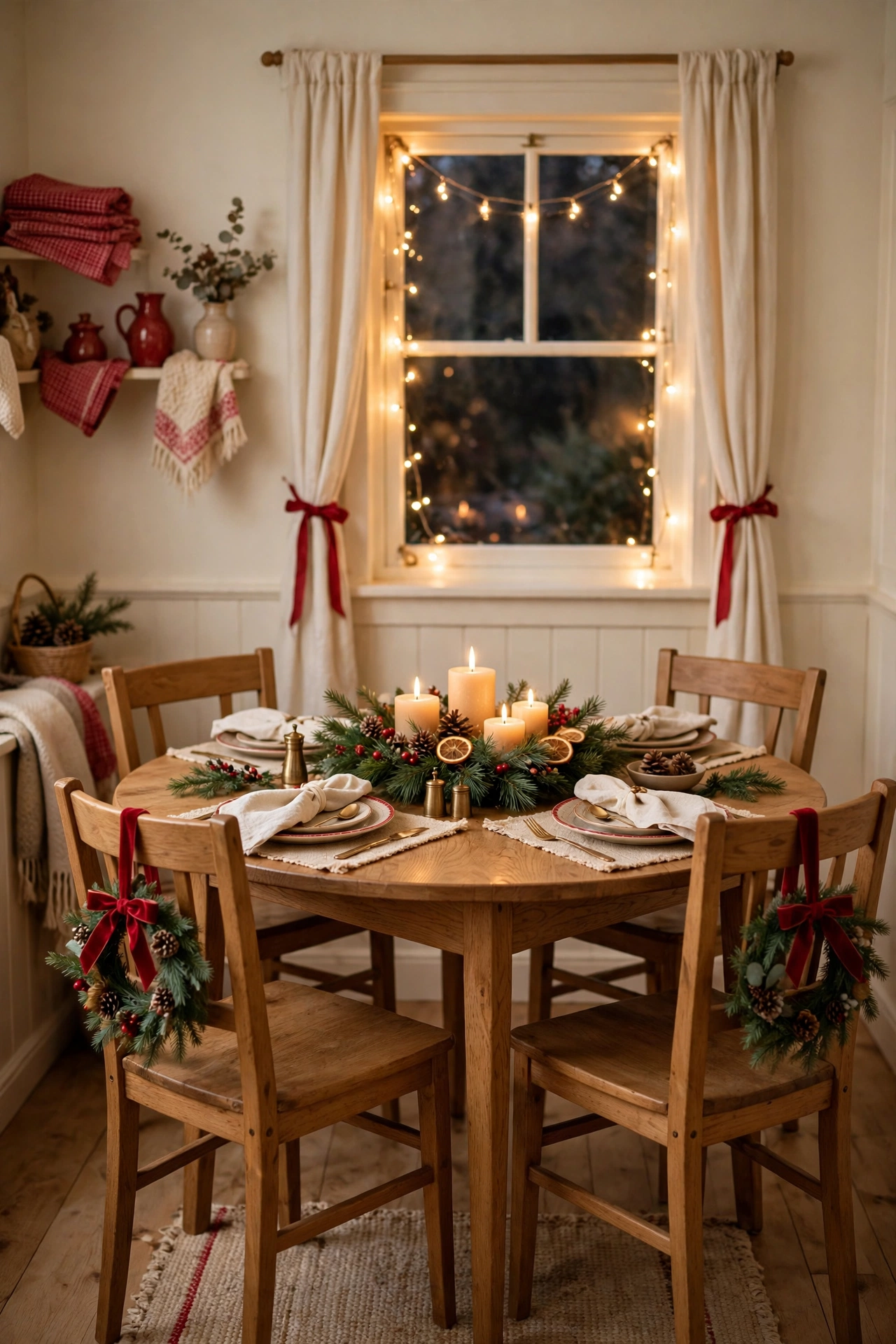
Once the table works, add the layer: the chairs, the sideboard and the surfaces around the edge of the room. This layer makes the room feel finished. It is where most of the budget should go, because it is visible from every seat and it never gets in the way of dinner. Chair backs are the easiest win in the room. A small wreath tied to each chair back with ribbon takes five minutes per chair and transforms the whole table. Keep the wreaths small, no wider than the chair back, and tie them high enough that nobody leans back onto pine needles. If you have more than six chairs, dress only the two end chairs and leave the rest plain, which looks deliberate rather than half done. A simple alternative is a ribbon sash tied around each chair, or a small sprig of greenery tucked behind a name card at each place. All three cost almost nothing, and all three photograph beautifully.
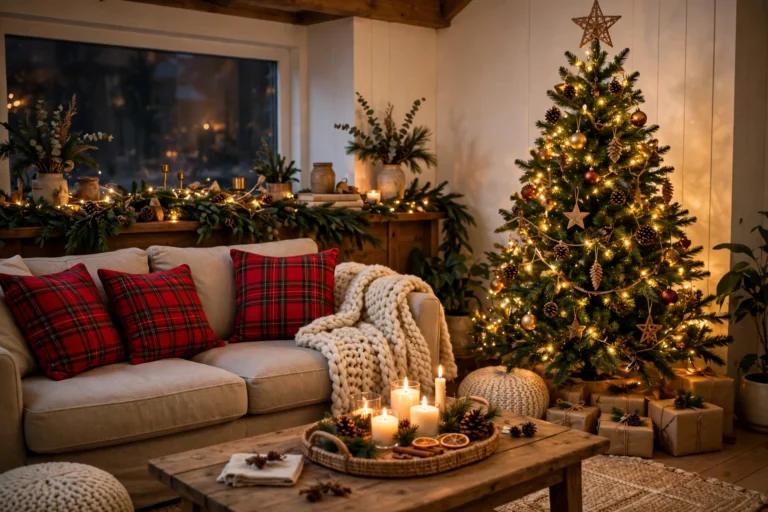
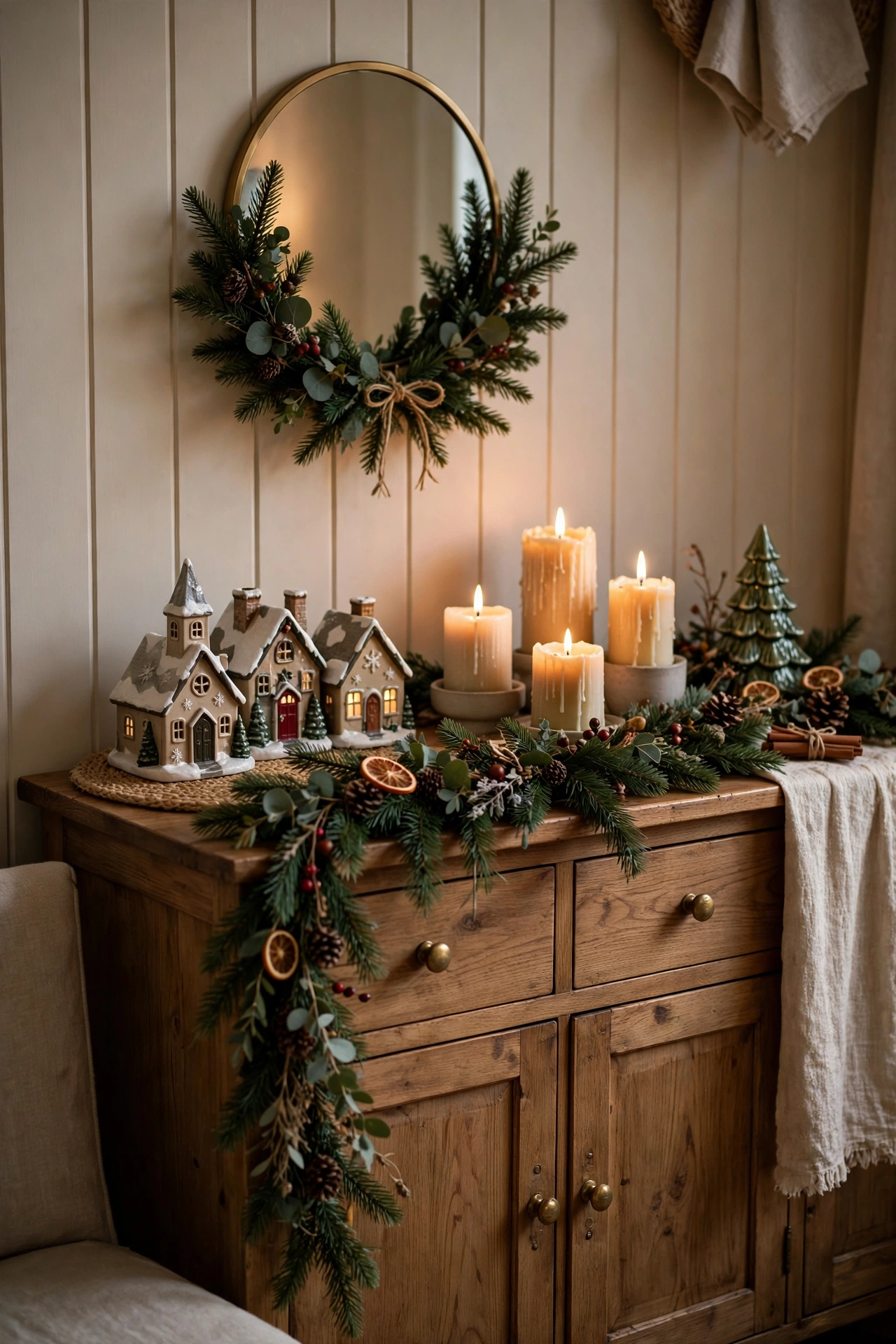
The sideboard is the working surface in the dining room at Christmas. It holds the serving dishes, the extra glasses, the water jug and the pudding, so it must stay usable. Dress it in zones: one end for display, one end for serving. The display end gets the garland, the candles and the small village or nativity. The serving end stays clear except for a tray that corrals the glasses. A mirror above the sideboard doubles the candlelight and makes the room feel bigger, and a wreath hung on the mirror is the single most effective wall decoration in a dining room. Our Christmas Shelf Decor Ideas covers the same layering rules for sideboards and shelves, and the same greenery first, height at the back, light last formula applies here.
Do not forget the floor and the corners. A basket of rolled blankets by the door, an evergreen in the empty corner, a small rug under the table if the floor is cold: these ground the room and stop it feeling like a showroom. A tree belongs in the dining room corner only if it does not block the walkway to the kitchen. If it does, move it to the living room. Put a tall branch in a vase on the sideboard instead. A room that is easy to walk through feels festive. A room you have to squeeze through feels like a storage cupboard with lights.
Keep one surface clear. The top of the sideboard, one wall, or the window sill, pick one. Leave it empty. That empty space is what lets the decorated surfaces breathe. It gives you somewhere to put the serving dishes when they come off the table. A room with no empty surface feels cramped by the end of the first course, no matter how pretty it looked in the photographs.
Light the Room So It Glows Instead of Glares
Christmas light in a dining room should come from small warm lights, not from one bright ceiling light. A single overhead bulb makes everyone look tired and makes the decorations look flat. Several low warm lights make the same room look golden, make the food look better, and make the whole evening feel longer and slower in the best way. Start with the chandelier, if you have one. A garland draped over a chandelier is the classic dining room hero, and it works because the light is already where the garland wants to be. Use a light faux garland, never a heavy fresh one, and wire it on in two places so it cannot slip. Keep the garland clear of any real candle flame, and keep the bulbs warm white, never cool white. Cool white light over a dinner table looks like an office. Warm white light looks like Christmas. If you have a pendant light instead of a chandelier, hang one small wreath from it or drape a single strand of greenery around the cord, and stop there. Candles do most of the work, and they need rules. Taper candles in brass holders down the centre of the table, pillar candles on the sideboard, tealights in glass holders on the window sill. That is three heights, three places, one warm colour. Never put a real flame under a garland, beside a curtain, or within reach of a child or a sleeve. Battery candles are the honest answer on a table with children, on a sideboard under a shelf, and anywhere a flame would be left burning after everyone has gone to bed. Modern battery candles flicker well enough that guests will not notice, and nobody has to watch them. Fairy lights belong in the room, not just on the tree. A strand woven through the sideboard garland, a strand around the window frame, a strand in a glass jar on the sill: these are the lights that make the room glow from the edges while the candles glow from the centre. Use warm white micro LEDs on a timer, six hours on and eighteen hours off, so the room lights itself every evening without anyone remembering. One strand per surface is enough. Two strands on one surface is the point where fairy lights stop looking magical and start looking tangled. Dim the ceiling light, or turn it off. If your dining room light has a dimmer, use it. Set it low enough that the candles are doing the real work, and the ceiling light is only filling in the shadows. If there is no dimmer, turn the ceiling light off once the candles are lit and dinner is served. The room will feel smaller, warmer and more intimate at once, which is exactly what a Christmas dinner should feel like.
Walls, Windows and a Tree in the Corner
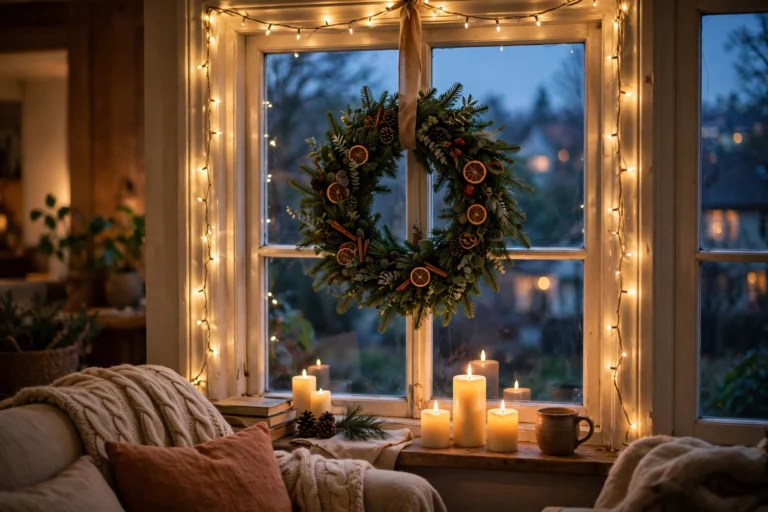
Walls are the largest undecorated surface in most dining rooms, and they are also the easiest to overdo. One decorated wall beats four busy walls every time, so pick the wall your guests face, decorate it well, and leave the rest alone. The wall behind the sideboard is the usual choice, and a single large wreath is usually the right decoration for it. A wreath wider than the sideboard looks wrong, so size it to about two thirds of the sideboard width and hang it at eye level. A mirror with a wreath on it is even better, because it doubles the light. If you do not have a mirror, a row of three small framed prints, a garland swag across the top of the wall, or a set of stockings hung in a neat row all work. The rule is one idea per wall. A wreath and a garland and three prints on the same wall is three ideas, and the wall will look like a noticeboard. Windows deserve a simple treatment. A garland across the top of the window frame, a pair of battery candles on the sill, and a small wreath in the centre of the glass is the whole recipe. Keep the sill clear enough to open the window, and keep candles away from curtains. A window dressed this way looks good from inside at dinner and from outside on the street, which is a rare double win. If your dining room has a large window, a string of warm fairy lights around the frame will do more for the room than any wall decoration, because it frames the dark evening outside. A tree in the dining room corner is a question of space, not taste. A slim pencil tree or a small tabletop tree on a plant stand fits most dining rooms, and it gives the corner a reason to exist. A full seven foot tree belongs in the living room, unless your dining room is genuinely large. If the corner is tight, a tall branch in a vase, a potted evergreen, or a stack of wrapped boxes with a bow on top will fill the same corner without blocking the walkway. Whatever you choose, keep the path from the kitchen to the table completely clear. The person carrying the turkey should never have to sidestep a tree. The ceiling is the last wall, and most dining rooms should leave it alone. A garland on the chandelier is enough. Paper stars, hanging ornaments and draped fabric across a dining room ceiling look magical in photographs and feel oppressive at a real dinner, where everyone is sitting directly underneath them. One exception is a single paper star in the window, which is a Scandinavian tradition and works precisely because it is alone.
Colour Schemes That Work at a Dinner Table
Colour is where Christmas dining rooms go wrong most often, because the table gathers colour from everywhere: plates, napkins, glasses, candles, the centrepiece, the crackers, the food itself. A dining room needs a colour plan more than any other room, and the plan should be decided before a single decoration is bought. Traditional red, green and gold still work, because they are warm, familiar and forgiving. Red napkins, green garland, gold cutlery, white plates. The trick is to let red and green share the room rather than fight for colour. Pick one as the main colour and one as the accent. Red as the main colour with green as the accent feels festive and bold. Green as the main colour with red as the accent feels calm and woodland. Either way, gold should be the only metal in the room. Silver and gold together on one table look like two sets of decorations arguing. Neutral and natural is the 2026 favourite, and neutral and natural suits a dining room particularly well, because it lets the food be the colour. Cream linen, wooden chargers, white plates, green garland, brass candlesticks, one deep green or burgundy accent in the napkins. This palette photographs beautifully, this palette suits both old and new houses, and this palette never looks dated in January, because the pieces work all year round. The 2026 heritage palette shift, warm cream, deep green and heritage red, is really just this neutral scheme with one confident red, and this palette shift is the safest choice for a first Christmas dining room. Blue and silver is the cooler alternative, and blue and silver works best in a dining room with white walls and good evening light. Navy napkins, silver cutlery, white plates, frosted greenery, a few silver ornaments in the centrepiece. Keep the blue deep and the silver brushed, not shiny, so the table feels wintry rather than icy. Blue and silver suits a formal dinner, a smaller table, and a household that already owns silver candlesticks. Blue and silver does not suit a house full of small children and red stockings, where blue and silver will look like the wrong party. Pick two colours and one metal, write them down, and stick to them across the whole room. The napkins, the runner, the candles, the wreath and the crackers should all agree. If a decoration does not match the plan, the decoration goes in another room or back in the box. That discipline is what separates a dining room that looks styled from one that looks like every decoration the household owns was put out at once.
Small Dining Room Ideas
A small dining room is easier to decorate for Christmas, not harder, because every decoration is closer to the guests and the room fills up faster. The rules change a little, but the result can be the cosiest dining room in the house. Start by accepting the size. A small dining room cannot hold a tree, a sideboard display, a full garland and a dressed table all at once, and trying will make it feel like a cupboard. Pick the table and one other surface, and leave the rest plain. The table and the window, or the table and one wall, is enough. A small room with two well decorated surfaces feels festive. A small room with five decorated surfaces feels crowded.
Use the vertical space. A small dining room has walls and a ceiling that a large room wastes. Hang the wreath on the wall, run the garland up the window frame instead of across the table, put the candles on a high shelf, and keep the table surface for eating. A tall thin centrepiece, a few tall taper candles in slim holders, gives height without taking up table space. A low wide centrepiece in a small dining room eats the only space the food needs.
Choose a round table if you can, or work with the one you have. A round table seats four comfortably and leaves no dead corners, and a single low centrepiece in the middle reaches everyone. A small rectangular table should have the centrepiece along its centre line, not across its width, so it never blocks a place setting.
Folding chairs are fine for Christmas. They are easier to dress than heavy dining chairs, because a ribbon sash or a small wreath ties to a folding chair in seconds. Keep the palette light. A small room with dark red walls, dark wood and heavy decorations feels smaller by the hour. Cream linen, white plates, green garland and one red accent will make the same room feel bright and open.
Mirrors help more in a small dining room than in any other room: one mirror on the wall opposite the window doubles the daylight and doubles the candlelight, and the room feels twice as big after dark. Store the extras where they belong. A small dining room has no room for spare decorations, so the pieces that do not fit the plan should go back in the box now, not sit on the sideboard hoping for a use. A tidy small dining room with a dressed table and a lit window will always beat a large dining room full of decorations that have nowhere to sit.
The One Hour Plan and the Under 50 Dollar Budget
A Christmas dining room does not need a weekend. It needs one hour, a clear plan, and a budget decided before you start. This section gives you both, and the honest costs that go with them. The one hour plan runs in four fifteen minute blocks. First fifteen minutes: clear the room. Everything that is not a chair, a table or a sideboard goes into one basket and out of sight. Second fifteen minutes: lay the base. Tablecloth or runner, placemats, plates, glasses, cutlery, napkins. The table is set before a single decoration appears, because a set table tells you how much space is actually left. Third fifteen minutes: the hero and the greenery. Hang the wreath, drape the chandelier garland, lay the table garland, dress the sideboard. Fourth fifteen minutes: light and detail. Candles out, fairy lights on, name cards written, one sprig of greenery on each plate. Then step outside, come back in through the door, and look at the room the way a guest will. Anything that looks wrong from the doorway is the thing to fix. Anything that looks right from the doorway is done. The under 50 dollar budget is realistic if you shop what you own first. A faux garland, about 12 to 15 dollars, is the one purchase worth making, because it works on the table, the sideboard and the chandelier, and it lasts for years. Battery fairy lights, about 8 to 10 dollars, are the second. A pack of taper candles, about 5 dollars, is the third. Ribbon, twine and name cards, about 5 dollars, are the fourth. That leaves about 15 dollars for the thing that makes the room yours: a set of linen napkins in your colour, a small wreath for the wall, or a ceramic village house for the sideboard. Everything else, plates, glasses, cutlery, the mirror, the chairs, the sideboard itself, you already own. A dining room decorated with 50 dollars and an hour of work will look better than a dining room decorated with 300 dollars and no plan, because the plan is what guests notice, not the price tags. Shop at home before you shop anywhere else. The red mugs from the kitchen, the brass candlesticks from the living room, the plain white plates from the everyday cupboard, the evergreen branches from the garden, the pinecones from the park, the ribbon from the gift drawer, all of these are dining room decorations already. The best Christmas dining rooms are not the ones with the most new purchases. They are the ones where the owner looked around the house first and only bought the two or three things that were genuinely missing.
Conclusion
A Christmas dining room is not a showroom. It is a working room that has to hold dinner, hold conversation, and hold the people you love for a few hours on the darkest evenings of the year. Decorate it for that job, and it will feel festive without ever feeling formal. Start with the room, not the table. Pick one hero, clear the clutter, dress the chairs and the sideboard, light the room with warm low light, choose two colours and one metal, and leave enough space for the food. A small room needs even less, a table and a window, and a little discipline about what stays in the box. Give the room one hour and fifty dollars, and it will give you back a whole season of dinners that feel like Christmas from the moment the candles are lit. Set the table tonight, light the candles, and sit down in the chair furthest from the kitchen. If the room feels warm, if the light is golden, if you can see the faces across the table, the dining room is done. Save this guide, and come back to it next year, when the same garland, the same candles and the same plan will be waiting in the box, ready to do it all again.