Christmas Window Decor Ideas That Glow Day and Night
Your windows are the one Christmas decoration that does two jobs at once. From inside, they frame the room and catch the evening light. From outside, they are what neighbours and guests actually see first, long before they reach the front door. A tree sits in one room. A mantel sits on one wall. A window glows through the whole street after dark, and it does that work every single evening in December, whether anyone is visiting or not.
That is also why windows are easy to get wrong. A window dressed only from the inside can look flat from the street. A window dressed only for the street can look cluttered from the sofa. The trick in this guide is simple: dress every window for both sides at the same time. Pick one clear focal point, add light in one warm colour, keep the sill low and clear enough that daylight still gets in, and repeat the same simple idea across the windows in one room instead of giving each window a different theme. Nothing here needs a designer budget. Most of it needs a wreath hook, a string of battery lights, and an afternoon you were going to spend untangling lights anyway.
1. The Both Sides Rule: Design for the Sofa and the Street
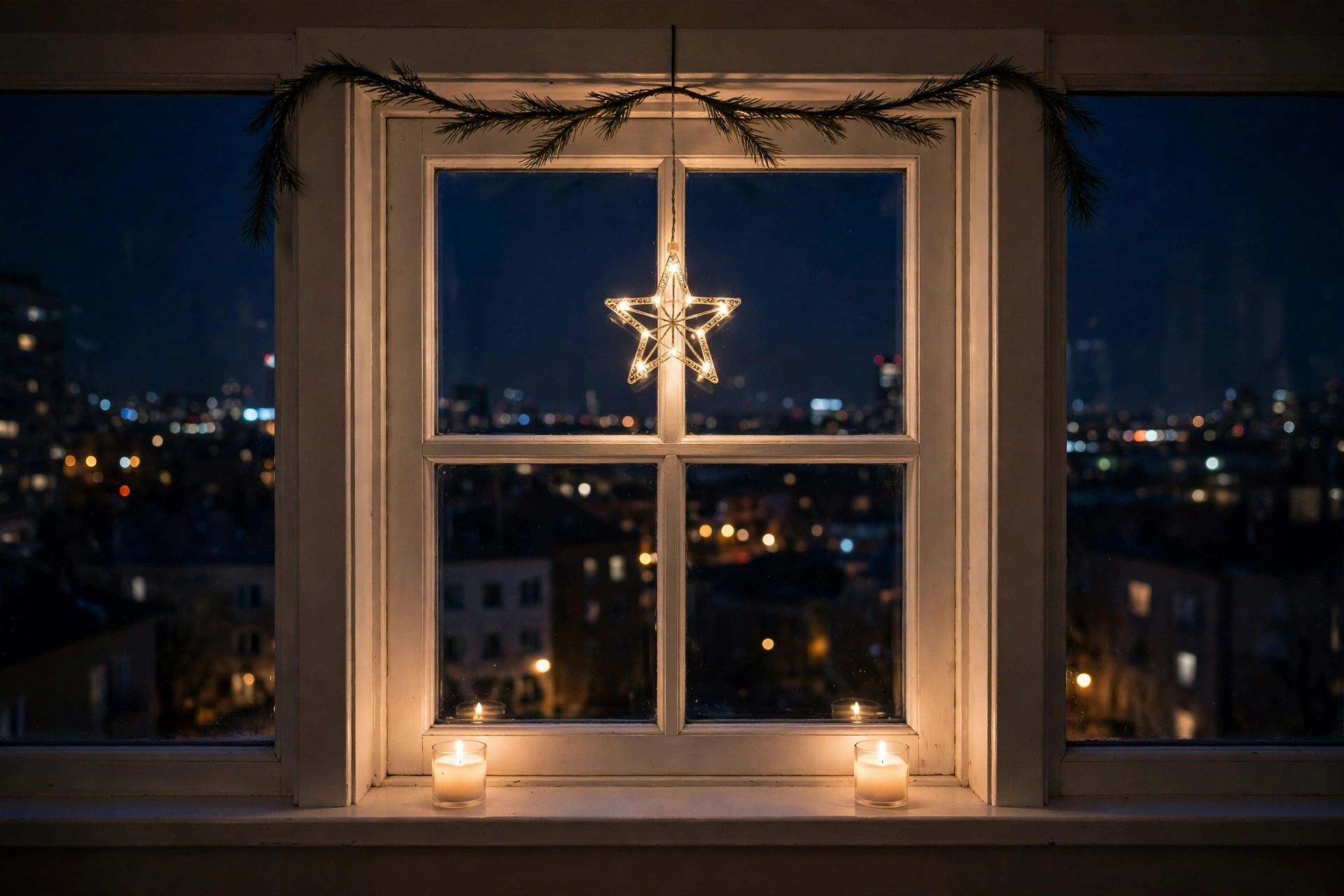
Before you hang anything, stand in both places. First, stand where you sit in the evening and look at the window. Then go outside, or step back to the far side of the room, and look at the same window as a stranger would. A good window decoration reads clearly from both spots. A wreath in the centre, a line of candles on the sill, or a star light hanging in the glass all pass this test, because they have one clear shape. A dozen small ornaments scattered across the glass usually fail it, because from the street they blur into clutter, and from inside they block the view.
Keep daylight in mind too. A window is still a window in December. If you cover the whole pane with paper snowflakes, heavy garland, and hanging ornaments, the room goes dark by three in the afternoon, and the decoration that was meant to feel festive starts to feel closed in. Leave at least the middle of the glass clear, or keep the decoration to the frame and the sill, so the room still gets its winter light by day and glows by night. The best test is boring and reliable: sit down at dusk, turn the window lights on, and look at the room. If the window feels like a picture, it is done. If your eye keeps jumping from one small thing to another, take one thing away.
Safety comes first here, in a way it does not for a mantel or a shelf. Curtains and lights are a bad pair when they touch. Keep string lights, candles, and any warm bulb away from curtain fabric, and use battery or LED lights near curtains, because LED lights stay cool to the touch. Use flameless candles on a sill near curtains, never a real flame. If a curtain blows in a draught and brushes a light, the light should be cool, the candle should be fake, and nothing should be able to catch. Check the same rule for paper stars and dried branches near a radiator under the window. Pretty is easy. Pretty and safe near fabric takes a thirty second check.
2. The Wreath in the Window: One Focal Point That Works Twice
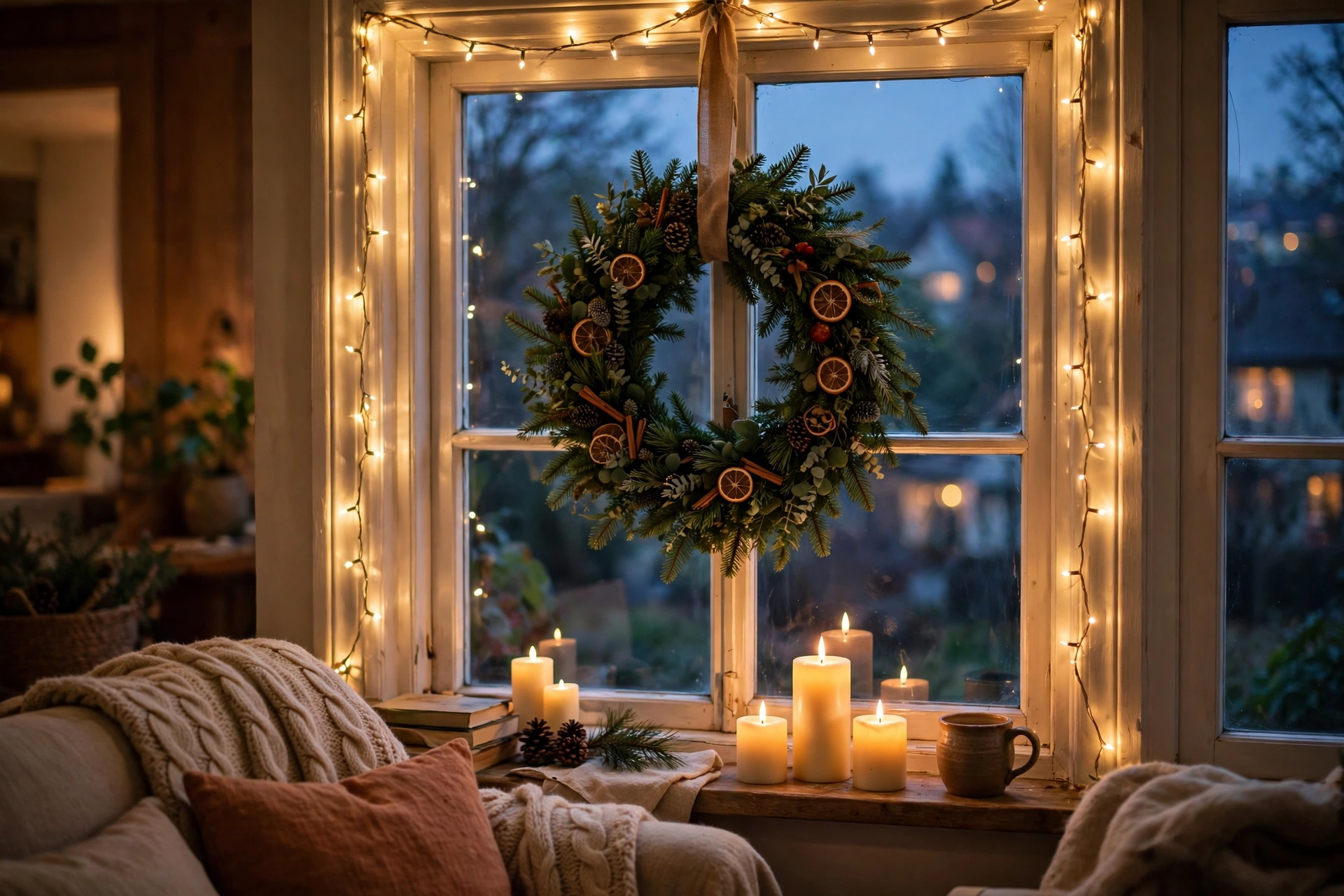
A wreath hung in the centre of a window is the easiest Christmas window idea there is, and it is popular for a reason. From the street, it reads as a warm welcome. From inside, it frames the view like a living picture. It works on a front window, a bedroom window, and a kitchen window, and it works even better when every window in one room gets the same wreath, because repetition makes a house look planned instead of decorated window by window.
Hang it so the centre of the wreath sits at about eye level from outside, not up near the top of the frame where nobody sees it. For a standard window, that usually means the top of the wreath sits a little below the top of the glass. Use a suction cup hook rated for the wreath weight on the inside of the glass, or a clear adhesive hook on the frame, and test it before you walk away. A wreath that falls at midnight is a small disaster, and a wreath that falls onto a sill village is a bigger one. If the window opens, hang the wreath from the frame, not from the moving sash, so opening the window for air does not drop the whole display.
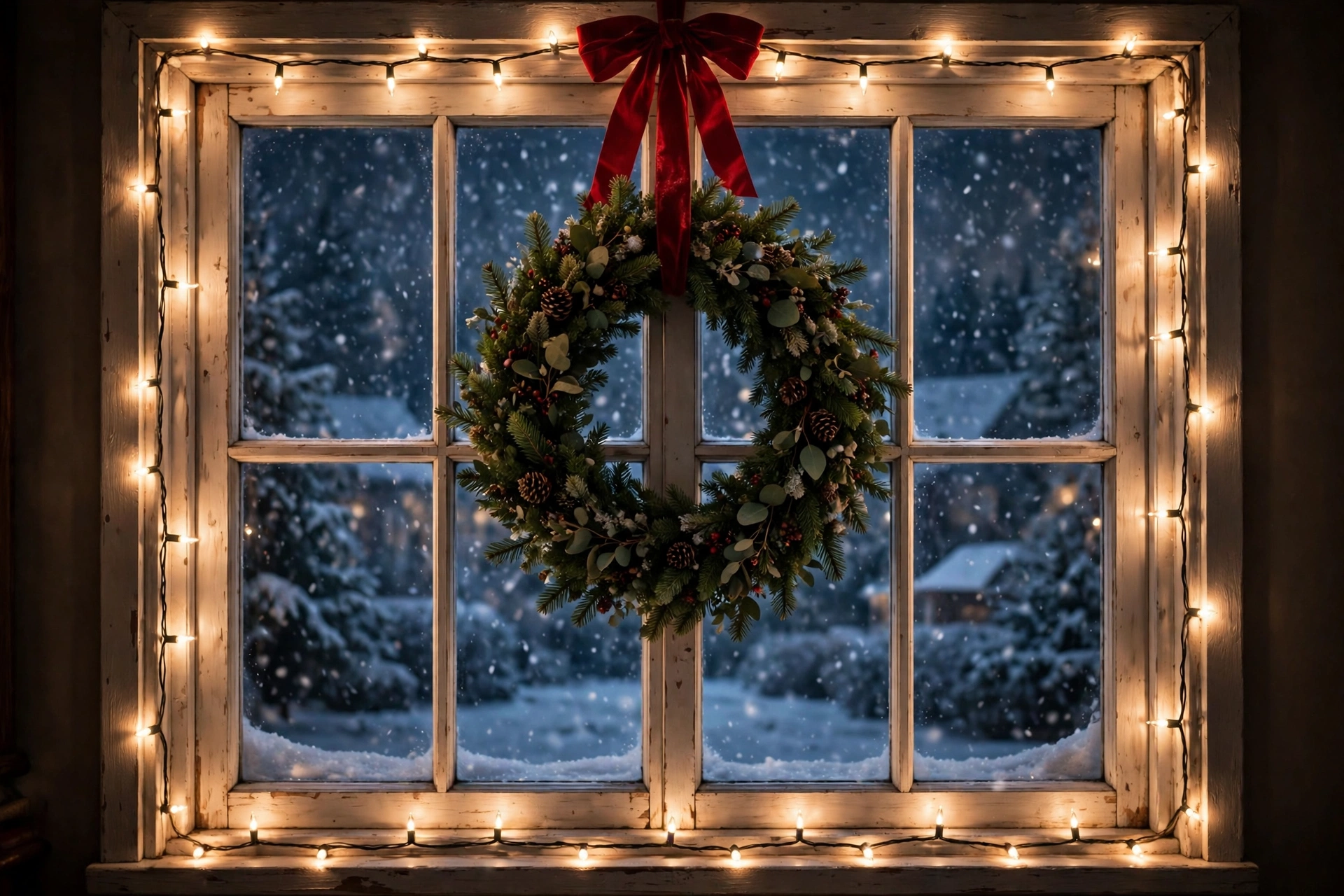
Ribbon is what makes a window wreath look finished. A wide ribbon, 2 to 2.5 inches, in velvet or satin, looped over the top of the window frame and tied to the wreath, hides the hook and gives the wreath a tail that moves gently in the room. Red velvet reads as traditional. Cream or gold reads as calm. Plaid reads as cosy. Pick one ribbon and use it on every window wreath in the room, because matching ribbon is what turns three separate wreaths into one design. Add a short strand of warm white fairy lights woven through the wreath before you hang it, with the battery pack tucked on the sill behind a candle, and the wreath glows after dark, which is exactly when a window wreath looks its best. Battery lights with a timer are worth the small extra cost, because they switch themselves on every evening without anyone climbing onto a chair.
For a double window or a wide picture window, hang two wreaths, one in each pane, at exactly the same height. For a tall narrow window, hang one smaller wreath, not a full size one that crowds the glass. The wreath should fill about half to two thirds of the width of the pane. Bigger than that, and it blocks the light. Smaller than that, and it looks lost. If you already have a wreath on the front door, use the same greenery on the window wreaths, so the door and the windows feel like one welcome. Our guide to Christmas front porch decor shows how that outside welcome comes together, and matching window wreaths are the simplest way to carry it around the house.
3. Lights That Frame, Not Flood: Strings, Curtains, and Stars
Lights are what make a Christmas window glow, but more lights are not always better. A window outlined in one clean line of warm white lights reads as elegant from the street. The same window covered in three different colours, two flashing modes, and a curtain of lights behind a wreath reads as a shop display. Pick one light idea per window, and one light colour per room, and the house will look calm instead of frantic.
The frame outline is the classic choice. Run one string of warm white lights around the inside of the window frame, tucked just behind the trim so the wire hides, with the battery pack on the sill. Warm white, 2700K or warmer, is the right choice for a living room window, because cool white light on greenery reads as cold and commercial. For a bedroom window, warm white is even more important, because the window glows all evening while people are trying to wind down. Measure the frame before you buy. A standard window needs about 6 to 8 feet of lights for a clean outline, and a wide window needs a second string joined at the centre, not one string stretched thin.
Curtain lights, the falling strands that hang from the top of the window like a sheet of light, suit one statement window, not every window in the house. Use them on the main living room window, or the window above the dining table, and leave the other windows with a simple wreath or candles. One curtain of lights in a room is magical. Four curtains of lights in a room is glare. Star lights work the same way. One large star, or three small stars at different heights in one window, is a beautiful focal point. A star in every window, in every room, stops being special by the second room.
Outdoor lights need a different check. If you hang lights on the outside of the window, use lights rated for outdoor use, keep the plug and any join out of standing water, and do not run a cord across a walkway or a step to reach the window. Battery lights solve most of that problem, and they also solve the timer problem, because a battery pack with a timer switches on at dusk without anyone going outside in the cold. From the street, the difference between a plug in string and a battery string is invisible. From the person who has to switch them on every night, it is the difference between a decoration that gets used and one that stays dark.
4. The Sill Is a Stage: Candles, Villages, and Low Layers
The windowsill is the most underused Christmas surface in a small home, and it is the one neighbours see most clearly after dark. Three battery candles in glass holders, two small bottle brush trees, and a short string of lights along the sill create a vignette that glows at dusk and costs almost nothing. Keep it low, so daylight still gets in, and keep it simple, so the sill still looks like a sill, not a shelf that has been filled to the brim.
Candles are the heart of a sill display. Vary their heights, three heights in a group of three or five, and space them evenly, with the tallest at the ends or in the centre, never in a straight row of identical candles. Battery candles with a flicker effect and a timer look real from the street and from the sofa, and they are the only safe choice near curtains. Glass hurricanes around a candle make the light softer and protect the flame, real or fake, from a draught. If you use real candles anywhere on a sill, keep them away from curtains, never leave them burning in an empty room, and never put a real candle under a hanging ornament or a paper star. Most sill displays are better with flameless candles, and nobody standing on the street can tell the difference.
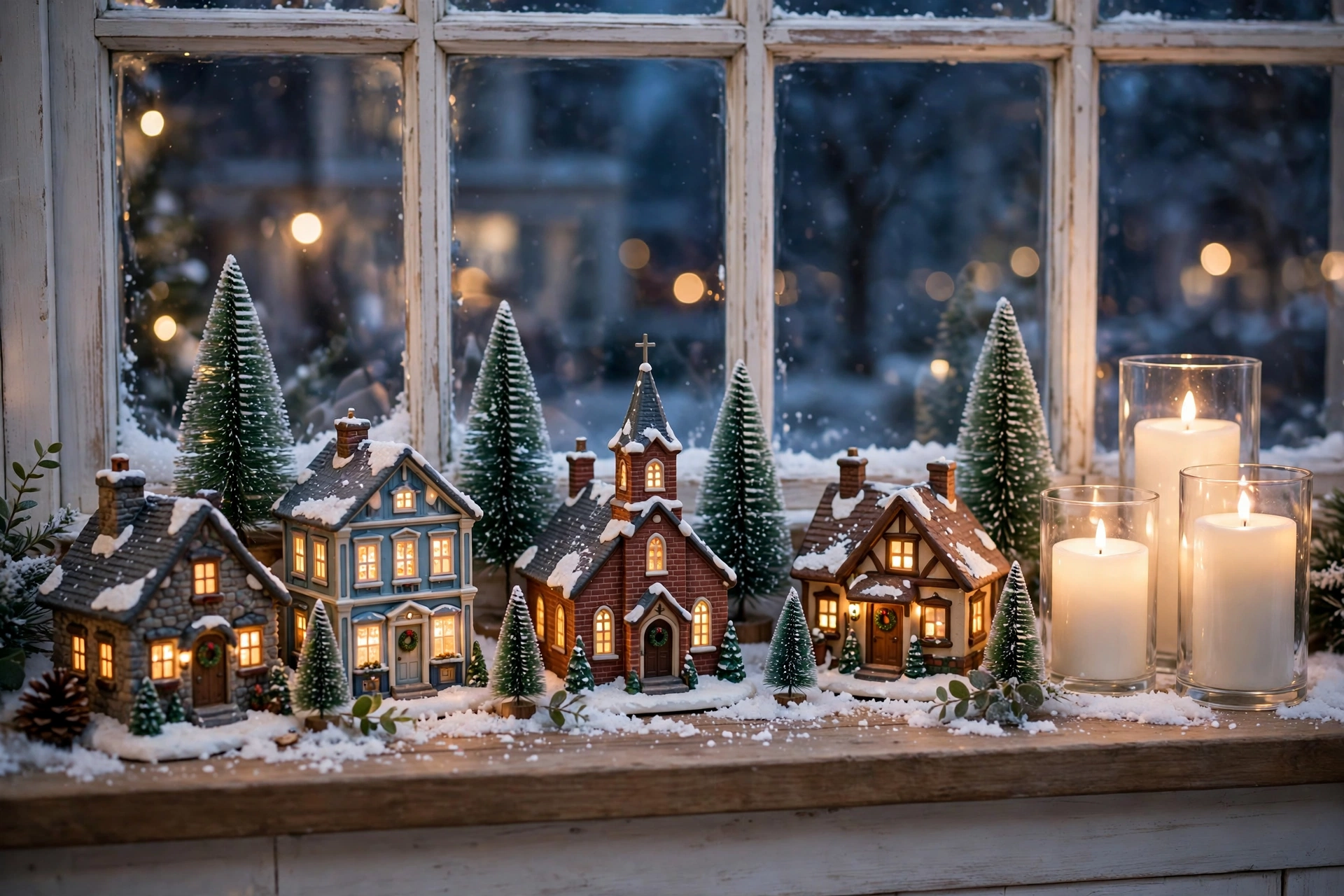
A Christmas village on a sill is the next step up, and it is the decoration that stops people in their tracks. A row of tiny lit houses, bottle brush trees, and a dusting of fake snow turns an unused sill into a miniature winter scene that glows all evening. Build it on a narrow board or a tray, so the whole village lifts off in one move for cleaning, and keep the tallest house below the middle of the window, so the village does not block the view by day. Add one string of fairy lights woven through the fake snow, not draped over the houses, so the light comes from inside the scene. This idea works especially well in bedrooms and children’s rooms, where the gentle glow doubles as a night light through December. It also works on a deep kitchen sill, where the village can be seen from the table at dinner.
The low layer finishes the sill. A bowl of spare ornaments, a short strand of wooden beads, a few pinecones, or a small stack of books with a tiny tree on top, all sit under six inches tall and fill the gaps between candles without blocking light. The rule is the same as for a mantel: tall pieces at the ends, medium pieces in the middle, low pieces filling the gaps. A sill that follows that rule looks finished with five items. A sill that ignores it looks cluttered with fifteen.
5. Garland Frames and Swags: Greenery Without Blocking the View
Garland around a window frame gives a window a full, festive border, and it does it without covering the glass. Use faux pine, cedar, or eucalyptus garland, and tuck in small ornaments, pinecones, or fairy lights, but keep the garland on the frame, not across the pane. A garland that crosses the middle of the window blocks the view and makes the room dark. A garland that frames the window makes the view feel festive.
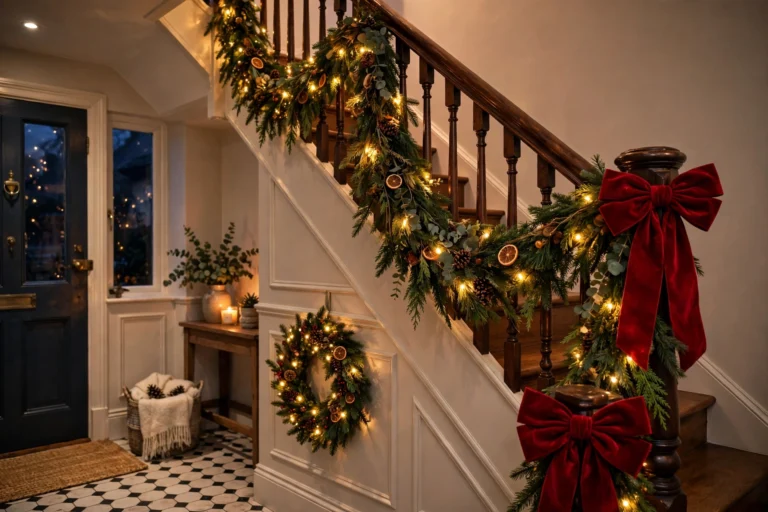
Measure the frame the same way you would measure a mantel or a banister. For a garland that runs flat along the top of the frame and down both sides, you need the width of the window plus twice the height, plus a little extra for a soft drape at the corners. For a swag across the top only, with the garland dipping in the middle, you need about 1.5 times the width, so the dip hangs 6 to 10 inches below the top of the frame without pulling tight. Two thin garlands twisted together look fuller than one expensive thick one, and a basic pine garland plus a cedar strand, twisted loosely, reads as one lush garland for a fraction of the price. That trick works on a staircase too, and if you have just dressed your stairs, our guide to Christmas staircase decor uses the same fullness trick on a banister, so the greenery in the hall and the windows can match.
Fasten garland to a window frame with clear adhesive hooks or small command hooks on the top of the frame, not with nails or tape on painted trim. The garland hides the hooks completely, and nothing gets drilled. For a rental, this is the whole game. Removable hooks, a garland that lifts off in one move, and no damage to a frame you do not own. Check the weight before you walk away, especially if you have added ornaments or lights to the garland. A garland that is too heavy for its hooks will sag in the middle within a day, and a sagging garland looks worse than no garland at all.
Inside the room, a garland swag across the top of a window pairs beautifully with a wreath in the centre, as long as the two do not fight. Use the same greenery for both, and keep the swag shallow, so the wreath stays the star. Outside the room, the same swag reads as a frame from the street, especially after dark when the lights woven through it glow. One garland, two views, no extra work. That is the both sides rule again, and it is why garland frames are worth the measuring step.
6. Four Finished Looks, One Window
Same window, same wreath hook, same sill, just swap the colours and the accents, and the window changes character completely.
Traditional red and green is the nostalgic one. Deep green garland around the frame, a wreath with red berries, red velvet ribbon, brass or gold candle holders on the sill, and warm white lights. It forgives mismatched pieces, because mismatched pieces read as collected over the years, which is the whole point of a traditional window. Add a plaid bow at the top of the wreath and it is done.
Neutral and Scandinavian is the calm one. Pale faux pine or eucalyptus garland, a simple wreath with no berries, cream candles, pale wood or white ceramic houses on the sill, and warm lights only. Keep metal to one finish, matte black or brushed nickel, and skip the red entirely. This look suits small rooms and modern houses, because it does not shout, and it photographs beautifully in daylight. It also carries beautifully into January if you take the ribbon off and leave the greenery, which is a bonus for anyone who hates undecorating in one big rush.
Jewel tones is the dramatic one. Emerald or deep green garland, burgundy and plum ribbon on the wreath, gold candle holders, and a few navy ornaments tucked into the garland. Rich and a little theatrical, best in rooms with dark furniture or low evening light. One honest warning: jewel tones eat light, so add more fairy lights than you think you need, or the window will look dark in the evening, which is exactly when guests see it most.
Woodland and natural is the cheapest one, and often the prettiest. Plain greenery, pinecones gathered for free, dried orange slices on twine hung in the window, cinnamon sticks tied in small bundles on the sill, and a burlap or jute ribbon. No ornaments needed, no colour story to match, and everything in it can go back to the garden or the compost in January. This is the look to choose if you have children who want to help, because pinecones and orange slices are decorations a child can actually make and hang without breaking anything. Hang dried oranges high, away from pets, because they look like treats to a dog.
7. Small Windows, Rentals, and Windows Without a View
A small window is easier, not harder, once you accept that one good idea beats three crowded ones. For a small window, use one wreath or one star light, not both, and keep the sill to three items at most. A full garland frame on a narrow window eats the glass and makes the room feel smaller, which is the opposite of festive. A slim garland across the top only, a single star in the centre, and two candles on the sill, and guests see a festive window, even though the glass itself stays clear enough to let light in.
Renters have the same rule with one extra constraint: nothing that damages the frame, the glass, or the wall. Suction cup hooks on glass, adhesive hooks on the frame, a tension rod across the top of the window for hanging a garland or a ribbon line, and a tray village on the sill, all lift off in January without a mark. A tension rod is especially useful, because it lets you hang a garland swag or a row of paper stars across a window without a single hook. If your lease forbids adhesive hooks too, a freestanding solution works: a tall lantern on the sill, a small tree on a table in front of the window, and candles that sit, not hang, on the sill.
A window without a good view, a window that faces a wall, a parking area, or a neighbour’s brick, deserves decoration more, not less, because the decoration becomes the view. In that case, a curtain of lights or a fuller sill village is the right call, because the window is now a picture, not a view. Frosted window film with a simple pattern, applied with water and peeled off in January, turns a bad view into a soft glow by day, and at night the lights behind it glow through the film beautifully. A window that faces a busy street also benefits from a simple rule: keep the decoration to the top half of the window, so passers by see the glow, but the lower half still lets you see out and lets daylight in.
This same decorate up, not out, idea works for a small entryway too, and if you have just dressed your hallway, our guide to Christmas entryway decor shows how one palette carried from door to windows makes the whole house feel planned. Carry the same ribbon, the same light colour, and the same greenery from the entryway to the windows, and the house stops looking decorated room by room.
8. The Outside View, the Neighbour Test, and the January Take Down
Once the windows are dressed, do the neighbour test. Step outside at dusk, stand on the pavement or across the street, and look at the house. The windows should glow in one warm colour, with one clear shape in each window, and the same idea repeated across the front of the house. If one window is red, one is blue, one is flashing, and one is dark, the house looks accidental, even if each window looked fine from inside. Fix it by matching the light colour first, because light colour is what the street sees most. Matching wreaths come second. Matching sill candles come third, and only if you can see them from the street.
Check the practical details from outside too. No cord should cross a walkway. No light should shine directly into a neighbour’s bedroom window. No decoration should block an escape route or a window that needs to open. A window decoration that blocks a fire escape or a bedroom window that must open is not a decoration, it is a hazard, and it should come down even if it looks beautiful. Keep at least one window in each bedroom clear enough to open quickly, and keep sill villages off the sill of a window that is the room’s only exit.
The take down deserves a plan too, because window decorations left up until February look tired, and a garland ripped down in one rush sheds needles everywhere. Take ornaments off first, then lights, then garland, then wreaths, working from the top down, and bag the garland before carrying it through the house. Faux garland goes back in its box for next year. Fresh sprigs go to compost. Ribbon, if it is wired and undamaged, goes back in the box too, because good wired ribbon lasts for years, and buying the same ribbon again next December is money spent twice. Suction cups and adhesive hooks come off with warm water, and any residue wipes away before it hardens.
Start with the both sides rule, keep the light warm and in one colour, and let one clear focal point do the work in each window. Do that, and your christmas window decor will glow from the street and feel calm from the sofa, while still letting daylight in by day, which is, after all, the job a window has to do every day of December.