Christmas Kids Room Decor Ideas for Magical Bedtimes
A child’s bedroom is the room that most people think about last when they plan Christmas decorations, and that is why a child loves discovering the holiday inside it. A child wakes up surrounded by Christmas instead of walking past it in the hallway. A small tree by the bed, lights a child can turn on alone, and a stocking with a child’s name on it: these little things make December bedtimes into memories that a child will keep for years. I remember the excitement when my child first saw the lights.
The key is to decorate for a child, not for a photo. A child’s bedroom must stay safe, sleep friendly and easy to clean. Glass ornaments, cords and anything breakable should not be at a child’s height. Everything in this plan follows that rule first and the pretty part second. The result is a room that looks festive by day and glows gently at night, and still feels like a normal bedroom on a school evening. I have seen how a child smiles when the room glows.
You do not need a big budget or a whole weekend. Most of these ideas use items you already own plus one or two small purchases, and almost all of them can be finished in an afternoon with a child’s help. Let a child pick the theme, hang the ornaments a child made and choose the spot for the tree. A room a child helped decorate is a room a child will love. I love watching a child choose the colors.
1. Start With Safety, Then Add the Magic
Before a single decoration goes up, make sure the room is safe for a child who will touch everything. This is the least exciting step and the most important one. A beautiful room that keeps a parent awake at night is not worth it.
Use shatterproof ornaments only. Felt, wood, fabric and plastic ornaments can fall off a tree and survive, and so can the child who knocks them off. Keep glass, ceramic and anything with sharp edges out of the room completely, or high on a shelf an adult can reach and a child cannot. The same goes for tinsel and small loose pieces that a toddler might put in their mouth.
Keep the lights high and cords hidden. Hang string lights above the bed, along a shelf or around a window frame, never across the floor or trailing from the bed. Use battery lights with a timer instead of plug in lights where you can. A battery pack tucked behind the dresser removes the cord problem entirely, and a timer means the lights switch themselves off after bedtime. Check that no bulb gets hot, and never let a child sleep with lights wrapped around bedding.
Keep the floor clear. A kids room is a play space first, so the walkway from the bed to the door must stay open. Put the tree in a corner, not in the middle of the room. Keep decoration boxes out of the way once you finish. If the room is small, decorate upward: walls, shelves and the headboard, not the floor.
Let your child help, with safe jobs. Let them place the soft ornaments, choose the garland colors and stick the window decals on. Jobs like this make them feel ownership of the room, and they are the reason the room feels magical to them rather than just decorated.
2. The Mini Tree They Can Decorate Themselves
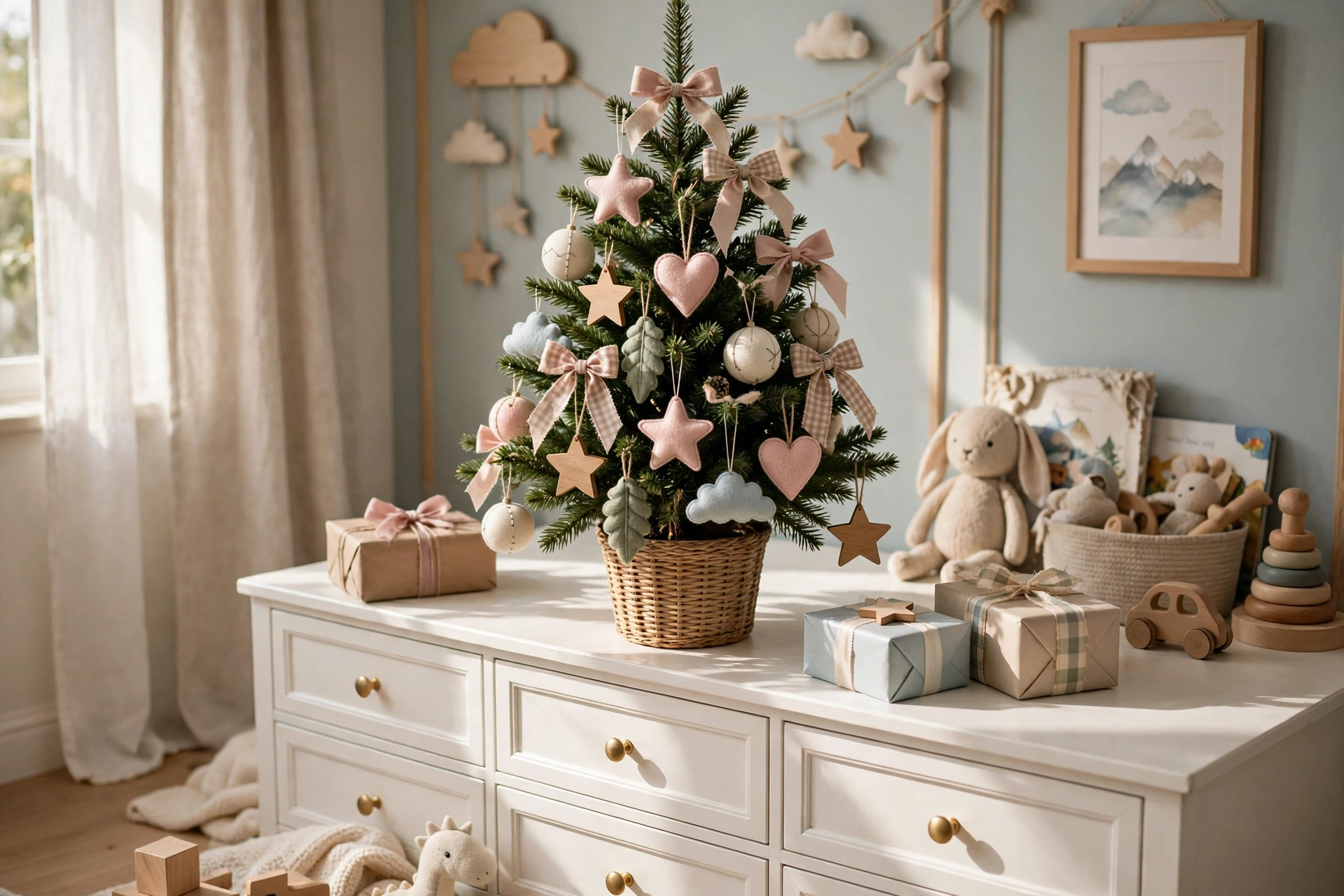
Every kids Christmas room needs its own tree, and small is better than big. A tree between two and four feet tall fits on a dresser, a sturdy shelf or a small table in the corner. It is the right height for a child to decorate without climbing, and it leaves the floor free for playing.
Let the tree be theirs from start to finish. Hand them the ornaments and step back. The tree will not look like a shop window, and that is the point. A tree decorated by a child, with clusters of ornaments in one spot and bare branches in another, has more charm than a perfect one. Keep a few spare soft ornaments nearby so they can redecorate whenever they like.
Choose the tree to match the room, and browse these Christmas tree decor ideas for more inspiration. A slim green tree suits a small room because it takes almost no floor space. A white or flocked tree looks lovely in a pink or pastel room. A potted tree in a basket looks calm and natural in a woodland or neutral room. If the room is shared, one small tree between the beds works well, with each child decorating one side.
Decorate it with things that cannot break. Felt ornaments, wooden shapes, paper stars, pom poms and ribbon bows are all safe and light. Add a simple star or bow on top that a child can place themselves, standing on the bed with an adult beside them. Skip the glass baubles and the heavy ornaments that pull branches down.
Keep the tree stable. A small tree on a dresser needs a heavy base or a basket it cannot tip out of. If the tree stands on the floor, wedge the base against the wall or the corner so it cannot fall forward. Check it after the first night, because a tree that falls at 2 in the morning is a bad way to learn it was unstable.
3. Bedding That Does Half the Work
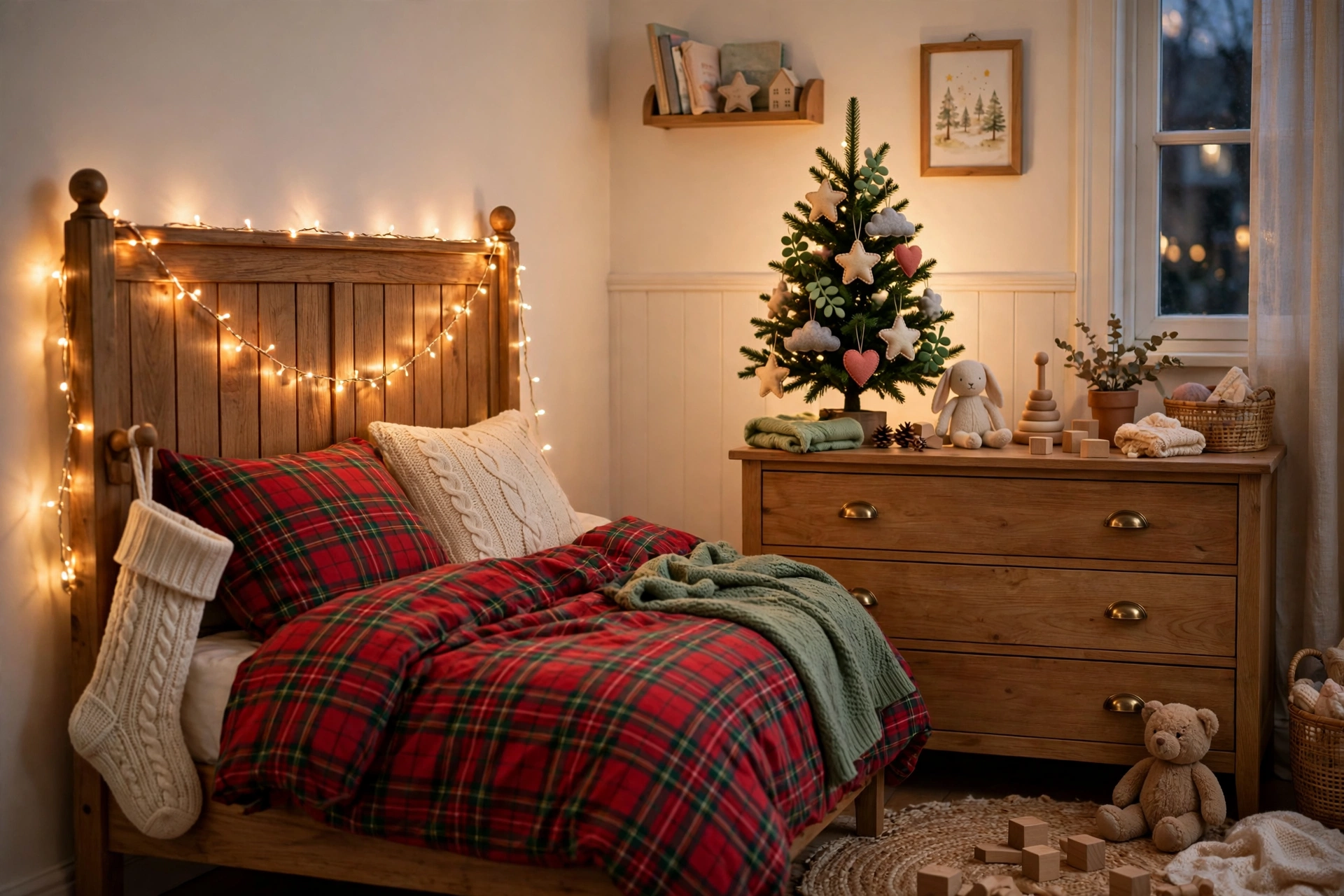
The bed is the biggest surface in a kids room. Changing the bedding is the fastest way to transform the whole room. A festive duvet cover, two pillow cases and a throw at the foot of the bed can do more than a dozen small decorations scattered around.
Pick a pattern that your child will love looking at every night. Red and green plaid is the classic choice and fits almost any room. A duvet with reindeer, snowflakes or Christmas trees feels festive without needing anything else. For a quieter look, use a plain deep green or cranberry cover and add one festive pillow. Let your child choose between two options that you have already picked, so the room still matches and your child still feels it is theirs.
Layer a throw and a pillow for warmth and texture. A soft fleece throw in cream or red folded at the foot of the bed looks inviting. It gives your child something warm to pull up while they read. A lumbar pillow with a simple Christmas word or a small embroidered tree finishes the bed without cluttering it. Keep the number of pillows low so bedtime stays simple.
Do not forget the little ones. For a toddler bed or a crib, keep it simpler still. A fitted sheet in a festive color and one soft blanket is enough. Nothing loose, nothing with small parts and nothing that covers the face. The walls and the shelves can carry the decorating in a nursery, and the bed stays safe.
Wash everything before the first night. New bedding can feel stiff and smell of the shop. One wash makes bedding soft and ready. It is a small job that makes the first festive bedtime feel properly special.
4. Lights They Can Sleep Under
Christmas lights turn a kids room into a magical place after dark. Children love Christmas lights more than any other decoration. The warm glow turns an ordinary bedroom into a wonderland, and it doubles as a gentle night light that makes bedtime easier.
Hang a single strand of warm white fairy lights where the child can see them from the bed, along the headboard, around the window frame or draped along a shelf, to give the whole room a soft glow. One strand is enough. Two or three strands start to look busy and make the room feel like a fairground instead of a bedroom.
Choose warm white lights over colored lights for the bedroom. Colored lights are fun in a playroom. Warm white lights are calmer at bedtime and match every color scheme. If the child loves color, add one small colored strand to the Christmas tree and keep the wall lights warm white. The bedroom stays peaceful. The Christmas tree still gets its moment. Warm white also works beautifully in our Christmas living room decor ideas.
Give the child control of the Christmas lights. A battery string with a small remote or a simple switch that the child can reach is a wonderful idea. The child can switch the Christmas lights on at story time and off at sleep time, which makes the child feel grown up. This also stops the call for a parent to switch the lights. A timer setting of six hours on and eighteen hours off means the Christmas lights glow every evening and switch themselves off after bedtime without anyone remembering.
Keep every Christmas light out of reach of small hands where it matters. Christmas lights above the bed or along a high shelf are fine. Christmas lights at mattress level, wrapped around the bed frame or tangled in bedding, are not. Check the batteries once a week, because a strand of Christmas lights that dies halfway through December is a small sadness that can be avoided easily.
5. Stockings, Garlands and the Wall Above the Bed
I love the wall above the bed; it is the best spot to decorate in a child’s room because it can be seen from the bed and is safely out of reach. A garland, a row of stockings or a few paper stars up there gives the child something lovely to look at while they fall asleep. A Christmas wreath on the bedroom door completes the look.
Hang a garland along the headboard or across the wall above it. A felt ball garland in red, green and cream is soft, light and impossible to break. A paper chain your child made themselves is even better, because they will point at it every night. A pine garland with a few wooden stars suits a calmer, woodland style room. Whichever you choose, hang it with removable hooks or tape that will not mark the paint.
Give every child a stocking with the child’s name on it. Hang the stocking on the bedpost, on a hook beside the bed or on a small shelf, not on a mantel the child cannot reach. A stocking at bed height lets the child peek inside it on Christmas morning without leaving the bed. Personalize it with a felt name, an iron-on letter or a simple tag tied with ribbon.
Add wall decorations that can be taken down easily in January. Removable snowflake decals on a pale blue wall look magical and peel off without leaving a trace. Paper stars hung from the ceiling on thread turn in the draught and catch the light. A simple framed print with a reindeer or a Christmas tree above the dresser finishes the wall without adding clutter.
Keep the display to one wall. A garland above the bed, a stocking beside it and a few stars on the next wall are enough. When every wall is decorated, the room stops feeling restful. One strong festive wall, with the rest of the room calm, is the balance that works best at bedtime.
6. A Reading Nook for Christmas Stories
December is the month when Christmas stories come alive, and a small reading nook is the place for those stories. A corner of the room with a cushion, a blanket and a basket of books becomes the place where the day ends, and children will ask for one more story far more often when the corner looks inviting.
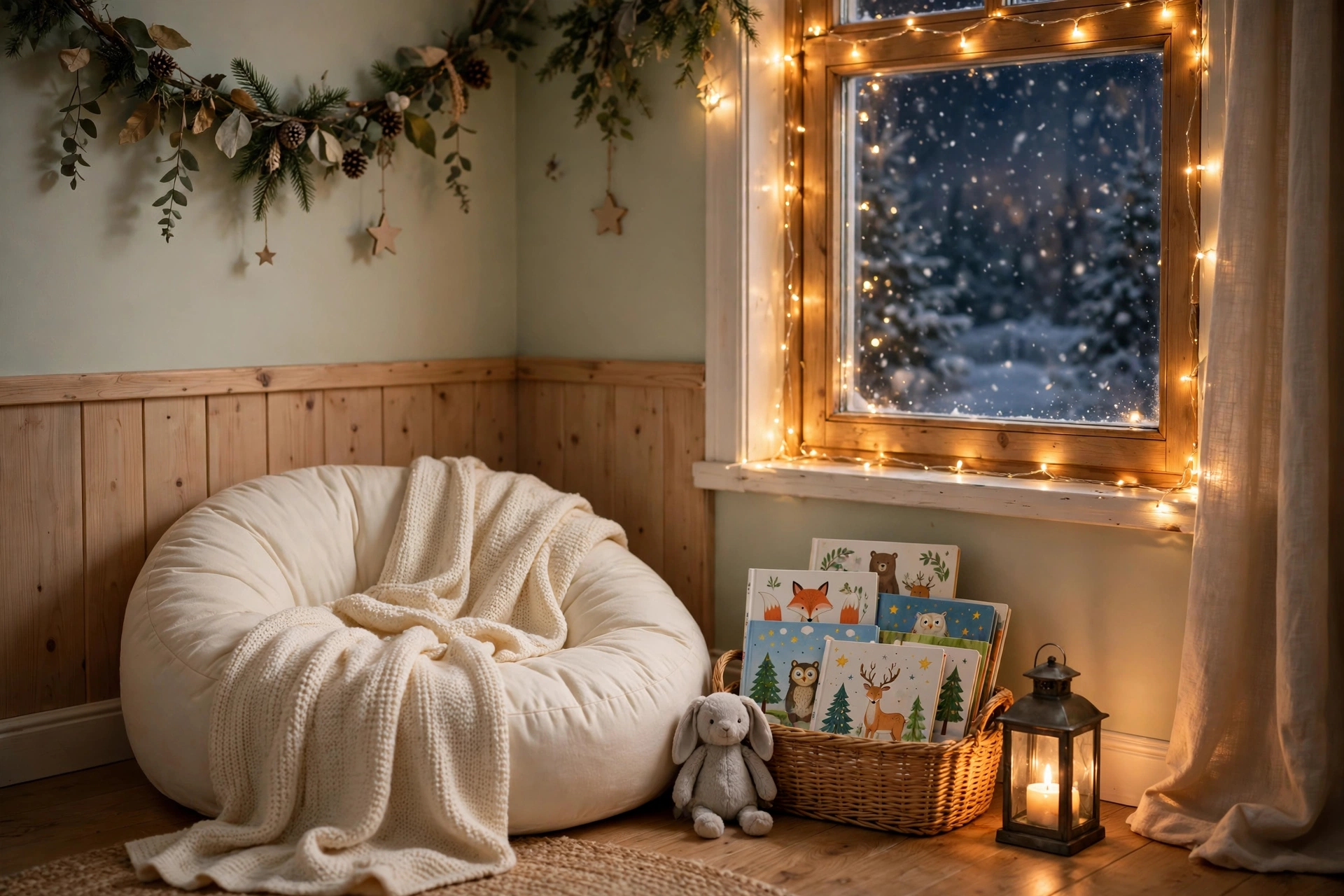
Build it from what you already have. A floor cushion or a beanbag in the corner, a soft throw and a small basket or crate of Christmas books is all it takes. Add a small lamp or a battery lantern so the corner has its own light. If the room has a window seat, that is the perfect spot: a cushion, a throw and the books, with fairy lights along the window frame above.
Fill the basket with Christmas picture books. Let your child choose the bedtime story. A small collection of five or six books, rotated through December, feels richer than a shelf full of books they never touch. Add a notebook and pencils so they can draw their own Christmas pictures or write a letter to Santa.
Make it part of the routine. Story time in the nook, then lights out in the bed, gives the evening a shape children find comforting. On Christmas Eve, the nook becomes the place where they wait for Santa, and the blanket they read under becomes the one they take to bed.
7. The Advent Countdown Corner
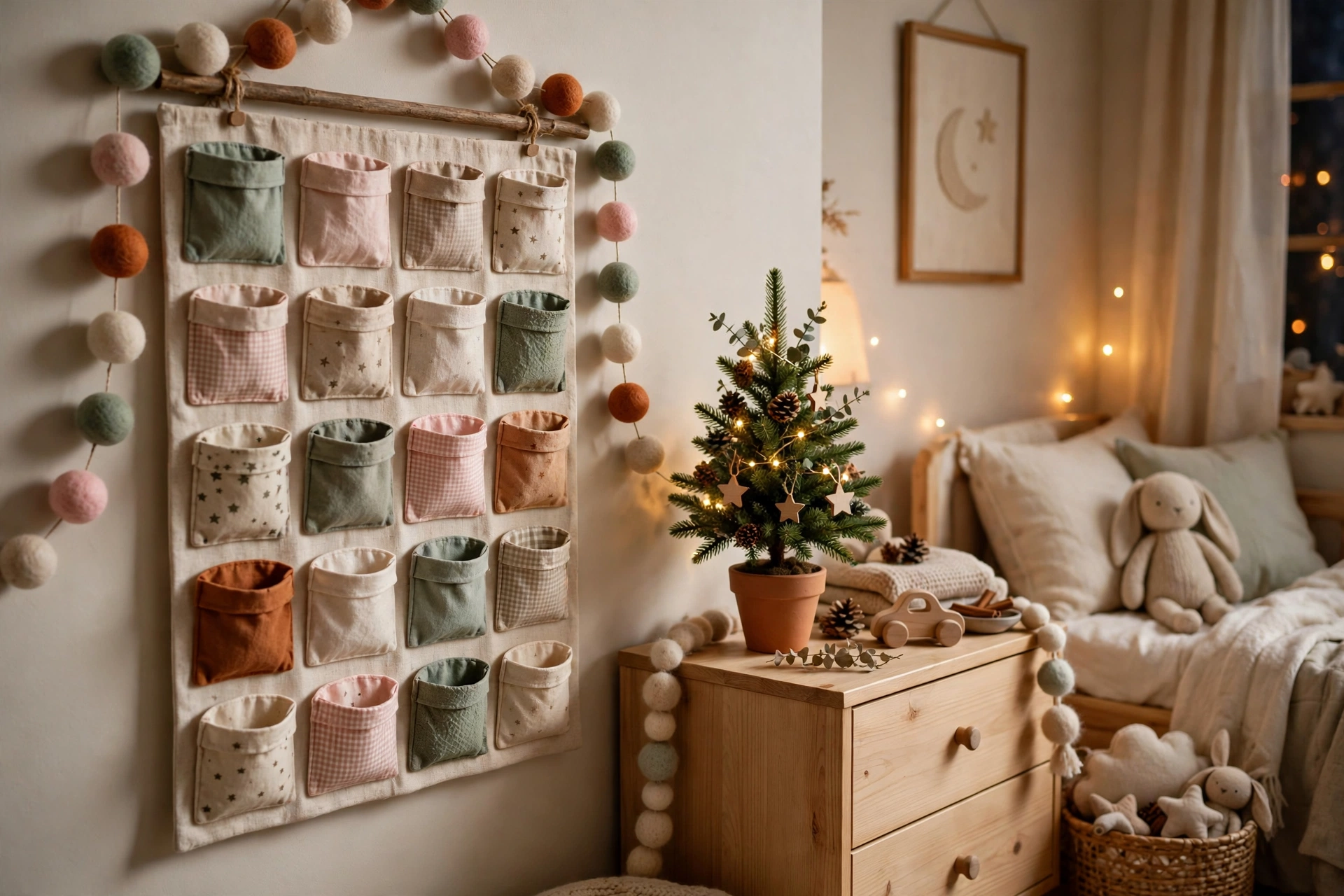
The wait for Christmas feels like half of the excitement for a child, and an Advent calendar turns that waiting into a daily ritual. A countdown corner on the dresser or on the wall gives your child something to look forward to every single morning.
Choose a calendar that fits the room. A fabric calendar with twenty four small pockets is reusable year after year and looks lovely on a wall. A simple paper calendar with doors to open costs little and is easy to find. A row of twenty four small numbered bags hung on a string is a lovely handmade option, and children love opening a bag each morning to find a small treat or a note inside.
Put the calendar where your child can reach it. A calendar on a high shelf your child cannot open themselves is a missed opportunity. At their height, on the dresser or on the wall beside the bed, the calendar becomes part of their morning. Fill the pockets with a small chocolate, a sticker or a tiny note with a Christmas activity for the day, such as making paper snowflakes or reading a particular story.
Keep the countdown corner tidy. One calendar, one small dish for the treats and perhaps a tiny tree or a candle lantern beside it is enough. The corner should feel like a special station, not like another pile of decorations.
8. Themes Kids Actually Love
Choosing a theme helps you decorate easily. Every choice asks the question: does it fit the theme? The best themes for a kids Christmas room are the ones your child already loves. Pick one together. Let the theme guide the colors, the tree and the bedding.
I love a pink Christmas for children who enjoy soft colors and sparkle. A white or silver tree, pink and silver ornaments, a pink throw on the bed and warm white lights make the room feel like a snow globe. Keep the pink on the bedding and the ornaments and let the walls stay calm so the room still feels restful at night.
A woodland theme suits a calm, natural room. Deep green bedding, a small real or faux pine tree, wooden ornaments, pinecones and a garland of dried orange and eucalyptus feel like a forest in December. Add a plush fox or deer on the bed and a few wooden stars on the wall and the room feels like a storybook.
A sporty or hobby theme makes the room personal. A mini tree dressed in team colors, a Santa hat on a favorite trophy and a mug of cocoa on the nightstand tell a story only your child could tell. This theme works well for older children who might feel too grown up for reindeer but still want Christmas in their room.
A shared room needs a theme both children can agree on. Red and white with a shared tree between the beds, matching stockings with different names and one garland across the wall above both beds keeps it fair and festive. Let each child choose the ornaments for their own side of the tree so the room feels like theirs, not like a compromise.
Whatever theme you choose, keep it to three colors at most. Three colors repeated in the bedding, the tree and the garland make the room look designed instead of accidental. Add a fourth color only in one place, such as the stockings, and the room stays calm enough to sleep in.
Conclusion
A Christmas room for kids is not about spending the most or putting up the most decorations. It is about giving a child a room that feels like Christmas belongs to them. A small tree they decorated, lights they can switch on themselves, a stocking with their name on it and a corner for Christmas stories: these are the things they will remember when they are grown up, long after the ornaments are packed away.
Start with safety, let your child pick the theme and the tree, change the bedding, hang one string of warm lights and give the countdown a corner of its own. Do it together in one afternoon, and the room will be ready before the first carol plays. Then, on Christmas Eve, tuck them in under the fairy lights and let the magic do the rest.