Christmas Hallway Decor Ideas That Keep the Walkway Clear
The hallway is the first room guests walk through and the last room most people decorate. It is narrow, it is busy, and it has to stay usable every single day, which is exactly why it deserves a plan rather than a pile of leftover decorations. A well decorated hallway feels welcoming the moment the front door opens, and it sets the tone for the rest of the house without blocking a single step.
The good news is that a hallway does not need floor space to feel festive. It needs height, light, and repetition. Walls, doorframes, mirrors, and a console or shelf do most of the work, while the floor stays clear for coats, bags, boots, and the everyday traffic of December. This guide follows that order. It starts with the walkway, moves through garlands, consoles, wreaths, rugs, and light, then covers small and narrow hallways, and finishes with the daily life test that keeps the space working all month.
Each section ends with a simple rule you can use right away, even if you only have one evening to decorate. Nothing here needs a nail in a rented wall, a new piece of furniture, or a large budget, and everything here can be taken down in January without damage.
1. Start With the Walkway, Then Add Decor
A hallway is a route first and a display second. Before you hang anything, walk the route like you do on a normal day. Carry a bag, open the front door fully, step aside if someone passes by, and put your keys down where you usually do. Pay attention to where your shoulders, elbows, and shopping bags actually go. That is where decor will be knocked, snagged, or stepped on.
Once you know the route, measure the clear width. Most hallways feel comfortable with at least 36 inches of clear walking space. In a narrow hallway, every inch matters. Keep bulky items, baskets, and floor trees out of the walking line. If a console sits against the wall, its depth is part of the hallway, not extra space. So any decor on it must stay shallow.
Plan the decor in zones instead of spreading it all over the corridor. One dressed doorway, one console vignette, and one wreath on a wall give a finished look. Much decor on every surface makes the space feel cramped. Pick the zones that guests actually see: the view from the front door, the wall beside the console, and the doorway into the main living room. For the entry itself, see Christmas Entryway Decor Ideas.
Rule: walkway first, decor second, and at least 36 inches clear at all times.
2. Decorate Up, Not Out
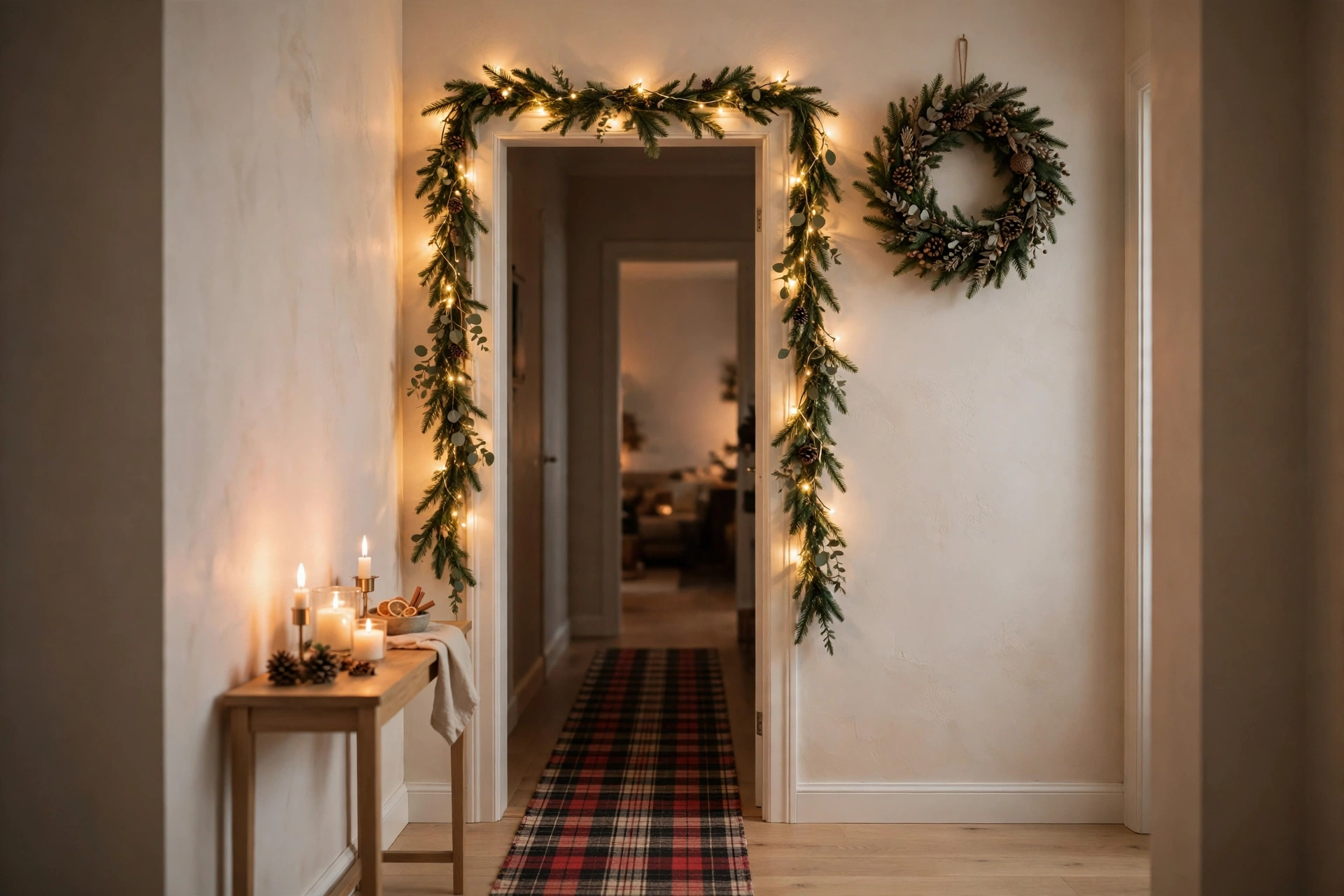
The best hallway trick remains the simplest: decorate up, not out. Walls, doorframes, and ceilings provide free space in the hallway, while floor space is precious. A garland over a doorway, a wreath at eye level, and fairy lights along a picture rail give a festive hallway without taking a single inch of floor.
Start at eye level because that is where guests look first. A wreath on the wall, a framed winter print, or a mirror dressed with a garland will read instantly. Then add height above it: a garland across the top of a doorway, lights along a ceiling beam, or hanging ornaments at different heights in a stairwell hallway. For more stairwell ideas, see Christmas Staircase Decor Ideas. Keep the lowest hanging items above head height so nobody has to duck or dodge them.
Use the vertical space in layers, not in one long line. One layer at eye level, one layer above the doorway, and one low layer on a console or shelf will feel balanced. A single strand stretched along the hallway at one height can look flat, while three short, well placed moments feel intentional. Removable hooks and clear clips hold most of this hallway decor without damaging paint, which matters in rented homes.
Rule: up, not out, with the hallway decor at eye level and above.
3. Frame Doorways With Garland
I have found that a doorway garland serves as the hallway version of a welcome sign. It frames the entrance to the next room, draws the eye forward, and makes the whole corridor feel connected to the decorated rooms beyond it. It also costs no floor space at all, which is why it works even in the narrowest hallway.
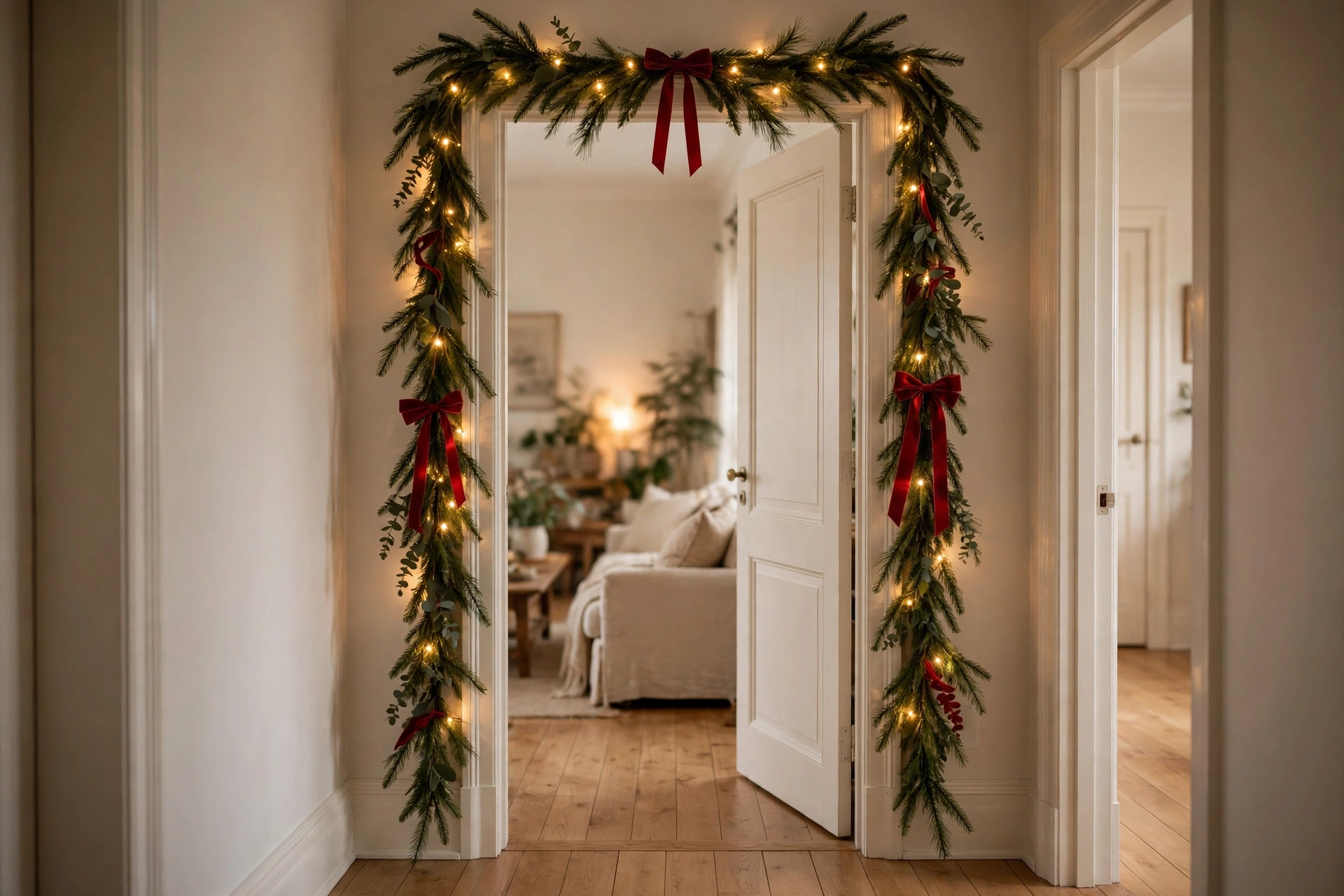
Choose a slim garland for a hallway, not a thick one. A full, heavy garland looks wonderful on a wide porch, but in a hallway it can brush shoulders and shed needles onto the floor. A slim cedar, eucalyptus, or sparse faux pine garland, about three to four inches wide, sits against the frame and still reads as Christmas from across the room.
Fix it in two or three places, not just at the top corners. Removable hooks on the frame, clear clips along the top, or a tension rod inside a wide doorway will hold it without nails. Tuck the ends in neatly, keep the garland clear of the door itself, and test the door swing before you finish. Add lights only if the strand is battery operated and the battery pack has a home on a shelf or hook, not dangling in the walkway. A few red berries, small pinecones, or one repeated ribbon bow will tie the garland to the rest of the house.
Rule: one slim garland per doorway, fixed in three places, clear of the door swing.
4. Style a Console That Still Works
If your hallway has a console table, it is the hardest working surface in the space. It holds keys, mail, sunglasses, and bags, and at Christmas it also has to look festive. The solution is the same tray idea used in the living room: give the decor a clear edge, and leave the rest of the surface free for real life. See Christmas Living Room Decor Ideas for how that tray idea works in a larger room.
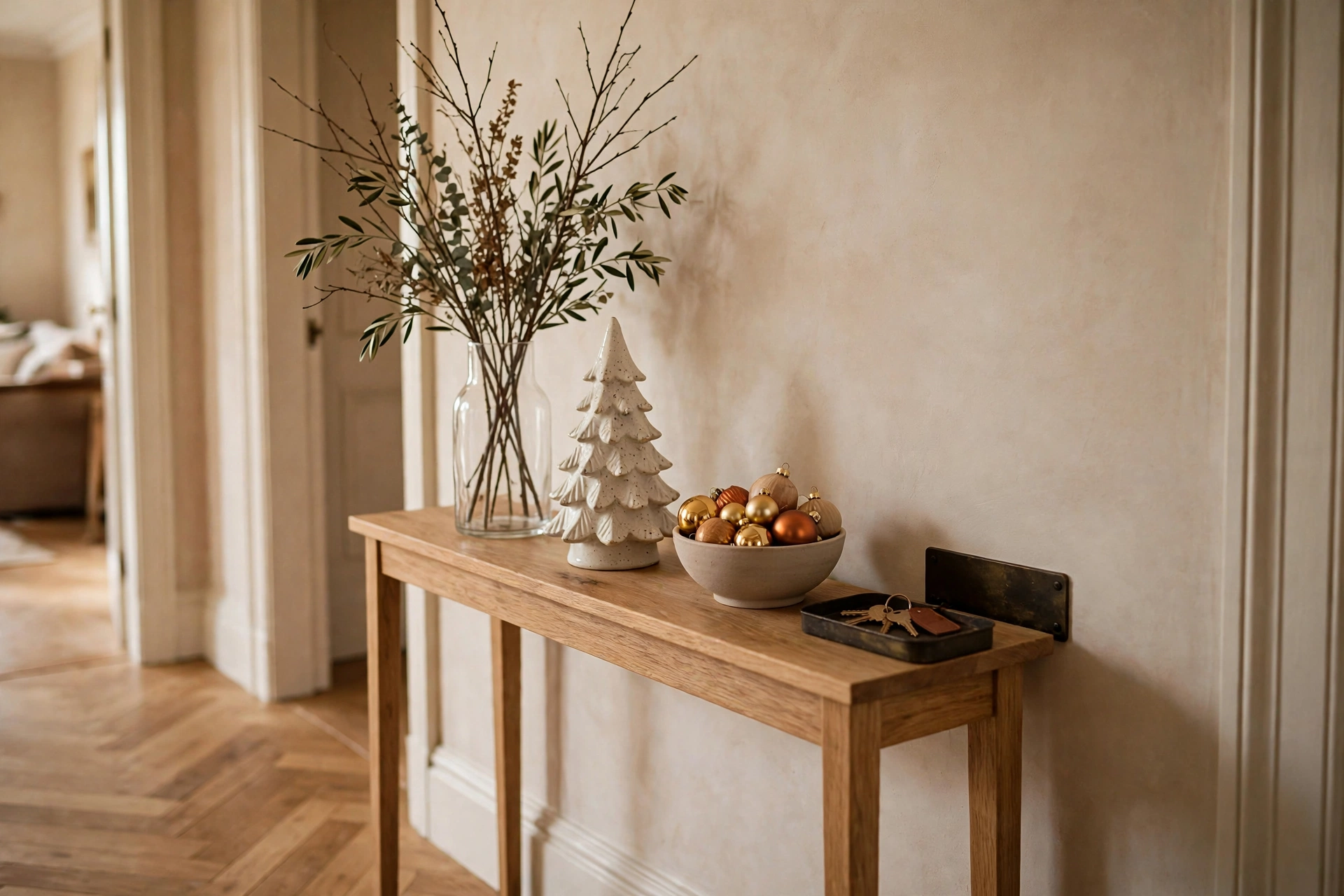
Start with three heights on a slim console. Something tall at one end, such as a vase of branches or a tall candle holder, something in the middle, such as a small ceramic tree or a stack of books, and something low at the other end, such as a bowl of ornaments or a candle in a glass holder. Keep the display pushed toward the wall, because a console is often only 10 to 14 inches deep, and anything near the front edge will be clipped by coats and bags.
Use one tray for the everyday items. A brass, wooden, or woven tray holds keys and mail in one place, and one festive detail on the tray, such as a pine sprig or a small ornament, is enough to make it feel seasonal. The rest of the console stays clear, so coming home does not mean clearing decor before you can put your bag down. A runner or a strip of fabric along the back edge can add color without taking depth, and a plaid or deep green runner ties the console to the tree in the next room.
Rule: three heights, pushed to the wall, and one tray for everyday items.
5. One Wreath, One Mirror, One Clear Focal Point
A hallway does not need several focal points. It needs one, placed where guests look when they pause. In most hallways that focal point is a wreath above the console, a mirror dressed with greenery, or a single piece of festive art on the main wall. Pick one, and let the rest of the hallway support it.
A wreath suits a console wall because it moves the biggest statement off the surface entirely. An 18 to 22 inch wreath suits most consoles, and a width about half to two thirds of the table length looks planned rather than oversized. Hang it at eye level, centered above the console, and keep the wall around it simple so the wreath can be seen from the doorway.
A mirror is the other strong choice, especially in a dark or narrow hallway. A mirror opposite a doorway or beside a light source bounces light and makes the corridor feel wider, and a small garland or a pair of removable bows around its frame makes it festive without covering the glass. Do not dress both a large wreath and a large mirror on the same small wall, because they will compete. Choose the wreath for a wall that already has a console, and choose the mirror for a wall that needs light.
Rule: one focal point per wall, at eye level, with space around it.
6. Ground the Hallway With a Runner Rug
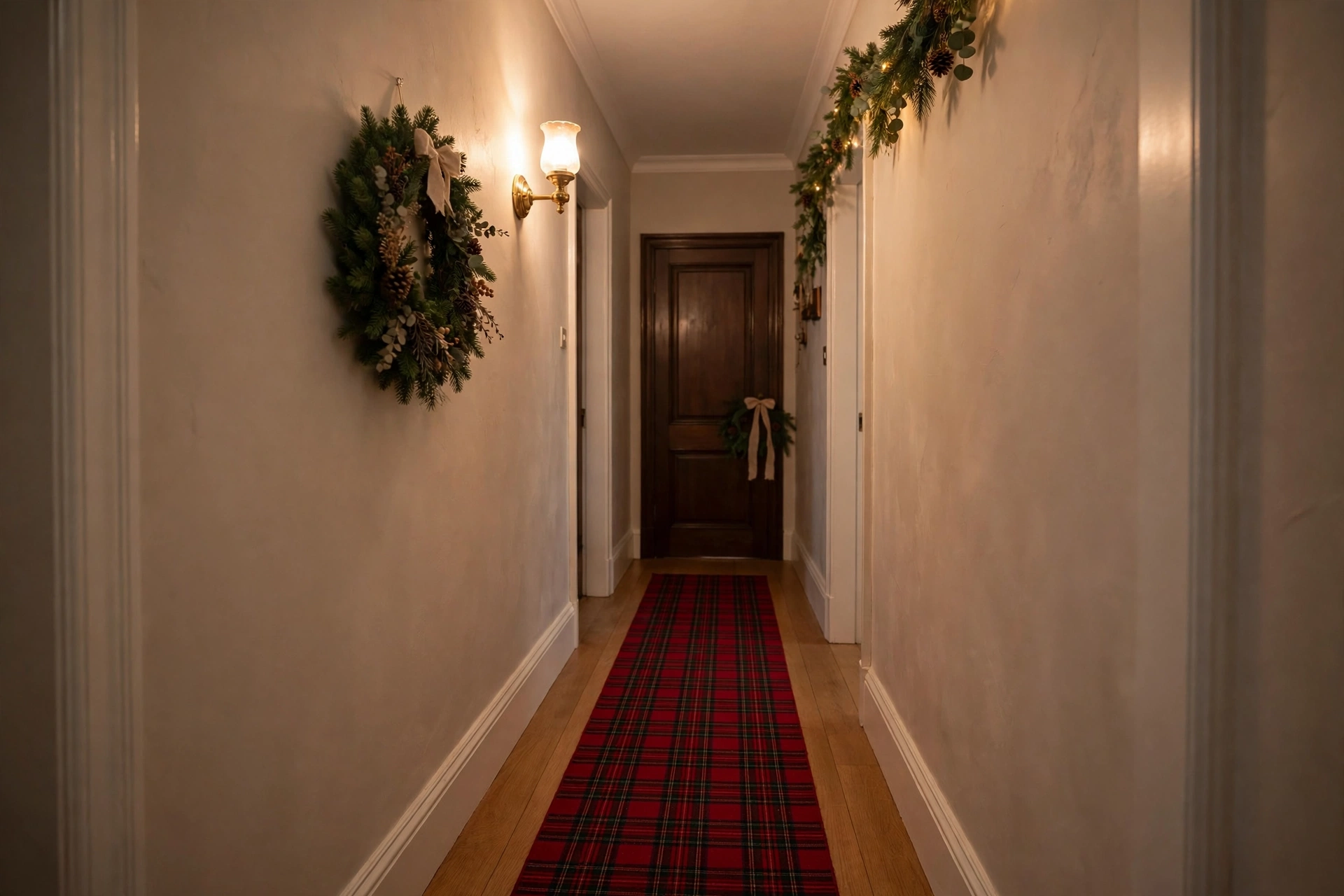
A runner rug is the fastest way to make a hallway feel finished, and it is also the most practical Christmas purchase for the space. It adds color, texture, and warmth underfoot, it protects the floor from wet boots, and it guides guests through the house without taking up any extra room.
Choose a runner that fits the hallway, not one that fills it. Leave a few inches of floor visible on each side, and choose a length that stops short of doorways so the rug does not bunch under a door. A low pile rug is best for a hallway, because doors, boots, and vacuum cleaners all cope better with low pile, and a non slip backing or a thin rug pad keeps it in place on hard floors.
Color does the decorating here. A deep red, plaid, or warm green runner carries the Christmas palette through the corridor, even if the walls stay plain. If the hallway already has patterned tiles or a busy floor, choose a plain runner in one palette color instead, so the floor does not fight the walls. A washable runner is worth the extra cost in December, when wet boots, pine needles, and muddy paws are part of daily life.
Rule: a low pile runner, a few inches narrower than the hallway, in one palette color.
7. Layer Warm Light at Three Heights
Hallways are often the darkest rooms in the house, with no window or only a small one, so light matters more here than anywhere else. The same three layer rule used in the living room applies, adapted for a corridor: low light on the console, middle light from a lamp or wall light, and high light from garland lights or a ceiling fixture, all warm white.
Low light comes from battery candles on the console or in a glass jar on a shelf. Use flameless candles in a hallway, because real flames sit inches from passing coats, scarves, and dry greenery, and a narrow space leaves no safe distance. Middle light comes from a small table lamp on the console or a wall light at eye level, fitted with a warm white bulb around 2700K. High light comes from fairy lights woven through a doorway garland or along a picture rail, on a timer so they switch on as daylight fades.
Keep every light warm white, because one cool white strand beside warm strands will stand out and make the rest look harsh. Keep cords behind the console or along the wall, never across the walkway, and keep battery packs on a shelf or hook where they can be reached without moving decor. A hallway that glows at three heights feels welcoming even on a dark afternoon, and it makes the whole house feel warmer when the front door opens.
Rule: low, middle, and high, all warm white, all flameless near coats and greenery.
8. Small and Narrow Hallway Tricks That Actually Work
A small hallway is not a problem to solve, it is a size to respect. The rules are stricter, but the result can be just as festive, because a small space needs fewer items to feel finished. Start by choosing one focal point, one garland, and one light layer, and stop there. A small hallway with three well chosen moments looks curated, while a small hallway with ten small items looks cluttered.
Use flat decor for a narrow wall. A flat wreath, a framed print, a wall mounted advent calendar, or a row of small stockings on hooks all sit against the wall and leave the walkway clear. A wall mounted tree shape, made from a garland outline or a string of lights in a triangle, gives a tree feeling without a footprint, and it is a good choice for an apartment hallway with no floor space to spare.
Use shallow shelves and ledges for the small details. A picture ledge can hold a row of bottle brush trees, a ceramic house, and a candle jar, all within three inches of the wall. A radiator cover can hold a tiny village if it is kept clear of heat vents and flammable items. A hanging organizer on the back of a door can hold scarves and gloves, so they do not end up on the console. In a small hallway, storage is decor, because a clear surface looks festive and a crowded surface does not.
Rule: one focal point, flat decor, and shallow shelves, with nothing on the floor.
Conclusion
A Christmas hallway does not need to be grand to feel welcoming. It needs a clear walkway, decor that goes up instead of out, one slim garland on a doorway, a console that still works, one clear focal point, a runner underfoot, and warm light at three heights. Small hallways need the same order, only edited harder, with flat decor and shallow shelves doing the work that floor space cannot do.
Start with the walkway and the doorway, add the console and the wreath, and then stop when the hallway feels finished. If you are unsure whether to add one more item, walk the route with a bag in your hand. If the item gets in the way, leave it out. A hallway that is easy to walk through, warm to look at, and simple to tidy in January is finished, even if a shop shelf still holds something pretty. That calm, welcoming feeling is what guests notice first, and it is what makes the rest of the house feel like Christmas from the moment they step inside.