Christmas Dining Table Decor Ideas for a Table Guests Remember
The dining table is the one Christmas decoration that has to do a real job. The tree only has to look good. The mantel only has to look good. The table has to look good while holding roast potatoes, a gravy boat, six glasses, a jug of water, and elbows, all at the same time, for two hours, with people reaching across it. Most Christmas table guides forget that second part. They show a table so covered in decor that there is nowhere to put a plate, and then they call it a tablescape.
This guide does it the other way round. First we protect the space for eating, then we decorate what is left. We decorate it in a way that can be lifted away in one move when the platters arrive. That one rule, low and liftable, is the difference between a table that photographs well and a table that hosts well. Everything here works for a long family table and for a small round table in a flat, because the principles are the same and only the size of the centrepiece changes.
1. The Rule That Saves Every Table: Low, Liftable, in the Middle Third
Before you buy or cut anything, learn the three measurements that decide whether a table works. First, the centrepiece should stay in the middle third of the table width, so each place setting still has a full plate width of clear space. Second, it should stay below eye level for a seated guest, roughly under 12 inches tall, so people can see each other and talk without leaning around a vase. Third, it should sit on something you can lift in one move, a tray, a runner, or a board, so clearing for dessert takes ten seconds instead of ten minutes of moving ornaments one by one.
Sit down in a chair and look across the table before you commit to anything tall. This is the test most people skip, because a centrepiece always looks smaller standing up than it does from a chair. If you have to move your head to see the person opposite, the centrepiece is too tall, no matter how pretty it is. Move tall items to the sideboard instead, where they can be admired without blocking anyone. The sideboard is the table’s best friend at Christmas, and we will come back to it in section 7.
Keep the serving plan in mind too. If dinner is served family style, with dishes passed around, you need more clear space than if plates come ready from the kitchen. A centrepiece that works for a plated dinner can fail completely for a buffet style meal where every dish lands on the table. When in doubt, make the centrepiece narrower, not shorter, because a narrow greenery runner leaves room on both sides while a wide bowl eats space from every setting.
2. Pick One Colour Story and Repeat It Three Times
A Christmas table looks planned when one colour story repeats in at least three places, and it looks accidental when every piece is a different shade. Pick two main colours plus greenery, and stick to them on the table, the napkins, and one accent somewhere else in the room. Classic red and gold is the easiest win, because most people already own red napkins or gold candles. Deep green and cream feels calmer and more modern, and it photographs beautifully in candlelight. Navy and gold is the bold choice, and it works best if your dining room already has cool tones, because warm wood plus navy can fight each other.
Once you pick the story, repeat it on purpose. If you choose red, use red in the napkins, red berries in the centrepiece, and place one red accent on the sideboard, like a red candle or a bowl of red ornaments. If you choose gold, use gold cutlery or gold napkin rings, tuck gold ornaments into the greenery, and add a gold ribbon on the chairs or the sideboard mirror. Three repeats is enough. Five repeats starts to look like a theme park, and one repeat looks like a mistake.
This is also where shopping at home saves real money. Before you buy a single new thing, walk round the house and gather everything that already fits your colours: candle holders from the living room, a bowl from the kitchen, ribbon from the wrapping drawer, and ornaments from the tree box that never make it onto the tree. Our guide to decorating for Christmas on a budget uses the same carry one palette room by room idea, and it works on the table better than anywhere else, because a table only needs a few pieces to look finished.
3. Five Low Centrepieces That Actually Work for Dinner
You do not need five centrepieces. You need one centrepiece, chosen for your table size and your patience. Here are the five builds that survive real dinners. They are listed from easiest to most effort.
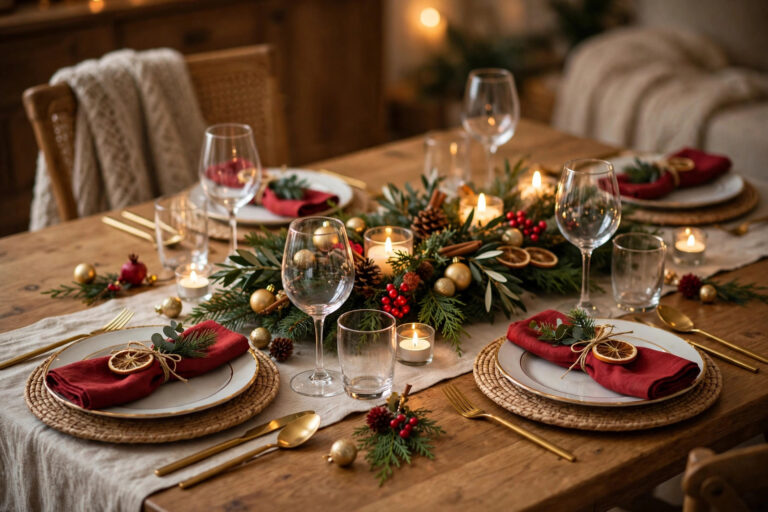
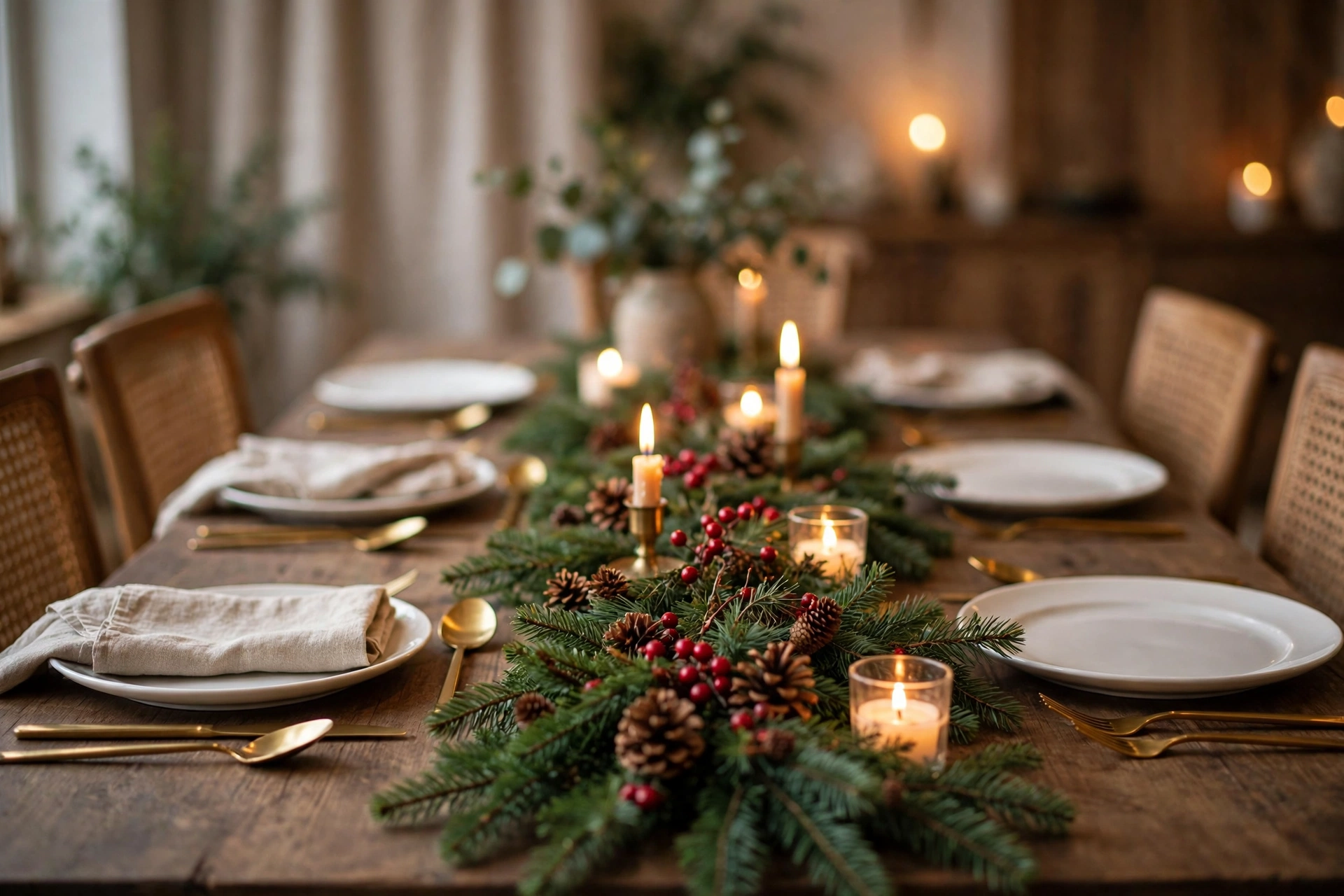
First, the greenery runner. Lay a narrow strand of mixed evergreens, cedar, pine, or eucalyptus, straight down the middle of the table. It should be about the width of a dinner plate. Tuck in pinecones and small ornaments. It smells wonderful when the room warms up. It costs almost nothing if you use trimmings, and it lifts off in one roll when dinner is over. Keep it narrow. A runner that spreads to the plates is not a runner, it is a hedge.
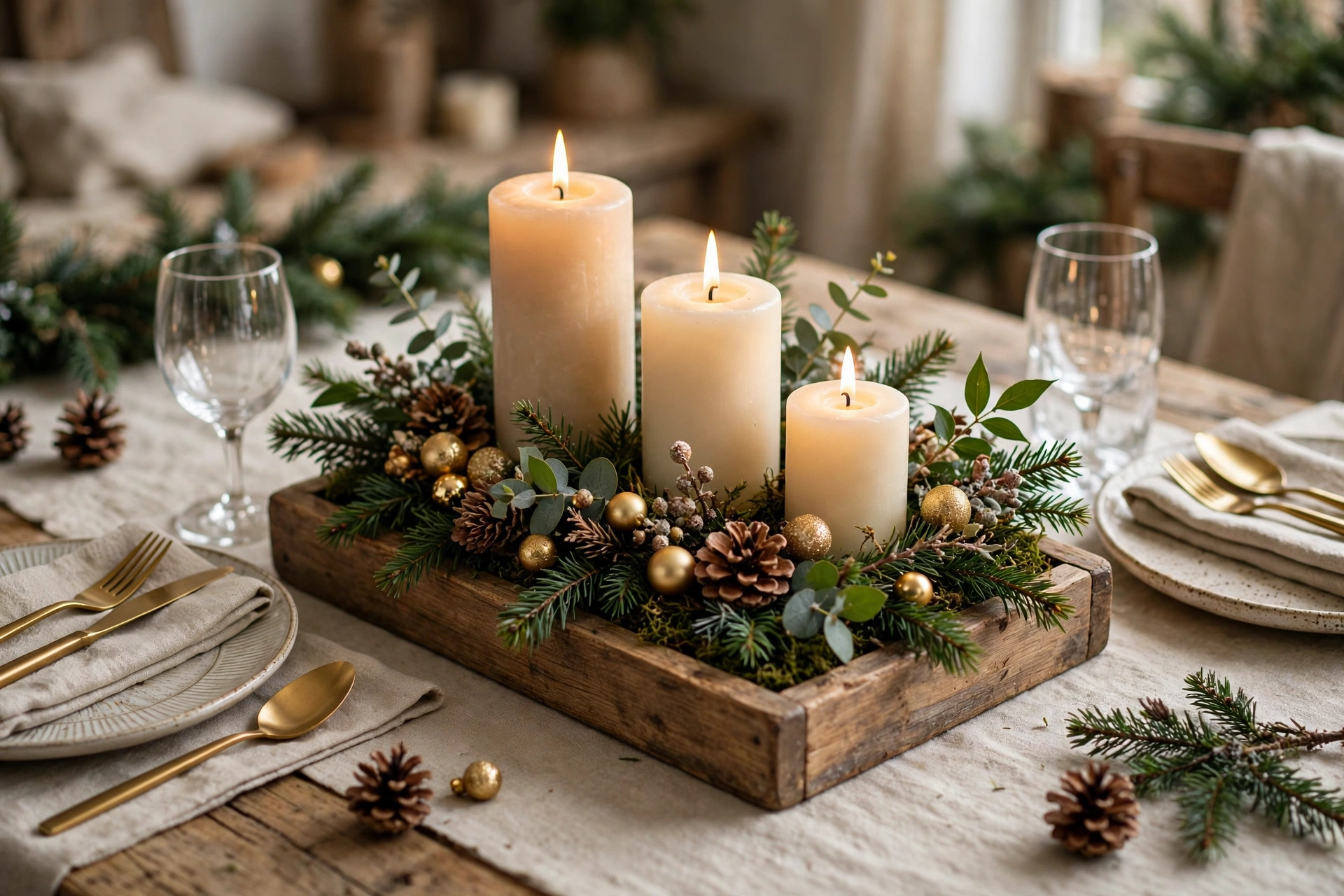
Second, the tray centrepiece. Put a wooden tray, a mirrored tray, or a large platter in the middle, and build everything on it: three pillar candles of different heights, sprigs of greenery, and a scattering of ornaments. The tray is the whole trick, because it turns ten loose items into one object you can move with one hand. This is the best choice for a small table, and it is the one I recommend to anyone who is hosting for the first time.
Third, the bowl centrepiece. Fill a low, wide bowl with pinecones, dried oranges, cinnamon sticks, and ornaments, and set it in the middle. It is the fastest build on this list. It doubles as a talking point, and guests can pick it up and move it themselves when the food arrives, which is a feature, not a flaw. A bowl of clementines works the same way and gets eaten, which is the most honest kind of decor.
Fourth, the candle cluster. Group candles in odd numbers, three or five, in holders of different heights, down the centre of the table, with a little greenery tucked around the bases. Odd numbers look natural, mixed heights look collected rather than bought as a set, and candlelight does more for a table than any ornament. Use battery candles if children are at the table or if the greenery is dry, and never leave real flames unattended near napkins or sleeves.
Fifth, the fruit and foliage build. Split a few pomegranates open, add whole figs, walnuts, and sprigs of rosemary or cedar, and arrange them low along a runner. It looks like a painting, it smells like Christmas, and nothing in it is wasted, because the fruit goes into cooking or snacking after dinner. Keep the arrangement under 8 inches tall, and keep anything sticky away from the tablecloth edge where sleeves catch it.
4. Place Settings That Feel Special Without New Dishes
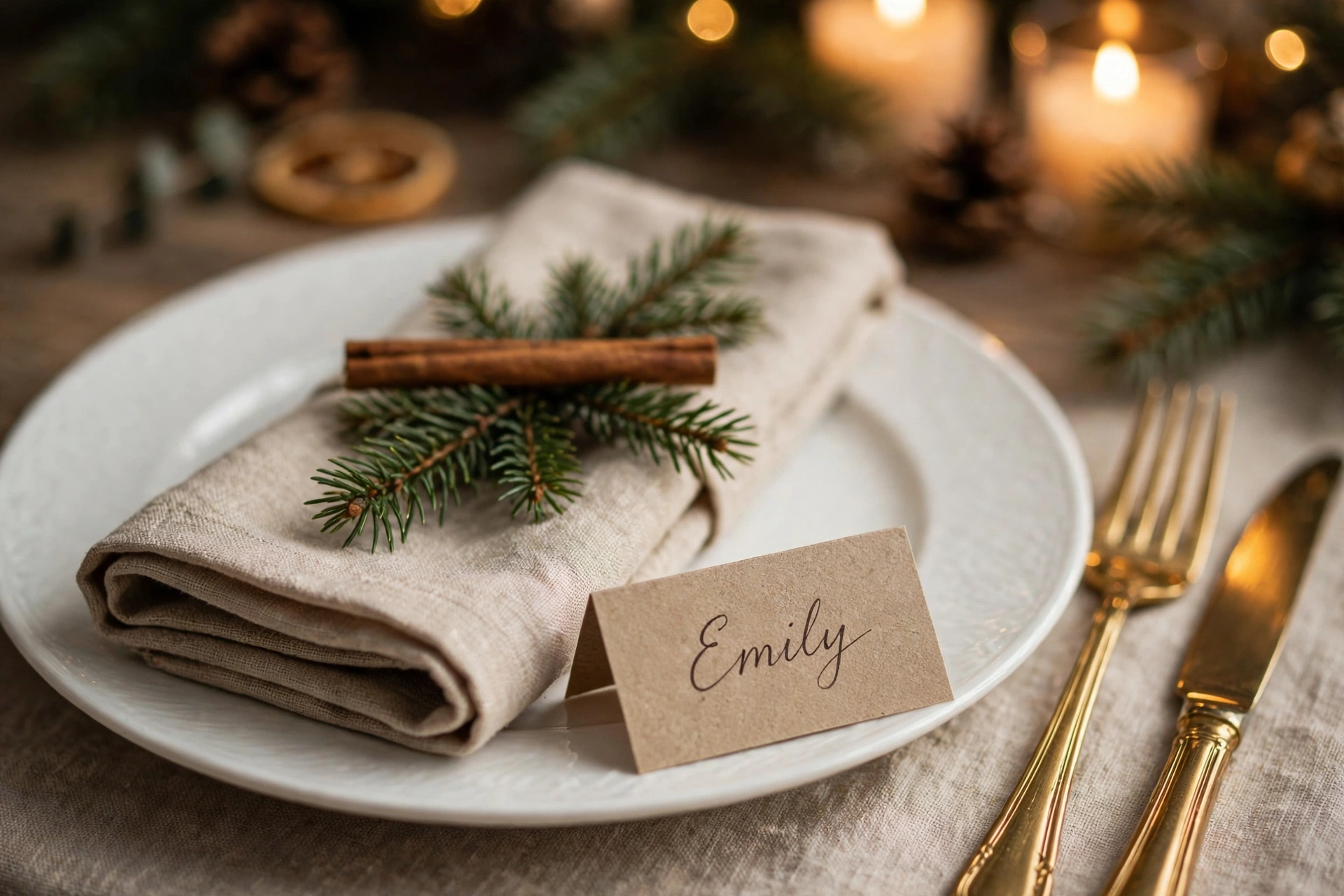
You do not need a Christmas dinner set. You need one small change at each place, repeated for every guest, so the table looks intentional from the door. The cheapest change with the biggest effect is the napkin. Fold a cloth napkin into a simple rectangle, lay it on the plate, and tuck a short sprig of evergreen, a cinnamon stick, or a tiny dried orange slice under the fold. It costs pennies, it smells good, and guests notice it before they notice the plates.
If you want one more step, add a name card. A hand written card on a small piece of card, propped against a glass or tucked into the napkin fold, makes guests feel expected rather than just invited, and it solves the seating shuffle that happens when everyone stands around wondering where to sit. For children, a small cracker or a tiny wrapped sweet at each place does the same job, and it gives them something to do while adults pour drinks.
Chargers, the large decorative plates that sit under dinner plates, are the one purchase worth considering if you host every year, because a gold or wooden charger makes plain white plates look festive without replacing the plates themselves. If you do not own chargers, a large woven placemat does the same framing job for a fraction of the price. Skip chair bows unless you have tried sitting in the chair with one on, because bows look charming in photos and annoy everyone who actually sits down, especially at a long dinner.
Keep the cutlery simple and the glasses honest. One wine glass and one water glass per person is enough for most dinners, and a jug of water on the table means nobody has to ask for a refill. If you own gold or brass cutlery, Christmas dinner is the night to use it, but do not buy a new set for one meal when a ribbon tied round the cutlery bundle gives you the same festive signal for free.
5. Light the Table in Layers, and Keep It Warm
Lighting is what turns a Christmas table from decorated into something magical, and it follows the same warm rule as the rest of the house. Swap out any bulb brighter than 3000K in the dining room for a warm 2200K to 2700K bulb, dim the overhead light if you have a dimmer, and let candles and fairy lights do the rest. Cool white light over a Christmas table can make the whole room feel more like a cafeteria, no matter how good the centrepiece is.
Create light in three layers. The low layer is candles or battery lights in the centrepiece itself, at table height. The middle layer is a lamp or a pair of candles on the sideboard, which adds depth behind the table. The high layer is the overhead light, turned down low, or a pendant with a warm bulb, so faces are lit softly from above without harsh shadows. If you only have one layer, make it the candles, because candlelight flatters everyone at the table and hides a multitude of sins in the cooking.
Safety matters more than atmosphere. Never place a real flame near dry greenery, paper napkins, or a sleeve, and never leave candles burning in an empty room. Battery pillar candles have improved so much that most guests cannot tell the difference across a table, and they let you put light inside the greenery itself, where a real flame would be risky. If you use fairy lights in the centrepiece, use battery lights with a timer, and make sure the battery pack is in a spot where it will not get wet from a spilled glass.
6. Small Christmas Dining Table Decor: The One Tray Formula
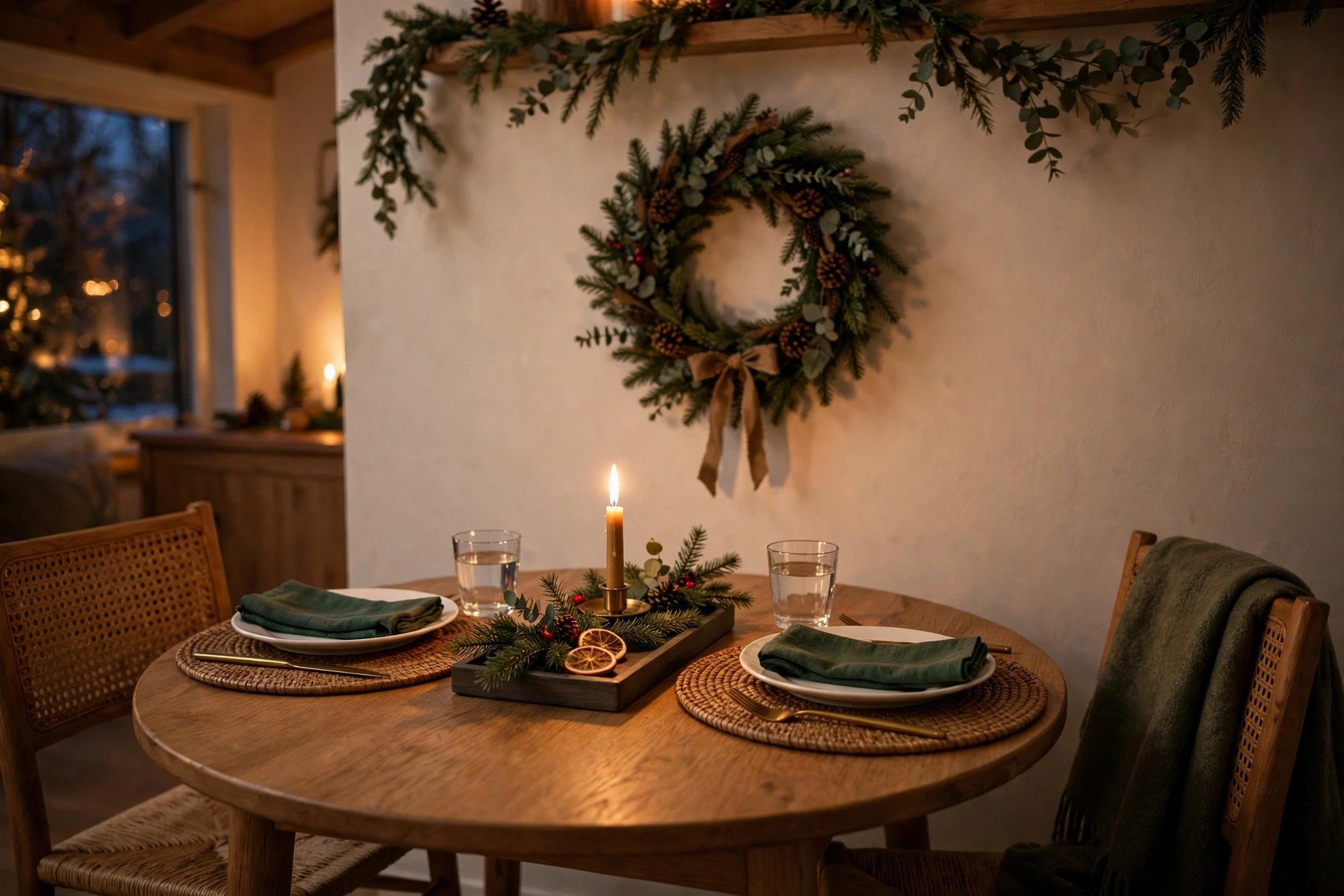
Small tables are easier, not harder, once you accept that one good centrepiece beats three small ones. For a small christmas dining table decor plan, use placemats instead of a full tablecloth, because a tablecloth bunches at the edges of a small table and eats space you need. Choose one low centrepiece on one tray, a bowl of pinecones and ornaments, a small lantern, or a tray with two slim candles and stems, and leave the rest of the table clear.
The formula is simple: one tray, one repeat colour, and slim candles if you use candles at all. Skip the runner on a round table, because runners slide and bunch on round tops, and use a round placemat or a small circular mat under the tray instead. If you like height, put it on the sideboard or a nearby shelf, not on the table, because a tall item on a small table blocks every face, not just one.
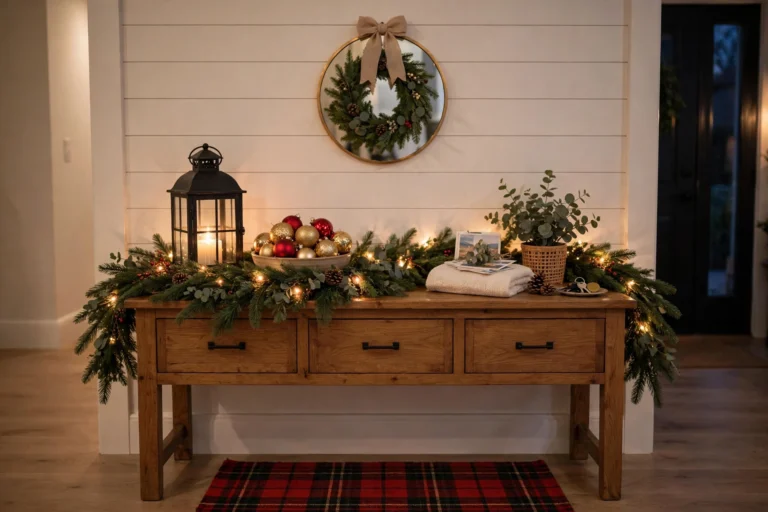
A small table benefits from decorating the room around it. Hang a wreath on the dining room wall or the sideboard mirror, drape a short garland along the sideboard, and put a small potted pine on the windowsill. Guests see a festive room, even though the table itself stays clear enough to eat at. This is the same decorate up, not out, idea that works for a small entryway, and if you have just dressed your hallway, our guide to Christmas entryway decor ideas shows how one palette carried from door to dining room makes the whole house feel planned.
For a two person table, the same rule holds, smaller. One tray, one candle, stems, and a napkin sprig at each place is a complete Christmas table. You do not need to fill every inch to make it feel festive, and an empty inch where a plate goes is not a failure, it is the point.
7. Let the Sideboard Carry the Rest of the Room
The sideboard is the secret to a table that looks full and lovely without feeling packed. Move everything that does not need to be on the table to the sideboard: the dessert plates, the extra glasses, the drinks station, the tall candles, the big arrangement, and the cake stand. Dress the sideboard with a runner, a mirror or a wreath above it, and one lamp or candle group, and it becomes a second display that guests notice and enjoy while they wait for dinner.
Set up a drinks corner on one end of the sideboard, with glasses, a jug, and a small bowl of garnishes. This way guests can serve themselves without crowding the table. Put dessert on the other end, covered and ready to bring out, so the table does not have to hold the pudding for two hours while everyone eats the main course. If you have no sideboard, a console table, a kitchen counter near the dining room, or even a sturdy stool with a cloth over it does the same job. The point is not the furniture, it is having somewhere for things to live that is not the table.
This also solves the porch to table journey for guests. They arrive through a dressed porch, step into a welcoming entryway, and sit at a table that is festive but usable, with the rest of the celebration visible on the sideboard. If you are still planning the outside welcome, our guide to Christmas front porch decor ideas covers wreaths, garlands, and lanterns that survive real weather, so the first impression matches the table inside.
8. The One Hour Table Plan, and What to Skip
If you only have one hour before guests arrive, follow this order. First ten minutes: clear the table and wipe it down. Next fifteen minutes: lay the runner or placemats, set the plates, cutlery, and glasses, and put the napkin sprig at each place. Next fifteen minutes: build the centrepiece on its tray, place it in the middle third, and sit down to check the view across the table. Last twenty minutes: light the candles, dim the overhead light, dress the sideboard, and step outside and come back in like a guest, because that is the view your guests will get.
What to skip is as useful. Skip tall centrepieces that block faces. Skip scented candles plus potpourri plus a scented centrepiece, because three scents together smell like a shop, not a home, and they fight with the food. Skip confetti and loose glitter on the table, because it ends up in the gravy. Skip a tablecloth that slides, a runner that hangs into laps, and any decor that cannot be lifted away when the platters arrive. And skip buying a whole new set of anything for one dinner, because the best Christmas tables are made from things you already own, rearranged with care.
Start with the tray, pick one colour story, keep the centrepiece low, and let the sideboard do the heavy lifting. Do that, and your Christmas dining table decor will look like it belongs in a magazine, while leaving room for the dinner itself, which is, after all, the reason everyone is sitting down together.