Christmas Porch Decor Ideas That Welcome Guests Before They Reach the Door
The front porch is the first Christmas decoration anyone sees, and it is the one most of us decorate last. We fuss over the tree, the mantel and the table, and then on the first evening guests arrive, the entrance is still bare: a plain door, an empty mat, no light. Guests notice that gap before they notice anything inside, because the porch sets the mood for the whole visit.
The good news is that a porch is easier to decorate than any room in the house. There is no furniture to move, no floor plan to fight, and the whole job can be done in an hour or two. The catch is weather. Rain, wind and cold will test everything you put outside, so porch decor has to be chosen for survival first and looks second. This guide follows that rule. Every idea here stands up to a real December, works on a big porch or a tiny stoop, and comes down fast in January.
1. Christmas porch decor starts with the door, because the door does most of the work
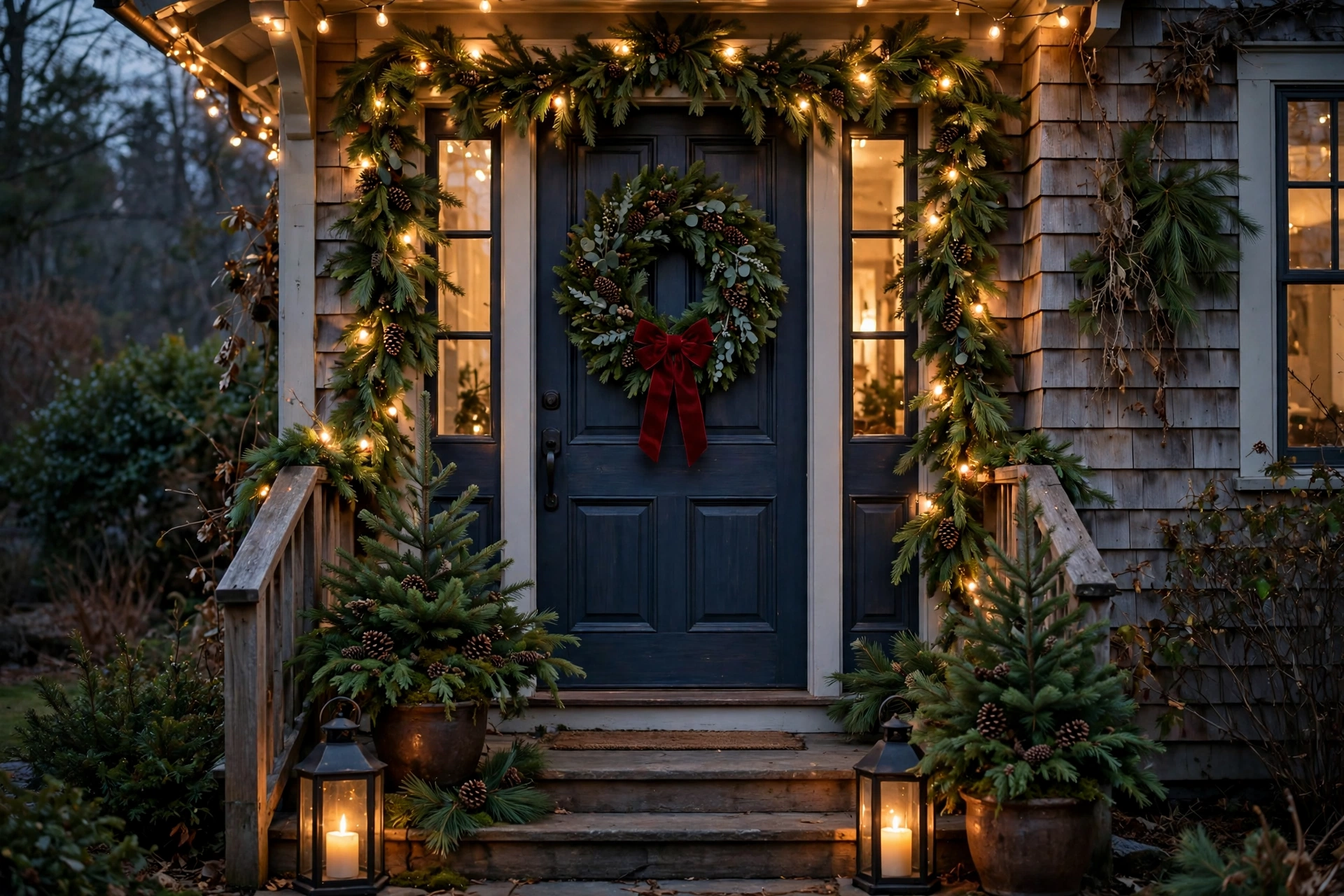
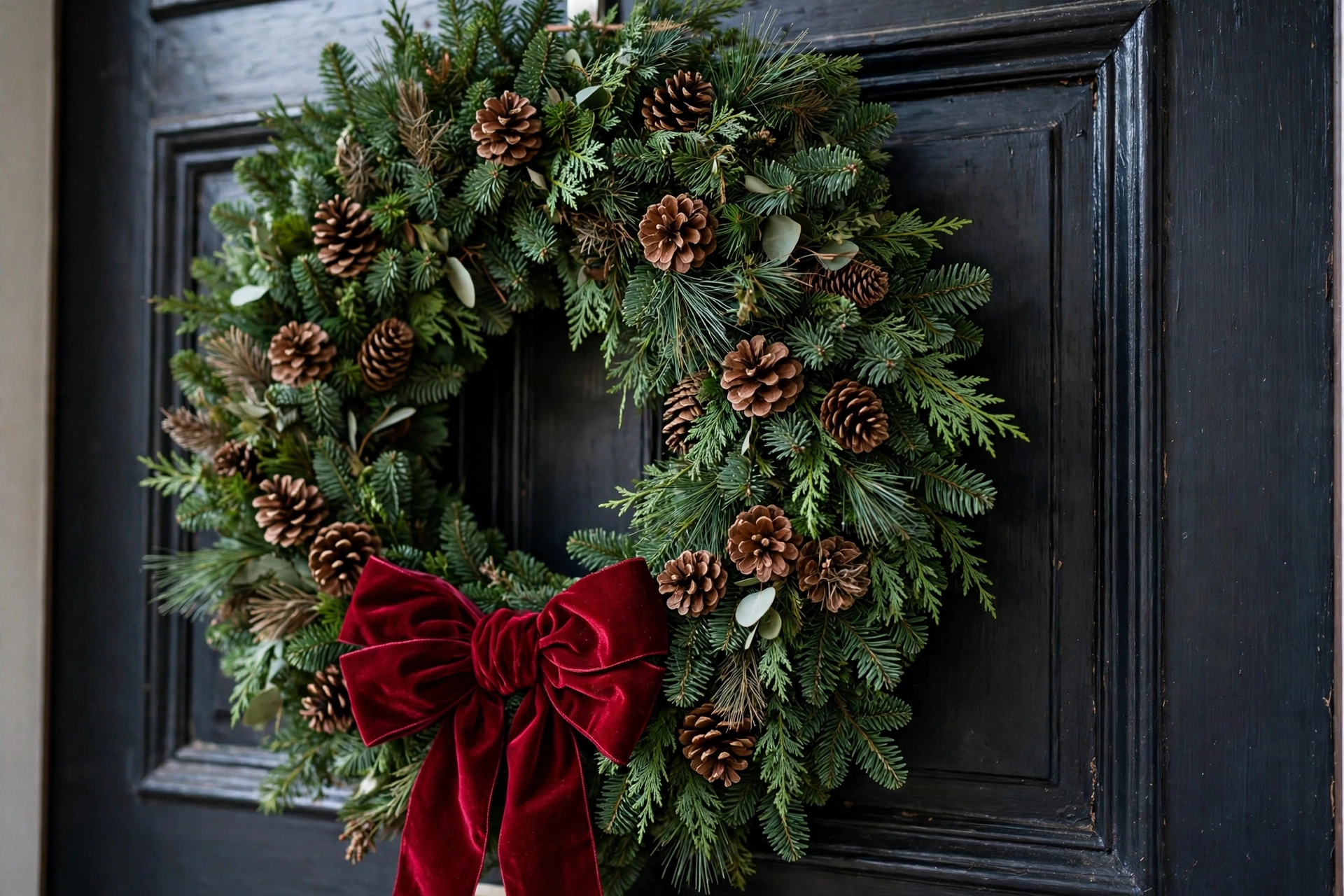
If you do only one thing on your porch this Christmas, hang a wreath. The door is the focal point of the whole entrance, and a wreath is the fastest way to make it read as festive from the street.
Size matters more than style here. A wreath should fill about half to two thirds of your door’s width. A small wreath lost on a big door looks like an afterthought, while an oversized wreath squeezed onto a narrow door looks cramped. Measure your door before you buy: on a standard 36 inch door, a 24 inch wreath is usually right.
Hang it at eye level, not up near the top of the door. Eye level is where guests actually look, and it is where the wreath photographs best. Use an over-door hanger or a sturdy adhesive hook rated for outdoor use, and wire the wreath on in two places so wind cannot spin it. A wreath that turns sideways in the first storm is worse than no wreath at all.
As for style, full evergreen with a few pinecones and one deep red or plaid bow suits almost every house. If your door is already a strong color, keep the bow simple so the wreath and the door are not competing. One bow, one wreath, one clear message: welcome.
2. Frame the Door With Garland, But Keep It Full
A garland around the door frame turns a plain doorway into a proper Christmas entrance. Hang it across the top and down both sides, and add a bow or a small cluster of ornaments at each top corner where the garland turns.
The mistake most people make is buying a thin garland. From the sidewalk, a single skinny strand reads as a thin green line, and the whole porch looks under-decorated. Zip-tie two strands together so the garland reads ten to twelve inches thick, and it will look generous from twenty feet away. A door frame needs about five to six metres of garland in total, so buy a little extra rather than stretching one strand thin.
Choose a full, bushy garland, real or faux, and keep it simple if your wreath is already busy. If the wreath has a big bow and ornaments, let the garland stay plain greenery. If the wreath is simple, the garland can carry a few baubles or a ribbon. One of them leads, the other supports. When both shout, the entrance looks cluttered.
Secure the garland with wire or clear zip ties every couple of feet, fastened on the underside so the ties do not show. Outdoor adhesive hooks work on smooth frames, but on brick or rough wood, wire around a nail or a small screw holds better in wind. Snip the ties off in January and the frame is back to normal in minutes.
3. Add Lanterns for Evening Glow
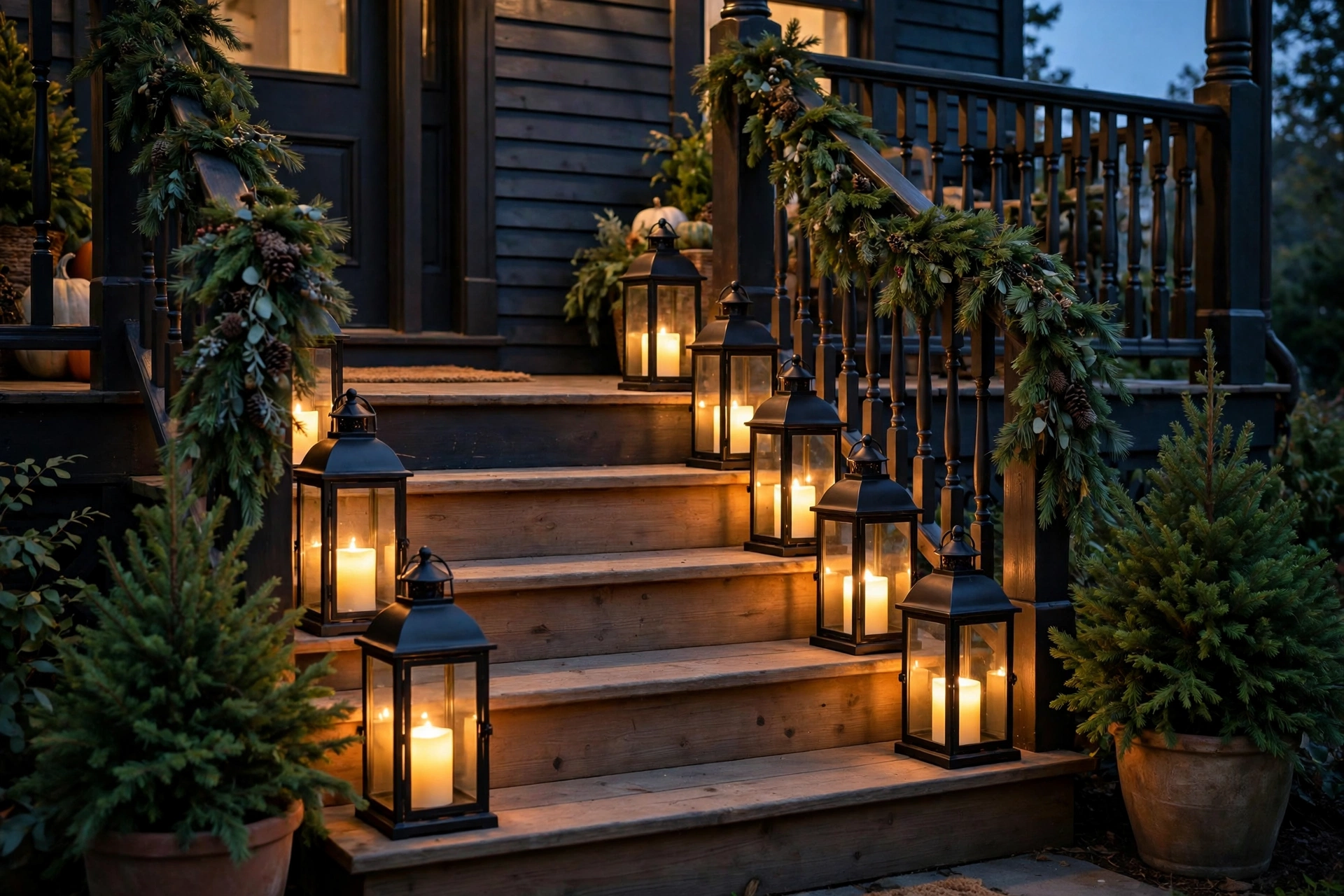
A porch without light at night is just a dark doorway, no matter how good it looks in daylight. Lanterns are the easiest fix, and they give the porch a glow that string lights alone cannot match.
Place two lanterns, one on each side of the door, for instant symmetry. Lanterns between 40 and 60 centimetres tall look right beside most doors; tiny ones disappear, and giant ones block the path. Fill them with battery candles on timers so they switch on at dusk without you thinking about it, and tuck a small sprig of greenery or a red bow on top of each lantern to tie them to the wreath.
Warm white light only. Cool white light on a porch reads cold and bluish, and it makes greenery look grey instead of green. Warm white matches candlelight, and it is the same rule that makes indoor Christmas lighting feel cozy. If your porch already has a wall light, swap its bulb for a warm white one for December, and the whole entrance will feel like one planned scene.
Never use real flames in lanterns near dry greenery. Battery candles look convincing behind glass, they run for weeks on a timer, and they remove the one real fire risk on a porch full of evergreen branches.
4. Use Planters That Earn Their Place
Planters are the workhorses of porch decor. A pair of tall urns or pots flanking the steps, filled with fresh cedar, magnolia leaves, red twig dogwood and a few oversized pinecones, gives more curb appeal per dollar than almost anything else you can buy, and the pots themselves last for years.
If you already own planters, you do not need new ones for Christmas. Pull out the summer flowers and refill with winter branches: cedar and pine for green, red twigs for height, pinecones for texture. The arrangement does not need to be perfect. Branches cut at different heights look natural, and a little messiness reads as real rather than store-bought.
Weigh planters down before the first storm. A brick or a bag of sand in the bottom stops wind from tipping them, and it also stops a full planter from being dragged by a strong gust. If your porch gets direct wind, wire tall branches to the pot rim so they cannot sail away. A planter that survives December intact is worth more than a prettier one that falls over in week one.
5. Light the Path, Not Just the Porch
Guests arrive in the dark in December, and the walkway matters as much as the porch itself. A few lights along the path make the house feel welcoming from the street, and they keep visitors from tripping on a step they cannot see.
The simplest path lights are mason jar luminaries: a wide-mouth jar with a scoop of epsom salt at the bottom, a single battery tealight, and a length of twine at the neck, spaced two to three feet apart along the walkway. Each one costs under two dollars, and together they look like something out of a magazine.
If jars feel too crafty for your house, small solar stake lights or a string of warm white lights along a low hedge does the same job. Keep the path lights the same color temperature as the porch lights. Mixed white and warm white along one walkway looks accidental, while one consistent warm glow looks planned.
Hide cords carefully. Run extension cords along edges, under mats, or behind planters, never across the middle of the walkway. A lit path that trips someone has failed at its one job.
6. Small Porch? Decorate Up, Not Out
A small porch or stoop is actually easier to decorate than a big one, and cheaper too. You need fewer pieces, and each one makes a bigger impact. The rule is simple: decorate up instead of out.
Hang the wreath, drape garland over the door and along the railing, and add a hanging lantern or a lit wreath from the porch ceiling. Those vertical surfaces hold decor without using a single inch of floor. Then pick just one floor-level accent: a slim potted evergreen, one lantern, or a compact planter. One is enough. Two planters, a bench, a sled and a stack of presents on a four-foot stoop is not festive, it is a blocked doorway.
Pick one side if the porch is narrow. Instead of matching pots on both sides of the door, make one bigger grouping: a tall pot, a lantern, and a small stack of wrapped empty boxes in brown paper and twine. That single grouping reads as intentional, and it leaves the walkway clear.
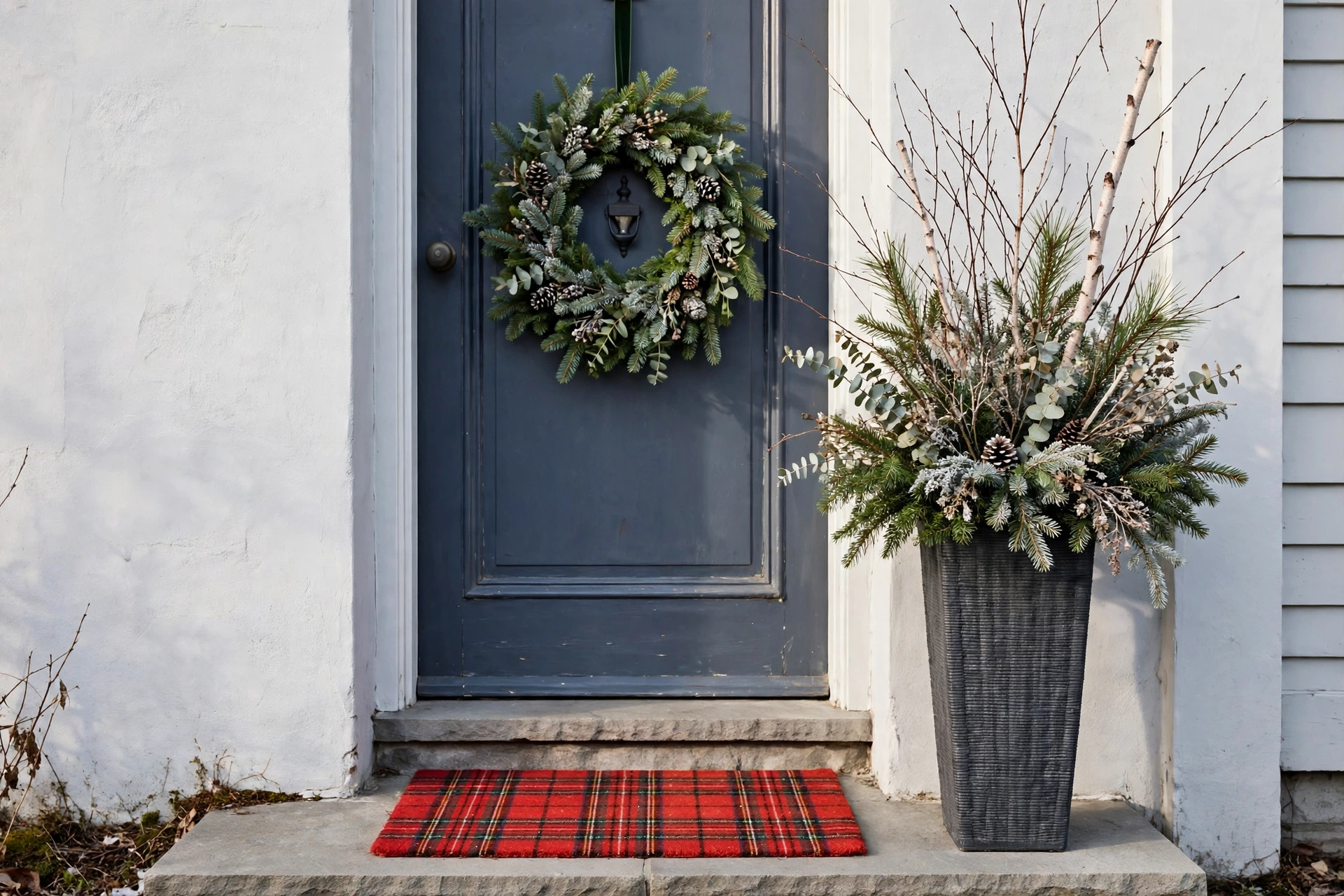
Use the door itself as decor. A wreath plus a ribbon down the center of the door can carry a tiny porch on its own, and a plaid doormat adds color without taking any space at all. When every item earns its place, a small porch looks curated rather than crowded.
7. Pick a Palette and Repeat It
Porches go wrong when they collect color schemes instead of choosing one. A red wreath, a blue light-up snowman, a gold doormat and a plastic reindeer add up to four ideas and no plan, and the porch reads as a clearance aisle.
Pick three colors and repeat them everywhere: evergreen, deep red, and the black or wood your door already has is a combination that suits almost any house. If you prefer a quieter look, evergreen, white and warm gold works just as well, and it photographs beautifully in snow. The palette is not the point; the repetition is.
Repeat the palette in the wreath bow, the planter ribbon, the doormat, and one pillow or throw if you have porch seating. When the same three colors show up in four places, the porch looks designed even if the pieces themselves are simple. When every piece brings its own color, even expensive decor looks random.
This same discipline helps indoors too. If your budget for the whole house is tight, our guide to decorating for Christmas on a budget shows how one palette and a room-by-room plan keep costs down without making the house look thin.
8. Make It Survive Real Weather
Outdoor decor fails in predictable ways, and most of them are preventable in ten minutes. Run through this checklist before you call the porch done.
First, wind: wire wreaths and garlands in more than one spot, weigh down pots and lanterns, and bring pillows and throws inside before a storm. A cushion left out in rain takes days to dry and smells damp for the rest of December.
Second, water: use outdoor-rated lights and extension cords, keep connections off the ground and under cover, and check that planters drain. A pot with no drainage drowns its branches in the first heavy rain and freezes solid in the first cold snap.
Third, cold: faux greenery handles frost better than fresh, but fresh greenery smells better and costs less. On a covered porch, fresh cedar and pine hold well into February. On an exposed porch, faux is the practical choice, and good faux evergreen now looks real from the street.
Fourth, safety: keep decor clear of the walkway, the steps, and the door swing. Nothing should force a guest to step around it, duck under it, or push past it. A porch that is easy to walk through is a porch that gets used, and a porch that gets used is the whole point.
9. Add One Personal Touch
The porches people remember have one thing that is not from a store display: a handmade wreath, a sled from childhood, a sign with the family name, a pair of old skates leaning by the door. That one personal piece is what turns a decorated porch into your porch.
It does not need to be big or expensive. A simple wooden sign, a basket of pinecones collected on a walk, or a vintage lantern found at a thrift store all do the same job. Place it where guests see it as they reach the door, not hidden behind a planter. One personal touch beats five generic ones, because it is the detail people mention when they leave.
If your porch has seating, one plaid throw folded over a bench or rocker finishes the scene. It tells guests the porch is a place to sit, not just a display to walk past. And when the holidays end, that throw goes back inside and the porch is already halfway to its everyday look.
10. Plan the January Takedown Now
The best porch decor is decor with an exit plan. Before you put anything up, know where it will go on the second of January. Wreaths hang in a bag in the garage. Garland coils into a box. Planters go back to their everyday plants or empty pots stacked by the wall. Lights wind onto a reel, not into a tangled knot.
If you cannot answer where something will be stored, do not buy it. That single question has saved more porches from clutter than any organizing system, and it keeps next December easy: you open one box, and the whole porch comes back.
Take the red bows and the lit pieces down first, and leave the greenery and lanterns up for a few extra weeks if you like. Evergreen without ornaments reads as winter rather than Christmas, and it softens the bare feeling of January. When you are ready for the full reset, our guide to Christmas storage and the early home reset walks through packing it all away so January feels easy instead of empty.
A Porch That Welcomes
A great Christmas porch is not about how much you fit on it. It is about a wreath at eye level, a full garland, warm light, and one or two planters that survive the weather. Do those four things well, and your house will feel welcoming from the street every evening in December.
Start with the door this weekend, add the lanterns next, and let the porch grow festive one layer at a time. Your guests will feel the difference before they even knock, and that is exactly what a front porch is for.