Christmas Throw Pillow Ideas for a Cozy Sofa
A sofa is the piece of furniture most people look at every evening in December. It is also the easiest one to change. You do not need a new sofa, a new rug or a new tree to make the living room feel like Christmas. A few Christmas throw pillow ideas, done well, can do the whole job in five minutes. It costs less than the price of one takeout dinner.
Swap the covers, fluff the pillows, drape a throw over one arm, and the room suddenly looks dressed for the season. The trick is buying covers, not whole pillows. Slip a Christmas cover over the inserts you already own. Then the sofa gets a new outfit for December and its old one back in January. Covers cost a fraction of full pillows. They store flat in a drawer. They let you change the whole look next year for a few dollars instead of a whole new set.
This guide covers the looks that work. It covers the sizes that fit. It covers the styling rules that keep a sofa looking styled instead of cluttered. It covers the budget buys that make it all affordable.
1. Start With Covers, Not Whole Pillows
The best and simplest Christmas throw pillow idea is to buy covers, not pillows. A set of four plaid covers usually costs between twelve and twenty-two dollars. A set of four whole pillows in the same fabric can cost three times as much. Then you would have to store four bulky pillows for eleven months of the year. Covers fold flat. Covers stack in a drawer. Covers slip over the inserts you already own in about a minute each.
Make the insert two inches bigger than the cover for a plump look. An eighteen-inch cover needs a twenty-inch insert. A twenty-inch cover needs a twenty-two-inch insert. The larger insert fills the corners properly and stops the cover from looking flat and sad. If you are buying covers for the first time, measure the pillows you already own before you order. A cover that is one inch too small will never zip closed properly. A cover that is two inches too big will sag.
Check the closure before you buy. A hidden zipper along the bottom edge is the best choice because it disappears when the pillow sits on the sofa. Envelope closures are fine for a guest room. Envelope closures can gape open on a sofa that is used every day. Avoid covers with buttons on the front. Buttons dig into your back when you lean on them. Buttons catch on knit throws.
Wash the covers before you use them for the first time. Wash them again in January before you store them. A cover that goes into storage dirty will come out in December with a stain you cannot explain. Store them flat, in a labelled bag or box. Write a note inside that says which sofa they belong to and how many inserts they need. Next December you will thank yourself.
2. The Classic Plaid: Red, Green and Tartan
Plaid is the backbone of a classic Christmas sofa, and it is the pattern to buy first if you are starting from scratch. A red and green tartan reads as Christmas at a glance, even from across the room. It works with almost every other Christmas decoration you own, from the tree to the garland to the stockings. Two tartan covers at the ends of the sofa give you a finished look before you add anything else.
The most useful tartan is a red and green set, typically 12 to 22 dollars for four covers. Look for a tight weave and a hidden zipper, and read the reviews for colour accuracy, because cheap tartan can look red in pictures but arrive orange. A buffalo check in red and black is the bolder cousin, and it fits a cabin or farmhouse room better than a formal one. A green tartan on its own is quieter. It works well in a room where the tree and the garland already bring plenty of red.
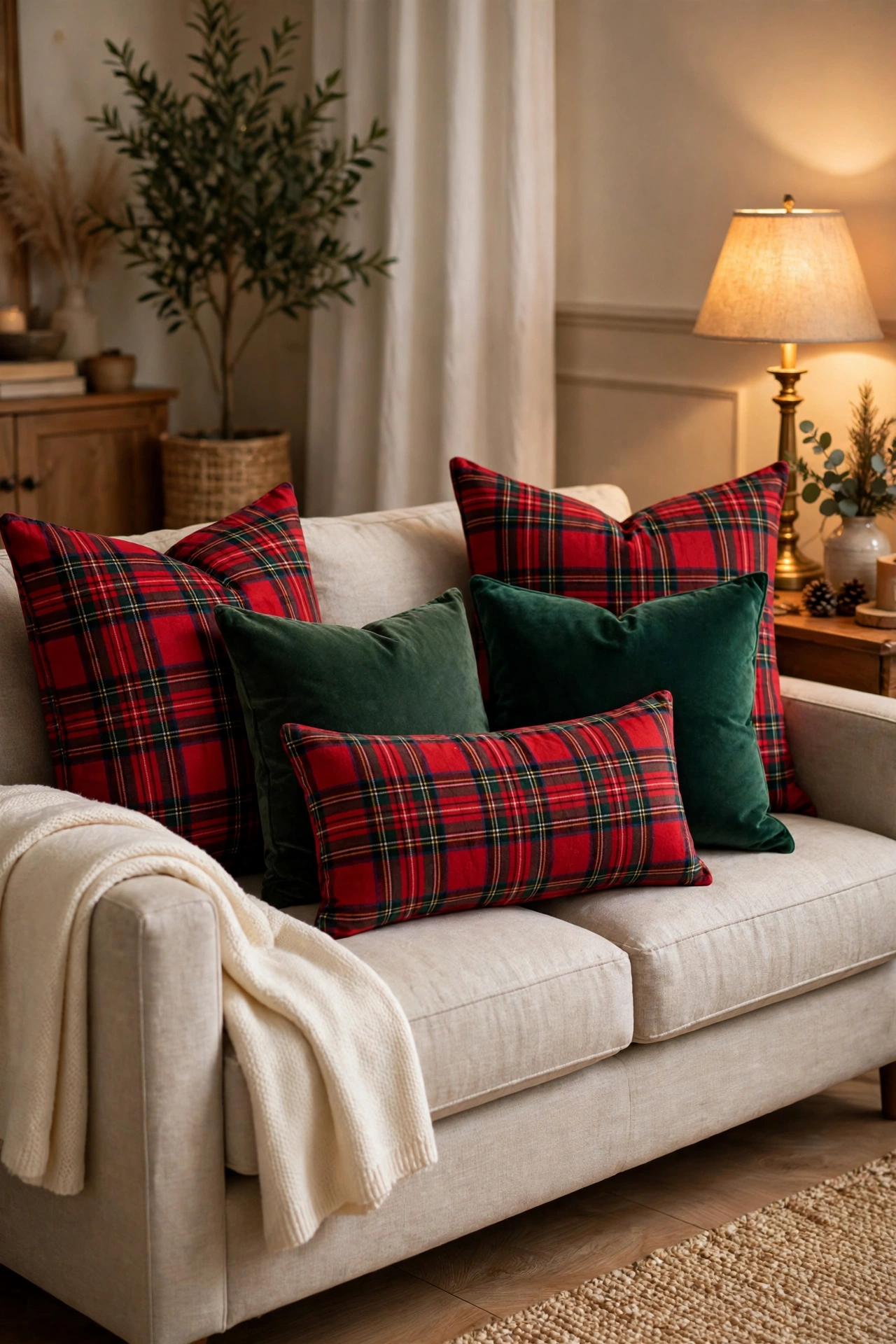
Use plaid as the anchor, not the whole sofa. Two plaid pillows at the corners, then one solid pillow in front of each one, is the combination that stylists use most, because the solid pillows calm the pattern down and stop the sofa from looking like a picnic blanket. A tartan lumbar in the middle ties the two sides together, and one small plaid cushion on an armchair repeats the pattern in the rest of the room without overdoing it.
Plaid also hides a lot. A tartan cover forgives pet hair, crumbs and the odd chocolate fingerprint far better than a plain cream cover, which makes it the practical choice for a house with children or a dog. In a living room where the sofa has to share the space with a tree, a garland and a coffee table, the living room guide on this blog shows how to balance the pillows with the rest of the room so nothing fights for attention.
3. Velvet, Knit and Faux Fur: Texture Does the Work
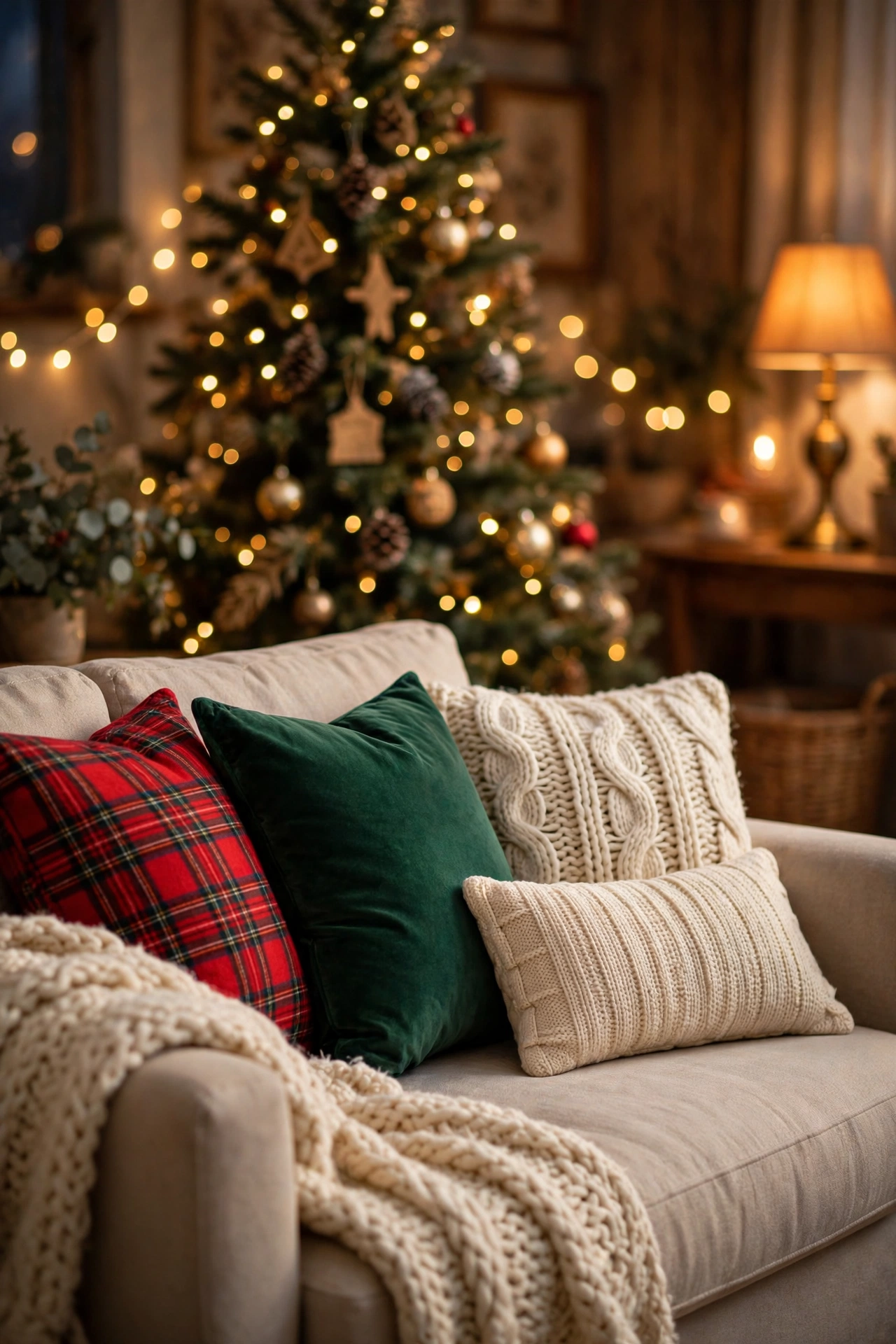
If plaid gives you the pattern, texture gives you the warmth. A sofa with three different textures feels rich and inviting, even in a simple colour palette, while a sofa with three pillows in the same flat fabric looks thin and unfinished. Aim for three surfaces in each grouping: one smooth, one nubby, and one plush.
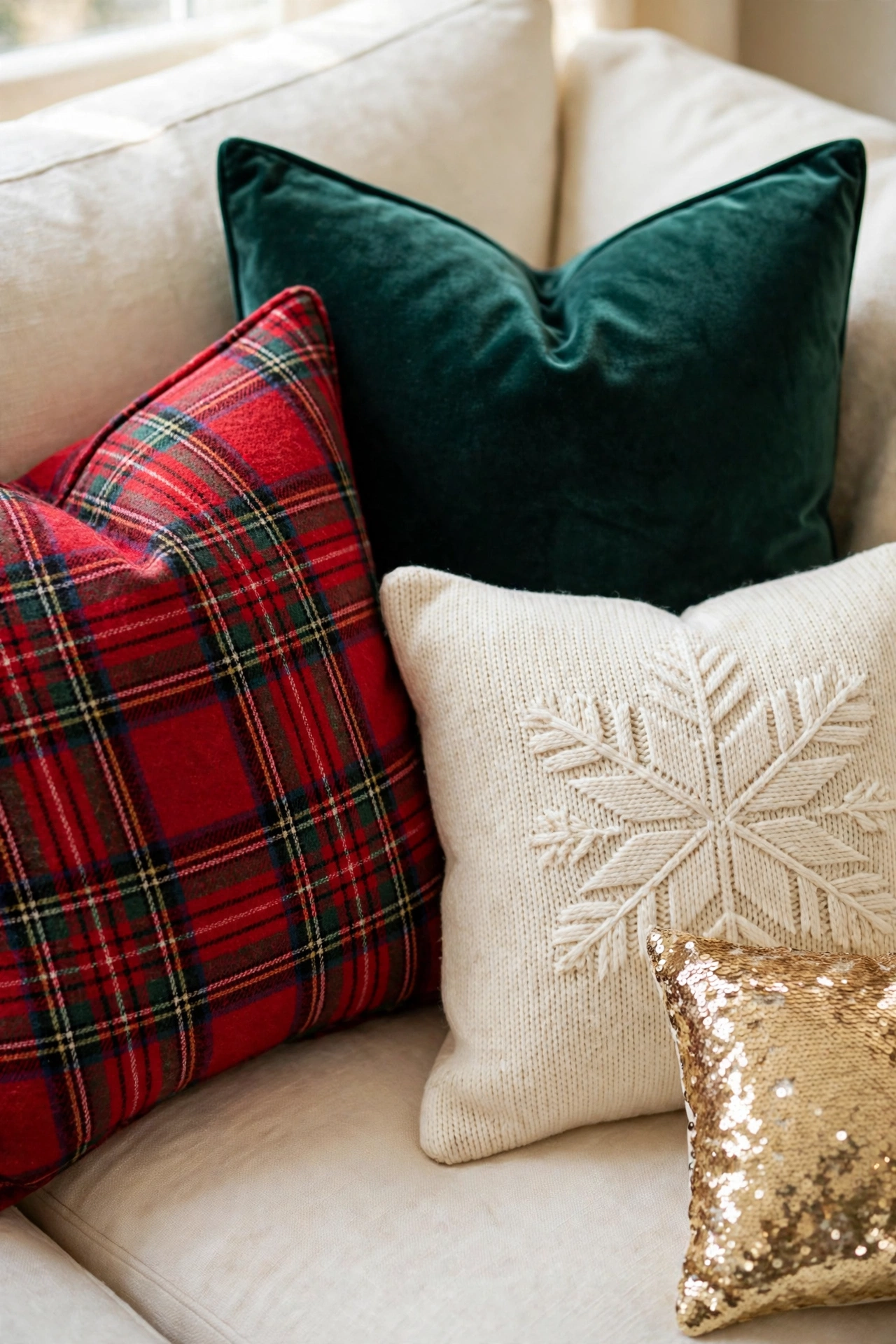
Velvet is the most elegant Christmas throw pillow idea on a budget. An emerald velvet cover, typically 12 to 20 dollars for two, looks expensive under lamplight, and deep green reads as Christmas without a single motif. Wine red velvet is the other classic, and it lasts past New Year as a winter colour, so you get two months of use from one purchase. Velvet also photographs beautifully, which matters if the sofa is the backdrop for Christmas morning photos. Keep velvet away from the dog’s favourite spot, because it shows every hair, and brush it with your hand in one direction before guests arrive to bring the nap back to life.
Knit covers are the cozy sweater of the sofa world. A chunky knit cream cover, typically 11 to 19 dollars for two, is thick, soft and instantly inviting on a cold December evening. A white snowflake knit cover is the quiet, snowy option for a sofa that already has a lot of colour from a tree, a garland or a red blanket. Knit covers stretch a little, so buy them true to size rather than sizing down, and keep them away from anything with a hook or a zipper that can snag the yarn.
Faux fur is the cover guests reach for first, because it is soft and warm and looks like a winter luxury even at a budget price, typically 13 to 22 dollars for two. One faux fur pillow per sofa is enough. Two make the sofa look like a ski lodge, and three make it look like you are hiding the sofa. A gold sequin cover is the party pillow: one sequin cushion on a sofa catches lamplight and candlelight and makes the whole room feel festive after dark. Keep sequins to one small cushion, and never put a sequin pillow where someone will rest their face, because sequins scratch.
4. Motifs and Words: Trees, Reindeer and One Good Phrase
A motif pillow is the playful one, and one or two per sofa is the right amount. A reindeer or tree motif cover, typically 9 to 16 dollars for two, is the fun pick, especially in a house with children who want the sofa to look festive rather than formal. An embroidered tree on cream linen is the quietest motif, and it suits a calm, neutral room where a loud print would fight the furniture. A small Santa, snowman or nutcracker cushion works best on an armchair or a child’s bed, where it can be the star instead of one of many.
Word pillows need more restraint than motif pillows. One cushion that says Merry Christmas or Joy in a simple font is charming. Three word pillows on one sofa read like a shop window, and nobody can sit comfortably against a pillow covered in stiff lettering. If you love words, put the word pillow in the middle, in front of the plainest cushion, so the text has room to breathe, and keep the other pillows solid or patterned.
Mixing motifs is where most sofas go wrong. One motif, repeated twice at most, plus solids and textures, is the safe rule. A tree pillow and a reindeer pillow on the same sofa compete with each other, and the eye does not know where to rest. Pick the motif your family loves most, buy it in two sizes or two colours, and let the plaid and the velvet do the rest of the work.
Children love choosing the motif pillow, so let them. A sofa with one pillow the kids picked themselves is a sofa they will actually sit on, and a tree or reindeer cushion that survives December can come back out next year as a tradition. Wash motif covers inside out, on a gentle cycle, so the embroidery and the print last more than one season.
5. How Many Pillows, What Sizes, and the Odd Number Rule
The odd number rule costs nothing and fixes most sofa problems: three, five or seven pillows, never two, four or six. Odd numbers look styled because the eye reads them as a group with a centre, while even numbers read as two matching pairs, which looks like a furniture showroom. A standard three seat sofa takes five pillows comfortably. A loveseat takes three. An armchair takes one pillow and one throw.
Layer the pillows big to small, the way stylists do. Put the biggest square pillows in the corners first, angled slightly toward the middle. Next, add a medium pillow in front of each one, offset toward the centre. Finish with one small or lumbar pillow in the middle, in front of everything else. The front pillow is the one people see first, so make it the prettiest one you own, whether that is the sequin cushion, the embroidered tree or the tartan lumbar.
Sizes matter more than most people think. On a standard sofa, 20 inch squares at the corners, 18 inch squares in front of them, and a lumbar around 14 by 24 inches in the middle is a combination that works almost every time. Oversized 24 inch pillows suit a deep, modern sofa, and they work as the big anchor at each end. Small 16 inch pillows disappear on a large sofa, so save them for armchairs, benches and kids rooms.
Leave room to sit. A sofa dressed with pillows should still have two clear seats, and nobody should have to move three pillows to sit down for dinner. If the sofa is where the family watches films every night, keep the count at three and store the extra two on a nearby chair, then put them back when guests arrive. A sofa that is beautiful but unusable is a decoration, not furniture.
6. Palettes That Work: Five Combinations for Every Room
Choosing a palette before you shop is the step that saves the most money, because it stops you buying one pillow in every colour and ending up with a sofa that looks like a sale rack. Pick two main colours plus one accent, and commit to them across every pillow and throw in the room. These five combinations work in almost any home.
Classic red and green with cream is the traditional Christmas sofa. Two red tartan pillows at the corners, two deep green velvet pillows in front, one cream knit lumbar in the middle, and a cream throw over one arm. It suits a room with a real tree and a green garland, and it photographs beautifully.
Forest green and warm white with natural wood is the calm, modern choice. Two green velvet pillows, two cream linen pillows, one small embroidered tree cushion, and a chunky knit throw in cream. It suits a room with white walls and light wood, and it stays pretty all winter, not just at Christmas.
Burgundy, blush and gold is the soft, elegant option. Two burgundy velvet pillows, two blush pink covers, one gold sequin cushion in the middle, and a cream throw. It suits a room with brass lamps and warm wood, and it works for New Year as well as Christmas.
Navy, cream and silver is the cool, wintry palette for a room that already has a lot of red elsewhere, like a red tree skirt or red stockings. Two navy velvet pillows, two cream knit pillows, one silver sequin cushion, and a grey throw. It reads as winter rather than Christmas, which means it can stay out until February.
Black and white with one red accent is the bold, graphic choice. Two black and white buffalo check pillows, two plain cream pillows, and one small red lumbar in the middle. It suits a modern room with clean lines, and the single red pillow does all the festive work, so the rest of the sofa stays calm.
Whichever palette you choose, repeat it beyond the sofa. One cushion on the armchair in the same colours, one throw on the bed in the same colours, and the whole house feels planned instead of accidental. The palette is the thread that ties the rooms together, and the pillows are the cheapest way to carry it.
7. Pillows Beyond the Sofa: Beds, Chairs and Benches
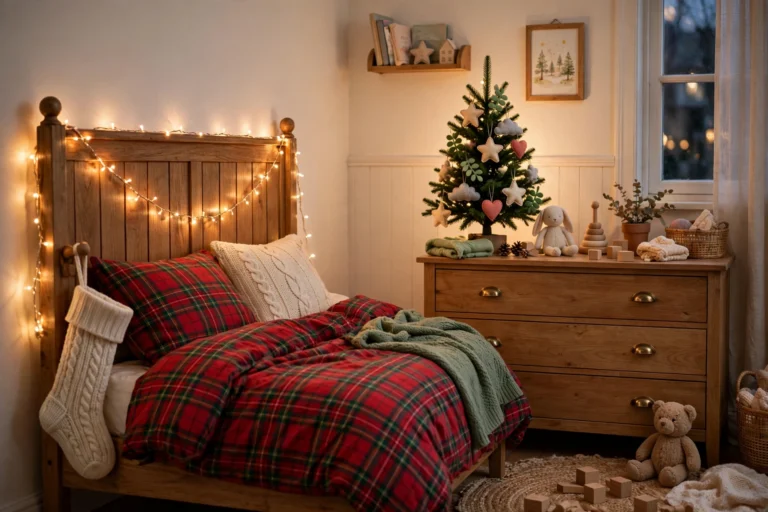
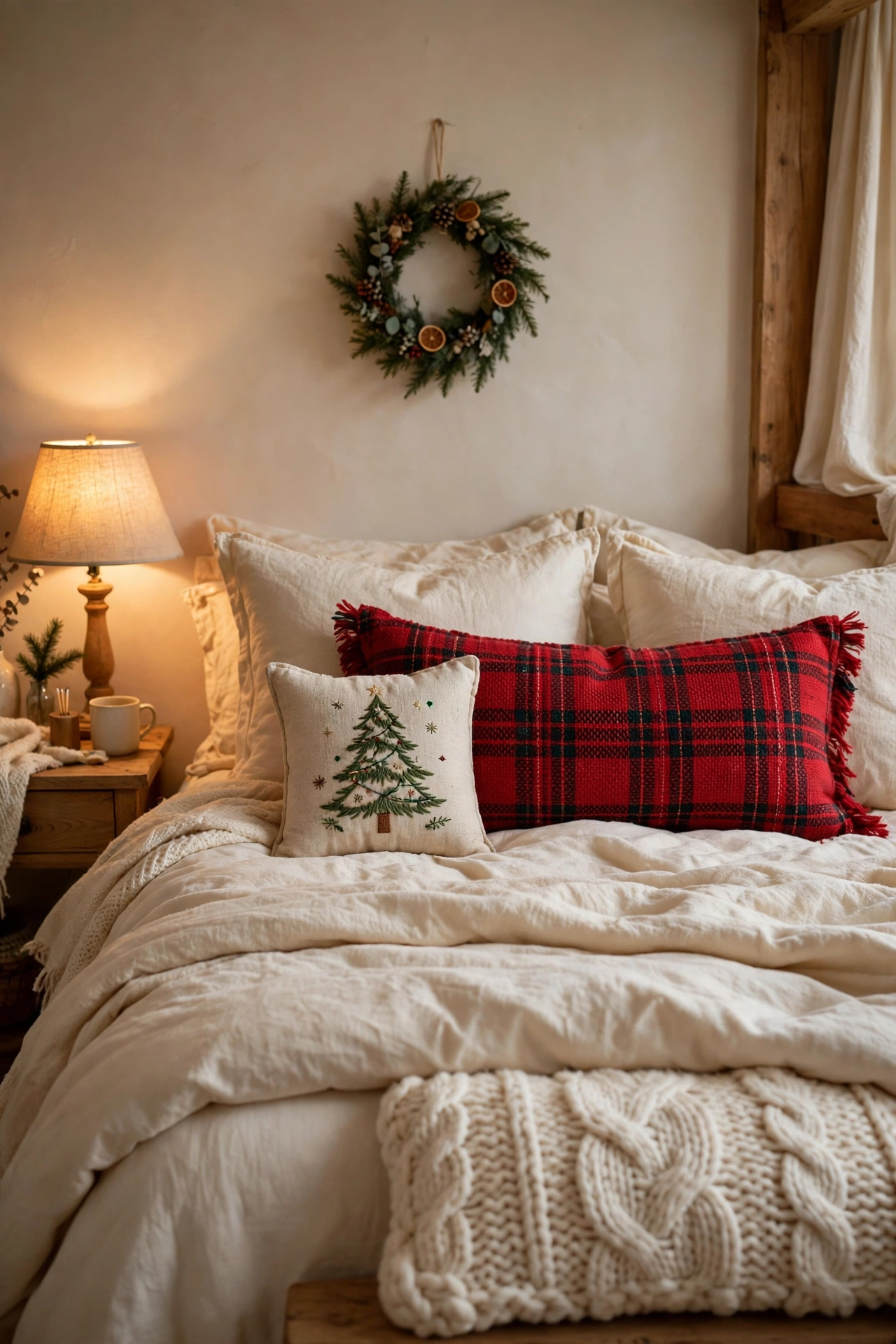
Pillows do not have to live on the sofa. A bed takes Christmas pillows beautifully, and the rules are simpler there, because nobody has to sit on them all evening. Start with the sleeping pillows you already own, add two palette pillows in front of them, and finish with one festive lumbar or one small embroidered cushion at the front. A red plaid lumbar on a cream bed, with a small tree cushion in front of it, is the whole look, and it takes thirty seconds to make in the morning.
Keep bedroom pillows calm. A bedroom at Christmas should feel cosy, not busy, and the pillows should help you sleep, not keep you awake. One festive cushion is enough on a bed that already has a throw and a garland on the wall. Battery fairy lights along the headboard and a small wreath above the bed do the rest of the work. The bedroom guide on this blog shows how to layer bedding and pillows in the order that actually feels cosy, from flannel sheets to the one cushion at the front.
An armchair needs just one pillow and one throw. A single tartan or velvet cushion, in your main colour, with a folded throw over the arm you face, turns a reading chair into a Christmas corner without any effort. A bench in the hallway or at the foot of the bed takes two small pillows and one folded throw, and it is the first thing guests see when they arrive, so it is worth the thirty seconds it takes.
A window seat is the easiest win of all. Two pillows in the corners, one lumbar in the middle, and a throw folded over the edge, and the coldest seat in the house becomes the one everyone fights over. Use outdoor or washable covers on a window seat, because condensation and cold glass can mark a delicate cover over a few weeks.
8. Kids Rooms, Small Sofas and Budget Buys
Kids rooms get the playful pillows, and the rules are looser there. A small tree cushion, a reindeer cover, a Santa lumbar, and a soft faux fur pillow they can hug are all fair game, and the kids should help choose them. Keep everything washable, because a kids room pillow will be sat on, jumped on, and probably used as a fort wall before December is over. A kids room wall that the child helped to decorate, with pillows they picked themselves, is a room they will love all December, and the kids room guide on this blog has the full plan for a room that feels magical without costing much.
A small sofa is easier, not harder, to dress with pillows. Three pillows are enough: one large square at each end and one lumbar in the middle, or one square, one lumbar and one small motif cushion. Skip the second layer entirely, because a small sofa with five pillows has no room left to sit on. A loveseat with three pillows and one throw looks curated, while the same loveseat with five looks crowded.
Budget buys are where covers earn their keep. A set of four plaid covers for a typical price of 12 to 22 dollars dresses a whole sofa for the price of one takeout dinner. Two velvet covers for 12 to 20 dollars add the expensive look. One sequin cushion for around 10 dollars adds the sparkle. Shop your own home first: the cream knit throw you already own, the red cushion from last year, and the tartan scarf in the drawer can all become pillow styling for free.
Buy one good set a year instead of five cheap sets at once. A set of well made covers with a hidden zipper and a tight weave will last five Christmases, while a set that costs a few dollars less but sheds, fades or splits at the seam will cost you twice as much when you replace it next year. Check the reviews for washing and fading before you order, and wash one cover first as a test before you wash the whole set.
Conclusion: Swap the Covers, Keep the Sofa
Christmas throw pillow ideas do not need a big budget or a new sofa. Buy covers, not whole pillows. Pick two colours plus one accent, and stick to them. Layer big to small, in odd numbers, with three textures in every grouping. Start with plaid at the corners, add velvet and knit in front, finish with one lumbar in the middle, and let one throw do the rest.
Start with the sofa, because it is the piece everyone sees and sits on. Then carry the same palette to the bed, the armchair and the kids room, one pillow at a time. When January comes, unzip the covers, wash them, fold them flat, and put them away with a note. Next December, the sofa will be ready in five minutes, and the room will feel like Christmas before the tree is even out of its box.
Save this guide before you start shopping, and measure your inserts before you order. The covers are the cheapest Christmas makeover in the whole house, and the sofa you already own is the only sofa you need.